YEA Lesson Library
Scratch, Scratch, Scratch
About This Lesson
Using Pharaoh’s response to the plagues being taken away, the student is taught that God is merciful, allowing time for each to repent. God’s patience should never be taken as permission to continue to rebel.
Scriptures
Exodus 8:16-32
Psalm 15:1-5
Proverbs 29:1-3
Ecclesiastes 8:9-13
Isaiah 66:1-2
Galatians 6:7
Galatians 6:7-9
Words to Know
DISTINCTION - to perceive a difference
CHARACTER - moral excellence and firmness; a person marked by notable or conspicuous behavior
The Lesson
You've known people who never learn their lesson. They just repeat the same mistake over and over again. Pharaoh was the worst in doing this. In spite of inconvenient and uncomfortable plagues, he hardened his heart and refused to let God's people go. So God said to Moses, "Tell Aaron to strike the dust with his rod, and it will become lice, throughout all the land of Egypt." Moses and Aaron did as God commanded, and lice infested the entire nation, covering the Egyptians and their animals. The magicians tried to do the same with their secret arts. but this time they failed. (Exodus 8:16-18 TLB).
Imagine what it must have been like to watch everyone scratching their heads, bodies, and all sorts of embarrassing places. There are at least three kinds of lice but the Bible doesn’t tell us what kinds God sent. Female lice lay nits in the hair when a person has head lice. You don't have to be a dirty person to get them. Lice can cause diseases but, generally, they are mostly embarrassing, and make you more uncomfortable than ill. Body lice are usually caused from not bathing or changing your clothes often enough. Either of these would be embarrassing and drive you nutty with the constant itching.
The magicians told Pharaoh: "This is the finger of God." But Pharaoh's heart was hard and stubborn, and he wouldn't listen to them. I doubt seriously that God exempted him from lice. He was scratching along with everyone else.
But God had yet to get Pharaoh's attention. The next morning God told Moses to get up early to meet Pharaoh at the river where he bathed, and tell him, "Jehovah says, 'Let my people go and worship me.'" No, three times was not the charm, and this was the third plague. Moses laid out Pharaoh's options. If he didn't let the Israelites go, God would send swarms of flies throughout Egypt. Houses would be filled and the ground would be covered with flies. This time, God spared the Israelites of this plague. They lived in Goshen and no flies were there. This was to make Pharaoh know that God was the God of all the earth by making a distinction between the Egyptians and the Israelites.
Pharaoh's palace was buzzing with flies, as was every other Egyptian home. How unappetizing it must have been to have flies all over their food! Pharaoh didn't tolerate this for long before summoning Moses and Aaron. "All right, go ahead and sacrifice to your God, but do it here in the land. Don’t go out into the wilderness." Pharaoh said. Being a controlling person, he wasn't about to let the Israelites leave the country - at least until things got considerably worse. Pharaoh may have had other motives as well. Moses refused to sacrifice to God in Egypt. The Egyptians hated the Israelites sacrificing to God so much, Moses feared they would be killed. He insisted they take a three-day trip into the wilderness to sacrifice to Jehovah. Pharaoh agreed and asked Moses to plead to God for all the pesky flies to go away.
Moses agreed with this warning, "Never again lie to us by promising to let the people go and then changing your mind." Moses left and asked the Lord to get rid of the flies. God caused the swarms to disappear. As soon as they were gone, Pharaoh was up to his old tricks. He hardened his heart again and didn't let the people go.
Pharaoh was a born gambler. He was willing to push, even with God, as far as he could and hoped he didn't get caught. He would say one thing and do another. It wasn't enough to see the Nile turn to blood and Egypt's water supply ruined. Frogs were certainly not pleasant, but he quickly forgot about them as soon as God removed them. He had now endured the discomfort from having lice. Filthy swarms of flies were a terrible irritation, but all of these things were quickly forgotten as soon as God removed them. Pharaoh was a man of no character. Not even his word was good.
Are you a gambler like Pharaoh? Do you push God, maybe as far as you dare, and even your parents, and the law? The Living Bible adds understanding to your memory verse. "Don't be misled; remember that you can't ignore God and get away with it: a man will always reap just the kind of crop he sows! If he sows to please his own wrong desires, he will be planting seeds of evil and he will surely reap a harvest of spiritual decay and death; but if he plants the good things of the Spirit, he will reap the everlasting life which the Holy Spirit gives him. And let us not get tired of doing what is right, for after a while we will reap a harvest of blessing if we don't get discouraged and give up." (Galatians 6:7-9 TLB).
It's too easy to promise God we'll do what He says and then renege on our word, as Pharaoh did. King David asked, “Lord, who shall abide in thy tabernacle? Who shall dwell in thy holy hill?" His answer includes, "He that sweareth to his own hurt, and changeth not" (Psalm 15: 4). If your word is not good, neither God nor man can depend on what you say. It's a requirement for dwelling in God's holy hill.
Why do people like Pharaoh push and renege on their word? God is so gracious and merciful that He gives us time to turn around and repent. We often misinterpret what God is doing by His wrath not immediately descending upon us. We find in Ecclesiastes 8:11, "Because sentence against an evil work is not executed speedily, therefore the heart of the sons of men is fully set in them to do evil." Will you be like Pharaoh and take the chance that God won't follow through with a punishment, or will you obey God immediately?
Student Prayer
Gracious and merciful God,
Thank You for Your patience. Help me never to misinterpret it as You being lax with consequences. Help me learn to love and fear You from these seminars about the plagues You brought on Pharaoh's Egypt because he pushed the envelope too far and constantly gambled with Your patience. Forgive me of my sins.
In Jesus' name I pray.
Amen.
Daily Devotions
Sunday - Galatians 6:7-9
Monday - Psalm 15:1-5
Tuesday - Ecclesiastes 8:9-13
Wednesday - Exodus 8:16-18
Thursday - Proverbs 29:1-3
Friday - Isaiah 66:1-2
Saturday - Exodus 8:19-32
Objectives
At the end of this seminar, students will be able to:
1. Give details and the order of the four plagues studied so far.
2. Have a greater fear to harden their hearts when they are tried or corrected.
Topics & Themes
Aaron
Egypt
God’s Mercy
Moses
Pharaoh
Plagues
Punishment
Rebellion
Repentance
Materials Needed
Bible, The Living Bible, YEA Students' and Presenter's books, attendance and memory verse charts, songbook, long butchers' paper (save for the next seminar), markers, notebook computer, paper, printer, pencils, prizes, tape
How to Teach This Lesson
As each student enters the classroom, greet them warmly and have them draw one of the papers on which you wrote the name of a plague before class. Try to mix up the kids so good friends won't be in the same group. Open the class with prayer.
Explain to the class that this Activity will help them remember all of the plagues and their order. They are to brainstorm ideas for headlines and work in two separate groups. Students can use the computer to make a separate headline for each of the two plagues they were assigned, using whatever fonts and colors they would like, or they can do it by hand. Then they are to tape their headlines to the butchers' paper, if they didn’t draw directly on it. They can be as creative as they like. Give them a few minutes to complete the project (save space for the last six plagues for later classes). Call the students back to sit in a semicircle.
Debrief - Ask: What's the story behind headline # 1- who are the people and events that were involved? What's the story behind headline #2 - who are the people and events that were involved? What’s the story behind headline #3 - who are the people and events that were involved? What's the story behind headline #4 - who are the people and events that were involved? Why did God participate in hardening Pharaoh's heart? What did God do to harden Pharaoh’s heart? (He simply removed the plague). What scripture can you think of that warns us against hardening our hearts? Ask a student to read Proverbs 29:1 from The Living Bible.
Lead paragraph - Divide the class into its original groups. Hand out a piece of paper and pencil to each student and ask them to write a lead paragraph about each of the plagues for which they wrote the headline. Explain that a lead paragraph should have a good attention grabber that leads naturally into the subject. Give them a few minutes to write the two paragraphs for their headlines and call them back together. Have both groups read their lead paragraphs, then vote on which one was best. Give a small prize to the group that wrote the best lead paragraph.
Lice - Ask: Has anyone known someone who had lice? If it was you, we don't need to know that. How did the person find out they had lice? What did that person do to get rid of them? How long did it take to be clean of them? Why do you think Pharaoh reneged on his promise to let God's people go to the desert to worship? What were his consequences for reneging?
Flies - Ask: Has anyone seen flies so bad that they made the ground jet black?How many of you have a fly swatter in your house? On a bad day, how many flies have you ever killed? Have you ever had a fly to bite you? Why do you think Pharaoh reneged on his promise to let Gods' people go to the desert to worship?
Teacher-Directed Activity
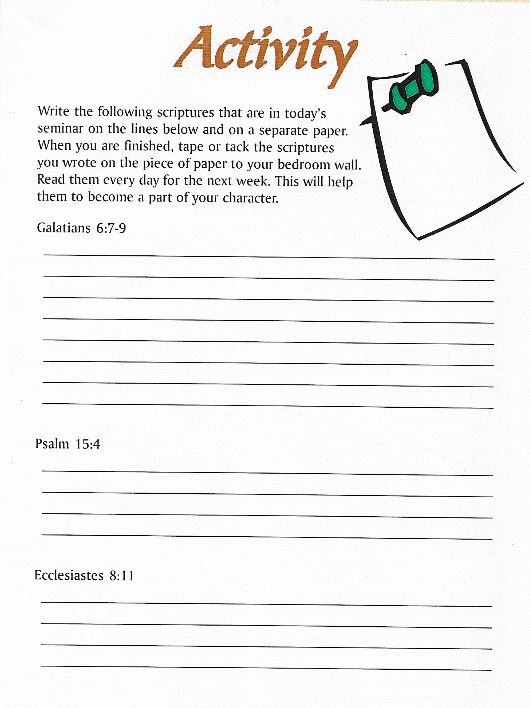
Ask: How many of you wrote out the scriptures in your book and on a separate piece of paper? Take a minute to allow the students who haven't done this assignment to do it now. Ask one of the students who has written the scriptures on a separate piece of paper how he feels that reading them every day will help him to remember the point God is making.
Song
"Create in Me a Clean Heart" is on page 36 of The Group Songbook.
Closing Prayer
Have the students form a circle and hold hands. Ask a student to read Galatians 6:7-9. Begin with yourself, then ask each student to give one thing about the four plagues studied so far that has made the greatest impression on them. Ask a student facilitator to lead in prayer thanking God for His patience and mercy and asking Him to help us not to harden our hearts when we are tried or corrected.
Printable Pages