YEA Lesson Library
More Plagues
About This Lesson
After teaching about the first two plagues in Egypt, this lesson exhorts the student to consider his own life: Is God first? Are other things more important than God? What changes need to be made?
Scriptures
Exodus 8:1-16
Exodus 20:1-6
Zechariah 14:9-21
Matthew 15:7-9
John 4:21-24
2 Corinthians 13:5
1 Thessalonians 1:7-10
Revelation 13:8-15
Revelation 14:7
Words to Know
RENEGED - go back on a promise or commitment
ANNOYANCE - a source of vexation or irritation
KILOMETER - metric system - a kilometer is 1.6 longer than a mile.
The Lesson
Put yourself in Moses shoes and ask, "Am I really ready to go to Pharaoh one more time and tell him that "Jehovah says, 'Let my people go and worship me?'" That's exactly the order Moses received from God. Seven days passed since the Nile had turned to blood. Pharaoh probably sighed with relief thinking his visitors wouldn't return with a message from God. But no such luck.
To motivate Pharaoh, or at least try to get his attention, God added a penalty to the message if he hardened his heart and refused to let the Israelites go into the wilderness to worship Him. He said, "If you refuse, I will send vast hordes of frogs across your land from one border to the other.” Now that's a lot of frogs!
Egypt's land area is basically the same today as it was when Moses was meeting with Pharaoh. Today it's 1,001,449 square kilometers. In other words, Egypt is about the size of Texas and New Mexico. You know that it would take a gaggle of frogs to cover Texas and New Mexico! The frog was one of Egypt's gods. Well, if the Egyptians loved their gods, they were going to see a lot of them. Then the Lord said to Moses. "Instruct Aaron to point the rod toward all the rivers, streams, and pools of Egypt, so that there will be frogs in every corner of the land." Aaron did, and frogs covered the nation.
Think about it. Frogs invaded the homes, bedrooms, ovens, bread-kneading troughs, and even Pharaoh's palace. Pharaoh could see his hopping gods right up close - frequently. Imagine sitting down to eat with frogs hopping on your table, plate, glass, and silverware. A frog isn't really the type of garnish you want on your ice cream, is it? Pharaoh and all the Egyptians had these croaking, crawling, creeping intruders - everywhere! The magicians again imitated this miracle and somehow produced frogs. But who needed more frogs at a time like this? Pharaoh had enough of his frog gods. He summoned Moses and Aaron and told them to "Pray to the LORD to take the frogs away from me and my people, and I will let your people go to offer sacrifices to the LORD."
Moses said to Pharaoh, "I leave to you the honor of setting the time for me to pray for you and your officials and your people that you and your houses may be rid of the frogs, except for those that remain in the Nile." "Tomorrow," Pharaoh said.
Moses replied, "It will be as you say, so that you may know there is no one like the LORD our God. The frogs will leave you and your houses, your officials and your people; they will remain only in the Nile." Moses prayed to God about the frogs and God answered Moses' prayer. Frogs died in the houses, courtyards, and in the fields. What an absolute stench! Frogs were piled up everywhere. The land reeked of them. Compared to what was to come, frogs were just a trivial annoyance. But, in spite of the smell, Pharaoh regained his confidence and reneged on his word.
God had a plan and was working His plan. Was Pharaoh going to outsmart God? His plan was that Pharaoh, the Israelites, and the Egyptians would know well that He was the one true God of Heaven by the time He delivered the Israelites. Seminar One in the first book of the Great Bible Heroes series (to follow the Creation series) starts with, "Then God issued this edict: "I am Jehovah your God who liberated you from your slavery in Egypt. You may worship no other god than me. You shall not make for yourself an idol in the form of anything in heaven above or on the earth beneath or in the waters below. You shall not bow down to them or worship them: For I, the LORD your God, am a jealous God, punishing the children for the sins of the fathers to the third and fourth generation of those who hate me, but showing love to a thousands of those who love me and keep my commandments" (Exodus 20:1-6). This is absolute bedrock to your Christian faith. The Egyptians had many gods, of which frogs were just one. But the God of Heaven is Supreme. He's worthy of our complete trust and worship.
What does all of this have to do with this seminar? The very first plague God sent on Egypt was turning the Nile into blood - that's where Pharaoh threw all the little boy babies to die. The next plague gave them their fill of one of their gods - croaking, crawling, creeping frog gods. The Egyptians were in total violation of the first commandment.
Then what does all of this have to do with you? Can we point a finger at Pharaoh without examining ourselves? What things do we put before the true God of Heaven? The way we know is by what we do. Do we give in to peer pressure and drink or break the Sabbath? Do we put other relationships above our relation- ship with God? What about physical things such as a car, stuff, clothes, the way we look, sports, etc.? Are these things more important than pleasing God? Do these things take the place of reading your daily devotionals and praying? What happens when you do this? "For I, the LORD your God, am a jealous God, punishing the children for the sins of the fathers to the third and fourth generation of those who hate me."
But the flip side is all good. God says He will show "love to thousands of those who love me and keep my commandments." God didn’t want Pharaoh or the Egyptians to get hurt, but they disobeyed and suffered the consequences. He doesn't want you to get hurt either. Will you put Him first in your life and keep His commandments daily?
Student Prayer
Awesome God and Supreme Ruler,
Thank you for showing me the way to happiness and peace. Help me to look at Pharaoh's example and learn from history so I will never have to learn it firsthand. Forgive me for putting other gods before you.
In Jesus' name I pray.
Amen.
Daily Devotions
Sunday - Revelation 14:7
Monday - Revelation 13:8-15
Tuesday - John 4:21-24
Wednesday - Matthew 15:7-9
Thursday - Zechariah 14:9-21
Friday - 2 Corinthians 13:5
Saturday - 1 Thessalonians 1:7-10
Objectives
At the end of this seminar, students will be able to:
1. Tell the story of the second plague God brought on the Egyptians.
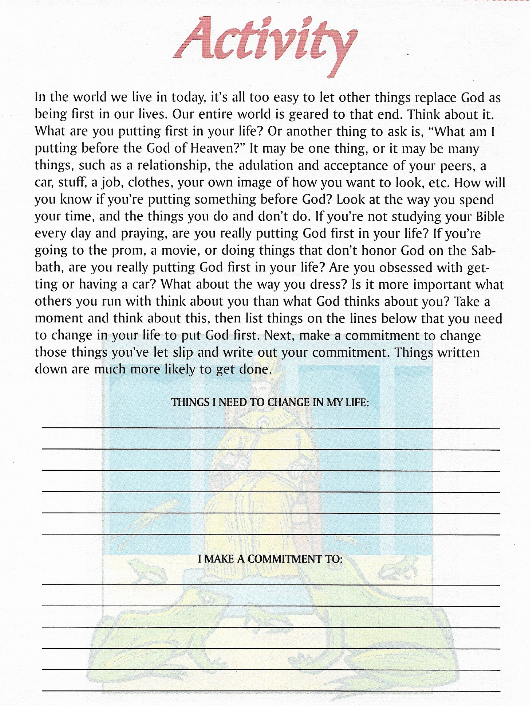
2. Identify things in their own lives that they are putting before the God of Heaven.
3. Make a commitment to stop putting these things before the God of Heaven.
Topics & Themes
Egypt
God’s Omnipotence
God’s Plan
Idols/Idolatry
Plagues
Putting God First
Repentance
Ten Commandments
No Other Gods
Putting God First
Materials Needed
Bible, YEA Students' and Presenter's books, attendance and memory verse charts, songbook, pencil, paper
How to Teach This Lesson
After opening the class with prayer, divide your students into three groups. Appoint a student facilitator for each group and give each a piece of the paper you wrote before class. Explain that each group is to brainstorm their question(s) and come up with the answer. Give them a few minutes to brainstorm and come to their conclusions. Then bring them back to sit in a semicircle. State the assignments in order and ask the facilitator from each group to give their answers.
Debrief - Ask: How did you feel about brainstorming worship with a group of young people? What does worship mean to you? How is this experience like or unlike some other aspect of your life? How did you feel about making a list of things that need to be changed in our Sabbath services for you to feel you really worship? What elements of your Sabbath service need to be changed to create a more worshipful atmosphere? How did you feel about making a list of things that young adults can do to put God first in their lives? Describe an experience when you feel that you really worship God? Where do you feel you worship God best? Can you worship God in vain? How? Ask a student to read Matthew 15:9. Will there come a time when people will be forced to worship someone other than God? Ask a student to read John 4:22 and Revelation 13:8-12.
Israel and Egypt worship God - What do you think God expected the Israelites to do when he sent Moses to tell Pharaoh to "Let my people go into the wilderness to worship me?” (Since the Passover was coming up, it was likely that God was speaking of Israel keeping the Passover and First Day of Unleavened Bread.) What time in the future can you think of when the Egyptians will worship God? Ask a student to read Zechariah 14:9-21.
Application - What areas do you feel you need to change in your life to worship God as He would have you do? How important is keeping the commandments in the worship of God? Ask a student to read Matthew 15:9 again. Now that you've identified in the students' Activity some things that you're putting before the God of Heaven, what are you going to do about it? How can this help you to be a better example of Jesus Christ? Ask a student to read 1 Thessalonians 1:7-10. What are changes you will be making in your life to ensure you really are worshiping God and God alone?
Background - Ask a different facilitator to read the Background in the Presenter's Guide to the class.
Teacher-Directed Activity
Ask one of the student facilitators to go over the Activity in the students' book with the class.
Song
"How Majestic Is Your Name" is on page 71 of The Group Songbook.
Closing Prayer
Have the students form a circle and hold hands. Ask a student facilitator to read Exodus 20:1-6 aloud and ask a different facilitator to lead in prayer.
Printable Pages