YEA Lesson Library
The Big Picture
About This Lesson
Using the confrontation between Pharaoh and Moses as an example, the student is taught that when things don’t go according to plan, it’s good to remember that God works things out in His way in His timing.
Scriptures
Exodus 7:1-25
Numbers 23:15-24
Psalm 139:23-24
Isaiah 55:8
Words to Know
ARROGANT - exaggerating one's worth in an overbearing manner
STUBBORN - unreasonably or perversely unyielding
The Lesson
Have you ever felt that someone really let you down, and that nothing works out for you any more? Moses must have felt that way when he went to Pharaoh and got very disappointing results. Things went from bad to worse. What do you do at a time like that? Do you look for someone to blame? Do you turn to God? Well, Moses did both - he blamed God and he talked with God about the enormous problem he had on his hands.
You will recall from last week’s seminar that Moses went to Pharaoh to ask that he let God's people go. After that, Pharaoh made things much more difficult for the Israelites and treated them brutally. So Moses went to God. "Lord," he protested, "how can you mistreat your own people like this? Why did you ever send me, if you were going to do this to them? Since I gave Pharaoh your message, he has only been more and more brutal to them (the Israelites) and you have not delivered them at all!?”
Your memory verse explains a lot. "For my thoughts are not your thoughts, neither are your ways my ways, saith the LORD.” God was looking at The Big Picture, not the immediate. He had a plan to deliver Israel in His time and His way and it would be bigger and better than anyone thought.
God reassured Moses that he would see what He was about to do to Pharaoh. Moses knew the man he was dealing with. He was arrogant and stubborn and would have to be forced to let God's people leave. After all, the Israelites made his economy work. If more than a million people left that country, his work-force would be greatly diminished and his economy would go into the tank. But God reminded Moses that He is God and He kept His solemn covenant with Abraham, Isaac, and Jacob. Part of that covenant included giving their descendants the land of Canaan. "And now I have heard the groanings of the people of Israel, in slavery now to the Egyptians, and I remember my promise." God has a timetable He's working, and He's not forgetful of His promises.
God told Moses to go back and tell the Israelites that He was going to use His mighty power to perform great miracles to deliver them from Egyptian slavery and set them free. Then they would know that He is Jehovah, and He is the One who would rescue them and bring them to the Promised Land.
Moses told the children of Israel what God had told him. By this time they were so down and discouraged that they wouldn't listen. So God sent Moses back again to tell Pharaoh that "he must let the people of Israel go." Moses was as human as any of us and he didn't like this assignment. Furthermore, he didn't like it that Pharaoh rebuffed him and that things got even worse for the Israelites. So Moses protested to God, "My own people won't even listen to me any more; how can I expect Pharaoh to? I'm no orator!”
God didn't appreciate the foot-dragging He was getting from Moses so He commanded that Moses and Aaron go back to Pharaoh and demand that he release God's people. Moses would be God's ambassador to Pharaoh, and Aaron, his brother would be his spokesman. But. .. God said that He would cause Pharaoh to stubbornly refuse again. At this point Moses must have wondered whose side God was on. God had a plan and He was going to show His power through a series of miracles. But God warned them that Pharaoh still wouldn't listen. Why? Well, God wanted the Egyptians to learn that He is God. So God's plan was larger than just the Israelites. Doubtless, God's special people are the Israelites, but He also loves Gentiles and wants them to know about Him and be in His Kingdom as well.
Eighty-year-old Moses and 83-year-old Aaron made the trek back to Pharaoh and had another confrontation with him. God had prepared Moses to perform a miracle before Pharaoh to prove that God had sent him. Aaron threw down the rod in front of Pharaoh and it became a serpent. Pharaoh wasn't impressed. He called in his magicians and they did the same thing with magic. But, God hadn't forgotten His servants. Moses' serpent swallowed the magicians' serpent. The saga continued and God was right again. Pharaoh's heart was hard and stubborn and he wouldn't listen to Moses.
When God has a plan, He sees it through to completion. He sent Moses and Aaron back the next morning to meet Pharaoh at the river when he arrived. "Tell him to let my people go into the desert to worship me." Again, Pharaoh didn't listen. So, Moses hit the water of the Nile River with his rod, as God had told him. All the water in the Nile turned to blood and all the fish died. The Nile was their source of drinking water. But now they couldn't drink it.
Think about it. Why did God select the Nile River for His first plague on the Egyptians? Do you remember that Pharaoh commanded all the Israelites to throw their little boy babies into the Nile River? Do you think God had forgotten about this? God is a God of love and of justice. But this still didn't convince Pharaoh to let God's people go. His heart just became harder.
How do you react when God doesn't answer your prayers as you've asked? Do you get discouraged, begin doubting God, or have a bad attitude? Or do you go to God and ask Him to show you why this is happening so you can mend your ways? Try the prayer below.
Student Prayer
"Search me, O God, and know my heart; try me, and know my thoughts: And see if there be any wicked way in me, and lead me in the way everlasting" (Psalm 139:23-24).
In Jesus' name I pray.
Amen.
Daily Devotions
Sunday - Isaiah 55:8
Monday - Psalm 139:23
Tuesday - Exodus 7:1-7
Wednesday - Exodus 7:8-14
Thursday - Exodus 7:15-18
Friday - Exodus 7:19-23
Saturday - Numbers 23:15-24
Objectives
At the end of this seminar, students will be able to:
1. Explain how the Nile River was so important to the Egyptian's agriculture, economy and religion.
2. Discuss why the Nile River was the place God chose to do the first plague.
Topics & Themes
Aaron
Abortion
Egypt
God’s Judgment
God’s Plan
God’s Promises
Moses
Nile River
Pharaoh
Plagues
Prayer
Serpent
Materials Needed
Bible, YEA Students' and Presenter's books, attendance and memory verse charts, songbook, paper, timer
How to Teach This Lesson
After opening the class with prayer, divide the class into three groups. Assign a student facilitator from each group to draw one of the "straws" or strips of paper. Explain that each group is to go to a different section of the room and read the Background you gave them, but concentrate on the section that is on their strip of paper. When the bell rings they are to come back together and each facilitator is to explain the part that the Nile plays in Egypt's 1) agriculture, 2) economy, and 3) religion. Each portion assigned on the paper they drew is to be presented by the group’s facilitator.
Debrief - How did you feel about doing this assignment? How does it help you understand the important role the Nile River played in Egyptian agriculture? The economy? Their religion? Why do you think God elected to systematically destroy Egypt's agriculture through a series of plagues? (They used slave labor to build their economy. Those slaves were God's chosen people. And they mistreated them!) Why do you think God selected the Nile for the very first plague? (Pharaoh had killed innocent Hebrew boy babies by throwing them in the Nile).
Abortion - Who knows how many babies have been killed through abortion since Roe v Wade? What comparison can you draw between Pharaoh killing all the Hebrew boy babies by drowning them in the Nile with the millions of babies having been killed by legalized abortion? Did Pharaoh get by with it? Will God let us get by with it? Why is this so repulsive to God? There are two sides to God. What are they? (God is a God of love and of justice). Can there be justice without penalties? How can you make sure that you receive God's love rather than justice?
Teacher-Directed Activity
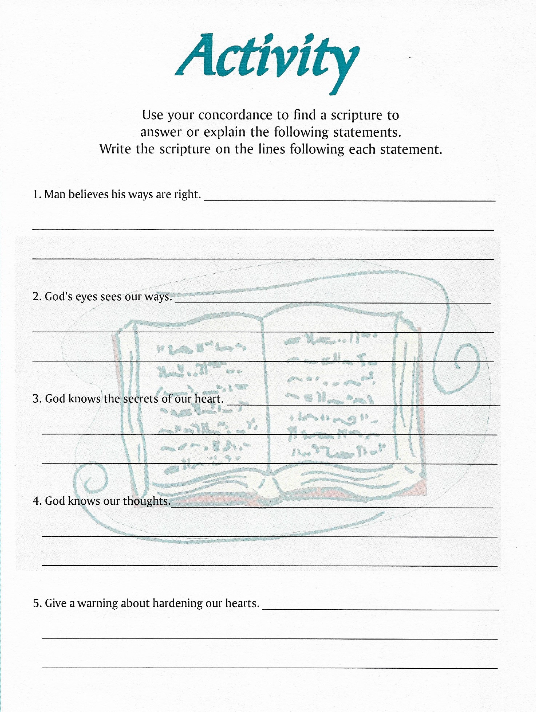
Ask a student facilitator to go over the students' Activity with the class and allow students to share their scriptures.
Song
"Amazing Grace" is on page 61 of The Group Songbook.
Closing Prayer
Have the students form a circle and join hands. Ask each student to give one point or thing they learned from this seminar and how ti will impact their life or thinking. Ask a student facilitator to lead in prayer thanking God for their new understanding of Him and His word. Ask God to continue to open their minds to deeper things from His Word each day.
Printable Pages