YEA Lesson Library
Saved From Infanticide
About This Lesson
This lesson gives Moses’ history and calling from God, as well as addressing the national consequences of abortion and infanticide.
Scriptures
Exodus 1:9-22
Exodus 2:1-25
Exodus 3:1-22
Exodus 21:22-25
Psalm 127:3-5
Lamentations 4:1-6
Acts 17:25-26
Words to Know
PERPLEXED - Unable to grasp clearly or to think logically and decisively
DRUDGERY - dull, irksome, and fatiguing work: uninspiring or menial
INFANTICIDE - killing of babies
The Lesson
Now the Israelites had become slaves to Pharaoh, King of Egypt. This new king felt no obligation to Joseph's descendants. Pharaoh was a brutal taskmaster who forced them to work long, hard hours in the fields. They had to carry heavy loads of mortar and brick to build cities. The harder he forced them to work, the more babies they had. The Israelites experienced a real population explosion. This new king feared the Israelites would outnumber the Egyptians. He didn't want that to happen because the Israelites would be harder to control. He had a problem to solve. Unfortunately, Pharaoh did not make a wise choice.
In Pharaoh's time, they didn't have the wherewithal to perform partial birth abortions by killing the baby and sucking its brains out before it was completely out of the birth canal. But not having this technique didn't stop him from infanticide - killing of boy babies. He gave instructions to the Hebrew midwives to kill all Hebrew boys as soon as they were born, while allowing girl babies to live. The midwives feared God more than Pharaoh and refused to participate in infanticide. Pharaoh wanted to know why they disobeyed his orders, so they explained that the Hebrew women had their babies so quickly they didn't arrive in time for the birth. God blessed the midwives and the Israelites continued to multiply and become a mighty nation.
Since Pharaoh's orders to the midwives didn't solve the population problem, he commanded his people to throw newborn Hebrew boys into the Nile River. A young Hebrew man and woman from the tribe of Levi married and had a beautiful baby boy. There was no way this new mother wanted her baby thrown into the Nile. So she hid him as long as she could - about three months. When she could no longer hide the baby, she made a little boat, waterproofed it with tar, and put her baby in it. She went to the river and laid the little boat with her son in it among the reeds. The baby's sister watched from a distance to see what would happen to the baby.
Pharaoh's daughter, a princess, came to the river. She spotted the boat floating with a crying baby boy in it. She was very touched by this and immediately thought this was a Hebrew boy. The baby's sister came out of hiding and offered to find a Hebrew woman to nurse the baby. The princess agreed. So the girl rushed home to get the baby's mother. The princess told this woman to take the baby home and nurse it and she would pay her for doing it. The princess named this little boy Moses, which means “to draw out.” Moses was brought up in Pharaoh's palace as a Prince of Egypt, but he knew he was a Hebrew.
After he became a man, Moses went one day to visit his fellow Hebrews. He certainly didn't like what he saw: the living and working conditions of the Hebrews were awful!
Several years later the King of Egypt died leaving the Israelites in deep trouble because of their slavery. They groaned and wept bitterly before the Lord. God heard their cries from heaven and remembered his promise to Abraham, Isaac, and Jacob to bring their descendants back into the land ofCanaan. God knew that time had come.
While Moses tended his father-in-law's flock, an angel of God appeared to him as a flame of fire in a bush. Moses noticed the bush was on fire, but it didn't burn up. He went to investigate this unusual situation. God called out to him, "Moses!, Moses!” Moses was a bit perplexed and asked, "Who is it?"
"Don't come any closer," God told him. "Take off your shoes, for you are standing on holy ground. I am the God of your fathers - the God of Abraham, Isaac, and Jacob." Moses covered his face with his hands, for he was afraid to look at God.
Then the Lord told him, "I have seen the deep sorrows of my people in Egypt, and have heard their pleas for freedom from their harsh taskmasters. I have come to deliver them from the Egyptians and to take them out of Egypt into a good land, a large land, a land flowing with milk and honey - the land where the Canaanites, Hittites, Amorites, Perizzites, Hivites, and the Jebusites live. Yes, the wail of the people of Israel has risen to me in heaven, and I have seen the heavy tasks the Egyptians have oppressed them with. Now I am going to send you to Pharaoh, to demand that he let you lead my people out ofEgypt" (Exodus 3: 4-10 TLB).
Put yourself in Moses' shoes. You are Hebrew and should have been thrown in the Nile to drown, but Pharaoh's own daughter rescued you. You were brought up in the King's palace and now God tells you to go to Pharaoh and demand that he release the people who are keeping his economy going. What would you have said? Moses had the same concerns and human nature that you would have. So he told God that He had the wrong man for this job. But Moses was the man God had Saved From Infanticide and chosen to do this big task. And God wasn't going to leave Moses without His help. God told him, "When you have led the people out of Egypt, you shall worship God here upon this mountain!"
Moses' next thought was that the Israelites wouldn't even know which god was sending him. Their 400 plus years in slavery caused them to lose sight of the true God and to be confused with the false gods of Egypt. God gave Moses several of His names to help the Israelites understand who He was: The Sovereign God, I Am, Jehovah, the God of your ancestors Abraham, Isaac, andJacob. Moses' instructions were to call the elders of Israel and tell them that God spoke to him through a burning bush, had seen their suffering, and would rescue them from humiliation and drudgery. He assured Moses that his job wouldn't be easy because of Pharaoh. But God promised to bring pressure on Pharaoh to break his will. This is the calling of a man named Moses and the beginning of the story of the Exodus.
Student Prayer
God of Abraham, Isaac, and Jacob,
You are an awesome and merciful God. Thank you for seeing the suffering of the Israelites and delivering them. This gives me faith that you are a God who sees man's suffering and you hear us when we cry out to you.
In Jesus' name I pray.
Amen.
Daily Devotions
Sunday - Psalm 127:3-5
Monday - Acts 17:25-26
Tuesday - Exodus 3:4-10
Wednesday - Exodus 21:22-25
Thursday - Lamentations 4:1-6
Friday - Exodus 1:9-17
Saturday - Exodus 1:18-22
Objectives
At the end of this seminar, students will be able to:
1. Tell the story of how Moses was called of God to set His people free.
2. Explain that God is the Life-giver and to usurp God's prerogative by taking life, as in abortion, will incur severe consequences.
Topics & Themes
Abortion
Burning Bush
Calling
Consequences of Sin
God, Life-Giver
God, One and Only
God’s Character
God’s Promises
Moses
Murder
Pharaoh
Slaves
Suffering
Materials Needed
Bible YEA Students' and Presenter's books, attendance and memory verse charts, songbook, map of the USA, Dollar Store calculators, chalkboard, chalk, push pins
How to Teach This Lesson
Greet each student warmly and open with prayer.
If you have enough students, divide the class into groups of 3-4. Tell them they’re going to do some research today to 1) find the current number of US abortions and 2) a way to grasp the enormity of the loss. Let the students choose which of the following options to research. Give them about 20 minutes to do the research and math and come up with a memorable way to present their findings to the rest of the class.
The Population of How Many States? In this scenario, the students will have to look up 1) how many abortions have been performed from 1973 to date; 2) the current total U.S. population; and 3) the current population by state. Then they will have to figure out what percentage of people are missing due to abortion. Once they have that percentage, they can figure out how many states would have their population completely wiped out to reach that percentage.
The Capacity of a College Football Stadium times what? In this scenario, the students will have to look up 1) how many abortions have been performed from 1973 to date; 2) the capacity of a college football stadium; and 3) how many times the stadium could be filled to represent the number of people aborted.
The Distance from NYC to LA - how many times?
In this scenario, the students will have to look up 1) how many abortions have been performed from 1973 to date; 2) the average height of adults in the U.S. Since average height is given for men and women, they can either average the heights or figure out the percentage of US men vs. women and figure out what the average overall height would be; and 3) the distance from NYC to LA. If the adults lay down foot to head, how many times could you go from NYC to LA.
Debrief - Ask: How would you feel if you had heard on the news that the population of all of these states had been destroyed (based on student research)? How would you feel if you lived in one of these states and knew that every person in it was targeted to be destroyed? How is this like or unlike anything else in our world today? What impact do you think destroying the entire population of these states would do to the US economy? What impact would it have on Social Security? Pundits have been warning that Social Security is in danger of being defunct because there are more people drawing from it than paying in. What if [insert number here] stadiums of people were also paying into Social Security? What if we had enough people to stretch from NYC to LA [inset number] times to help our economy by being doctors, police, teachers, inventors, etc?
Ask: Can you think of reasons why there are fewer people paying into Social Security? (Answers should include: Time spent working to climb the corporate ladder, high rates of divorce, climate activist pressure to reduce the birth rate, abortion - all reasons why there are fewer and fewer people in the U.S.) How does what is happening in the U.S. today relate to the seminar for today? What did Pharaoh do to solve the population problems with the Israelites? Why didn’t it work?
Abortion: Let’s talk again about the total population equivalent of [insert number] states having their entire population destroyed. All of these people could have been paying into Social Security, had they not been killed by abortion. Do you remember how many people paid into the Social Security system when Ida May received her first check? If we continue this trend of aborting our population, will we be able to support Social Security in the future?
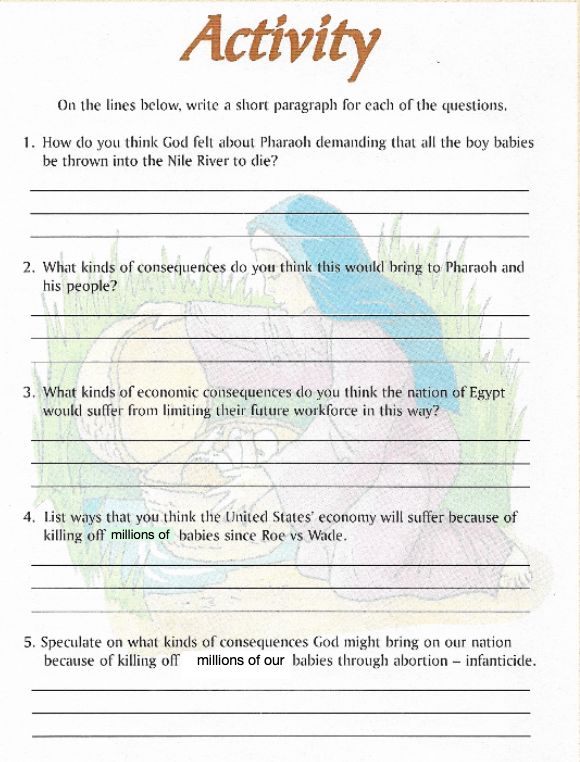
Is There More? - Ask: In what other ways do you think the reduction of population - infanticide - has brought about problems for our nation? Read the remainder of Background. Will abortion work today? Why or why not? What kinds of consequences do you see our nation reaping for killing off [insert number from student research] babies? Do you think we’re finished reaping the consequences?
Pharaoh’s Wrong Decision - Why was it wrong for Pharaoh to kill off these boy babies? What kind of self-importance do you think he had? What was wrong with him usurping this type of authority? Ask a student to read Exodus 21:22-25. What is the penalty a man incurs if a woman miscarries as a result of his actions? Then how do you think God looks upon abortion? Future seminars will clearly show you what Pharaoh’s consequences were. What do you think will be the consequence for our nation? What do you think the consequences are for a woman who had an abortion? Have a facilitator read the following to your class: Washington, DC, Mar. 10 (Culture of Life Foundation/CWNews.com) “A medical researcher from the University of Michigan Medical School told the US senate last week that ‘abortion increases rates of breast cancer, placenta previa, pre-term births, and maternal suicide’.”
Dr. Elizabeth Shadigian, testifying before the Senate Sub-Committee on Science, Technology, and Space, said that “statistically, all types of deaths are higher with women who have had induced abortions.”
Song
"I Have Decided to Follow Jesus" is on page 60 of The Group Songbook.
Closing Prayer
Have the students form a circle and join hands. Ask a student facilitator to lead the class in prayer thanking God for life and a knowledge of how important it is to Him. Ask that we will never despise or cheapen life and always value it as He does. Help us to realize that, should a mistake be made, abortion is not the answer.
Printable Pages