YEA Lesson Library
Persistent Prayer Pays
About This Lesson
Using Jesus’ examples of being persistent in prayer, this lesson teaches the importance of first having a relationship with God and then persevering in prayer.
Scriptures
Genesis 18:23-32
Matthew 6:9-13
Luke 11:5-10
Luke 11:10
Luke 18:1-8
John 17:1-26
Romans 12:9-21
Ephesians 6:18-20
Colossians 4:1-3
1 Thes. 5:11-18
Words to Know
PERSISTENCE - the act of continuing a course of action in spite of opposition or criticism.
DELIMITER - a character of space indicating the beginning or end (usually of a piece of computer data).
The Lesson
In 1940, Wilma Rudolph was the 20th of 22 children to be born in her family. She was born with polio and suffered serious bouts of pneumonia and scarlet fever. Polio left her in a leg brace until she, in faith, removed it when she was eleven years old.
Having been born with a disability didn’t stop Wilma – she was determined and persistent. At 13 she got involved with basketball and track at school. It didn’t take long before Wilma was running and winning races. As a sophomore in high school, she participated in the Olympic Games in Melbourne, Australia. But she lost the 200 meter race. Wilma didn’t give up. She became more determined than ever.
After entering Tennessee State she became a member of Ed Temple’s “Tigerbelles” track team. In 1960, she set a world record for the 200 meter dash during the Olympic trials. Then in the Olympic games in Rome, she became the first American woman to win three gold medals in the 100 meter dash, the 200 meter dash and the 400 meter relay. Wilma worked her way through school and later became a coach. Her autobiography was a best-seller, and in 1977 it became a television movie, starring Cicely Tyson.
As an African-American child with a terrible disability, the odds were certainly against Wilma ever attaining such achievements and honor. But the thing she had in her favor was the determination to hang in there regardless of any snags or handicaps.
You already know that high achievements and honor require persistence and determination. If we let such things as disabilities or hardship deter us, we’ll probably be mediocre at best. But have you ever thought that getting answers to your prayers can require the same kind of persistence and determination? Jesus told His disciples a story of a widow who had been harmed by a man and wanted justice. Unfortunately, she had to deal with a godless judge. Think of the excuses she could have made. She could have easily said, “I’m a poor widow lady in a society where women are considered second class citizens. I’m afraid of the man who harmed me and this godless, harsh judge.” But she didn’t fall prey to the “victim” trap. Even though the judge totally ignored her at first, she kept coming back again and again.
Eventually her persistence got on the judge’s nerves. He said, “I fear neither God nor man, but this woman bothers me. I’m going to see that she gets justice, for she is wearing me out with her constant coming!” Jesus went on to say that if an evil judge can be worn down by the persistence of a widow lady, don’t you think a merciful God will surely give justice to His people who plead with Him day and night? Jesus assured them that our Father will answer us quickly.
The principle of persistence is so important that Jesus told another story. Let’s suppose you need to borrow some loaves of bread so you go to a friend’s house at midnight. You shout up to him that a friend has just come for a visit and you don’t have food for him. Your neighbor might shout back at you, “Don’t ask me to get up. The door is locked for the night and we’re all in bed. I can’t help you this time.” Jesus said even though he won’t get up and give you the bread, because you’re a friend, he’ll do it if you’re persistent enough. The same thing is true with prayer. He said, “I will do whatever you ask in my name” John 14:14 (NIV).
Jesus is not teaching that the only requirement for answered prayer is to nag Him. James 4:3 says, “You do not have, because you do not ask God. When you ask, you do not receive, because you ask with wrong motives, that you may spend what you get on your pleasures” (NIVSB). James 5:16 helps us get a more complete picture of what is required before we can expect our prayers to be answered. “The effectual fervent prayer of a righteous man avails much.” So what does it mean if we feel we’re asking for something in prayer the proper way and in the proper frame of mind and we still don’t get what we ask? This is often the source of real problems for growing Christians. Should you think God is like the Easter Bunny or Santa Claus? How can you believe in Him if He doesn’t do what He said He will do?
Remember, God doesn’t measure time the way human beings measure it. To Him a day is the same as a thousand years and a thousand years is the same as one day. We measure time based upon the sun and the moon – which He created. He doesn’t have those same delimiters. He can answer your prayers when He deems it is best for you. As you pray, one of the most important things to keep in mind is to ask that God’s will be done. Sometimes it’s necessary for God to delay or deny a heartfelt request because He knows what is really best for you. He knows the future and His plans for you. But stay with it in prayer until you know it is not God’s will for you to have what you have requested.
Student Prayer
Awesome God,
You are so wonderful, yet you care so much about me that you hear my prayers when my heart is right with you. You know what is best for me. Grant me the faith to trust you and the persistence not to give up easily with the requests I bring to you.
In Jesus’ name I pray.
Amen.
Daily Devotions
Sunday: Genesis 18:23-32
Monday: Ephesians 6:18-20
Tuesday: Luke 18:1-8
Wednesday: Colossians 4:1-3
Thursday: John 17:1-26
Friday: 1 Thessalonians 5:11-18
Saturday: Romans 12:9-21
Objectives
At the end of this lesson, students will be able to:
1. Explain the importance of being persistent in prayer.
2. Discuss how persistence can change the outcome of things in their lives.
3. List five essential elements to answered prayer.
Topics & Themes
Faith
God’s Love
God’s Will
Jesus, His Ministry
Parables
Persistent Widow
Perseverance
Prayer
Prayers, answered
Relationship with God
Materials Needed
Bible, YEA students’ and teacher’s books, newsprint pad or chalk board, attendance and memory verse charts, marker, prize, songbook, CD or cassette tape, tape player, large sheet of butcher’s paper
How to Teach This Lesson
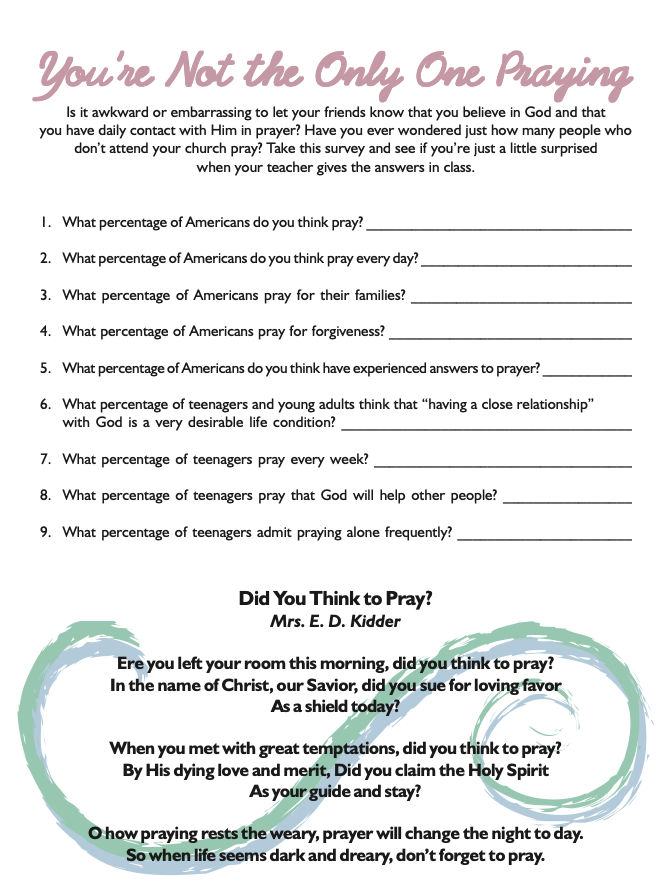
After opening the class with prayer go over the activity in the student’s book – You’re Not the Only One Praying. Poll the class for each question and have a student keep track of individual students’ answers. That student should determine who has the percentage that is closest to the correct answer for every question. The one with the most close answers should get a prize. Be sure to have done the research prior to class to find the most recent statistics.
Debrief - What kind of surprises did you have when you did this activity? How does this impact your feelings about being a religious person? How will this knowledge affect your relationship with other Christians at school? How will it affect your prayer life?
Wilma Rudolph - Say: “Eleanor Roosevelt said, ‘You gain strength, courage, and confidence by every experience in which you stop to look fear in the face. You must do the thing which you think you cannot do.” Ask: What deterrents or disadvantages do you think Wilma Rudolph had? What kinds of feelings did you have about Wilma Rudolph’s achievement? As the students give answers, list them on the newsprint pad. They should include: being one of 22 children in the family, born with polio, in a brace until she was 11, and she lost the 200 meter race in the Olympics in Melbourne, Australia. Would you have given up with such handicaps or deterrents? What lessons did you learn from her? List these on the pad as the students give them.
The widow lady - How did you feel about the widow lady going to the judge for help? What kinds of deterrents did she have? List these on the pad. If you had been the widow lady, how would you have felt about going to the judge and asking for help? Had she decided to throw a pity party, what excuses for not persisting could she have come up with? (She was a widow, men had little respect for women in that society, she was a victim.) What would you have done? Why?
Your prayer life - Since God is all-powerful and can make things happen that are impossible for us to do, how does this affect your prayer life? How long do you think you should continue praying for something if you don’t get an answer? You learned in your lesson that God’s not the Easter Bunny or Santa Claus. He expects certain things from you before He will answer your prayers. Let’s put this puzzle together. Ask one of the students to read Matthew 6:9-13 aloud. Then ask: To whom do we address our prayers? How are we to forgive others? Whose prayers are answered? Ask one of the students to read James 5:16 aloud. What can hinder your prayers from being answered? Ask one of the students to read Isaiah 58:1-2 aloud. Ask: Do you think an unforgiving spirit is sin? Write on the pad: “Keys to Answered Prayer.” Under it write: 1. Sin prevents God from hearing prayers. 2. Unforgiving spirit equals unrighteousness. 3. Effectual fervent prayer of a righteous man avails much. Now ask: What other ingredients have you learned from this lesson? Write on the pad, 4. God’s will must be done and, 5. Pray without ceasing. Ask: How do you think this lesson will change your life? How will it change your prayer life? What do you plan to do about it?
Teacher-Directed Activity
Create a prayer wall with butcher’s paper. Have kids write prayer request on it throughout the year. Encourage them to spend some time each week silently praying for every individual who is put on the prayer wall. When prayers are answered, circle the person’s name. At the end of the year have the students look at all of the circle and thank God for answering their prayers.
Song
“I Love You, Lord” is on page 46 of The Group Songbook.
Closing Prayer
Have the students form a circle and join hands. Ask one of the students to lead in prayer asking God to help the class to put into practice the things we’ve learned in today’s lesson.
Printable Pages