YEA Lesson Library
You and the Law
About This Lesson
Drawing on Jesus’ teaching from the Sermon on the Mount, this lesson emphasizes the importance and value of keeping both the letter and the spirit of the law of God.
Scriptures
Exodus 20:1-17
Deuteronomy 5:6-21
Psalm 19:7
Jeremiah 31:33
Matthew 5:17-48
Romans 2:12-23
Romans 6:23
Galatians 3:10-29
1 Timothy 1:6-11
Words to Know
ABOLISH - to do away with.
PLANKTON - organisms occurring in a body of water; primarily microscopic algae and protozoa.
The Lesson
If you have studied physics then you know all about the law of gravity. You know that without gravity you could lay a book on a table and it wouldn’t stay there. The book would float in the air. Of course the table wouldn’t stay on the floor either. Gravity is necessary! It’s in the nature of things. In other words God designed it to be that way because it is good for human beings. Without gravity, water wouldn’t stay in the ocean.
Think about it, where would we be without the oceans? Did you know that islands, such as the British Isles, get a significant amount of the oxygen people living in England, Ireland and Scotland breathe every day from plankton in the ocean? If there were no water in the oceans, there would be no plankton, and of course there would not be enough oxygen to support life for Great Britain’s population.
What about the law of God or the Ten Commandments? Are the Ten Commandments an arbitrary set of rules imposed by God on mankind to deprive us of things we would really like to do? Did it add to God’s stature to call Moses up to the mountain and give him the Ten Commandments? Do you somehow make God bigger or greater when you keep the Ten Commandments? Were the Ten Commandments nonexistent before God wrote them with His own finger on two tables of stone? What about Adam and Eve? Was there no law for them to obey? Did they have no idea what was right and what was wrong for them to do?
Has anyone ever told you that the Ten Commandments were done away when Jesus was crucified? Have you been told that the Law of God was nailed to the cross? What does Jesus say about this? And what does He have to say about You and The Law?
A crowd of people followed Jesus and His disciples as He went up into the mountain. He began to teach these people the Beatitudes. Then He proceeded to help them understand the purpose of the law. He reminded the people, “Do not murder, and anyone who murders will be subject to judgment.’ But I tell you that anyone who is angry with his brother will be subject to judgment. Again, anyone who says to his brother, ‘Raca’ is answerable to the Sanhedrin. But anyone who says, ‘You fool!’ will be in danger of the fire of hell.’” (Matthew 5:21,22 NIV Study Bible for Kids).
Did you notice that Jesus didn’t say that it is wrong to take a life under any circumstance? Under the law, civil governments are allowed to take the life of a person who commits certain crimes. Jesus is saying that the root of murder is anger, and anger is murderous in principle. Now notice what Jesus said, “anyone who is angry with his brother will be subject to judgment.” It’s obvious that Jesus didn’t change the law and give us permission to break the sixth commandment. Rather, He extended the application to include being angry with your brother.
Listen to what Jesus said next. “If you start to make an offering to God and remember that your brother has something against you, leave your gift in front of the altar and make amends with your brother. Then you can come and make your offering.” We are more likely to remember when we have something against others than when we have done something to offend others. But we cannot truly worship God when our relationship is not right with our brother.
Jesus brings up the seventh commandment, “Thou shalt not commit adultery.” Again, He took it further than the literal command. He said, “I tell you that anyone who looks at a woman lustfully has already committed adultery with her in his heart.”
Did you notice that Jesus said that if you have the wrong kinds of thoughts about someone you are not married to, you have broken the seventh commandment. Jesus didn’t do away with the seventh commandment, He shows that the intent of your heart can break this commandment and made it to even include wrong thoughts.
Why is sex outside of marriage so wrong? God wants you to be pure and He doesn’t want you to steal something that rightfully belongs to another. The sexual relationship is the sole right of one man and one woman who are married to each other. Any other sexual activity, including fooling around as a teenager, is stealing from that beautiful relationship. It’s destructive to all parties, including the children of those people who cheat and are cheated. Everyone involved suffers when a home is broken because of adultery.
What about the fourth commandment? We learned in the last lesson that the Sabbath was not abolished when Jesus was crucified. “Do not think that I have come to abolish the Law or the Prophets. I have not come to abolish them but to fulfill them. I tell you the truth, until heaven and earth disappear, not the smallest letter, not the least stroke of a pen, will by any means disappear from the Law until everything is accomplished” (Matthew 5:17). Why? It is because God’s law is eternal! It’s because it is for your good to keep the Law. The Law shows you how to stay out of trouble and live a joyful life.
The only things nailed to the stake were Jesus and a sign that said, “King of the Jews.” The Law wasn’t given because God wanted to impose a harsh set of rules on us. Just like the law of gravity, it is beneficial and necessary for mankind. It’s in the nature of things. The Law defines sin and shows us how to stay out of trouble and be genuinely happy. The Law shows you how to have the right kind of relationship with God and your fellow man. Keeping the Law is the way to become a winner!
Student Prayer
Great Father,
Thank you for such a holy, just and good law that caused Moses’ face to shine when he received it. Help me to have a proper respect and appreciation for your Law and to keep even the intent. Help it always to be a lamp unto my feet to keep me out of trouble. I want to be a winner.
In Jesus’ name I pray.
Amen.
Daily Devotions
Sunday: Exodus 20:1-17
Monday: Deuteronomy 5:6-21
Tuesday: Jeremiah 31:33
Wednesday: Psalm 19:7
Thursday: Romans 2:12-23
Friday: Galatians 3:10-29
Saturday: 1 Timothy 1:6-11
Objectives
At the end of this lesson, students will be able to:
1. Explain that Jesus did not come to do away with any portion of the Law, but to add deeper meaning to it.
2. Discuss ways in which the world would be a much better place to live if everyone kept God’s law.
Topics & Themes
Anger
Attitude
Beatitudes
God’s Law
Jesus, His Ministry
Obedience
Relationship with God
Sacrifice and Offerings to God
Sermon on the Mount
Sin
Ten Commandments
Adultery
Murder
Sabbath
Materials Needed
Bible, YEA students’ and teacher’s books, songbook, CD or cassette tape, music player, marker pens, paper, tape, timer
How to Teach This Lesson
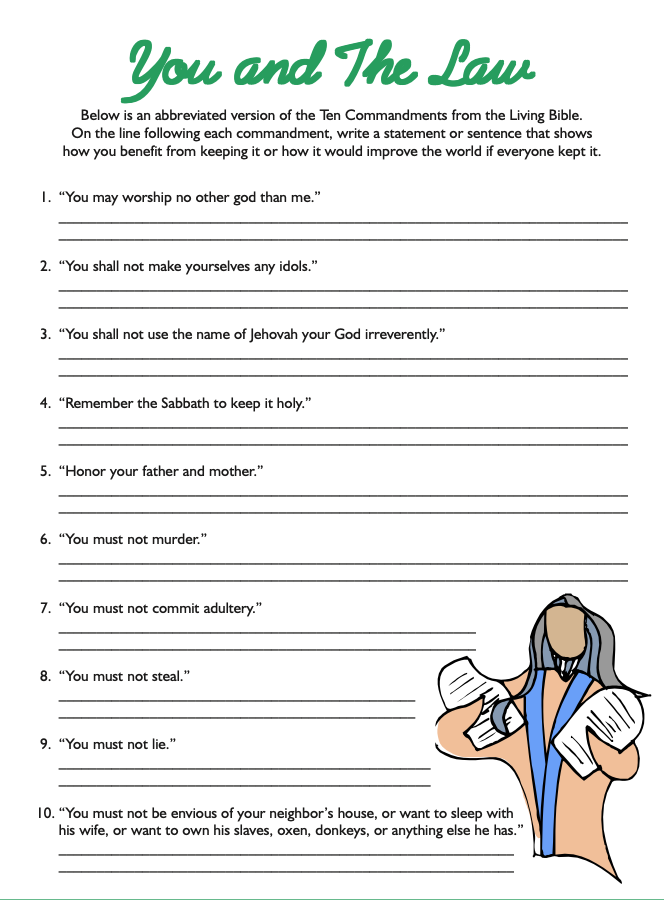
Before class, write each one of the abbreviated Ten Commandments lengthwise on a different 36 inch strip of paper. (See “You and the Law” under “Activity” in the students’ book.) Along the left side of each strip of paper draw lines across and write numbers one to ten to make it look like a ruler. (Write one at the bottom and ten at the top). Tape all ten strips of paper to a wall or to the floor.
Give each student a pen as they arrive. Open the class with prayer. Begin the class by telling them that each strip of paper represents one of the Ten Commandments. Ask them to use their marker pen and make a check mark by the number that indicates how they feel each commandment should be kept on a scale from one to ten – number ten being the greatest and number one being the least.
Now tell them they will have three minutes to think about how they personally keep each commandment on a scale from one to ten. Are you keeping each commandment the way Jesus would have you keep it? Is there room for improvement? Do you do a better job with some than with others? Do you need to improve the way you keep some of the commandments? As you think about these questions, isolate the commandments you’re most inclined to break. Think about why you break it, how you can avoid breaking it, and what plan of action you will take to prevent breaking it in the future. Remind students that they have three minutes to think about this assignment. Say go and set the timer.
Debrief - When the timer rings, ask one of the students to read James 4:17 aloud. Ask another student to read 1 John 3:4 aloud. Ask: How do you think God looks upon us when we break His commandments? Now have a student read Romans 6:23 aloud. Ask: What are the consequences for breaking God’s law? What does God promise to those who follow Him? Have students share their plan of action to do a better job of keeping the commandments.
Use the activity in their book and the information under “Background,” to discuss how they will benefit from keeping each commandment and how much better the world would be if everyone kept all ten of the commandments. Then ask: Which of the Ten Commandments have been abolished? Why do you feel the way you do? Ask one of the students to read Matthew 5:17-19 aloud.
Teacher-Directed Activity
The activity for this lesson is under “How to Teach This Lesson.”
Song
“This Is My Commandment” is on page 51 of The Group Songbook.
Closing Prayer
Have the students form a circle and hold hands. Invite a volunteer to lead in prayer thanking God for revealing such a wonderful law to us – a holy, just and good law.
Printable Pages