YEA Lesson Library
Pharaoh’s Dreams
About This Lesson
This lesson reviews the dreams of Jacob, Joseph, the Cupbearer, and Pharaoh, then it emphasizes that God sometimes uses dreams to give information. Obeying God’s laws also gives wisdom.
Scriptures
Genesis 41:1-44
Psalm 111:10
Psalm 119:98-100
Psalm 119:129-130
Proverbs 1:1-7
Proverbs 9:9-10
Proverbs 15:14
Ephesians 1:17-18
2 Timothy 3:12-17
Words to Know
BUDDED - a flower from which fruit grows
FEAR - to be in awe of, reverence
HONOR - to show deep respect
WISDOM- knowledge, understanding
The Lesson
Sherry woke up in the middle of the night. She had a funny dream. Silly animals went to school - a dog that had stripes like a zebra, a horse that had a tail and hopped like a rabbit. And, the teacher was a giant apple that could talk.
Have you ever had a funny dream like that? Maybe your dream was scary. Or, maybe it was just funny, like Sherry's. When you woke up did you wonder what that dream meant?
During Bible times God sometimes spoke to people in their dreams. Remember Jacob's dream about the stairway to heaven? God spoke to Jacob. God also spoke to Joseph in dreams. God promised to bless both Jacob and Joseph. He would give them a large land. He would make great nations from them. Joseph would be so important that his father, mother, and brothers would bow down to him. Today's lesson tells about two other people who had funny dreams.
Joseph was in prison for something he didn't do. While he was there he was placed in charge of the other prisoners. Pharaoh's butler was in prison, too. The butler's job was to bring Pharaoh his food and drink.
One night the butler had a dream. He dreamed about a vine that had three branches. The vine budded and grew large bunches of grapes. The butler didn't understand the dream. So, he asked Joseph if he knew what it meant. Joseph said that God would help him understand the dream.
Joseph said that the dream was good news. He would soon have his job back. The butler was very happy. He said he would never forget what Joseph did for him. But, when he got out of prison, the butler did forget Joseph.
Two years later, Pharaoh began having dreams. One night he dreamed about fat cattle and big fat ears of corn. Then he dreamed about skinny cattle and sickly, skinny corn. Pharaoh called in all of his wise men. But, no one in all of Egypt could understand the dreams. Then the butler remembered Joseph. He said, "Joseph told me what my dream meant. I'm sure he can tell you about your dream."
So, Pharaoh called for Joseph. He told Joseph his dreams. Joseph said, "God is the one who can tell what the dreams mean. He will help me understand.”
Joseph told Pharaoh that there would be seven good years. Corn would grow, the cattle would be fat. After that, there would come seven bad years. The corn would dry up and die. The cattle would be skinny. People would go hungry. Joseph told Pharaoh to find a wise man whom he could trust. He should put him in charge of storing corn during the good years. That way there would be food to eat during the bad years.
Pharaoh thought this was a great idea! Joseph was the only man he knew who had God's Spirit and wisdom. So, Pharaoh put Joseph in charge of collecting and storing the corn. He had the most important job in all of Egypt.
God blessed Joseph because Joseph honored Him. God made him very wise. Joseph loved and obeyed God - even when things were going against him.
Student Prayer
Dear Heavenly Father,
Thank you for
helping Joseph understand the dreams. You are the only One who could give him such wisdom. Help me trust you like Joseph did - even when things are going against me.
In Jesus' name.
Amen.
Daily Devotions
Sunday - Proverbs 1:6-7
Monday - Psalm 119:98-100
Tuesday - Psalm 119:129-130
Wednesday - Proverbs 1:5
Thursday - Proverbs 9:9-10
Friday - Proverbs 15:14
Saturday - Ephesians 1:17-18
Objectives
At the end of this lesson, the children will be able to:
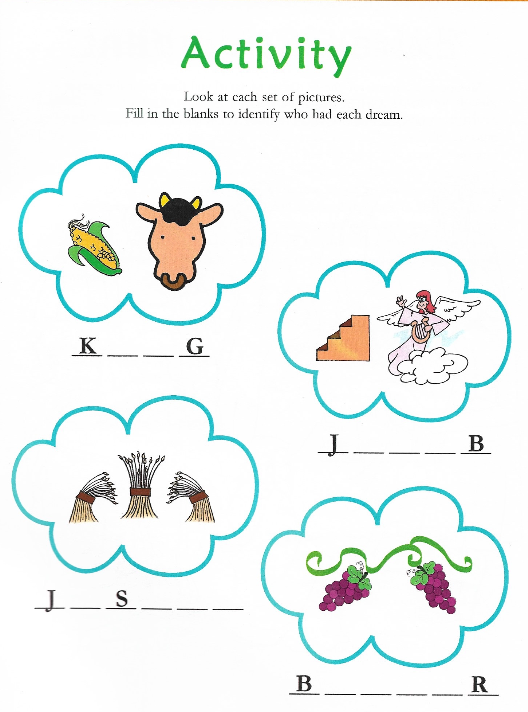
1. Describe the dreams that Jacob, Joseph, the butler and king had.
2. Tell that in Bible times God sometimes spoke to people in dreams.
3. Emphasize that God gave Joseph wisdom to tell what the dreams meant.
4. State that Joseph loved and obeyed God - even when things were going against him.
Topics & Themes
Dreams
Egypt
Grapes
Honor God
Jacob
Joseph
Loving God
Obedience
Pharaoh
Pharaoh’s Cupbearer
Trusting God
Wisdom
Materials Needed
Bible, YEA students' and teacher's books, attendance and memory verse chart, songbook, stars, music player and music tapes or CD, cardboard or poster board, black construction paper, yarn, metal paper fasteners, tape, glue, scissors, white construction paper, double stick tape or flocked paper, flannel board, awards
Preparation
“Why?” is a popular question in the lower elementary classroom. You need to be there with answers that will steer their developing reasoning abilities in the right direction. The conclusions they come up with on their own can often be off base.
Help children in this age group understand that Joseph could interpret dreams only with God's power. Dreams were a way of conveying God's message through a man who was empowered by God's Spirit. Joseph didn't take credit for his ability, but gave glory to God for using him.
Enlarge and copy the "dream" pictures from the student's book onto white construction paper. Cut out the four individual "dreams" and back with flocked paper or double stick tape.
Write or type the memory verse on paper (one for each child) and cut into strips. Cut 18x12" black construction paper into 5" wide strips (one for each child in class). Cut 9”x12" black construction paper into 9" squares, and cut enough 9" squares of cardboard or poster board for each child to have one. Make tassels out of colored yarn: Cut yarn into 12" pieces. Group 3 pieces of yarn together, fold in half and tie together with another piece of yarn, leaving a tail of at least 6" to attach ti to the mortar board.
How to Teach This Lesson
Begin by asking the children to tell about a dream they have had. Ask: How did you feel when you awoke from your dream? Were you afraid? Did you think it was real?
God speaks through dreams - The dreams we will talk about in today's lesson were special dreams. They were not nightmares. They were special messages from God. And, only a man who loved God and served Him could tell what the dreams meant.
(Place the "dream" pictures on a flannel board.) Ask: What did Jacob's dream about the stairway to heaven mean? God's voice spoke to Jacob and told him that he would make great nations from his family. God also said that He would give Jacob a large land to live in. God promised to bless Jacob’s family.
Joseph’s dreams about the bundles of wheat, and the sun, moon, and stars bowing down to him made Joseph’s brothers very made. They thought Joseph was a smart aleck, wanting them to serve him. They didn’t know that God had plans to use Joseph in a special way.
Ask: What did the butler’s dream about the grape vine mean? God used Joseph to tell the butler that his job would be restored to him. Then God would use the butler to have Joseph released from prison.
Finally, ask: What did the king’s dreams about the fat and skinny cows, and the fat ears and the dried up corn mean? God was warning the king about a famine, a time when there wouldn’t be enough food to eat. First there would be seven years of plenty - lots of corn and food. During this time, the people would store up their extra food. Then when the bad times came, they could eat the food they had stored,
God uses Joseph - The butler and the king were upset and even frightened by their dreams. They couldn’t understand what they meant. But, God used Joseph to help them understand. Joseph loved God and obeyed Him, even when he was in prison. He didn’t forget God when it seemed like everything was going against him. Joseph knew that God was always with him. And, because he obeyed and honored God, God made him wise.
God can make you wise. - Our memory verse says, “The fear of the Lord is the beginning of wisdom.” This means that if you will obey God’s commands, love Him and worship Him, you will begin to be wise. God’s Word, the Bible is our greatest teacher. This is how He speaks to us today. If you will read it and listen to what God says, you will know how you should behave. God will show you how to be happy. He will show you how to have friends. Obeying God's Word will help you in everything you do. Do you want to be wise?
Review Questions
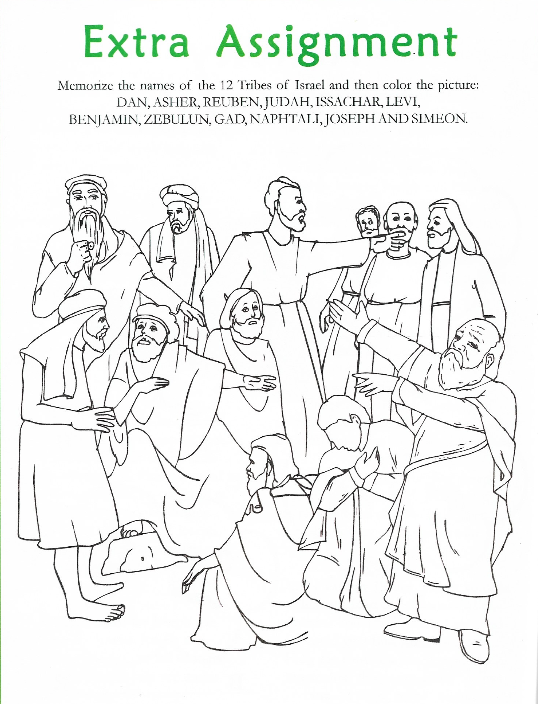
Review questions have been included in the lesson. In their place, have the students recite the Twelve Tribes of Israel that was assigned the first class. Give an award to those who can.
Teacher-Directed Activity
The children will be making mortar board hats for this lesson’s activity. Give each child an 18x5” strip of black construction paper, a 9” square sheet of construction paper, and a 9” square of cardboard (or poster board). Glue the square paper to the cardboard square. Gold the top of the paper strip 1/3 of the way down. Turn the strip over and glue the memory verse to the wide section of the construction paper strip. Cut slits along the folder edge of the strip, about 1” apart. Tape the ends together forming a band. Fold the tabs to the inside of the band. Cover the tabs with glue and invert in the center of the cardboard side of the square. Press down firmly and allow to dry. Using a metal fastener, attach the tassel in the center of the top of the mortar board.
REACH Activity
1. Joseph was in charge of the prisoners. Have kids draw a picture of Joseph and the butler while he is telling him about his dream. Try using chalk on brown paper to help it look like a prison.
2. Grapes were commonly grown in biblical lands. Have kids find out where and what kinds were grown and how they were used. Ask: Do you like grapes? Make a meal or snack that includes grapes. (Hint: Use a Bible commentary or dictionary.)
3. The butler told Joseph that he would remember him, but two years went by before he remembered Joseph. Ask: Have you ever been forgotten by someone who said they would do something for you, but didn’t? Or have you been the one that has a forgetful memory? Have kids read the following scriptures about a sparrow, their work, and a reminder: Luke 12:6; Hebrews 6:10; Hebrews 13:16. Then they should write a prayer of thanks to God for never forgetting, but always remembering them, even as He does the sparrows!
4. Have kids make a chart of Pharaoh’s dream. They should separate the seven years of abundance and the seven years of famine. Show what happened in Pharaoh’s dream. Ask: What did Pharaoh do when Joseph told him what his dream meant?
5. Let kids draw seven thin cows eating seven fat cows. Then draw seven thin ears of corn eating seven fat ears.
6. Acrostic poem: P-H-A-R-A-O-H-S D-R-E-A-M-S.
Note: Acrostic poem: Each letter of a word begins a line of the poem; i.e., in a “P-R-O-M-I-S-E” acrostic poem, “P” starts the first line, “R” starts the second line, “O” the third, etc.
7. Mural: Half and half—kids can make a mural of seven years of plenty (lots of water, green, food); seven years of famine (no water, brown, huge empty food storage bins).
8. Have students make a diorama that shows how Joseph did his next job: in charge of the land of Egypt!
9. Let kids make a word search with the “Words to Know” from all ten YEA lessons.
10. Collect food or personal items for a local food pantry or shelter.
11. Students should add the events from the lesson to Joseph’s biography card.
Note: Biography cards: Index cards for each Biblical character. Add information about that person; i.e., who their parents were, who they married, who their children were, what things they did to serve God, what their name means, etc.
12. Tell kids to continue Joseph’s journal. Ask: What would you write now?
13. Bookmark: Kids can write their memory verse on a paper strip, decorate it, laminate with clear contact paper, punch a hole and put a ribbon through it.
14. Have kids make a concentration game and match the dream with the correct person:
Joseph - sheaves bowing, sun, moon, stars bowing
Jacob - ladder, angels going up and down
Baker - loaves of bread
Cupholder - grape vine budded
Pharaoh - cows and corn
15. Let students make a board game for this YEA lesson book. They should include memory verses, trivia questions, lesson objectives, people, and events. Tell them to make sure to include directions on how to play the game and all of the pieces necessary for play. Then they can play it with family and friends.
Other Ideas:
The biography cards can be used in so many ways. They can eventually be kept in a file of Who’s Who in the Bible. Store in a plastic card file box. The cards can be separated by men and women of the Bible; people of the Old and New Testament; prophets; kings, etc. Cards can be used to record information on Bible foods, animals, and places. Cards come in different sizes and colors!
The biography cards can also be used as “note cards” for a future book about that person. Books come in all shapes and sizes, and are a very creative way for a young person to express themselves. Be sure to make an author’s page.
Cartography (making and drawing maps) is very interesting and fun for young children. Paper towel rolls will help keep the storage issue under control for small paper maps. For the study of one specific area, a floor map would be fun. Use a shower curtain instead of paper. Fold and store in a plastic zipper bag.
Dramatic play is an area children usually love. Save old shirts and belts, hats and scarves, and let them play dress up. Acting out a story makes it easier to remember as well as making a lesson more relevant to them.
Song
“Praise Him, Praise Him” is on page 76 of Kids Classics Collection.
Closing Prayer
Ask one of the children to lead in prayer, asking God to help them be wise as they obey Him.
Printable Pages