YEA Lesson Library
Tower of Trouble
About This Lesson
This lesson teaches that after Noah’s flood people eventually began rebelling against God again. They built the Tower of Babel. God confused their language. The student is taught that rebelling against God is never a good idea.
Scriptures
Genesis 11:1-9
Psalm 10:4
Psalm 18:2
Proverbs 16:18
Proverbs 26:12
Isaiah 14:12-13
Jeremiah 17:9
Jeremiah 49:16
Daniel 5:20-21
Words to Know
CONFUSE - to mix up
LANGUAGE - the way people speak and communicate
PLAINS - flat lands, suitable for grazing cattle
PROUD - thinking you're better than someone else
The Lesson
A new family moved into Connie’s neighborhood. There was a girl Connie's own age in the family. Connie went over to meet her. The mother answered the door. Connie said, "Hi, my name is Connie. I live down the street." But the mother just looked confused.
Connie tried again. She said,"Can your little girl come out to play with me?" This time the mother said something Connie didn't understand. This would be hard. They didn’t understand each other.
It is hard to understand someone who doesn't talk like you or speak your language. Just try making up some words. Ask someone to help you do your homework. "Rauzk nuk shul vi lu yegi?" It makes no sense! That's how things sounded when God mixed up people's languages.
Many years past after Noah left the ark. What did God tell them to do? He said they should have many children. Noah's sons did what God told them. Some of the people were farmers. Others took care of sheep and cows. Families were growing. Flocks and herds were getting bigger. Everyone needed more room.
People who raised sheep took them to the hills. There was grass to eat and plenty of room to grow. People who raised cows moved to the plains. There was plenty of grass and room there. Farmers moved where they could plant gardens. Hunters moved near forests where deer lived. There was room for everyone on God's great earth.
Everyone on earth talked the same way and spoke the same language. They all came from Noah's family. And they all got along with each other. They shared their land.
Some people didn't want to do what God said. They wanted to stay together. They built a big city called Babylon. They also built a tall tower. They made their own bricks. Everyone worked together. The tower got taller and taller. Soon the top of it reached up to the heavens. The people were very proud of it. They wanted everyone to see their tower. They wanted them to brag about it.
One morning something strange happened. The people went to work, as usual. One man asked another to hand him some bricks. But it sounded like, "Yark zi lobi dach!" What happened next was a big mess. People couldn't understand each other. They pointed to things. They tried to make each other understand. But it was just too hard to get things done. Soon they stopped working on the tower. Everyone wondered what happened.
God saw that His people weren't doing what He told them. They didn't spread out all over the earth. They stayed together and built a city and tower. They were proud. They thought they knew better than God. God wasn't happy about that. So He put a stop to their work. God confused their languages. They couldn't understand each other.
Soon the people of Babylon moved away. There was no need to live together any more. Now the people were doing what God told them to do. God helped them obey!
What happens when you don't obey your parents? Sometimes they punish you. You may spend time in your room alone. This helps you learn to obey them. Let's say Mom said, "Don't ride your bike in the street." But, you want to do it anyway. How could your mom help you obey? She might take your bike away for a while. This would help you obey. Sometimes God has to help us obey Him, too.
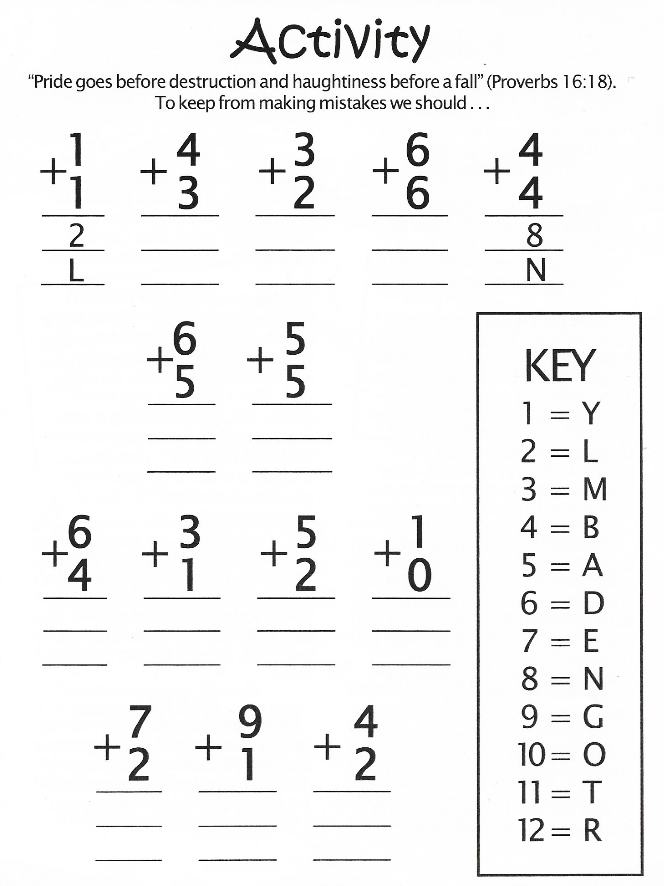
Your memory verse says, "If you are proud, you will be destroyed. If you are proud, you will fall." Don't think you are better than anyone else. Everyone should obey God. If you don't, He may have to help you obey!
Student Prayer
Dear Heavenly Father,
Teach me to obey you instead of doing things my own way. When I want other people to brag about me, I may be headed for a fall. Help me learn to always obey you.
In Jesus’ name.
Amen.
Daily Devotions
Sunday - Daniel 5:20-21
Monday- Proverbs 26:12
Tuesday - Psalm 10:4
Wednesday - Jeremiah 49:16
Thursday - Jeremiah 17:9
Friday- Psalm 18:2
Saturday - Isaiah 14:12-13
Objectives
At the end of this lesson, children will be able to:
1. Repeat what God told people to do after the flood.
2. Explain what some people did to disobey God.
3. Tell how God helped them to obey.
4. Recite their memory verse.
Topics & Themes
Babylon
Consequences of Sin
God’s Judgment
Pride
Putting God First
Rebellion
Tower of Babel
Materials Needed
Bible YEA Students' and Teacher's books, attendance and memory verse charts, stickers or stars, songbook, CD, music player, Bible lands map
Preparation
"Because God understands his own design for the development of a young child, he knows that a child learns best by doing. Parents were instructed to integrate the teaching of God's laws with everyday experiences. On the road, at home, going to bed, getting up — all of these were teachable moments (Deuteronomy 6:4-7) (Teaching on Target, by D.r Robert and Jane Choun).
To implement learning and insure that your lesson has an impact on the life of the children you teach, the lessons must be linked to their daily lives. Use examples that the children can recognize and relate to. Remember to keep your examples on an appropriate age level.
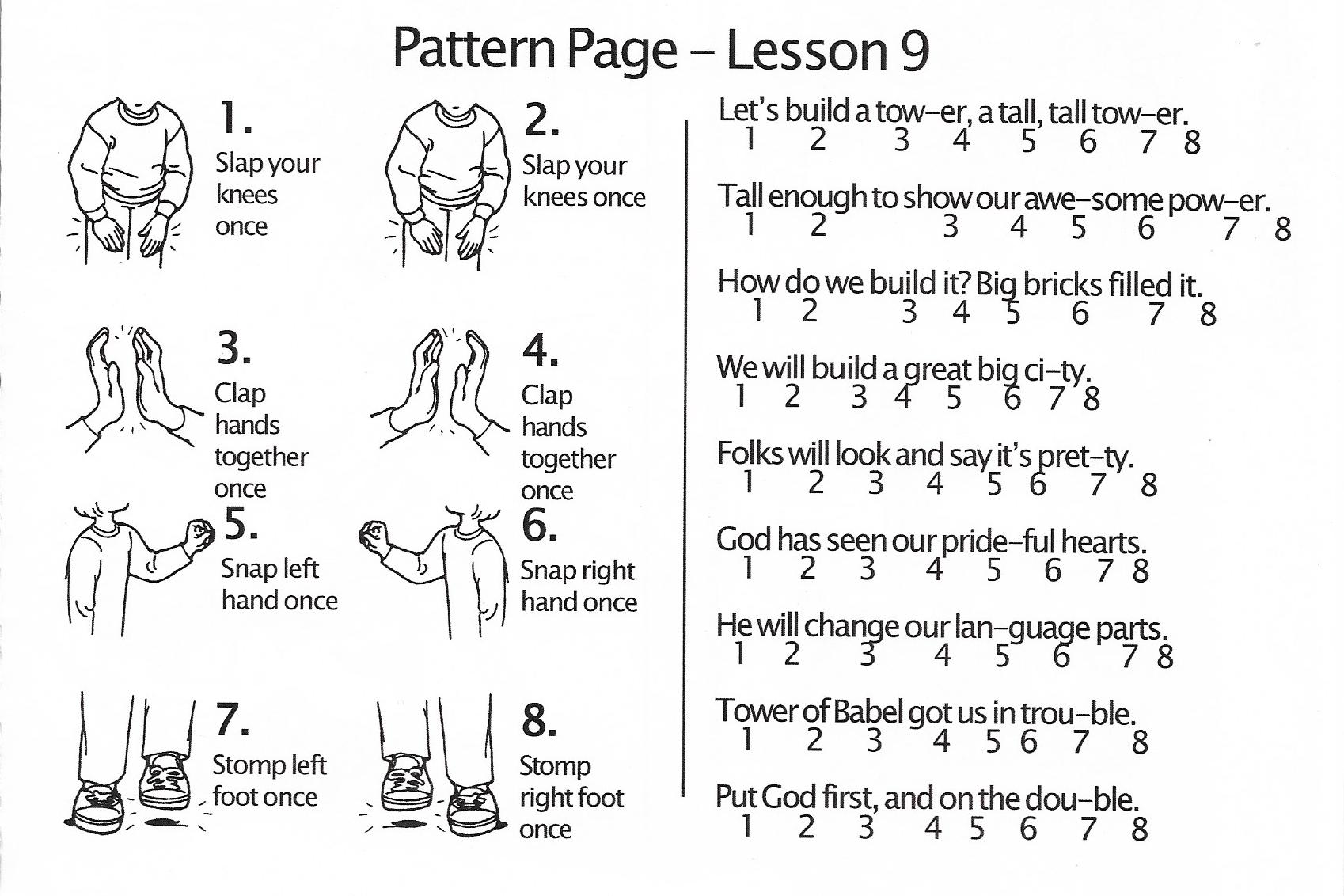
Before class, practice the hand movements and the rhyme in the activity section several times to get the rhythm down. The hand movements for this activity are located on the pattern page.
How to Teach This Lesson
Using a map of Bible lands will help children visualize the area of the landing of the ark and the tower of Babel. Maps can be purchased at a local Christian bookstore or found on the Internet. Indicate areas where people with sheep may have migrated (hills), where farming was done (plains), and show how people were spreading out, as God commanded.
The importance of obeying - God's purpose in instructing people to disperse and spread out was that the earth would be repopulated. All mankind, with the exception of Noah's family, had been killed in the great flood. God was giving both man and earth a fresh start. God's instructions were to have children and replenish the earth. If man failed to obey Gods' command, there would soon be no one left to enjoy what He created. God's commands are always for our own good. Failing to obey Him only leads to heartache and destruction.
Pride leads to destruction - Nimrod, a mighty hunter, led his followers to the plains of Assyria (Genesis 10:8-10). He decided to rebel against God's commands. His descendants on the plains of Shinar continued to rebel. They said, “Let us build ourselves a city with a tower that reaches to the heavens to that we may make a name for ourselves and not be scattered . . .” (Genesis 11:4). They put their will above God’s will. They invited the praise of men and exalted themselves above God. “For they loved the praise of men more than the praise of God” (John 12:43). As was said about King Uzziah, “ . . .when he was strong, his heart was lifted up to his destruction: for he transgressed against the Lord his God . . .” (2 Chronicles 26:16). God had to bring the people back to obeying Him.
Language confusion- Ask children wearing blue to form a group, children wearing red to form another, etc., until you have several small groups. Ask each child to make up nonsense words. One at a time, have children give directions using nonsense words while the others in the group guess the meaning. (You may have to help the younger children.) Ask: Was it easy to understand the nonsense words? How would you like your Mom and Dad or friends to talk like that all the time? That is what it was like at the Tower of Babel.
God, who created man, now gave every- one a different language to speak. That made it hard, if not impossible, to talk with each other. All work on the tower stopped. It was left incomplete. Instead of a tower to be admired, it was a reminder of their rebellion.
Helped to obey- Because people could no longer communicate, they stopped working on the tower. They soon began to move away from Babylon and scatter in different directions. Ask: What did God tell them to do when they left the ark? Do you think they would have stopped building or left Babylon if God hadn't confused the languages? God was helping them obey. Ask: Can you think of ways your mom and dad help you obey them?
Whenever you think you are better than anyone else, or if you think you know more than God does, watch out! You are headed for a fall! God may have to do something that will help you obey Him!
Review Questions
1. What were God's instructions to Noah’s family when they left the ark?
2. Why did some people go to the hills and some to the flat plains?
3. Why did some people not want to obey God?
4. What does your memory verse mean by, "If you are proud, you will be destroyed"?
5. What did they do?
6. What did God do to help them obey?
Teacher-Directed Activity
Seat children in a circle. Begin by practicing the series of moves pictured (see pattern page). Use the moves pictured for each line of this rhyme. You can increase the speed of the rhyme as the children learn the moves. See how fast the class can go!
Let's build a tower, a tall, tall tower.
Tall enough to show our awesome power.
How do we build it? Big bricks filled it.
We will build a great big city.
Folks will look and say it's pretty.
God has seen our prideful hearts.
He will change our language parts.
The Tower of Babel got us in trouble.
Put God first, and on the double.
REACH Activity
Special Materials Needed:
Timer, tape recorder, cassette tape, plastic lid, poster board, hole punch, ribbon
Activities:
1. Write in your Bible notebook about a time when you got into trouble for disobeying your parents.
2. Read Genesis 11:1-9. Then role play this week’s YEA lesson.
3. Do a sword drill. Use the Daily Devotional Scriptures in the YEA book, Color My World. Read out the Scripture reference. Then start the timer. When the child has found the verse, stop the timer. Read the verse and talk about how it relates to the lesson. Challenge the child to see how quickly he/she can find each of the verses in the Bible. The sword drill works well as a competition game if you have more than one child.
4. Write the sequence for this week’s YEA lesson on index cards. Mix up the cards. Then put them in order. Find a timer. Challenge your mom or dad to see who can do it quickest.
5. Divide a piece of paper into six equal blocks. Draw the sequence of events from the YEA lesson.
6. Write the memory verse using colored markers in your Bible notebook.
7. Read Philippians 2:3. How should we think of other people?
8. What does God think of someone who is proud and does not put God first? Read Proverbs 16:5.
9. What does God do for those people who are not proud? Read Proverbs 3:34.
10. How do you think the Tower of Babel was designed and built? Share and discuss ideas. Then read the YEA lesson.
11. After reading the YEA lesson, make a list of important words, including the Words to Know. Create a word search. Give it to a friend to solve.
12. Everyone experiences confusion at one time or another. Discuss and share what can cause someone to feel confused. What can we do when we feel confused about something?
13. Explain that English is the first, or primary, language of the United States of America. People from other countries move to our country who do not speak English. Spanish, French, and German are examples of some languages spoken in America besides English. God wanted to “confuse” the language of the people who built the tower. Our world languages come from God. Ask: Have you ever heard the language from a different country? Do you know what it sounds like? Check out the language tapes at the public library. Can you learn a new language? Try to learn how to count to ten in a different language, maybe Spanish.
14. God wants us to obey Him. Sometimes we decide to do something just because we think we have a good idea. The people who built the Tower of Babel thought they had a good idea. But the idea you have may not be what God wants you to do. Has that ever happened to you? What was the idea? Did it work out? Why or why not?
15. Do you know how to be happy? There is a song that will give you the answer. “Trust and Obey” is on page 193 of the CEM Hymnal. Learn the song. Using a plastic lid, trace a circle on a piece of poster board or cardboard, and cut it out. With a marker or crayon draw a smiling face on the circle. Choose a verse from the song and write it on the circle. Punch a hole at the top of the circle. Thread two pieces of six inch ribbon through the hole and knot them together. This happy bookmark will be a reminder to trust and obey God.
16. Use a Bible dictionary or encyclopedia, and a map, to find out what the Tower of Babel looked like and where it was located. Then, draw a map of the location and a picture of what the Tower of Babel would look like from the information in the Bible dictionary or encyclopedia. Share the map and picture with a friend.
17. Explain that many people are involved in the planning and construction of a building—an architect, engineer, and construction workers—to name a few. Find out the main job of each of these workers. Then, form a group so that everyone has one of these jobs and begin building! Take a picture of your group and the finished product. Then frame it.
18. Memory verse practice: Record the memory verse on tape. Practice until it is memorized.
Song
"O Be Careful Little Eyes" is on page 39 of the Kids Classics Collection.
Closing Prayer
Lead children in prayer, asking God to teach them not to be proud and haughty. Thank God for helping them to obey when they forget or when they deliberately disobey.
Printable Pages