YEA Lesson Library
Dinner with Sinners
About This Lesson
Using Jesus calling Matthew to be a disciple, this lesson teaches the importance of forgiving others and treating others with God’s love.
Scriptures
Psalm 51:12-13
Matthew 9:9-13
Mark 2:13-17
Luke 5:27-32
Luke 5:32
Luke 18:13-14
Romans 5:6-11
Ephesians 1:6-8
Colossians 1:21-22
Words to Know
REPENTED - turned from sin; being sorry for doing wrong
The Lesson
Jenny’s birthday was coming. She would be six years old. She was having a birthday party. Who should she invite? Pam was her best friend. She was first on Jenny’s list. Jason was Pam’s little brother. He could come too. Chrissy and Kathy were twins. They were in her class at school. She would invite them. Then there were her cousins, Shelbie, Breanna, and Todd— they were always fun! Was there anyone else?
Paula was a new girl who lived down the street. Jenny wasn’t sure if she liked Paula. Jenny’s Barbie doll was missing. She was sure that Paula took it from the porch. Why should she invite her to the party? Mother said, “Maybe Paula is lonely. She really needs a friend. You could help her meet some of your friends. Jenny still didn’t like the idea. But she knew her mother was right. She added Paula’s name to her list.
It was a great party! Mom made chocolate cake with white frosting. There was a clown face on top. And there was ice cream too! They played lots of games. They played in Jenny’s new swimming pool. Jenny got lots of nice presents. Everyone had a good time.
The kids were all leaving. Jenny saw Paula standing by herself. She wanted to talk to Jenny. Paula thanked Jenny for inviting her to the party. She handed Jenny a paper bag. Was this another birthday present? Jenny opened the bag. Inside was her Barbie. Paula said, “I’m sorry, Jenny. I shouldn’t have taken your doll. I just wanted you to play with me. Will you forgive me?” What would Jesus want Jenny to do?
Many of Jesus’ disciples were fishermen. One day Jesus was walking down the road. He saw a man sitting in a booth. The man was a tax collector. He was collecting money for the king. Some tax collectors were not honest. They collected more than they should, then kept part of the money for themselves. They were cheating the people. Jesus didn’t scold the tax collector. He asked the man to be one of His disciples. Why did Jesus want someone who cheated to be a disciple?
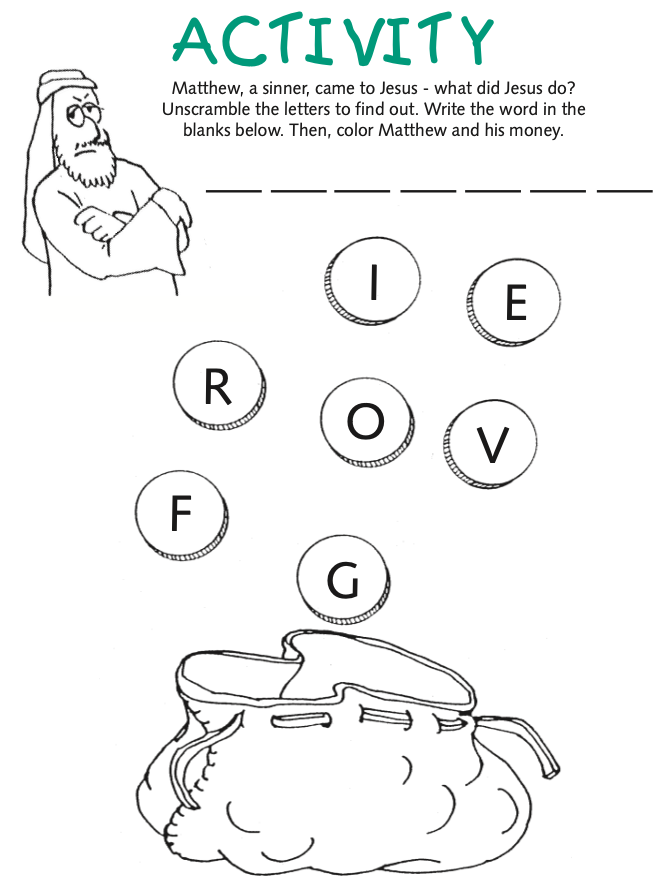
This tax collector was named Levi—some called him Matthew. Matthew asked Jesus and His disciples to his home for dinner. Some of Matthew’s friends were there, too. They were also tax collectors.
The religious leaders heard that Jesus ate with tax collectors. They were upset. They asked, “Why would you do such a thing? Are you friends with men who cheat the people?”
Jesus told them that people who aren’t sick don’t need a doctor. You go to the doctor when something is wrong. These men needed Jesus’ help. Jesus knew they were sinners. He showed them that cheating was wrong. He would forgive them if they repented and did what was right.
Paula learned to do what was right. She was sorry for stealing Jenny’s Barbie and gave it back. Jenny forgave her. Jesus wants us to learn to do what is right. Are you sorry for doing bad things? Jesus will forgive you when you tell Him you are sorry.
Student Prayer
Dear Father, Thank you for loving me. Help me learn to do what is right. Forgive me when I do things that make you unhappy. In Jesus’ name I pray. Amen.
Daily Devotions
Sunday - Psalm 51:12-13
Monday - Matthew 9:11-13
Tuesday - Luke 18:13-14
Wednesday - Romans 5:6-8
Thursday - Ephesians 1:6-8
Friday - Colossians 1:21-22
Saturday - Romans 5:10-11
Objectives
At the end of this lesson, students will be able to:
1. State what it means to be righteous.
2. Tell that repentance means to be sorry for doing wrong and to turn from it.
3. Explain that even children do things that make God unhappy.
4. Discuss that sin is like a sickness, and Jesus forgives and makes us well again.
Topics & Themes
Coveting
Disciples, Calling of
Forgiveness
God’s Love
Jesus, His Ministry
Loving others
Matthew (Levi)
Repentance
Sin
Stealing
Tax collectors
Ten Commandments
Preparation
Primary-aged children know when they have done something to upset their parents. Depending on the maturity level of the child, they are beginning to learn what things are right and what things are wrong. They will be able to understand that there are some things that make God unhappy, but may not have reached the level where they can recognize that they are sinners. Explain that the Bible teaches that all of us are sinners—even children. We all do things sometimes that make God unhappy. This is the reason Jesus came to earth to die. He came to pay the penalty for our sins. Just as a doctor is called to make a sick person well, so we must call on Jesus to make us “well” from our sins. When we tell Him we are sorry for doing wrong, He will forgive us.
How to Teach This Lesson
Children between six and eight years of age are people pleasers. They love and need approval from the adults in their lives. Help them see that when they sin, they lose the approval of others. Their parents may become angry or punish them. Their friends will not want to be around them. They may even be embarrassed and want to hide, like Adam and Eve. Emphasize that the solution is confession—admitting that you did wrong, and repentance—a change of mind and behavior. Parents and friends will give you a second chance, but God gives you a fresh, clean start!
Sin Separates - Ask: Do you know the first thing Adam and Eve did after they sinned in the Garden of Eden? The first thing they did was to hide. They knew God’s instructions were not to eat of the fruit of the tree in the middle of the garden. Because of their disobedience, they hid themselves when they heard God’s voice. They no longer had the same relationship with Him. Ask: When you do something wrong, how do your parents feel? Because they are unhappy, you are uncomfortable being around them. When you sin, you don’t feel as close to your Heavenly Father (Matthew 7:21-23).
It was because of Matthew’s sin of thievery that the Pharisees were critical of Jesus dining with him. They thought that Jesus should have nothing to do with sinful men. Ask: Whom did Jesus say needed to repent? “I came not to call the righteous, but sinners to repentance” (Luke 5:32).
Proverbs 16:28 tells us that friendships are often destroyed because of gossip. Telling bad things about someone else is destructive. God’s plan is for us to be kind to one another. The Pharisees who spoke evil against Matthew were as guilty of sin as Matthew was for taking money.
Sin Must Be Confessed - A person who truly confesses sin does not merely say he is sorry. Ask: If someone was sorry for doing wrong, but he did the same thing over again, would you believe he was really sorry? True confession is realized by acknowledging wrong (Psalm 51:1-3), and turning from it (Psalm 51:10; Proverbs 28:13). Confession may also require restitution to be made (Numbers 5:6-7). The story in the Student’s book was designed to help children understand that when they steal something, they not only need to confess it, but should return what was stolen. Ask: Why did Paula returned the Barbie doll she had stolen?
Sin Can Be Forgiven - God hates sin! Jesus had to die because of our sins. God is also merciful. Jesus paid the penalty for our sins, which is death. Dying on the stake made it possible for our sins to be forgiven (Psalm 32:1-5). Have an older student read 1 John 1:9. Ask: What does Jesus promise to do if we confess our sins? Not only are our sins forgiven, we are made clean again. Ask: If you scribble on paper with a pencil, then try to erase it, what happens? (You can still see traces of the marks.) God doesn’t just erase our sins, He gives us a whole new page—nice and clean!
Review Questions
1. We all know that sin is breaking God’s commandments or doing bad things. What do you think it means to be righteous?
2. When a person is really sorry for his sins, what should he do?
3. Who sins? Do mothers and fathers sin? Do children sin?
4. When you are sick, who should you talk to? When you sin, who should you talk to?
5. What does God do when we tell Him that we have sinned and are sorry?
Teacher-Directed Activity
This activity can be used to help the children remember the memory verse. The happy face represents the righteous; the sad face represents the sinner. Help children draw faces on the backs of two paper plates. On one, draw a happy face; on the other, draw a sad face. Staple or tape the two plates together with the insides facing each other. They may add “hair” by gluing pieces of yarn to both sides of the plate. Tape or glue a large craft stick (tongue depressor) at the bottom of the two plates as a handle.
REACH Activity
Special materials:
bright calendar pictures, write-on transparency film, permanent marker, magnetic tape, magnetic letters, magnet board
1. Do you know anyone who is lonely and needs a friend? Think about someone who might need a friend like you. If you could do something for them, what would you do? Talk about it with your family.
2. Would you have forgiven Paula for stealing from you? Why or why not? Talk it over with your family.
3. Have you ever taken anything that wasn’t yours? If you have taken something that didn’t belong to you, how did you feel? What happened after you took it? Did you return it? Why or why not? Write the answers in your Bible notebook.
4. Read the Ten Commandments in Exodus 20. Which ones teach about stealing and coveting? Write them in your Bible notebook.
5. Would you want someone to be your friend if they cheated you or stole from you? Why or why not? Talk it over with your family.
6. Find two Scriptures about forgiveness using your Bible and concordance. Write them in your Bible notebook.
7. Matthew was a tax collector. Find out more about him in a Bible dictionary or encyclopedia. What five questions would you ask him if you could? Write down five basic facts about Matthew in your Bible notebook.
8. Look at the “Words to Know” in the YEA lesson. Use each word in a sentence. Write them in your Bible notebook. Share them with family and friends.
9. Jesus taught us how to do what was right in many of His lessons. Use your Bible and concordance to find a story that Jesus told His followers and others about doing what is right. Tell the story to someone else.
10. Use magnetic letters and a magnet board to spell out the words of the memory verse. Practice until it is memorized.
11. Sing: “One Door and Only One” on page 44 of Kids Classics Collection.
12. Write the memory verse on the transparency film with a permanent marker. Lay the film over a pretty calendar picture. Hold the film and calendar picture together by framing them with strips of construction paper. Glue construction paper strips along the edges on both the front and the back. Put a couple of strips of magnetic tape on the back of the picture and hang it on the refrigerator.
13. In your Bible notebook, write the ending of the story from the YEA lesson. What did Jenny do about Paula?
14. Can you think of someone who didn’t treat you very well? What example did Jesus give you for how to treat that person? Write about it in your Bible notebook.
15. Can you think of something that you shouldn’t have done—a sin? How does God feel about your sin? But how does God feel about you? What does He promise to do when you are sorry for your actions? And if God can forgive you for what you’ve done, can you think of any reason why you shouldn’t forgive anyone who has mistreated you?
16. Sing: “Standin’ In The Need of Prayer” on page 53 of Kids Classics Collection. Sometimes we are tempted to think that someone else’s sin is worse than ours—and to compare ourselves with someone else. God says this is not wise. It is very important to remember that God is looking at us and our thoughts and actions alone. He doesn’t compare us with anyone else. We definitely need prayer.
17. Do a sword drill with the Daily Devotionals for this YEA lesson.
18. Sing: “Jesus Saves!” on page 42 of the CEM Hymnal. After you sing the song, find ways the words of the hymn make you think of your memory verse. Especially look at the second verse.
Song
“O Be Careful Little Eyes” is on page 39 of the Kids Classics Collection.
Closing Prayer
The teacher may lead in prayer, thanking God for His love and forgiveness. Remember to ask Him to help us do things that will be pleasing to Him.
Printable Pages