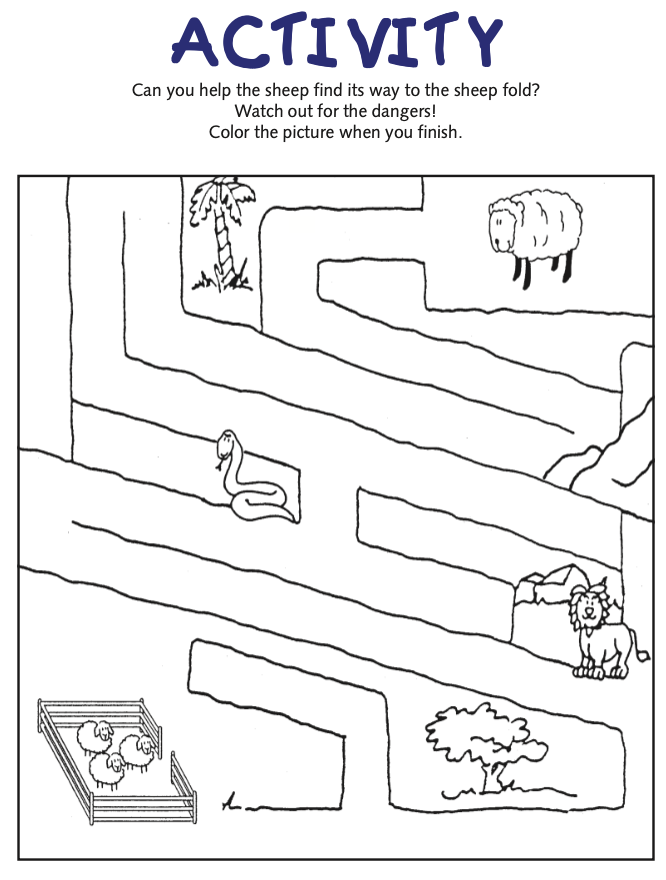
YEA Lesson Library
The Stray Sheep Comes Home
About This Lesson
This lesson explores the idea of sheep and their need for a shepherd. Then it teaches that Jesus is the Good Shepherd.
Scriptures
Psalm 23:1-3
Isaiah 53:5-7
Isaiah 53:6
Ezekiel 34:11-12
Matthew 9:35-36
Matthew 12:11-12
Luke 15:1-7
John 10:4-5, 11-16
Words to Know
FLEECE - a sheep’s wooly coat
ASTRAY - wander off
The Lesson
Mary had a little lamb
whose fleece was white as snow.
And everywhere that Mary went,
the lamb was sure to go.
It followed her to school one day,
which was against the rules.
It made the children laugh and play
to see a lamb in school.
This nursery rhyme helps us learn something about sheep. What did the lamb do that was against the rules? Sheep like to follow someone. That’s why they have a shepherd.
Have you ever visited the zoo or a farm and seen sheep up close? They have thick, wooly coats and skinny, little legs. Sheep do not have claws like a cat. They don’t have sharp teeth to bite with. They can’t run fast to get away from their enemies. A sheep doesn’t have anything to use to fight for itself. A sheep needs a shepherd to keep it safe.
The shepherd’s job is to take care of his sheep. He keeps the sheep safe from danger. He goes into the field before the sheep to make sure there is nothing to make the sheep sick. He builds a pen out of rocks or sticks. That’s where the sheep sleep at night. The shepherd lays down in the doorway of the pen. This lets him know if any sheep try to leave the pen. The shepherd can keep any other animals away from the sheep. A good shepherd loves his sheep. He knows each one by name.
One day Jesus was teaching a great crowd of people. Some of the people had been very bad. They told Jesus they were sorry for what they had done. Jesus loved them and forgave them. But, some of the religious leaders didn’t think Jesus should accept the sinners. So Jesus told a story about sheep to help them understand.
Jesus asked, “If you had 100 sheep, and one of them wandered off, what would you do?” He explained that a good shepherd would want to find his lost sheep. Shepherds know that sheep cannot take care of themselves. One might fall off a cliff and get hurt. It might go too far and not know how to get back. It might even meet a wild animal and become its dinner! A good shepherd first makes sure that the 99 sheep are safe. Then he goes looking for his lost sheep. He looks everywhere he thinks the sheep might go. He has to think like a sheep!
Pretend you are a lost sheep. What would you do? Would you “baa, baa” to call your shepherd? Would you try to find your way home? Would you be frightened?
A good shepherd doesn’t give up until he finds his sheep. Then he carries it where it will be safe. The mother of the little lost sheep will be so happy!
Jesus said, “You people are all like sheep. You need someone to look after you. Everyone goes astray sometimes. You need someone who will love you and bring you back home.” Sometimes the shepherd shows how happy he is. He invites his friends over to celebrate. Jesus said that He is like that good shepherd. He wants everyone to know He is happy when sinners come to Him. Even the angels are happy when we are sorry for our sins.
Student Prayer
Dear Father, I am one of your sheep. Thank you for being my Shepherd. Teach me to stay close to you and not wander away from your teachings. In Jesus’ name I pray. Amen.
Daily Devotions
Sunday - Luke 15:4-5
Monday - Isaiah 53:5-6
Tuesday - Matthew 12:11-12a
Wednesday - John 10:4-5
Thursday - Psalm 23:1-3
Friday - Ezekiel 34:11-12
Saturday - Matthew 9:35-36
Objectives
At the end of this lesson, students will be able to:
1. Tell how helpless sheep really are.
2. Explain that we are like sheep and need someone to take care of us.
3. State that Jesus is our Shepherd.
4. Recite the memory verse.
Topics & Themes
Bible study
God’s Love
God’s Protection
God’s Provision
Holy Spirit
Jesus, His Ministry
Good Shepherd
Sheep
Shepherd
Sin
Preparation
The theme for this book is Home Sweet Home. In keeping with that theme, we are assigning John 14:1-6, in addition to the weekly verses, to be committed to memory. The older children and those who are more advanced will be able to memorize all six verses. The younger children may only be able to memorize verses one, two and three. We suggest that you award those who have worked diligently at memorizing with a small gift at the end of these ten lessons.
Each part of this lesson, from the nursery rhyme to the activity, is designed to emphasize that we are like sheep in need of a shepherd. Be sure to allow each child to recite the memory verse; it too reinforces the theme of this lesson.
Since our theme is Home Sweet Home, you may want to make your attendance and memory verse charts in the shape of a house. On a large sheet of poster board, cut out the simple shape of a house. Divide the house (excluding the roof) into ten squares for each child. Each Sabbath the child is in attendance and/or recites the memory verse correctly, allow him or her to place a sticker in the appropriate square. Use the roof area to designate whether it is a memory verse chart or an attendance chart.
How to Teach This Lesson
Each time a child misbehaves is an opportunity to help them grow more Christ-like. This lesson about the lost sheep teaches children how precious they are to God. Even when they stray away from Him and His teaching, God’s loving Good Shepherd seeks them and brings them back into His fold. It is important for the children to learn that there are consequences for leaving the protection of the Shepherd. Like the lost sheep, we too are in danger of losing our way or of being attacked by the enemy, Satan, when we wander off in our own direction.
Since most of our children have not been raised around farm animals, make this lesson fun as well as informative. Ask them if they have ever seen a real sheep at close range—perhaps at a fair or in a petting zoo. As you ask the following questions, draw a sheep on newsprint, using the descriptions the children give. You should come up with some funny and unusual-looking sheep. Ask: Does a sheep have a large head or small? Does it have a long or short, fat or skinny neck? Is the sheep’s body fat or skinny, short or long? Does it have a smooth coat or curly? Are the sheep’s legs long or short, fat or skinny? Does it have a tail? What does it look like? Does a sheep have large eyes or small eyes? Does it have a big mouth or small?
The parable of the lost sheep is a wonderful picture of the relationship between the Lord and His children. We, as sheep, are in need of someone to lead us, someone to protect us, and someone who is willing to lay down His life for us. Our Good Shepherd does just that! He has given us His Word and the Holy Spirit as our guide through the trials and wildernesses of life. Many terms used in Scripture describe the Lord as our protector. He is our shield (Psalm 33:20); He is our fortress (Psalm 22:2); He is our high tower and refuge (Psalm 22:3). Just as the shepherd in the parable was willing to risk his own life in the wilderness to find the one lost sheep, so our Good Shepherd was willing to lay down His life for us (John 10:14-15). Jesus says of Himself, “For the Son of man is come to seek and to save that which was lost” (Luke 19:10). Parables are word pictures, designed to reveal to us the true image of God and His love for men. Jesus used parables to teach these principles because they began with something the people already knew and progressed to the unknown. Since many in Jesus’ day were shepherds, He knew that they could readily identify and understand the imagery. When teaching children, it is always best to begin your lesson with something the children know and understand—like a sheep. You may then work your way to the characteristics of sheep and shepherds.
Review Questions
For variety, make a game of your review questions. Draw an outline of a sheep on newsprint or poster board. Make six tails out of construction paper, numbering them from one to six. Attach a small piece of double stick tape on the back of each tail. Blindfold the children one at a time and have them choose a tail. When they pin the tail on the sheep, ask them the question corresponding to the number on the tail. (You may want to make up additional questions if your class is large.)
1. In our nursery rhyme we learn something about sheep. What do they like to do?
2. Can you think of several reasons why sheep need a shepherd?
3. What ways does a shepherd show that he loves his sheep?
4. How are we like sheep?
5. Who is our Shepherd? How does He show that He loves us?
6. Who is happy when a sinner comes home to our Good Shepherd?
Teacher-Directed Activity
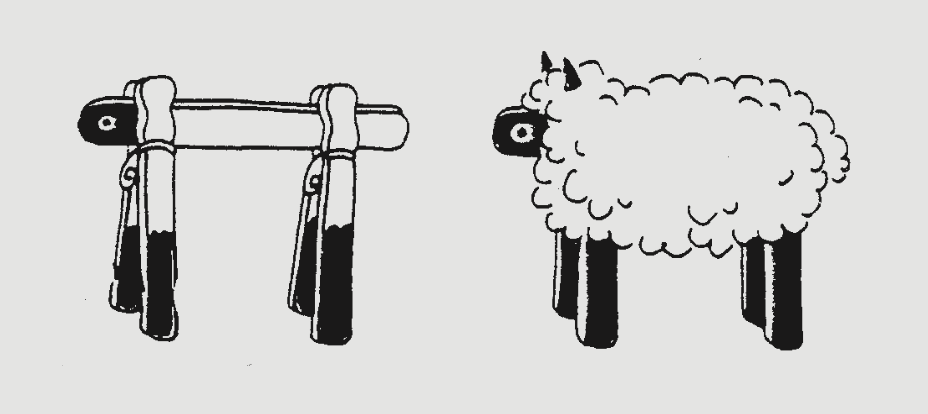
Each child will need one craft stick, two clip-style clothespins, cotton balls and tiny craft eyes. Paint or color one end of the craft stick black—this will be the sheep’s head. Glue on the eyes. Paint or color the ends of the clothespins black—these will be the legs. Clip the clothespins onto the craft stick. Glue cotton balls onto the clothespins and craft stick to form the sheep’s body.
REACH Activity
Special Materials: 100 tiny paper sheep, stapler
Information for #1-#5 should be recorded in a Bible notebook. After activity #5 students will be making a shape book that will include all of the first five activities.
1. What is the meaning of the word “shepherd”? Hint: use a Bible dictionary. From the definition and description, draw a shepherd with his tools.
2. How many different kinds of sheep are there? Where in the world is there a large population of sheep? Do people raise sheep where you live? Where in Bible lands were sheep raised? Write this and other interesting facts in your Bible notebook.
3. Would you want to be a shepherd? Why or why not?
4. The Bible names specific people as shepherds. Use a Bible dictionary and encyclopedia to find out who they were. Write the information in your Bible notebook.
5. Explain how you would feel if you were the shepherd looking for the one lost lamb or sheep. Write a paragraph explaining how it got lost and what you had to do to find it. Or is it still lost?
6. Using activities #1-#5 create a sheep or shepherd shape book about shepherds and their flocks. Share with family and friends.
7. Role play the parable of the lost sheep from the lesson or from Matthew 12:11-12.
8. Jesus said we are all like sheep and He is our shepherd. He wants to take care of you. How does it make you feel to know that He loves you that much? Write your own personal prayer in your Bible notebook telling Jesus how you feel.
9. Draw or trace the outline of a sheep or lamb on 81/2 x 11 cardstock or other heavy paper. Write the memory verse on it. Using a 6 x 2 inch piece of cardstock and glue or stapler, make a stand for the sheep. Now you can take your sheep with you anywhere you go!
10. Sing: “The Lord’s My Shepherd” is in the CEM Hymnal on page 58, or sing: “Savior, Like a Shepherd Lead Us” is on page 52 of the CEM Hymnal. In your Bible notebook, make a list from the hymn(s) of the ways that Jesus is our Shepherd.
11. Find the sheep. Photocopy the picture of the sheep until you have 100 sheep. Roughly cut them out. Hide one sheep somewhere in the room. Explain how the shepherd knows all of the sheep. It’s not just 100 sheep. Each is special to the shepherd. Start spreading the sheep out on the table in front of the child(ren). Dramatically tell them that there’s one missing. Ask the child(ren) to help look for the lost sheep. The hidden sheep should be plainly visible to an observant child. Once the sheep is found, make the connection to Jesus Christ. We are each special to Him. When one of us sins, Jesus loves us enough to try to help us see that what we did was wrong and be willing to repent.
12. Draw a picture of a sheep that has wandered away from the flock. Show the hoof prints leading away. Draw the rest of the flock and the shepherd looking for the lost sheep. Write the memory verse across the bottom of the picture.
13. Draw a picture of a child making a wrong choice and wandering away from Jesus. Draw the child’s parents looking for the child to bring him/her back home. Sometimes God uses other people in our lives to bring us back to Him. How is this picture like the picture drawn of the sheep that wandered away?
14. Read John 10:1-18. Write a list in your Bible notebook of how Jesus is the Good Shepherd.
15. What does this mean: “My sheep hear my voice”? Who are the sheep? Whose voice do they hear? How do they hear His voice? Write in your Bible notebook as many ways as you can that we hear His voice.
16. Read Revelation 3:20. Here is another Scripture which talks about hearing Jesus’ voice. Draw a picture of this verse. What door does Jesus knock on?
Song
“The Lord is My Shepherd” is on page 81of the Kids Classics Collection.
Closing Prayer
The teacher or assistant may lead in prayer, confessing that we are all like sheep, and thanking God for giving us a Good Shepherd.
Printable Pages