YEA Lesson Library
This is My Son
About This Lesson
This lesson introduces the student to John the Baptist and teaches about Jesus’ baptism.
Scriptures
Matt 3:3-17
Matthew 3:17
Matt 20:22 (KJV,NKJV)
Mark 1:4-11
Mark 16:16
Luke 3:1-20
Luke 7:29
John 1:31-33
Acts 2:38
Acts 13:24
Ephesians 4:5
Words to Know
WILDERNESS - a wild place where people don’t usually live
MESSIAH - Jesus our Savior
BAPTIZE - to be placed completely under water to show that your sins are forgiven
The Lesson
John the Baptist was a different kind of man. His clothes were made from a camel’s hair. He ate wild honey and locusts. Do you know what a locust is? It is a bug. It looks like a big grasshopper. We don’t usually eat locust sandwiches. But locusts are good to eat.
The Bible doesn’t say it is wrong to eat locusts. But it does say it is wrong to eat pork, shrimp, and pizza with pepperoni on it. Don’t you want to obey God?
John the Baptist started preaching in the wilderness. People came from all over to hear him. Some people thought John was the Messiah who would save Israel. But, John said he was not the Messiah. He came to tell them about Jesus. He is the Messiah.
John said the Messiah would be coming soon. “My job is to baptize you with water. The Messiah will baptize you with the Holy Spirit.” John told everyone they must repent. “Change the way you are living and stop sinning. Stop doing wrong things and be baptized. Let God wash your sins away.”
The people knew they had done a lot of bad things in their lives. Sin is breaking God’s law. Sins are things like not obeying your parents, stealing, lying, and doing wrong things on the Sabbath. The people told God they were sorry for their sins. They wanted to do what was right. They wanted to obey God and show they had repented. They asked John to baptize them.
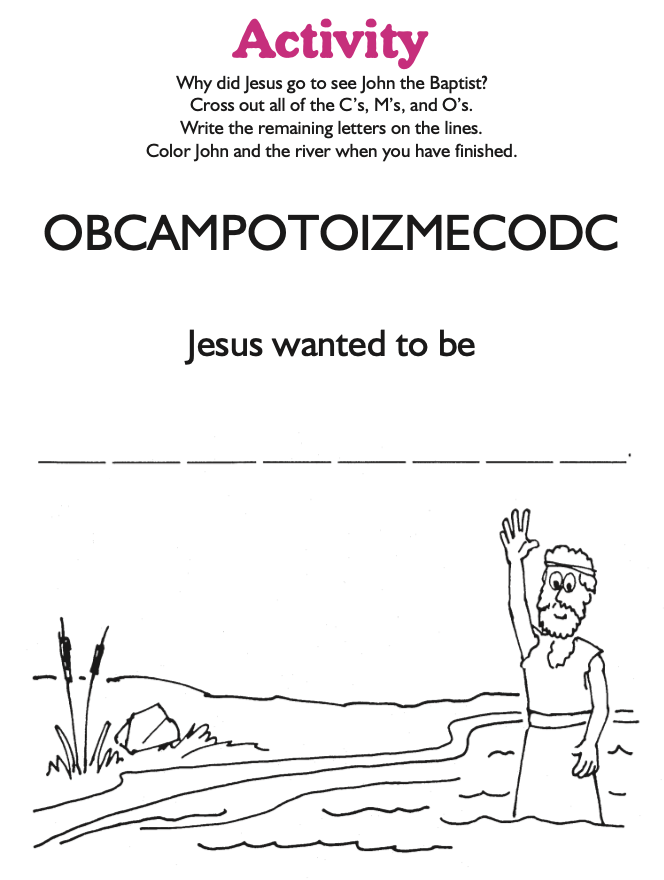
Jesus walked all the way from Galilee to the Jordan River. He asked his cousin, John, to baptize Him. John said, “Oh, I can’t baptize you. I am not as good as you are. You are the Son of God. You should baptize me.”
Jesus did everything His Father told Him to do. He had never sinned. He never did anything wrong. Jesus didn’t need to repent. He wanted to be baptized because His Father said that everyone should be baptized.
John and Jesus walked down into the Jordan River. John put Jesus’ whole body under the water. He brought Jesus up out of the water. Jesus showed us that we should obey God and be baptized.
Then something wonderful happened! As soon as Jesus came up out of the water the sky opened up. A dove flew out of heaven and landed on Jesus. What could this mean? God’s Holy Spirit came down in the shape of a dove. God was happy. He said, “This is my beloved Son, and I am very pleased with Him.”
God is happy when you are sorry for doing bad things. He is pleased when you obey Him. Coming to Sabbath School and obeying your parents also makes God happy.
It was time for Jesus to start telling people about His Heavenly Father. He wanted them to know what God could do for them. God wants everyone to go into His Kingdom. But they must repent and please God. When Jesus was baptized He pleased God. You should want to be like Jesus. You will understand what it means to repent when you are older. Then you will want to be baptized. God was happy when Jesus was baptized. He will be happy when you are baptized, too.
Student Prayer
Dear Heavenly Father, I’m glad that Jesus obeyed you and was baptized. I know Jesus never sinned. I’m really sorry for doing bad things and sinning. I want to obey you. Please help me always try to do right things. Thank you for loving and helping me. In Jesus’ name. Amen.
Daily Devotions
Sunday - Matthew 3:16
Monday - Matthew 20:22 (KJV)
Tuesday - Mark 16:16
Wednesday - Luke 7:29
Thursday - Acts 2:38
Friday - Acts 13:24
Saturday - Luke 3:3
YEAH — At-Home Activity
This age group may or may not have read their lesson. If they have read it, review the main points before beginning one of the following activities. If they haven’t read the lesson, read the lesson to them - or, more preferably, tell them the story from this lesson. Then do one of the activities below.
1. Lapbook. Lapbooks are made by gluing two (or more) file folders together and then attaching little pouches, flaps, or tiny books to the inside. These can be simply made or more elaborate as you become more comfortable with constructing them. The value of lapbooks is the collection and presentation of information in one place.
* Examples: Cut 3 x 3 pieces of colored paper. Write one description of John the Baptist on each piece of paper, i.e. clothes of camel hair, ate locusts and honey, cousin of Jesus, baptizing in the Jordan, identified Jesus as the Lamb of God. Gather the pieces into a pile; staple together at the top so you can flip through and see each page. Then affix the entire stack to the lapbook. On a strip of paper, write “John the Baptist” and glue to the lapbook above the stack of paper.
* Fold an 8.5x11 sheet of paper three times to make a tiny book. Cut the edges apart. Staple the back spine. In this tiny book write facts about the Jordan River. Glue the tiny book into the lapbook.
* Write a short paragraph describing baptism. Glue the paragraph into the lapbook. Be sure to title the paragraph.
* John the Baptist ate locusts and honey. Research both. Make a trifold pamphlet with facts about locust and honey. Glue into the lapbook. Include reasons why he might have chosen such a diet.
* Cut out pictures of people. Glue them into the lapbook all headed toward one edge of the lapbook where you’ve drawn a river. There would have been lots of people headed for the Jordan to be baptized by John.
* Draw a dove. Cut it out and attach it to the lapbook with a piece of yarn. Write the memory verse for the lesson on the dove.
2. Poster. Divide the poster into six frames. In one frame, glue camel’s hair (if possible) or hair-like material if you don’t have access to camel. Similarly, glue into the remaining frames pictures of 1) locusts and then write a short description underneath; 2) the Jordan River; 3) lots of people; 4) a dove; and 5) a written description of baptism.
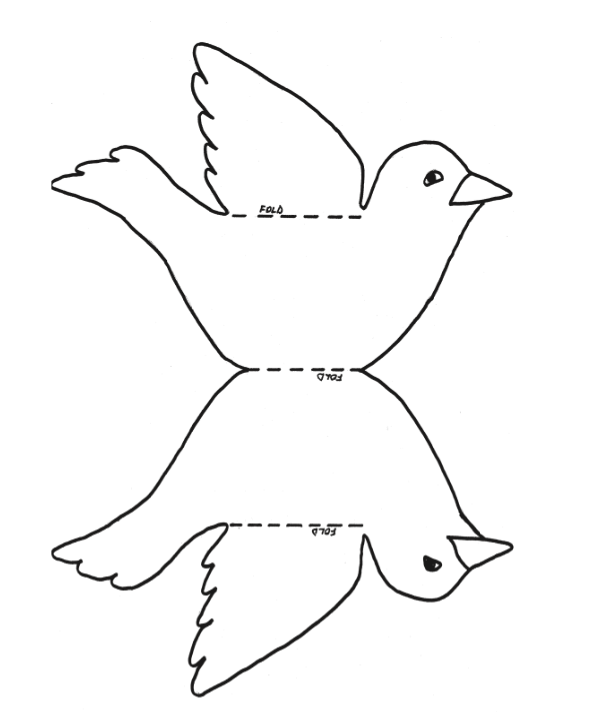
3. As a Dove. The Bible does say that the Holy Spirit descended on Jesus in bodily form as a dove. Have some feathers and a brick. Let the students feel each of them. Talk about what it would feel like to have each of these descend on you. Let the students describe the feeling each would give. Use the pattern in the teacher’s edition - let each student cut out and take home a dove.
4. Well-Pleased/Photos. Discuss with the students why God the Father was well-pleased with Jesus. Use the review questions in the teacher’s edition of the YEA books as a guide for talking about baptism (the reason God was pleased with Jesus). Ahead of class time (probably the week before), take a photo of each student with their dad (if possible). Make a card with the photo of the student with their dad, or the student by himself, or just the dad (whatever works for you). On the inside of the card, have the dad write why he is pleased with his child. Display on a bulletin board or have the students take them home and put them on the refrigerator.
5. Memory Verse Work. Have the students write the memory verse in big letters across an 11 x 17 sheet of paper. If they use bubble letters, they can color them in. Let the students draw pictures from this lesson around the words: a river, a dove, lots of people, locust, honey, a belt of camel hair. Add color with crayons, markers, or colored pencils.
Objectives
At the end of this lesson, students will be able to:
1. Explain that to repent means to be deeply sorry for disobeying God and to begin obeying His every way.
2. Know that Jesus was baptized as an example of what we should do.
3. Anticipate that when they are old enough to repent of their sins, believe in Christ and obey Him, they will be baptized.
4. Recite their memory verse.
Topics & Themes
Baptism
Belief/Faith
Dove
Food Laws
Forgiveness
Fulfillment of Prophecy
Galilee
God’s Kingdom
God’s Voice
Holy Spirit
Honey
Jordan River
Jesus, Messiah
Jesus Sets Example
John the Baptist
Locusts
Obedience
Repentance
Sin
Materials Needed
Bible, YEA teacher’s guide and student’s book, white construction paper for each student, crayons or markers, glue, yarn, scissors, attendance and memory verse charts, stars, songbook, cassette tape and tape player
Preparation
It has been said that, “Perfect preparation precedes perfect performance.” Make it a habit of reading next Sabbath’s entire lesson on the Sunday preceding the class. This gives time to prepare for the class. Good planning includes knowing the lesson well enough to make an interesting presentation, becoming familiar with the activity and song and gathering supplies.
Give some thought to the room where the class is held. Are there things that could be done to make it more conducive to learning – more child friendly? Should the blinds be opened to let more light in? What about the furniture arrangement? What can be done to make it better for this particular class? If the chairs and tables are inadequate, children can be taught sitting on carpet squares using lap boards. Supplies and books can be kept in a cardboard box and carried to the room each week if there are no bookshelves and storage bins to use.
How to Teach This Lesson
This lesson should be made fun and interesting. One way to do this is to keep the children involved in the lesson by asking them questions as you tell the story. Remember, six to eight year olds are more open to faith than they may ever be again. They are not too young for you to create the expectation that when they are older, they should repent, obey God and be baptized. Teachers and parents will want to give much prayer and thought to this as they study and prepare.
This lesson introduces God’s plan of salvation to the children. It is designed to create an awareness of sin, the need to repent, be baptized and receive the gift of God’s Holy Spirit. Conversion and a walk with Christ are the greatest things that can ever happen to these children. Sell the benefits and weave a strong life application throughout the lesson – especially in the conclusion.
Review Questions
Remind the class at the beginning of the lesson that questions will be asked. This will motivate them to listen better. The review questions will help you understand how well they grasp the lesson. Encourage class participation from every child. Praise the children when they participate and answer correctly.
1. What does it mean to repent?
2. What is sin?
3. Can you name some sins? (Help them if you need to with lying, stealing, doing things they should not do on the Sabbath, disobeying their parents, etc.)
4. Why was Jesus baptized?
5. Why are people baptized today?
A. To follow Christ’s example.
B. To obey the command in Acts 2:38.
C. To bury the old self in the watery grave of baptism (Romans 6:4).
D. To show that our sins are washed away (Acts 22:16).
Teacher-Directed Activity
This activity is to create flying doves. Enlarge and photocopy enough of the dove patterns onto white construction paper so that each child will have one. Allow the children to color both sides of the dove and cut it out. Fold the wings down on the dotted line. Fold the bodies of the dove on dotted line and glue the two sides of the dove together, attaching a piece of yarn to the top of the body. This can be hung in their room to remind them of Jesus’ baptism.
REACH Activity
Special Materials
Magazine pictures, bird book or encyclopedia, magnet tape
1. Write in your Bible notebook five things that you know make your parents happy. Why does doing these things make them happy? Do you want to do them? Why or why not?
2. Jesus wanted to please God, His Father, by being baptized. Write in your Bible notebook what baptism is and why someone would want to be baptized.
3. Find your favorite plastic animal or action figure. Fill up the sink. Put your toy in the water. How is this like baptism? How is not like baptism? Have you really baptized your toy? No, not really. Baptism is more than just going under the water. It is obeying God because you have repented of your sins and you want Jesus in your life. If a person does not repent and turn to God first, putting him/her in water is like putting your plastic toy in the water. It doesn’t mean anything.
4. Write an acrostic poem for B-A-P-T-I-S-M (see Notes for directions) telling what it is, who does it, and why it pleased God when Jesus was baptized.
5. Look up the Jordan River in a Bible atlas. Where was Jesus baptized?
6. Draw a picture of a dove coming down as Jesus was baptized. Then use tempera paints to paint your drawing. Be sure to write this week’s memory verse across the bottom of the paper.
7. Do a sword drill with the Daily Devotional Scriptures. (See Notes section for directions.)
8. Sing: “I’ve Got Peace Like A River” on page 63 of the Kids Classics Collection.
9. Draw a picture of what John the Baptist might have looked like, using the description in the YEA lesson. Find out more about him in a Bible encyclopedia.
10. What is a locust and where can they be found today? Research the locust in a Bible dictionary or encyclopedia.
11. Use a concordance to find other Scriptures about locusts in the Bible.
12. Why are some foods unclean to eat? Find out why by using the Bible and a concordance. Then make a chart with two columns labeled: Clean and Unclean. Glue magazine pictures in the correct column, or draw pictures. Hang the chart on the refrigerator or pantry door.
13. How long did it take Jesus to walk from Galilee to the Jordan River? Use a Bible map to find the answer. What is the furthest distance you have ever walked?
14. Think of all the uses for water. Make a list. What is your favorite body of water? Why? Draw a picture showing yourself enjoying the water.
15. Use the Words to Know in the YEA lesson to retell the lesson story to family or friends.
16. A dove is a kind of bird. Have you ever seen one? Use an encyclopedia or book about birds to find out more about them. Then draw a shape of a dove and write the memory verse in it. Put magnet tape on the back. Hang it and practice!
17. Sing: “Isn’t He Wonderful?” on page 42 of the Kids Classics Collection.
Song
“I Am A C-H-R-I-S-T-I-A-N” is on page 52 of the Kids Classics Collection.
Closing Prayer
Children should never remember a time when they did not pray. Call on different
children to pray on a rotational basis at the end of each class.
Printable Pages