YEA Lesson Library
Jesus as a Child
About This Lesson
This lesson teaches about Jesus' childhood, including time in Egypt as well as teaching in the temple when he was 12. It encourages the student to study God’s Word.
Scriptures
Hosea 11:1
Matt 2:13-15
Luke 2:13-15
Luke 2:19-25
Luke 2:39-52
Luke 2:52
Words to Know
PASSOVER - a day we remember Christ’s sacrifice for our sins
TEMPLE - God’s house; a place to worship and learn about God
CELEBRATE - to honor; observe or rejoice
SCRIPTURE - God’s written Word; the Bible
The Lesson
Last week you learned the wonderful story about the birth of Jesus Christ. There was no inn or hotel to stay in. So Jesus was born in a stable. An angel came and told shepherds where to find the baby Jesus.
Mary and Joseph took Jesus to Nazareth when He was old enough to travel. Jesus grew like any other child. He grew both strong and wise. But He was wiser than other children His age. God, His Father blessed Him.
Herod was the king when Jesus was a baby. He was jealous of Jesus. He told his soldiers to kill every baby boy two years old and younger. He wanted to make sure they killed Jesus!
An angel spoke to Joseph in a dream. He said, “Take Mary and Jesus to Egypt. Stay there until I tell you to return. King Herod is going to try to kill Jesus.” So, Joseph, Mary, and Jesus left for Egypt that very night. They stayed in Egypt until Herod died.
Later, Joseph had another dream. This time the angel said to take Jesus and Mary back to Israel. So Joseph took them to Nazareth where they would be safe. That is where Jesus grew up.
Everything was starting to look like spring in Nazareth. What happens in the Spring? It gets warmer. Trees begin to bud. Flowers bloom. And, we celebrate a special day in the spring. It is the Passover.
Jesus was now 12 years old. He went with his parents to take part in the Passover in Jerusalem. His friends and relatives went as well.
Jesus always obeyed his parents. Mary and Joseph could trust Him. They were on their way home after Passover. They thought Jesus was with friends or other people who traveled with them. But, that evening they couldn’t find Jesus anywhere. They were really worried!
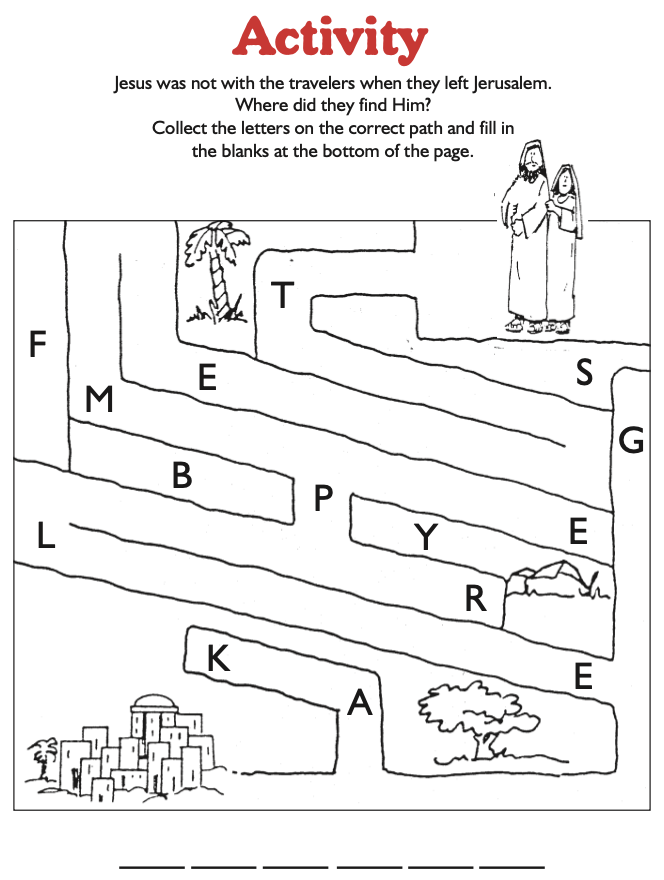
Mary and Joseph went back to Jerusalem. They looked for Jesus for three days. Guess where they found Him? Jesus was in the Temple. He was talking about the law of God with the teachers. He was even teaching them! Everyone was amazed at how well Jesus understood God’s Word.
Mary and Joseph didn’t know what to think. Mary said they had been looking everywhere for Him. “Why did you have to look for me?” Jesus asked. “Didn’t you know I would be at the Temple in my Father’s House?”
You should always let your parents know where you are. Jesus was not disobeying His parents. His heavenly Father knew where He was. Jesus was doing His Father’s work. He knew the Scriptures so well that even the teachers listened to Him. When He was finished teaching, Jesus went home with Mary and Joseph.
Jesus’ Father is our heavenly Father, too. He wants us to know His Word, the Bible, like Jesus did. Study it every day. Ask your mom and dad to read your Daily Devotionals with you every day. Also, remember to learn your memory verse each week. Try to come to Sabbath School every week. Your teacher wants to help you learn God’s Word. These good things will help you learn your Bible like Jesus.
Student Prayer
Dear Heavenly Father, thank you so much for giving us Jesus to be our Savior. Thank you for letting Him be our friend. Help us to learn more about Him every day. In His name we pray. Amen.
Daily Devotions
Sunday - Matthew 2:13-15
Monday - Luke 2:39, 40
Tuesday - Luke 2:13-15
Wednesday - Luke 2:19-25
Thursday - Luke 2:41-45
Friday - Luke 2:46-49
Saturday - Luke 2:50-52
YEAH — At-Home Activity
1. Popsicle Puppets. Using popsicle sticks, magazines, glue, scissors - cut out the characters needed to retell this lesson. If the students have not yet read the lesson, tell them the story (covering Luke 2:39-51 and Matthew 2:13-15) first. Then let them retell the story to you using their popsicle puppets. (Variation on REACH activity #3)
2. Sequence. Tell the story of Jesus growing up from this lesson. (Please be familiar enough with the lesson not to have to read it.) Once you’ve told the story, have the students tell you the major events that happened. Write each event on an index card. Mix up the cards and let the students take turns rearranging them. (REACH activity #4)
3. Cartoon Strip. Tell the story of Jesus growing up from this lesson. Be sure to emphasize the main points. When you’re finished ask the students to tell you what are the important points of the lesson. Write them on a sheet of butcher paper, dry erase board, etc. Then have the students draw a cartoon strip - one box for each event in the lesson.
4. Bird’s Eye vs. Worm’s Eye view. Tell the story of Jesus growing up from this lesson. Ask the students to retell the story from Mary’s perspective; Joseph’s perspective; Herod’s perspective; Teachers’ perspective in the temple; or even a pigeon’s perspective. After the role play, have them discuss the importance of perspective in telling a story.
5. Who Said? Tell the story of Jesus growing up from this lesson. As a comprehension check, ask the students to tell you who might have said (or who actually did say) the following:
a. Kill all the babies two years and younger. (What did this mean for
Jesus’ family? What did they do? How long did they stay in Egypt?
b. Why did you treat us this way? (Who said this? Why? How long
had they been looking for Jesus?)
c. Take the child to Egypt. (Who said this? To whom did he say this?
Why? How long did they stay?
d. Take the child to Israel. (Who said this? Why? What was Joseph’s
response? Why? Where did they live?
e. Why were you looking for me? (Who said this? Why? Was He
being disrespectful to his parents? Why? Is this something any of
us should do? How do we know Jesus was not a rebellious twelve
year-old (hint: vs. 51)?
Objectives
At the end of this lesson, students will be able to:
1. Explain that when Jesus was very young, Herod wanted to kill Him.
2. Describe how Mary and Joseph found Jesus with the teachers in the Temple.
3. Explain that they should know God’s Word like Jesus did.
4. Be motivated to read their daily devotionals, learn their memory verse and be in Sabbath School each week.
Topics & Themes
Angel
Bible study
Egypt
Herod
Honor Your Father
and Mother
Jesus, Childhood of
Jesus, Wisdom of
Jesus, Without Sin
Jesus Sets Example
Nazareth
Obedience
Passover
Temple
Ten Commandments
Materials Needed
Bible, YEA student’s and teacher’s books, memory verse and attendance charts, stars, tape player, cassette tape, songbook, crayons, scissors, glue, butcher’s paper and construction paper.
Preparation
Halley’s Bible Handbook suggests that the angel who appeared to Joseph in a dream and directed their flight to Egypt was Gabriel. Herod the Great (37-3 B.C.) got his throne, and kept it, by brutal crimes, even murdering his wife and two sons. He slew the children of Bethlehem trying to kill Jesus Christ. Mary and Joseph’s stay in Egypt was probably only a year or two.
How we wish that the Bible told us more about the childhood of Jesus. We know He was the oldest child in the family. He must have learned responsibility very early. After He was twelve, He probably went to Jerusalem three times a year for the holy days.
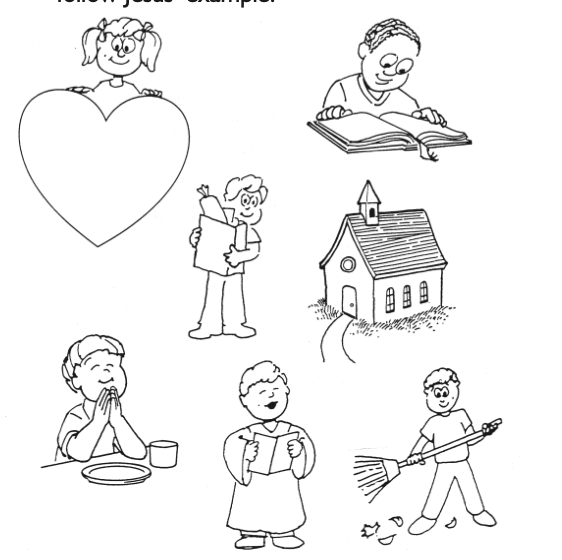
Before you come to class, cut enough strips of butcher’s paper six inches wide and five feet long so that each child will have one. Enlarge and photocopy the pattern pictures from page 7 onto construction paper, and give each child a sheet.
Arrive early enough to prepare the room and to anticipate the arrival of the children. As the children arrive, greet each one with a simile and a hug. Call them by name and let them know how happy you are to see them.
How to Teach This Lesson
The reading level of each child will vary.
We hope the parents and teachers will ensure that the children read or have read to them each of these lessons. Children don’t tire of hearing a story over again. Repetition is a way of learning.
Begin your class by talking to the children about good kings and bad kings. Ask them to tell you some things that good kings and bad kings do. Tell them that Herod was a really bad king who ruled the area where Christ lived. This should lead naturally into the lesson. Know it well enough to tell it with suspense and drama.
The life application in this lesson is for the children to learn the Bible. A systematic study of the Bible from the time a child can remember, will do much to lay a foundation for a lasting relationship with God. Make sure they learn how important it is that they know their memory verse, read their devotionals and study their lesson each week.
We can’t expect children to do as we say and not as we do. They will be watching your example more than you may know. Your attentiveness and taking notes in Sabbath services will most likely be observed by your students. They need to know that you take learning the Word of God seriously.
At the end of the class make sure each child has his book and growing chart to take home with him. Do everything you can to make them feel loved and important to you. This will ensure that they will want to come again and again to Sabbath School.
Review Questions
The review section is designed to reinforce the things learned in the lesson. Make this section a fun time. Try to include every child. But, don’t embarrass the shy child. Give time for them to feel comfortable participating. Praise them when they do.
1. Do you remember why Joseph took Jesus and Mary to Egypt?
2. What was the name of the bad king who wanted to kill Jesus?
3. Where did Mary and Joseph find Jesus when He was left behind?
4. What was Jesus doing in the Temple?
5. Can anyone tell us what time of the year this was? Was there a particular day mentioned that made it special?
6. Jesus knew God’s Word really well. What can you do to know God’s word?
Teacher-Directed Activity
The children will be making a Growing Chart. Give each child a strip of butcher’s paper and a sheet of construction paper with the patterns printed on it. Write across the narrow end of the strip, “Growing Chart.” Color and cut out these pictures. Glue them to the strip of butcher’s paper, beginning at the bottom and ending at the top, leaving space between the pictures. This can be hung on the wall and used to measure the child’s growth.
REACH Activity
1. Draw a map to trace the path Joseph and Mary took with Jesus from Nazareth to Egypt. Label the map with cities, land-forms, and bodies of water.
2. Who was Herod? Use a Bible encyclopedia that will teach you more about him.
3. Make popsicle stick puppets to retell the story from YEA Lesson 2. (See Notes for construction directions.)
4. Write the sequence of events for YEA Lesson 2 on index cards. Then mix them up. Put them in the correct order.
5. Passover is a special day. What happened on the first Passover? Read and share your favorite part of Exodus 12 with family or friends.
6. Read Luke 2:39-52 from the Bible. Then pretend you are Mary or Joseph. Write a journal entry in your Bible notebook telling what happened as you started home from celebrating the Passover in Jerusalem. Be sure to include how you felt when Jesus was missing, when you found Him in the Temple, and how you felt as you traveled home with Him.
7. Have you ever done something that really worried your parents? Ask them to share the story with you.
8. Jesus always obeyed His parents. Read the Ten Commandments. There is a promise at the end of the Fifth Commandment. Read Ephesians 6:1. Create and design a bookmark with a verse on each side.
9. Pretend you are one of the teachers in the Temple. Write a journal entry in your Bible notebook for the day Jesus sat and talked with you. Be sure to include how amazed you were at His knowledge.
10. Draw a picture of the Temple with Jesus sitting with the teachers of the law. Put in conversation bubbles for showing what Mary said to Jesus when they finally found Him.
11. Jesus was doing His Father’s work when Mary and Joseph found Him in the Temple. What is your father’s work? Would you want to do his kind of work? Write a paragraph stating why or why not.
12. Role play YEA Lesson 2.
13. Write a quiz for your parents from YEA Lesson 2. It can be true or false, multiple choice, or essay. After they take your quiz, be sure to grade the quiz and give them a sticker if they’ve done good work.
14. Do a sword drill with the Daily Devotional Scriptures. (See Notes section for directions.)
15. Read Psalm 119:97-100. Write in your Bible notebook how you can become wiser than your enemies and your teachers.
16. Use a dictionary to find the word “jealous.” Have you ever been jealous? Why do you think some people are jealous of others? What can you do when you feel jealousy toward someone? Use a concordance to find out what the Bible says about jealousy. Talk about it with your family.
17. Bible reading and study should happen every day. Have students write a one week schedule of Bible study times for themselves. Then the students can make a list of what they want to learn about Jesus. They can write notes or questions in their Bible notebook. Discuss with family or friends what they learned from their Bible study.
18. Students can create hand motions to accompany the memory verse.
19. Sing: “Come and Go with Me’ on page 83 of the Kids Classics Collection.
Song
“The B-I-B-L-E” is on page 18 of the Kids Classics Collection.
Closing Prayer
Lead the children in prayer thanking God for the example Jesus set by knowing God’s Word. Ask that God might help each child to follow Jesus’ example.
Printable Pages