YEA Lesson Library
Love Mercy
About This Lesson
This lesson explains that Jesus, as our Older Brother and High Priest, makes atonement for our sins and intercedes for us with the Father. This is pictured on the Day of Atonement.
Scriptures
Leviticus 16:1-34
Leviticus 23:27-32
Ezra 8:21
Micah 6:8
Matthew 5:7
Hebrews 7:25-28
Hebrews 9:24
Hebrews 10:3-5, 12-24
Words to Know
MERCY - to not require punishment or repayment even when it is due
INTERCESSION - to work between two people when there is a conflict
GLAZING - a coating applied to the edges of glass to seal a window
The Lesson
Twenty year-old Chad sat in the courtroom, thinking about his 11 year-old brother, Travis. What a mess Travis had gotten into. Their parents were on a missionary trip in Africa. Chad was to keep an eye on everything while they were gone. That shouldn't have been a problem. When they left, everything was fine. But Travis had responded to his parents' trip by getting into trouble. The first time had been no big thing. Everyone had been willing to let it go because Travis had never been in trouble. He'd always been such a good kid. Each time Travis got in trouble, fewer and fewer people were ready to let it go without some sort of punishment.
One of Travis' friends dared him to try to hit the high windows in the top of Old Man Carson's barn - with a rock. Travis hit the windows on his first try. The shattering glass alerted Mr. Carson and, this time, M.r Carson called the police. The police took Travis to the juvenile detention center. Today, Travis appeared before the judge and Mr. Carson. Chad was really worried about his little brother. What was making him act so badly?
When Travis walked into the courtroom, he looked like he had a bad night and hadn't slept at al. The sullen, angry Travis was gone. When the judge arrived, he called Travis, Mr. Carson, and Chad up to the bench. First, the judge outlined the list of all the offenses that Travis had committed - back to the first one. He said he understood that each of the previous problems had been overlooked. But, because Travis had continued to get into trouble, the judge couldn't overlook it anymore. For Travis' own good, there would be a penalty. This time Mr. Carson was very upset. As the judge said this, he looked at Mr. Carson and asked him to explain why breaking those windows was such a bad thing. Mr. Carson told Travis that those windows were for letting in light so Mr. Carson could see in the loft. The glass keeps the rain and snow out of the building, away from the bales of hay, the tools, and the structure of the barn.
For the first time, Travis turned to Mr. Carson and said, "I'm sorry. I shouldn't have broken those windows. It was wrong.”
Everyone could see regret on Travis' face. Mr. Carson said to the judge,"Travis will have to pay for the windows. I don't have the money to have them replaced, and I'm too old to climb up there to do it.”
Chad smiled. Looking at the judge, he said, "Your honor, I'd like to fix the windows. I'll buy the glass. I'll take the broken pieces out and put new ones in. I'll make sure the glazing is solid, inside and out. And I'l paint the whole barn.”
Travis stared at his older brother. "Why would you do that, Chad?" he asked.
"Because you’re really sorry this time, Travis. You can't fix the windows yourself. And, Travis, I'm doing it because I love you.”
The judge asked Mr. Carson if this arrangement was okay. Mr. Carson nodded and said, "I reckon everyone needs their older brother.”
Everyone needs their Older Brother. That's another one of the names of Jesus Christ. When you repent and accept Jesus as your Savior, you become a member of God's family and Jesus becomes your Older Brother.
As your Older Brother, one thing that Jesus does for you is called intercession. He came to this earth and lived as a human being. He knows what it is like to be tempted. He knows how you feel. The difference is that Jesus lived a perfect life and never sinned. When Jesus went to heaven, He sat at the right hand of God the Father to intercede for us. And God listens.
There's a day that pictures this intercession. It is the Day of Atonement. On that day, the High Priest took a goat, cut its throat, and caught the blood in a bowl as the goat died. Then he took the blood into the Most Holy Place where the Ark of the Covenant was. The High Priest sprinkled the blood on the mercy seat and in front of it. This was to make atonement for the uncleanness and rebellion of the people (Leviticus 16:16). The High Priest was the only one who could go into the Most Holy Place. And the high priest could only go once a year, on the Day of Atonement.
Jesus Christ is our High Priest. But He didn't offer the blood of a goat to make atonement for our sins. Jesus offered His own blood to God the Father to pay for our sins. Hebrews 10:12 says that when Jesus "offered for all time one sacrifice for sins, he sat down at the right hand of God." Jesus didn't take His blood into the Most Holy Place. "He entered heaven itself, now to appear for us in God's presence” (Hebrews 9:24). There, seated at the right hand of God, Jesus always lives to intercede for us (Hebrews 7:25).
We are like Travis. You and I, your parents, your family, your church, the whole world has sinned. We all sin, and we can't fix our relationship with God by ourselves. Travis couldn't fix the relationship with Mr. Carson by himself. His older brother Chad interceded for him and paid the penalty. Jesus did that for us. He shed His blood for our sins. Then He sat down next to His Father to intercede for us. That's called mercy - not having to pay the penalty when we deserve the punishment.
So what should your reaction be to the mercy God has given to you? Do you remember what we learned in Do Justly? “. . . What does the Lord require of you? To act justly and to love mercy and to walk humbly with your God" (Micah 6:8). God expects you to be merciful. You should give mercy to others even when they don't deserve it. Micah 6:8 says "to love mercy." Give mercy to others because you love to give mercy and because it was given so freely to you.
As you are fasting on this Day of Atonement, think of the mercy God gave to you. He paid for your sins with His own Son. Then think about what your response to His mercy is going to be. How can you show mercy to others? You've got an entire day of fasting - not to think of what you're going to eat after sundown - but to think of ways to Love Mercy.
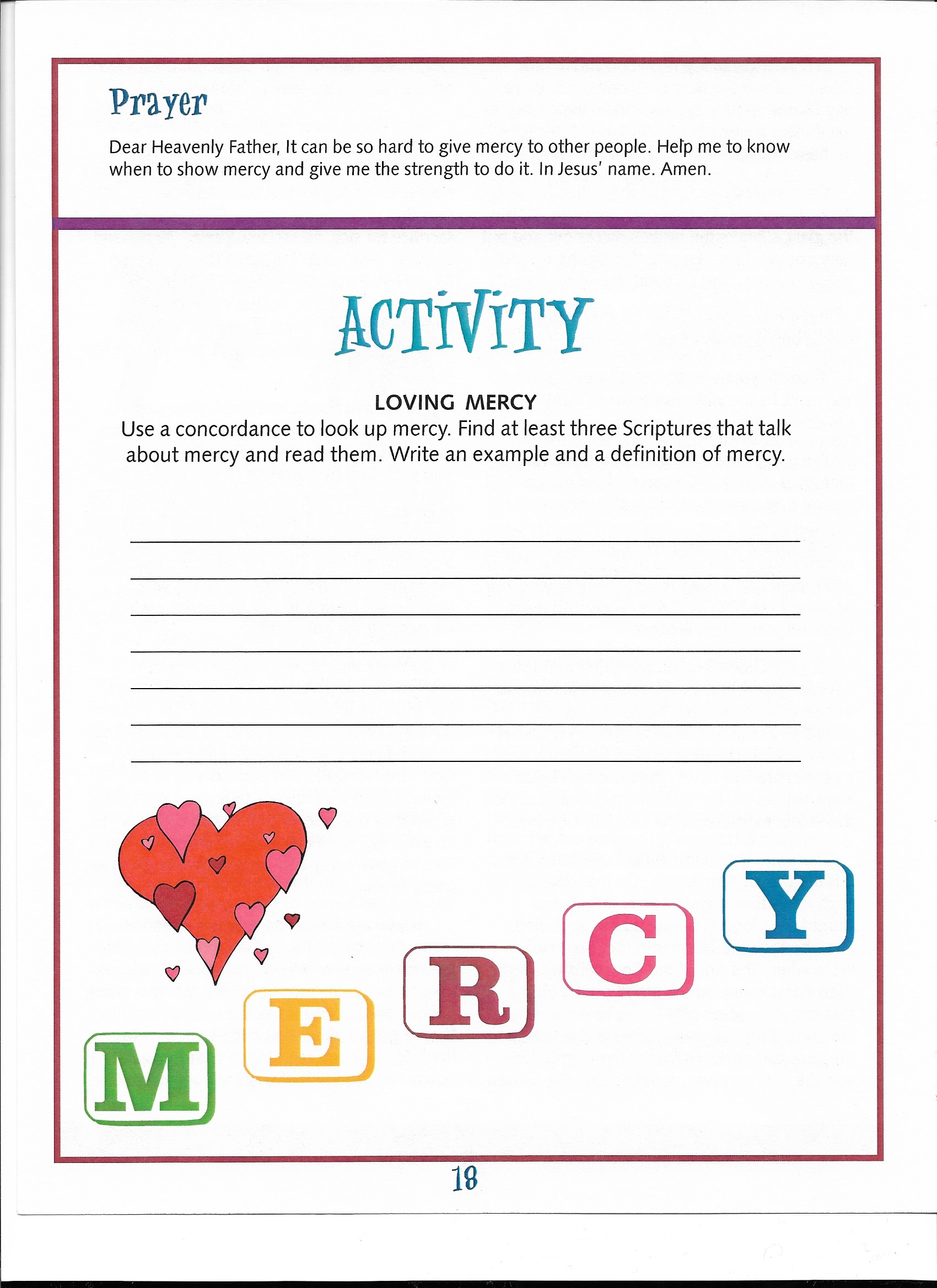
Student Prayer
Dear Heavenly Father,
It can be so hard to give mercy to other people. Help me to know when to show mercy and give me the strength to do it.
In Jesus' name.
Amen.
Daily Devotions
Sunday: Matthew 5:7
Monday: Leviticus 16:5-8
Tuesday: Hebrews 7:25-28
Wednesday: Hebrews 10:12-24
Thursday: Leviticus 23:27-32
Friday: Ezra 8:21
Saturday: Hebrews 10:3-5
Objectives
At the end of this lesson, students will be able to:
1. Define mercy.
2. Tell how mercy was shown by God on the Day of Atonement.
3. Relate the intercession of the High Priest on behalf of the people to Jesus' intercession for us.
4. Give concrete examples of how to apply mercy in their own lives
Topics & Themes
Day of Atonement
Fasting
Holy Days, Atonement
Holy of Holies
Jesus, High Priest
Jesus, Intercessor
Jesus, Older Brother
Mercy
Sin
Materials Needed
Bible, YEA Students' and Teacher's books, attendance and memory verse charts, star stickers, songbook, CD and player, colored pencils, pencils, markers, mural from previous lesson
Preparation
Juniors can be lavish in their mercy as well as resolute in their need for justice to be done. Many times they want an adult to even the score, to administer punishment to an offender. When presented with an opportunity to determine the punishment, Juniors can surprise you. Often the punishment is inappropriately harsh. Other times, they show a mercy which astounds the adult who was called in to administer punishment in the first place! Therefore, it behooves us as parents and teachers to help this age group determine when to apply justice (including appropriate consequences) and when to extend mercy. It's not an easy concept to grasp, although this age group will be more willing to extend mercy to someone they love. And there's a lesson in that too.
Prior to class, write each of the following situations on a note cards. They will be given to the students to role play during class.
1. Your little sister colors in your school notebook. Your parents leave her punishment up to you. She either misses her favorite cartoon for the day or she's not allowed to play with her friends for an afternoon. You know that she is truly sorry. You __________________________.
2. Your best friend is talking with some of your friends. As you walk closer, you hear them laughing about a secret you shared with your friend, something she was supposed to keep to herself. When she sees your face, she realizes how much it hurt you. You can tell she wishes she hadn't said anything. Your other friends are still laughing and now are making fun of you. You __________________________________.
3. Your older brother spent the morning teasing you. He and one of his friends made fun of your handwriting, your basketball shooting, your hair, and your shoes--anything they could think of. After your brother's friend went home, the house was really quiet. Then your brother walks into your room and asks if you want to ride bikes with him for a while. You __________________________.
4. A student at your school, in your grade but not in your class, is always bugging you. If you have a swing, he wants it. If you go down the slide, he's right there behind you, coming down too closely. If you grab a ball, he's in your way so you can't bounce it or shoot baskets. One day on the way home from school, you see this student. He's tripped on the sidewalk. He's torn a hole in the knee of his pants. His knee is bleeding. He's scraped his hands. His backpack has opened and books, pencils, papers are everywhere. You ____________________________________.
How to Teach This Lesson
After opening with prayer, write the definition of mercy on the board. Discuss what it means. Have students explain mercy in their own words.
Role play: 1) Role play the scene in the courtroom from the Students' lesson. Talk about the mercy the judge was able to extend to Travis because of Chad paying the debt, and why it's called mercy. 2) Have the students share the examples of mercy they thought of (see Student’s Activity). Divide the students into small groups to role play the situations on the note cards (see Preparation). Let students act out the answer for each. Talk about their answers and how it's okay to have different answers.
We extend mercy differently: and that's okay. (The role play will take a huge chunk of time out of your lesson time.)
Mercy from God: Have students return to sitting in a semicircle. Ask: How has God shown mercy to us?
Why the Day of Atonement?: Ask: Why couldn't God just tell His people that He was providing the mercy for their sins? Sometimes people who have received mercy decide that, since they will receive mercy anyway, it doesn't matter what they do. So every year, God assembled His people to show them there is a cost to sin. Sin causes death. But God didn't require the death of His people every year; He told them to kill the goat as a sin offering to make atonement for them.
Goat and Christ: Explain that the goat didn’t take away the sin of the people; it symbolized the sacrifice of the One who would. Also, Jesus Christ was the One who interceded on our behalf, just as the High Priest did when he took the blood into the Most Holy Place. The elaborate ceremony on the Day of Atonement pointed to the time when God would extend mercy through Jesus Christ to all who believe.
Memory Verse: Ask: What should be the reaction of those of us who have been shown such great mercy by our Heavenly Father? We should show mercy to others. This is a good time to recite the memory verse. (This is a nice lead-in to the activity.)
Review Questions
1. What is mercy?
2. Because each of us has sinned, what do we deserve?
3. On the Day of Atonement, what did God give to His people?
4. Why did God give mercy to His people on the Day of Atonement?
5. Who is our High Priest today, who intercedes for us before God the Father?
Teacher-Directed Activity
Micah 6:8 Banner
Continue the banner begun on the Feast of Trumpets. Have students make snapshot drawings, in random order, of situations where they are loving mercy. For example, a student says a hateful thing to another student. In a second bubble, write the second student's merciful response.
The students will continue drawing snapshots for the banner for the Feast of Tabernacles. Don't feel you have to have the mural completed with this activity.
REACH Activity
Back to the Bible: Intercession
Hebrews 7:25 and Romans 8:34 say that Jesus, who is seated at the right hand of the Father in heaven, ever lives to make intercession for us. How does He do that?
An intercessor is someone who intercedes, someone who gets between the offender (or sinner) and the person who was wronged (God). God has the right to demand that we die for the sins that we have committed. God made the rules and He expects them to be followed. But God also provided a way for our sin debt to be covered, for our debt to Him to be paid. It is through the death of Jesus Christ. Because Jesus is our Creator, He is worth more than all of Creation (Hebrews 3:3). That means Jesus Christ’s death is more than enough to pay for our sins - if we are repentant. Repentant doesn’t just mean you’re sorry; it means you don’t have any intention of doing that thing again. You have changed your direction. But you can also see why someone who continues to sin would make God so incredibly angry! Your lesson does a good job of explaining how Jesus Christ, as our older brother, pays the debt for us when we can’t.
So then, how do you plan to live the rest of your life? Write about this in your Bible notebook.
Journal Jot: The Reason Why
Do you know why your family and your church family observe the Day of Atonement every year? If you do, write about it in your Bible notebook. Make sure you use scripture references to explain why it’s important to keep this holy day. If you don’t know, ask your parents to explain it to you. Then write this information down, with scriptures, so that you’ll remember the next time someone asks you why you keep this holy day.
Word Study: cheçed
The word “mercy” in Micah 6:8 is the Hebrew word cheçed. It is “an attitude of love which contains mercy.” (Source: Zodhiates’ NAS Hebrew-Greek Key Word Study Bible, 1990.) And what is mercy? Mercy is not requiring a consequence when a consequence has been earned. The term “loving kindness” combines the idea of love and mercy - and is used frequently when talking about God’s attitude toward His people. We deserve death because we have all sinned. What God gives us is adoption into His family and eternal life. This should make us desire to serve Him more and more.
Write this word, its definition, and the scripture reference in your Bible notebook.
Just Toolin’ Around: Grace, Mercy, Justice, Righteous
There can be no mercy without justice. It isn’t mercy if everyone receives it. If everyone receives mercy, it’s just lawlessness and no justice whatsoever. But our God is righteous - that literally means that He always does what is right and just. Psalm 85:10 says, "Mercy and truth are met together; righteousness and peace have kissed each other.” God’s gracious mercy and His loving kindness have provided Jesus Christ as our righteousness as Jesus pays for our sin.
Create a drawing where four circles overlap each other. Do it in pencil so that you can erase the center section where they overlap. Write either “God’s Love” or “Jesus Christ” in the center section and grace, mercy, justice, and righteousness in the other parts of the circles. Color with different colors. Put you artwork where you can see it - to remind you of the blessing of God’s love and mercy to each of us.
Did you Know? The Mercy Seat
Sometimes people get the idea that the God of the Old Testament is mean and angry and harsh. That’s just wrong. It was God who told Moses to construct a mercy seat as the lid on the ark of the covenant (Exodus 25:21). The symbolism is unmistakable: God’s law is part of the covenant between God and His people; we cannot separate the law from our relationship with God. However, God is merciful. He extends His mercy to us when we don’t deserve it. And remember: God’s mercy to us caused the death of His only begotten Son. When someone does something to you that makes you mad, are you willing to extend that kind of mercy to him? Think about it.
Stretch It Out: Legal
There are more than 70 verses in the Bible which depict God as the Judge. On a piece of drawing paper, draw the picture of a courtroom. You are on trial. The prosecution has proven that you are guilty. God as the Judge is ready to pass sentence on you. You are guilty and you deserve death. But your defense is Jesus Christ. And He intercedes for you and pays your debt, allowing you to go free, but also to be adopted into the very family of the Judge.
Write your memory verse across the bottom of your drawing. Add color, if you wish. Display where you can see it to remind you of Jesus’ beatitude about mercy!
Music Notes: Jesus Paid It All
This hymn is found on page 93 of the CEM Hymnal.
Elvina Hall wrote the text to this hymn one day in 1865 during her pastor’s sermon. She was sitting in the choir loft and something he said sparked the thoughts in her head. She scribbled the words on the flyleaf of her hymnal. After the service, she showed the poem to her pastor. He had just been given a tune, composed by the church organist, John Grape. John Grape had entitled his tune “All to Christ I Owe.” The text and the music fit perfectly together - and that’s what we sing today. (Source: 101 More Hymn Stories, Kenneth Osbeck, 1985, pg. 160.)
Although I wouldn’t recommend not listening to the sermon, there are times when God inspires a thought. Thankfully, Elvina Hall shared her poem with her pastor. It’s almost as if God orchestrated the whole thing.
Write your favorite line in your Bible notebook after you sing this hymn.
Questions?
Remember to write down any questions that you think of as you are reading your lesson, daily devotionals, or doing the REACH activities. Plan to ask your parents or your pastor these questions.
Song
"I Will Sing of the Mercies of the Lord Forever" is on page 17 of Kids Classics Collection.
Closing Prayer
Lead in prayer thanking God for His mercy to us and asking for His help in knowing when and how to show mercy to others.
Printable Pages