YEA Lesson Library
Do Justly
About This Lesson
This lesson gives examples of applied justice and how the Feast of Trumpets relates to doing justly.
Scriptures
Exodus 19:10-13, 16-20
Exodus 20:18-20
Joshua 6:16
Micah 6:8
1 Corinthians 15:51-58
1 Thessalonians 4:11-18
Words to Know
JUSTICE - setting up or enforcing what is right
MIRACULOUSLY - in a way that is a miracle, not normal; God's involvement is obvious
JUSTLY - in a way that is right
WITNESS -someone who testifies, says that something is true, in this case, the story of Jesus and God's grace
The Lesson
Josh quickly picked another leaf to put in his bag. "That's six different ones," he thought. Then Josh heard the whistle that Mrs. Gooden had blown. The whistle meant that everyone had to meet at the picnic shelter. As he started walking to it, he thought about ignoring the whistle so he could continue picking up leaves. But he knew he couldn't. It was time to leave the park to go back to school.
There is a trumpet blast on the Feast of Trumpets that is kind of like when Mrs. Gooden blew her whistle. It signals something. Do you remember learning about how the trumpet blast will signal the return of Jesus? No one will be able to ignore the trumpet blast when Christ returns. However, the trumpet call also had other meanings for God's people.
The Israelites heard the sound of trumpets in Exodus 19. God had Moses bring all the people to the foot of Mount Sinai. Smoke covered the mountain. The mountain shook violently. The ground under their feet trembled. We might call that an earthquake or a volcano! Then God called Moses up onto the mountain. There God gave Moses the Ten Commandments.
This story helps us to know about a time when the trumpet sounded. It also helps us to understand what justice means. In Exodus, the trumpet sounded before God gave the Ten Commandments. He gave us His commandments so everyone would know what is right and what is wrong. If you keep the Ten Commandments, your life will work better and you'll be happier. When you do what is right, you are doing justly. God wanted the Israelites to Do Justly. He wants you to Do Justly and obey His law.
The trumpet sounded another time when Joshua led the people to take Jericho. Do you remember this story? Joshua had just taken over for Moses and led God's people into the Promised Land. This was the new home God was giving them. God told Joshua that He would hand Jericho over to them. This is how He would do it. For six days the people would march around Jericho one time each day, not saying a word. Then on the seventh day the people would march around Jericho seven times while the priests blew the trumpets. Then the priests were to blow a long, loud blast on the trumpets. And the people were to give a loud shout. Then the walls of Jericho came falling down!
The story of Jericho also helps us to see what justice means. The people of Jericho were wicked. They didn't obey God's laws. They didn't live like God wanted them to, so God destroyed Jericho. He miraculously gave the victory to Joshua because they were wicked. Had the people of Jericho obeyed God's laws and lived right, God wouldn't have destroyed them. This is an example of God doing justly.
What does this have to do with you and the Feast of Trumpets this year? There's a verse in Micah 6:8 that says, "He has showed you, O man, what is good. And what does the Lord require of you? To act justly and to love mercy and to walk humbly with your God." Look at the first thing God requires of you. He says to act justly.
What does it mean to act justly? It means you do the things that are right. You obey God's laws. Why? Because you belong to Him and because you love Him.
There's another reason why you should act justly. When you do what is right, you are an example to people around you. Your actions are a light to people of what is right. People need to know what is right. People need to know God. They need to know God's ways. Your actions are stronger than your words. What you choose to do is a brighter light than what you say.
On this Feast ofTrumpets, think about the trumpet call. Think of it as a reminder to act justly. Consider what you do. And do the right thing.
Student Prayer
Holy Father,
Thank you for the Feast of Trumpets that pictures our Friend Jesus Christ returning to earth to set up His Kingdom. Help your Kingdom to come soon.
In Jesus' name.
Amen.
Daily Devotions
Sunday: Exodus 19:10-13
Monday: Exodus 19:16-20
Tuesday: Joshua 6:16
Wednesday: Micah 6:8
Thursday: Exodus 20:18-20
Friday: 1 Corinthians 15:51-58
Saturday: 1 Thessalonians 4:11-18
Objectives
At the end of this lesson, students will be able to:
1. Recite Micah 6:8.
2. Define justice.
3. Give two biblical examples of applied justice.
4. Transfer the idea of justice to their own lives.
5. Relate the Feast of Trumpets to doing justly.
Topics & Themes
Feast of Trumpets
God’s Judgment
God’s Kingdom
Holy Days, Feast of Trumpets
Jesus, Return of
Justice
Loving God
Miracles
Obedience
Ten Commandments
Trumpets
Materials Needed
Bible, YEA Students' and Teacher's books, attendance and memory verse charts, star stickers, songbook, CD and player, butcher paper, colored pencils, pencils, markers
Preparation
Juniors like justice. They are beginning to become less concrete, less black and white viewers of their world. However, when a rule is established, they are very displeased if someone breaks the rule. They also have no problem with the administration of punishment if a rule is broken. They just ask that it be fair - that everyone be punished equally. You may be surprised at how many examples they can give you of what justice is. Be prepared to learn things that you may not have wished to know.
I often wonder if this is part of why God loves little children. Their sense of justice is so much more black and white than adults'. They don't try to dissimulate, excuse themselves, or blame others. They are okay with justice. It's the mercy that throws them.
How to Teach This Lesson
What is Justice?: Define justice to the students as "setting up or enforcing what is right." If a policeman stops a speeder and gives him a ticket, he is enforcing what is right. If your teacher tells the class her rules on the first day of school, she is setting up what is right in her classroom. Ask them to give you other examples.
Exodus 19:10-13, 16-20 and Exodus 20:18- 20: Read those Scriptures aloud to the students. Because of this event, the Israelites always think of the giving of the law, the giving of the Ten Commandments, when they think of the Feast of Pentecost.
Justice and Exodus: Ask: How is God giving His people the Ten Commandments an example of justice? It is setting up what is right. Do you remember the example of your teacher setting up the class rules? That's the first part of justice.
Trumpets and Jericho: Read Joshua 6:1-16 aloud to the students. For seven days the people of Jericho heard the trumpets being blown. The seventh day, the priests gave a loud blast on the trumpets and the walls fell down! The people of Jericho were completely destroyed. Why? Because they were wicked. They did not follow God's ways. This is the other half of justice. Giving laws is no good if people aren't required to obey them. The trumpet blast and the people's loud shout came just before justice came to Jericho. It’s like the police siren. That loud wailing siren lets the speeder know that justice is about to come.
Justice and the Feast of Trumpets: We are used to thinking of the Feast of Trumpets as the time when Jesus Christ will return. And that is one of the pictures, the most important of the pictures, of the Feast of Trumpets. And when Jesus returns, He is bringing justice with Him, to set to right what is wrong with this world, to reward those who love Him and do His will, and to punish those who don’t.
The Feast of Trumpets and you: You can use this holy day as a reminder that Jesus is coming back soon. He’s looking for people who live their lives the right way and follow His laws because they love Him.
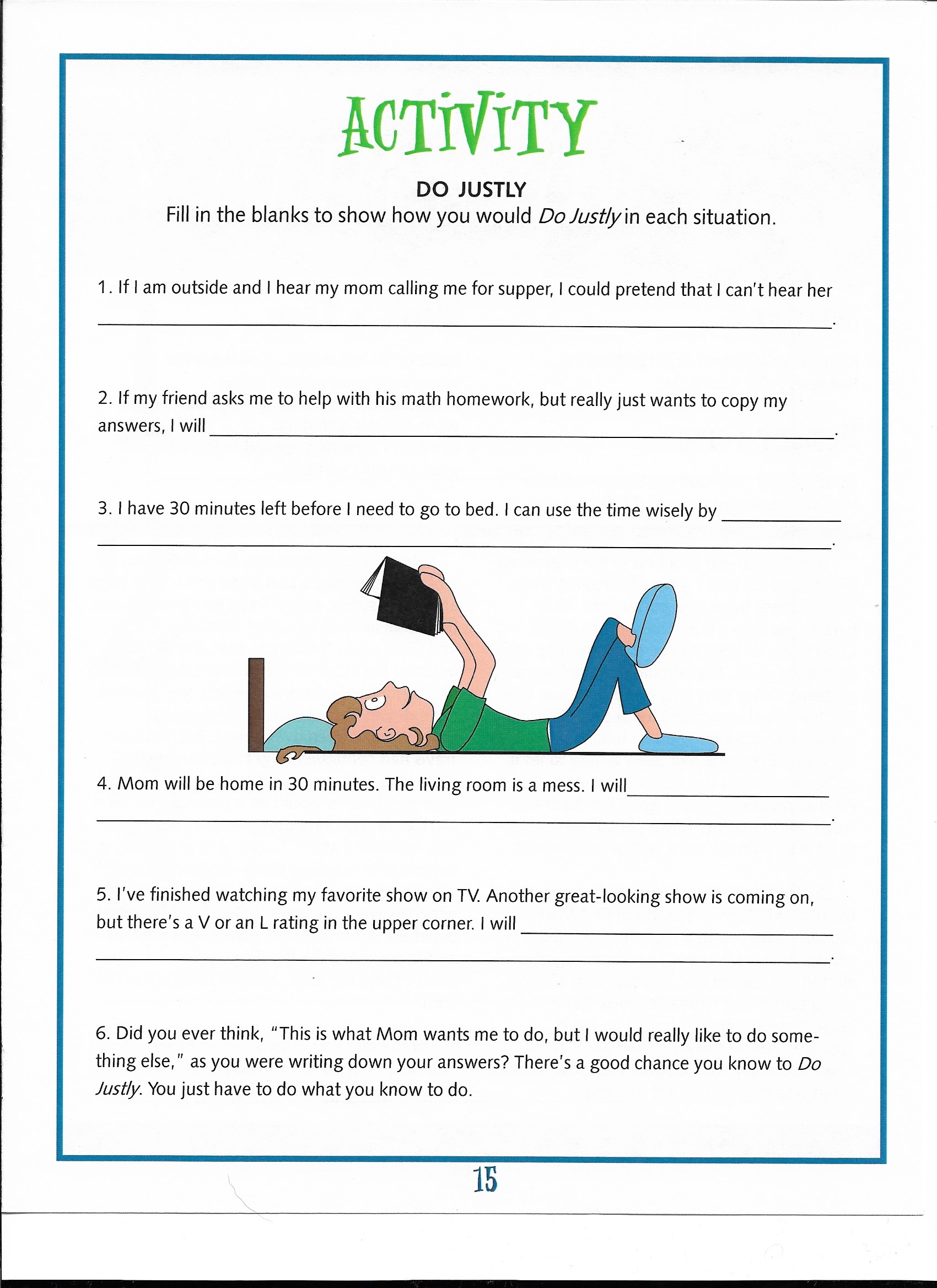
Micah 6:8: This is a good time to have the students recite the memory verse. Then read Micah 6:8 aloud to the students. Say: The first part of what God requires is “to do justly.” Doing justly is a choice. Review the activity in the students’ book. Ask the students to share their answers. Particularly, read the sentence at the end of the activity.
Review Questions
1. What does Micah 6:8 say?
2. What is justice?
3. What are two biblical examples of justice?
4. What is an example of justice in your life?
5. What does God require of you?
6. How is justice related to the Feast of Trumpets?
7. What is one thing the Feast of Trumpets would make you think of?
Teacher-Directed Activity
Micah 6:8 Banner
On a six-foot piece of butcher paper, write Micah 6:8 along the top. Have the children make snapshot drawings in random order of situations with them doing justly. For example, one student says to another, “Let’s ask to go to the bathroom five minutes before recess and go outside instead of going to the bathroom.” In a second bubble, write the second student’s just response.
Save this butcher paper for students to continue drawing snapshots for Atonement and Feast of Tabernacles’ activities. Don’t feel you have to have the mural completed with this activity.
REACH Activity
Back to the Bible: Jericho
Your lesson for the Feast of Trumpets references Jericho. Read Joshua 6. Note God’s exact instructions to the Israelites. Compare the noise of the people shouting and the trumpets sounding at Jericho with the noise we’ll hear when Jesus returns (1 Thessalonians 4:16). Write an essay to compare and contrast these two events. What do they have in common? How are they different. File your essay in your Bible notebook.
Journal Jot: The Reason Why
Do you know why your family and your church family celebrate the Feast of Trumpets every year? If you do, write about it in your Bible notebook. Make sure you use scripture references to explain why it’s important to keep this holy day. If you don’t know, ask your parents to explain it to you. Then write this information down, with scriptures, so that you’ll remember the next time someone asks you why you keep this holy day.
Word Study: mishpât
The word for “justice” in your memory verse (Do justice or Act justly) is the Hebrew word mishpât. It literally means “a judgement, sentence, formal decree, justice, right, privilege . . . God loves mishpât (Psalm 37:28). It is rooted in His character and ought to be emulated by godly people.” (Source: Zodhiates’ NAS Hebrew-Greek Key Word Study Bible, 1990.)
It shouldn’t surprise any of us that God is just. He does what is right. As the Creator and King of the Universe, He has designed a world and knows exactly how it will function best. His laws are for our benefit so that things will work well for us. Although we live in a world where we sometimes see laws that are not good, we should never confused man’s laws with God’s laws. Humans can made some terrible laws, but God never does. And, as Zodhiates stated, you cannot separate God’s laws from God; they are an expression of God’s character.
Write this word, its definition, and the scripture reference in your Bible notebook.
Just Toolin’ Around: Law
Using a Bible dictionary, lexicon, or concordance, find six other terms which mean “law.” Hint: you can find all of them in Psalm 119. Every verse in Psalm 119 has a word which means “law.” Write these words in your Bible notebook.
Did you Know? Decalogue
Another term for the Ten Commandments is Decalogue, a word with Greek origins. It literally means “Ten Words.” The Hebrew term that is translated “ten commandments” also literally means “ten words.” (Source: NIV Archaeological Study Bible, 2005, pg. 124.)
These “ten words” and the rest of God’s law are summed up by Jesus in Matthew 22:36-40. The greatest commandment is to love God with all of your heart and all of your soul and all of your mind. The second is to love your neighbor as yourself. If you look at the Ten Commandments, the first four are all about loving God; the last six are all about loving other people.
Stretch It Out: The Ten Commandments
The Ten Commandments that God gave to Moses at Mt. Sinai are the foundation of God’s law (although they are not the only laws, commandments, and ordinances He gave). On 11 x 17 drawing paper, recreate the stone tablets. Using paint or colored pencils, make the paper look like stone. Then write the ten commandments on your tablets. Plan ahead of time how big your letters will need to be to fit perfectly into your space. (You don’t want a lot of space left over or run out of space before you’re finished.) When you’re finished, post the Ten Commandments where you can see them as a reminder to do justly.
Music Notes: Come Thou, Almighty King
This hymn is found on page 3 of the CEM Hymnal.
The music to this hymn was written by Arthur Henry Messiter, who was an organist in NYC in the 19th century. The poem was written by Felice de Giardini, an Italian violinist and composer who died in Moscow nearly four decades before Messtier’s birth. (Source: Near to the Heart of God, Robert Morgan, 2010, April 12th.)
This holy day, the Feast of Trumpets, celebrates the time when we will all be joyfully welcoming the Almighty King, Jesus Christ. Sing this hymn with enthusiasm! Write the title in your Bible notebook as a banner. Add color. Then sing the hymn with your family.
Questions?
Remember to write down any questions that you think of as you are reading your lesson, daily devotionals, or doing the REACH activities. Plan to ask your parents or your pastor these questions.
Song
"O Be Careful Little Eyes" is on page 39 of Kids Classics Collection.
Closing Prayer
Lead in prayer, thanking God that He is just and asking for His help in doing justly.
Printable Pages