YEA Lesson Library
The Passover Lamb
About This Lesson
This lesson explains that the Passover lamb is a symbol for Jesus, the Lamb of God. Having to kill a lamb made the consequences of sin very real to the individual and should help the student understand the gravity of what Jesus did for each of us.
Scriptures
Exodus 12:1-13, 21-28
Leviticus 23:4-8
Deuteronomy 16:1-8
Psalm 81:3-5
Matthew 26:17-20
John 1:29
1 Corinthians 5:7-8
1 Peter 1:19
Words to Know
SYMBOL - something that stands for or represents something else
PASSOVER - the day God brought Israel out of Egypt after the death angel had passed over their homes; the Bible tells us to observe it every year on its anniversary
SIN - transgressing, not keeping or breaking God's law
The Lesson
Five-year-old Cynthia had been wanting a puppy. Finally, on a warm summer afternoon, her dad came home with an energetic and starving puppy that he had picked up at the dog pound. Cynthia, her brother and sister, and their mom sat under a cottonwood tree in the backyard, feeding the puppy and trying to think of a good name. Eventually, Cynthia settled on Blacky — probably because the puppy was all black with white paws, a small white patch on his chest, and white eyebrows.
Cynthia took Blacky with her everywhere. She played with him. She fed him. She even put him on her bed to sleep with her at night. Blacky became a very important part of the family for many years.
Israelite families also picked out a pet to bring into their families. Once a year, every year, on the tenth day of the first month, each family would pick a perfect year-old lamb out of the flock. They would bring the lamb home and during the next four days, the lamb would become like another member of the family. Imagine feeding it, playing with it, and laughing at it running and jumping and playing with you and your family.
How hard it would be to take that little lamb and kill it! After four days, the children in the Israelite family would have become very attached to the lamb. They would have loved the lamb. But God told the father to take the lamb and kill it. Then they were to eat it.
Can you imagine how hard it would have been to eat that meat? The children in the family would have been very sad about killing it. They might have felt like refusing to eat any of it.
Why would God ask His people to take a lamb out of the flocks, to make it a family pet, and then kill and eat it? God wanted people to really understand a couple of things. First, sin costs you something. Whenever you do something that is against God's law, it will hurt you in some way. And it will cost you something to make things right after you have sinned. So that the people would completely understand the cost of sin, God had them kill the lamb. The lamb meant something to the people. It hurt to have to kill it. But the people knew that killing the lamb had to happen because they had sinned.
But what does a little lamb have to do with sin? The lamb didn't make you sin. The lamb is completely innocent. It didn't really have anything to do with your sin. And, the lamb - all by itself — really cannot make things right again after you sin.
So why did God ask the people to kill a lamb? Because the lamb became a symbol for something else. A symbol is something that points you to something else. A symbol reminds you of something else.
A good example of a symbol that you might understand is money. What gives money any value? You can't eat it. You can't wear it. It doesn't keep you warm at night. Why is money worth anything? Somewhere along the line, people decided that carrying around paper (money) was a lot easier than carrying around things that other people might want — like a chicken or six tomatoes. The money itself isn't worth anything, but because it stands for other things of value, we can use it to buy things at the store.
In the case of the lamb, it stands for something of very great value. The lamb is a symbol of Jesus Christ. And that's the second thing God really wanted the people to understand. God the Father gave His very own Son to pay the price for sin. For your sin and for my sin. God wanted the people to understand what a big deal this was. Jesus Christ had to die for their sin. Just in case the people thought that it was no big deal for Jesus to die, God gave them a year-old lamb and told them to kill it. The people loved that lamb. They hated to slit its throat and watch the blood pour out because of what they had done. God wanted them to feel the same way about their sins causing the death of Jesus.
Jesus is the Lamb of God who takes away the sins of the world (John 1:29). If you can imagine how badly you would feel about killing a pet, you can imagine how much worse you should feel about causing the death of God's Son. Sin is a very bad thing. It costs you! But thanks to God, He loves you so much that He provided the Lamb to pay for your sin. As you celebrate Passover this year, think about the perfect lamb that was killed — the Lamb of God.
Student Prayer
Dear Heavenly Father,
Thank you for providing the Lamb to pay for our sins. Help us to truly understand the cost of sin. Help us not to sin.
In Jesus' name.
Amen.
Daily Devotions
Sunday: Exodus 12:1-13
Monday: Leviticus 23:4-8
Tuesday: Psalm 81:3-5
Wednesday: Exodus 12:21-28
Thursday: 1 Corinthians 5:7-8
Friday: Matthew 26:17-20
Saturday: Deuteronomy 16:1-8
Objectives
At the end of this lesson, students will be able to:
1. Give the definition of a symbol.
2. Explain the practice of taking a lamb on the tenth day and killing it on the 14th day.
3. Identify Jesus as the Lamb of God.
4 Explain why God had the people kill the lamb.
Topics & Themes
Consequence of Sin
Jesus, Lamb of God
Lamb
Passover
Sin
Symbol
Materials Needed
Bible, YEA Students' and Teacher's books, attendance and memory verse charts, star stickers, songbook, small stuffed animals (at least one more than the number of students in class), precut and preprinted card stock (see Preparation), lamb outlines (see Activity), glue stick, school glue, cotton balls, permanent marker, scissors, magnetic strips, pictures or drawings for Second Symbols
Preparation
Children this age are so visual and tactile! Plan to buy enough stuffed animals so that every student will have one, plus one or two extras. (These can be purchased at a dollar store fairly inexpensively.) Having the opportunity to actually pick out the stuffed animals they want will draw them naturally into the lesson. Precut a piece of card stock large enough to glue on a lamb outline for each student, leaving enough room along the bottom to print the memory verse before the children arrive. (See Activity.)
How to Teach This Lesson
Picking out a pet: Sit on the floor with the students. Pul the stuffed animals out of a bag. Put them in your lap. Show them each one. Then let each student choose which one they want. Take turns to avoid arguments over who gets which animal. Ask: What is the first thing you will do with your pet? Name it. If it were alive, what would you do with your animal? Play with it, feed it, care for it, make a place for it to sleep/stay.
On the tenth day of the first month: Say: This is very close to what the Israelites did every year, except each family was to pick out a perfect lamb from the flock. The lamb had to be a year old male without one thing wrong with it. Discuss what the family might have named the lamb, what they would have done with it. Read Exodus 12:1-6. Verse 6 says they had to take care of the lamb.
The 14th day: Ask: What happened to the lamb on the 14th day of the month? He was killed. Why? Discuss the first Passover and how the death angel passed over the houses which had the blood of the lamb painted on the sides and top of the door. Ask: Why was a lamb killed? Because it was a symbol of Jesus Christ who was killed to pay for our sins.
First Symbols: Select either of these two symbols to illustrate: Show the students a dollar bill. Ask: Why is this worth one dollar? Because everyone agrees that it is worth one dollar. It is only paper, but if you go into the store to buy a pack of gum, you'd better have a dollar because that's what the store wants. You can't take in a pocketful of your favorite rocks, a bird's nest, or five zucchini from the garden, but that's the way it used to be done. A couple of hundred years ago, people traded for what they wanted. A man might say, "I'll give you five fish, if you give me a cup of salt." It's much easier to carry a dollar around in your pocketful than to carry five fish — and a whole lot less smelly. So the dollar stands for anything people think is worth that amount. It's a symbol.
Second Symbols: Hold up a poster with "Jesus Christ is . . .” written across the top. Ask the students to tell you some of the things Jesus is. As they give you various symbols, paste pictures or drawings of them on the poster board with a glue stick. Examples: Bread of Life (a loaf of bread), Living Water (a picture of a stream), Light (a candle), the Vine (a picture of a vine), my Shepherd (a picture of a shepherd with sheep), the Way (a road), the Truth (the word "truth" written in bold letters), Life (the word "life" written in bold letters), Righteousness (the word "righteousness" written in bold letters), the Lamb of God (a lamb), our King (a crown), our all in all (the word "everything" in bold letters). Ask: Why are all of these different names or symbols used when we’re talking about Jesus? They help us understand who He is and how He is part of our lives.
The Lamb of God: The lamb was also a symbol. It stood for, it pointed the people to, it reminded them of Jesus Christ. (Have students recite their memory verse.)
The cost of sin: Why did God use a lamb? There are a couple of lessons. First, sin costs you something. When you do something wrong, you hurt your relationship with God and you hurt yourself. To fix things, to make them right again, you have to pay. Or Jesus can pay for you. But somebody has to pay to make things right. The lamb that each family took into their homes was the symbol for making things right. That's the second lesson we learn from killing the lamb. The people loved the lamb. It hurt them to kill it. It should also have hurt them to think of Jesus dying for their sins. It should hurt you to think of Jesus dying for your sins.
Praise God: Ask: How do you feel about Jesus being the Lamb of God and dying for your sins? It's a very serious thing. It should make us want to not sin, but we should be very grateful to God for providing the Lamb to die in our place. This Passover, remember to thank God for giving us His Son to pay for our sins.
Review Questions
1. Why did the lamb have to be perfect? Because it pointed to Jesus Christ.
2. Why did each family have to take a lamb on the tenth day?
3. Why did each family have to kill the lamb and eat it on the 14th day?
4. Why is sin so bad?
5. What is the only way to fix sin, to make things right again?
6. How should we feel about Jesus dying for our sins?
Teacher-Directed Activity
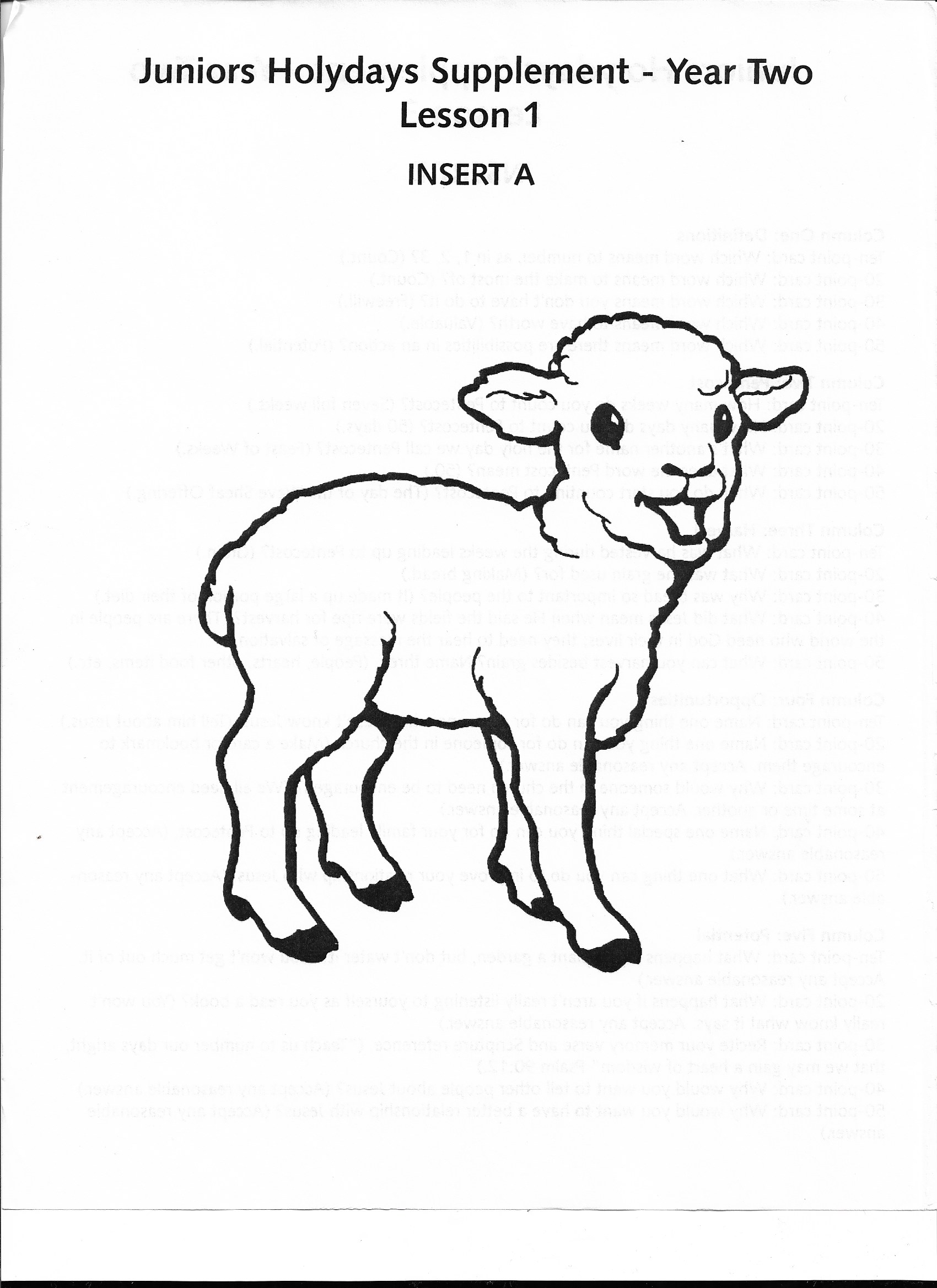
Copy the lamb, sized to fit card stock, for each student (see Pattern Page). Have them cut it out and glue it on the precut card stock. Be sure they don't glue over the top of the memory verse. Then glue cotton balls to the lamb. Finish by sticking a piece of magnetic tape on the back of the card stock. The students can take these magnets home to put on their refrigerator or give them away to someone in the church who needs encouragement this Passover.
REACH Activity
Back to the Bible: The Passover Lamb
Read all of Isaiah 53. If you are using a center-reference bible, look at some of the scriptures which link to this chapter. If you aren’t using a center-reference bible, look up John 1:36; Leviticus 16:21-22; 2 Corinthians 5:21; 1 Peter 2:25. Write down what information you find in your Bible notebook.
Journal Jot: The Reason Why
Do you know why your family and your church family celebrate the Passover every year? If you do, write about it in your Bible notebook. Make sure you use scripture references to explain why it’s important to keep this holy day. If you don’t know, ask your parents to explain it to you. Then write this information down, with scriptures, so that you’ll remember the next time someone asks you why you keep this holy day.
Word Study: airō
Airō is the Greek word in John 1:29 for “takes away.” It literally means “to lift, to raise, to take up, to take away.” The implication is that someone else is taking the weight or burden so that you don’t have to carry it.
What weight are you carrying that you should give to Jesus? Think about this solemnly.
Just Toolin’ Around: Passover
The Passover was (and is) so important to God’s people. Using a concordance, find five scriptures which talk about Passover, either how to observe it or when it was observed. Write these in your Bible notebook.
Did you Know? Celebrating
Hezekiah celebrated the Passover. 2 Chronicles 30:26 says it wasn’t celebrated like this since which king? That would have been around 200 years earlier!! But then there’s another note about the celebration of the Passover under the reign of Josiah in 2 Chronicles 35:18. Here it says the Passover hadn’t been celebrated like this since the days of whom? That would have been about 400 years earlier!! And some estimate that the original Passover was 400 years before that!
Celebrating the Passover is something God ordained as a perpetual ordinance. That means it never ends. We are supposed to be celebrating it each year. How do you feel about that? Write about this in your Bible notebook.
Stretch It Out: Symbols
During class you will talk about symbols. Jesus is the Light of the World. He’s the living Bread. He’s the Good Shepherd. He’s the Door. He’s the Way and the Truth and the Life. He’s the source of Living Water. He’s the Cornerstone. He’s the Lion of Judah and the Lamb of God.
Create a poster with each of these symbols. Find the corresponding scripture which tells you that He is each of these things. Make a note of the scripture under each symbol. Think of a good title for your poster - like “Jesus is My Everything” or “Jesus is My All in All.” Add color. Display your poster at church, with permission.
Music Notes: Victory in Jesus
This hymn is found on page 188 of the CEM Hymnal.
Both the words and the music were written by Eugene Bartlett, Sr. who was a singer, music publisher, producer, and songwriter. He published a hymnbook that sold 15,000 copies. “He felt his calling was to publish hymns and teach aspiring singers how to sight-read so he traveled the south, holding singing school and singing conventions.” But in 1939 at age 53, he “suffered a paralyzing stroke that left him unable to walk or even speak and for the most part, he was bedridden” for the next two years before his death. It was after his stroke, when most people thought his ability to serve God was over, that he wrote the most well-known of his hymns, “Victory in Jesus.” His son Eugene Bartlett, Jr. took over his father’s ministry and sang his father’s hymn at an evangelical meeting. Praise God for using this man to gift us all with a hymn which celebrates our victory in Jesus regardless of what life looks like here and now. (Source: https://backstorysongs.com/2019/10/31/victory-in-jesus/)
Sing this hymn. Then in your Bible notebook, write where Jesus has given you victory. Share your thoughts with your family.
Questions?
Remember to write down any questions that you think of as you are reading your lesson, daily devotionals, or doing the REACH activities. Plan to ask your parents or your pastor these questions.
Song
"Oh, How I Love Jesus" is on page 6 of Kids Classics Collection.
Closing Prayer
Lead in prayer thanking God for providing His Son, the Lamb of God, to take away the sins of those who love Him.
Printable Pages