YEA Lesson Library
Be Content
About This Lesson
Using the story of Jonathan and David’s friendship, this lesson teaches the student to trust God for what they need and to avoid coveting and fighting.
Scriptures
1 Samuel 18:1-5
1 Samuel 20:1-42
Psalm 37:4-16
Proverbs 5:13-15
Proverbs 14:12-14
Proverbs 17:22-28
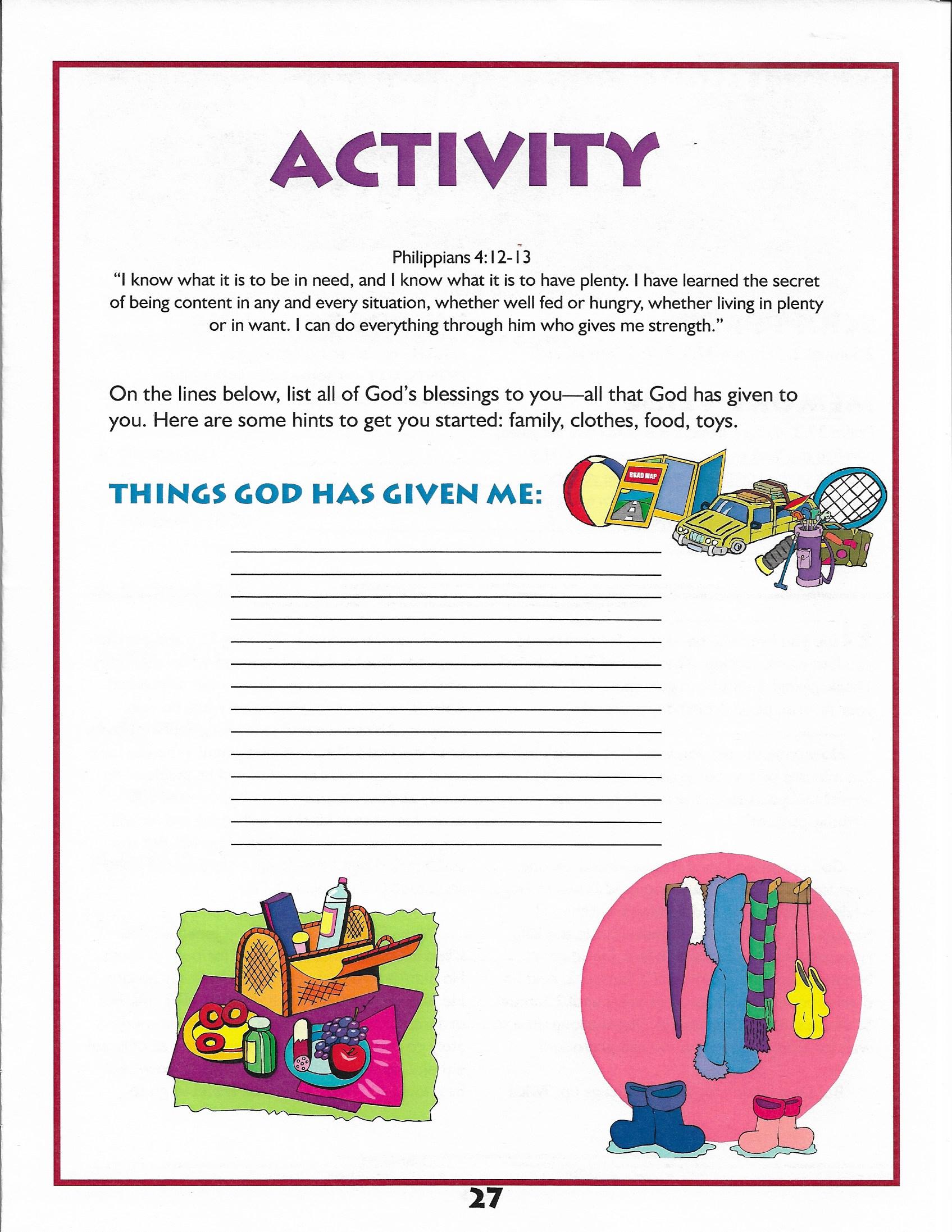
Philippians 4:12-13
James 4:1-3
Words to Know
CARNAL NATURE - the normal human character apart from God
COVENANT - a binding agreement
ACKNOWLEDGE - to admit the importance of, to express recognition
SCHEME - to plan, sometimes secretly, to accomplish some goal
The Lesson
"Hey! Give that back!”
"It's mine!”
"I had it first!"
“Mom!!"
Does this sound familiar? Too often, when two children get together, they quarrel over toys. But it doesn't just happen with kids. Adults also quarrel over what they want. It just may not be as obvious to everyone that an adult is upset because of something someone else has. Unfortunately, our carnal nature is like that. We think of ourselves and what we want first. If someone is taking what we think belongs to us, we don't like it very much.
But Jonathan didn't act that way. Jonathan was the son of King Saul. When Saul died, Jonathan would be king and rule Israel. At least, he would have - if Saul had obeyed God. Because Saul had not followed God, God took the kingdom away from Saul. Remember, Samuel anointed David to be king over Israel. Many princes might have secretly thought, "If I could just get rid of David, then I would be king when my father dies." But not Jonathan. Why not?
Jonathan loved David as he loved himself (1 Samuel 18:1). How did Jonathan show this love? First, Jonathan made a covenant with David. He gave him his robe, his tunic, his sword, his bow and his belt. Then when Saul wanted to kill David, Jonathan stood up for David and talked Saul out of it. Later, when Jonathan was convinced that David's life was really in danger, Jonathan told David. Then Jonathan and David renewed their covenant. Jonathan said to David, "Go in peace, for we have sworn friendship with each other in the name of the LORD, saying, 'The LORD is witness between you and me, and between your descendants and my descendants forever.’"
It would have been so easy for Jonathan to help Saul kill David. If he'd lied to David about what his father intended to do, he could have led David into a trap. With David dead, Jonathan could have been king. Instead, Jonathan gave his clothes and his weapons to David. This showed hisloyalty to David. And whether Jonathan knew it or not, it was like an acknowledgment that David would be king instead of Jonathan. Jonathan didn't fight and quarrel and scheme to get the kingdom. Rather than his carnal nature having control, Jonathan's love for God and for David had control in his life.
It's a good lesson for us. There are many things in this world that we think we need. But we don't, really. Those things aren't even needs. They are just things we want. When we want something that someone else has, it is called coveting. And it's wrong. When we want a position someone else has, it is still coveting. And it's still wrong. If we think we deserve something someone else has, it can lead to fighting and quarrels. It can ruin whatever relationship you have with that other person. And it's wrong.
God will give you what He wants you to have. You don't have to fight and quarrel and scheme. God has promised to give you what you need. He will take care of you. It's not your job to decide what God should give you. It's your job to trust Him — to trust that He cares for you and will give you what you need. When you are doing your job well, that means really trusting God to take care of you, then you can be satisfied and content with what you have. Being content is much better than fighting.
Imagine this: "Hey! Give it back!"
"O.K. I'm sorry. I didn’t realize you were playing with it."
"That's okay. Would you like to play together in my new treehouse?"
"Sure! That would be wonderful."
Activity
Teaching the Lesson:
Legacy Lesson: Student book/Teacher book - Teaching Time: 25 mins.
Lesson Prep - Teacher book - Time: 1 hour
Activity (Teacher book): Contentment Cards - Time: 30 mins.
Song: "I've Got Peace Like a River” - page 63 of Kids Classics Collection - Time: 5 mins.
Activity (Student book): Things God Has Given Me - Time: 15 mins.
Extending the Lesson - REACH Activities:
*Back to the Bible: Treasure
*Journal Jot: God’s Perspective
*Word Study: With Wrong Motives - kakōs
*Just Toolin’ Around: God First
*Did you Know? Jonathan’s Friendship
*Stretch It Out: Visualize It
*Music Notes: Savior, Like a Shepherd Lead Us
*Questions? - Writing Prompt - 10 mins.
Student Prayer
Dear Heavenly Father,
Help me be content with what You give me.
In Jesus' name.
Amen.
Daily Devotions
Sunday - Philippians 4:12-13
Monday - James 4:1-3
Tuesday - Psalm 37:7-16
Wednesday - Proverbs 5:13-15
Thursday - Proverbs 14:12-14
Friday - Psalm 37:4-7
Saturday - Proverbs 17:22-28
Objectives
At the end of this lesson, students will be able to:
1. Define the relationship between Jonathan and David.
2. State how Jonathan showed his love for David.
3. Apply the concept of contentment to their lives.
Topics & Themes
Contentment
Coveting
David
Friend
Jonathan
Kingdom
Sword
Trusting God
Preparation
Ours is a materialistic society. We have so much - so very much more than we really need. The present prosperity of our country is astounding. For the majority of the students we teach, hunger and going without basic necessities is not something they’ve ever experienced. Rather, they have an abundance. Yet, advertisers capitalize on that empty place inside that is looking for what will satisfy and bring contentment. Commercials showing happy, laughing children playing a colorful board game, brightly packaged toys and foods, athletes and movie stars who make obscene amounts of money — these all convey a message to our children that we must take conscious steps to contradict. Our contentment is found in Jesus Christ —though our carnal nature and the advertisers would strongly deny that! We must help our children understand this concept, and it will help if we are emulating that contentment in our own lives. With this in mind, create a set of activity cards before class (see Activity).
How to Teach This Lesson
Chocolate! Give each student a chocolate bar (Hershey's or Toblerone will work best). Tell them they can eat a little bit right then, but to save most of it for the end of the lesson. Then ignore the candy bars as much as you can.
Kings and princes: Discuss succession. When a king dies, his son takes his place as king. Talk about the privileges and responsibilities of being king. Discuss Saul and Jonathan. We are never told that Jonathan wanted to be king; instead we are told of his love for David.
Covenant: Discuss covenants. Say: When your parents got married, they exchanged rings as a sign of the marriage covenant between them. Define covenant. Then ask: What were the terms of your parents' marriage covenant? Usually it is something like "I, Mike, take this woman to be my lawfully wedded wife, to honor and cherish, to love and protect, in sickness and health until death do us part." Those vows your parents made to each other are the terms of the covenant. They promised to do certain things because of the relationship they agreed to. Discuss Jonathan and David's covenant (1 Samuel 20:42). Then ask: What was the sign of the covenant between David and Jonathan?Jonathan gave David his robe, tunic, sword, bow, and belt (1 Samuel 18:3-4). In a way, Jonathan was handing over the kingship to David, that is, acknowledging that God had taken the kingship from Saul and given it to David.
Being content: It is remarkable Jonathan didn't scheme to get the kingdom. Because of his love for David (and likely his love for God), Jonathan was content with the position God gave him. Instead of a life of anger and hatred, scheming to get something God wasn't going to give to him, Jonathan had a lasting friendship with David, knowing that he was not going against God's will. That's an incredible contrast!
Personal application: Discuss how this idea of being content with what you have works today. (Integrate the Activity here.) Help the students figure out how to remind themselves to be content. Then have each student recite their memory verse.
Chocolate! Emphasize that you are not trying to embarrass anyone. Have the students look at the chocolate they ate when starting the lesson. How many took just a little bit as directed? How many couldn't quit thinking of the chocolate and wanted to eat it all immediately? How many were content to wait, knowing that it was all yours eventually? How many wanted the one you had plus another one? How many thought about a brother or sister and planned to save some to give to them? How many would give the rest of the chocolate bar back because you really don't want anymore? Talk about how God has given us what we need. But there are lots of things that we want. None of the students needed chocolate. Some of them wanted to eat the whole candy bar immediately. Some were content because they knew they could have it all at the end of class. Some were willing to share. Some wanted more.
Philippians 4:12-13: Read this Scripture out loud. Emphasize how important it is to be content with what God has given you. After all, like getting the whole chocolate bar at the end of the lesson, you know that someday you will be sons of God in His Kingdom. He's handing the Kingdom over to you! You just have to wait, to learn to be content with what you have right here, right now. It is enough.
Review Questions
1. What kind of relationship did Jonathan and David have?
2. How did Jonathan show his love for David?
3. Why should you be content with what God has given you today?
4. How can you show your contentment?
5. What is the difference between Philippians 4:12-13 and James 4:1-3?
Teacher-Directed Activity
Contentment Cards
Each card states a situation to practice being content with what you have (what God has given you.) The teacher reads the card, setting up the situation. The students take turns giving responses. These are suggestions; add others that seem applicable.
1) At a birthday party, your friend is opening his/her presents. Out of a box, he/she pulls ________ (Have student name something he/she really wants.) How do you keep from feeling jealous? What do you tell yourself to remember to be content?
2) Dad brings home a toy for your little sister — just because he saw something he knew she'd like. How do you keep from feeling jealous? What do you tell yourself to remember to be content?
3) You're watching cartoons on TV. A commercial comes on showing children laughing and enjoying a toy _______________ (Have student fill in the blank.) How do you keep from feeling like you have to have that toy? What do you tell yourself to remember to be content?
4) Your mom has to go to Wal-Mart. You ask if you can go look at the toys. You see a ________________ that looks like it would be so much fun to play with. (Have student fill in the blank.) Your mom says no; she’s not going to buy it for you today. How do you keep from being mad at her? What do you tell yourself so that you remember to be content?
5) Your best friend invites you over to play with a new toy he/she just got. You love it. You want one like it.You ask your parents for one when you get home. They say no. How do you keep from pleading? What do you tell yourself so that you remember to be content?
REACH Activity
Back to the Bible: Treasure
Jonathan valued his friendship with David more than trying to one day be king against God’s will. It seems ridiculous to even think about people trying to get something - if God doesn’t want them to have it. There’s a companion verse to this concept in Matthew 6:19-21. Read these verses and then write a paragraph explaining how Jonathan’s actions towards David relate to these verses in Matthew. File your paragraph in your Bible notebook.
Journal Jot: God’s Perspective
We often see things and they look desirable to have. So we want them. We’re willing to work hard for them, to persevere to get them. And usually, that’s good. It’s important that we work hard for the things we want; they will have more value to us. But sometimes, we work hard for something that will not be good for us in the end. Can you think of an example in your own life? Write a paragraph about this - perhaps like the one below. File it in your Bible notebook as a reminder to always seek God’s will in the things you do because you know God wants the very best for you.
My mom and dad headed out the front door to go to church one Sabbath. When they got into the car, it wouldn’t start. So they had to move everything for church to the other car. Then, when they started it, they realized they’d have to stop at the gas station to fill up the car with gas. Soon they were on their way - with just a little delay. But that little delay might have saved their lives. Once on the interstate, about two miles down the road, there was a major multi-car accident that had just happened. They could very well have been in the middle of the accident if they hadn’t had to switch cars. At the time, they probably were wishing the car would start. Fifteen minutes later, they were very thankful to God that they hadn’t been involved in that accident.
Word Study: With Wrong Motives - kakōs
The phrase in the memory verse from James 4:1-3 which is translated “with wrong motives” is the Greek word which means “badly, to have; to have it badly, i.e. to be ill.” It can also mean “sore misery, related to experiencing grievous harm or affliction.” (Sources: Zodhiates’ NAS Hebrew-Greek Key Word Study Bible, 1990, H#2560 and https://biblehub.com/greek/2560.htm)
In other words, it is not only asking in a way that might mean evil towards someone else, it is asking for something that is not good for you. You may think it’s good for you, but it will not bring you closer to God. And that’s very bad. Our goal in everything we do, everything we pursue, everything we say and think should be to glorify God and become more like Jesus Christ.
Just Toolin’ Around: God First
There are lots of examples in the Bible of putting God first or seeking His plan instead of your own. Find three of them and write them in your Bible notebook. You might look up “God’s ways” in a concordance. When I did that, I found some interesting verses that I hadn’t considered. If you get stuck, look at these: Luke 15:10; Numbers 22:22; Revelation 15:3; Isaiah 35:8; Romans 10:3; Exodus 18:20; 2 Samuel 22:31. You could use these verses as references when writing an essay explaining why seeking God plan is a much better choice than simply striving for what you want without considering God’s perspective.
Did you Know? Jonathan’s Friendship
According to V. Gilbert Beers’ The Victor Journey Through the Bible (1996, p. 110), only the Philistines had the knowledge and expertise to forge iron javelins and spears. The Israelites would have been using wooden and stone weapons. For Jonathan to gift his iron sword and spear to David was absolutely amazing! “Jonathan’s iron sword was probably the most highly prized weapon in Israel. But without a second thought, he gave it to his friend David.”
Stretch It Out: Visualize It
In your mind, can you imagine the scene when Jonathan gave all of the armor and clothing to David? Can you imagine the reaction of the people who loved David? Can you imagine the outrage of King Saul? Can you imagine the approval from the angels? On a piece of drawing paper, create a scene. Draw Jonathan handing all of the pieces to David. (Be sure to read 1 Samuel 18:1-5 again so you know exactly what to draw.) Then in the corners of the paper, show the reactions of the audience: the people, King Saul, God’s angels. Write your memory verse across the bottom of the page. Display in your room as a reminder to seek God’s approval in all you do.
Music Notes: Savior, Like a Shepherd Lead Us
This hymn is found on page 52 of the CEM Hymnal.
The author of the text of this hymn is Dorothy A. Thrupp (1779-1847) - probably. She lived in London and was a “prolific writer of children’s hymns and devotional materials.” The problem is that she rarely put her name on her work, and when she did, she often used a pseudonym. So we don’t know for sure that this is one of her hymns, but it likely is. (Source: Amazing Grace, Kenneth Osbeck, 1990, p. 79)
Don’t you love this?! We’ve just had a lesson about seeking the glory of God, not looking for glory and honor for yourself, and then the backstory for this hymn is a shining example of someone who did precisely that. Dorothy Thrupp lived her life pointing children towards God, not trying to gain fame for her actions. And! She wrote lyrics which exhort each person to follow God’s leading for their lives. Pretty cool stuff!
Questions?
Write down any questions you have in your Bible notebook so that you can remember to ask your parents or your pastor.
Song
"I've Got Peace Like a River" is on page 63 of Kids Classics Collection.
Closing Prayer
Lead the students in prayer asking God to help them learn to be content and to trust Him in everything.
Printable Pages