YEA Lesson Library
Be Secure
About This Lesson
Using the story of David when Saul was jealous of him and persecuted him, the student will learn to trust in God in times of trouble. Things may not go well, but we know our loving and good God is in control.
Scriptures
1 Samuel 18-19
Psalm 20:7
Psalm 46:1-3
Psalm 46:10
Psalm 121:7-8
Matthew 5:11-12
Luke 12:3-5
1 Corinthians 10:13
Philippians 4:6-7
Words to Know
PERSECUTION - when someone is attacked because they are different
JEALOUS - (in this lesson) hostile towards a rival
SECURE - to feel or to be safe
TOLERANT - open-minded; charitable, lenient, merciful
The Lesson
People have many different beliefs. Not everyone believes in God. Muslims and Hindus worship an entirely different god. Some people believe in God, yet don't believe as we do. They celebrate Christmas and Easter and worship on Sunday. Some people are intolerant and can be really mean about other peoples' religions. People have even killed others for not worshiping their god. This is called persecution. And it's not fun. You want people to be tolerant of you and your beliefs.
David was persecuted after he killed Goliath. People should have been relieved that Goliath had been killed. David had done a great thing for Israel. And most people were very grateful. But King Saul was jealous and ungrateful. When Saul and David came back into town, people were singing, "Saul has slain his thousands, and David his tens of thousands." Saul didn't like that. He worried that David would try to be king. We’re not told exactly why Saul didn't let David go back to Jesse, but Saul definitely wanted to keep an eye on David.
David did everything well. Saul gave him a high rank in the army. The people liked that. But Saul only grew more jealous of David. He became out of control and angry. When David was playing the harp, Saul threw a spear at him, trying to pin him to the wall. Twice David managed to get out of the way! Saul was jealous and afraid because he knew that God was with David. So Saul decided he'd try to get rid of David another way. Saul put David in charge of 1000 men and sent him out to fight the Philistines thinking he'd be killed in battle. But God was with David and David had great success! This only made the people love David more. It also made Saul more determined to get rid of David. Saul sent David to fight the Philistines as much as possible. He thought David would be killed in battle.
Saul's daughter, Michal, loved David. Saul found out and was very happy about it. He wanted David to kill 100 Philistines. Then David could marry Michal. Saul was sure David would be killed in battle, trying to kill 100 Philistines for the king. But David went out and killed 200 Philistines. Then Michal married David.
Saul became even more jealous and afraid of David. God helped David in everything he did. The Israelites thought David was a hero. So Saul told Jonathan, his son, and all the attendants to kill David. But David was like a brother to Jonathan. So Jonathan warned him to hide while he talked to King Saul, his father.
Jonathan told his father that David had not wronged him. Instead what David had done was very good for both Saul and Israel. He said. "The LORD won a great victory for all Israel, and you saw it and were glad. Why then would you do wrong to an innocent man like David by killing him for no reason?" Saul listened. Then he vowed, "As surely as the LORD lives, David will not be put to death." But Saul wasn't very good at keeping his word.
David fought the Philistines. Again, God gave him success. This was too much for Saul. One day when David was siting playing the harp, Saul lost control. The Bible says an evil or injurious spirit came upon Saul. Again, he tried to kill David by pinning him to the wall with his spear. But David escaped. This time Saul sent men to David's house to kill him. But Michal warned David and helped him escape through a window.
David went to Ramah where he found Samuel and told him everything Saul had done. Saul found out where David had gone. Three times Saul sent men to capture David, but each time they began prophesying instead. Finally, Saul decided to go himself. But when he got to Ramah, the Spirit of God came even upon Saul, and he walked along prophesying. He took off his royal robes and lay all day and night prophesying. Once again, God protected David and did not let Saul kill him.
It would be a very scary thing to know that the king, the most powerful man in the whole country, wanted you dead. But David knew that God was with him and had protected him many times. Persecution is never fun, and God doesn't promise to always protect us from people who would harm us. Hebrews 11 is full of examples of people who were persecuted because they loved God. How could they endure the trouble? They knew that God was watching and working things out according to His will. Jesus tells us, "Blessed are you when people insult you, persecute you and falsely say all kinds of evil against you because of me. Rejoice and be glad, because great is your reward in heaven, for in the same way they persecuted the prophets who were before you” (Matthew 5:11-12 NIV).
Persecution is never easy. When persecution comes, pray that God will give you strength. Tell Him exactly what is happening. You know God is in control. He will work out things for good in your life. When you have taken it all to God, you just need to trust Him. God says, "Be still, and know that I am God" (Psalm 46: 10a). Knowing He is God and being still, you can also know that you are secure.
Activity
Teaching the Lesson:
Legacy Lesson: Student book/Teacher book - Teaching Time: 25 mins.
Lesson Prep - Teacher book - Time: 45 mins.
Activity (Teacher book): Where Do You Find Shelter? - Time: 45 mins.
Song: "Little David" - page 3 of Kids Classics Collection - Time: 5 mins.
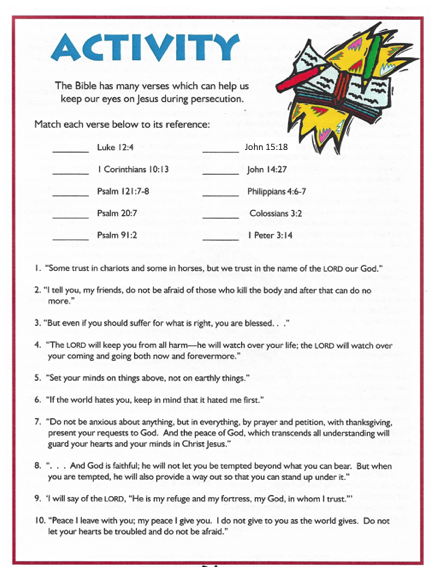
Activity (Student book): Scripture Matching - 20 mins.
Extending the Lesson - REACH Activities:
*Back to the Bible: Persecution
*Journal Jot: Trouble, Persecution, Suffering
*Word Study: Refuge - machaseh
*Just Toolin’ Around: Comfort Scriptures
*Did you Know? Saul Prophesied
*Stretch It Out: Music
*Music Notes: Moment by Moment
*Questions? - Writing Prompt - 10 mins.
Student Prayer
Dear Heavenly Father,
Help me know that in You I am secure. I don't have to fear what anyone can do to me.
In Jesus' name.
Amen.
Daily Devotions
Sunday - Psalm 46:1-3
Monday - Matthew 5:11-12
Tuesday - Luke 12:3-5
Wednesday - 1 Corinthians 10:13
Thursday - Psalm 121:7-8
Friday - Philippians 4:6-7
Saturday - Psalm 20:7
Objectives
At the end of this lesson, students will be able to:
1. Relate Saul's jealousy of David.
2. Tell David’s response to Saul's attempts to kill him.
3. Define persecution.
4. Explore Scriptures that help when we're enduring persecution.
5. Understand that persecution happens to God's people.
Topics & Themes
David
God’s Protection
Persecution
Philistines
Saul
Trouble
Trusting God
Preparation
To believe that nothing bad ever happens to Christians is not biblical. It's a grave disservice to allow children to believe they won't suffer, endure persecution or calamities, to believe that Christians only experience good things in this life. Without an accurate picture of what God is doing, we could be tempted to throw out the whole thing when events don't match our expectations. Never do we want children to lose their innocent and pure faith in God because we didn't tell them the whole truth. In this life there will be trouble. This life is not our goal. It is a training ground for what God is preparing for the future. Growing pains are painful. Without cognitive dissonance, there is no growth. God never promised this life would be a rose garden. We need a balanced vision that shows God will be with them at all times and children can trust Him no mater what. Encourage students to memorize many verses to strengthen their faith in God.
Find the book The Three Little Dinosaurs by Jim Harris at your local library, if possible, to take to class.
How to Teach This Lesson
After opening the class with prayer, follow the lesson plan below.
Define persecution: Write "persecution" on the board. Talk about what it means. Discuss events in the students' experiences.
Block the lesson: If the student lesson were a play, the director would have to "block" the action a step at a time; that is, help the students walk through the lesson, who says what and does what, step by step through the story. Help the students act out David's story in 1 Samuel 17-18.
Discussion points during blocking:
1) Talk about Saul's jealousy. Saul had lost God's Spirit and the kingdom because of his own actions.
2) Note David's reaction to Saul's attempts on his life. David got out of the way and eventually went to Samuel. David was a mighty warrior — had killed many Philistines — yet he never tried to kill Saul to defend himself. Talk about why David did this. Then have a student read 1 Samuel 24:6-7.
3) Discuss David’s success in whatever he did. Have a student read: If the Lord is for me, who can be against me. (Romans 8:31) Saul tried to send David into battle to have him killed.
4) Talk about Saul's vows. Again, in 1 Samuel 19:6, Saul makes a vow, which he soon breaks.
5) Discuss the events at Ramah in 1 Samuel 19:18-24. Saul's prophesying was in stark contrast to his murderous behavior. God can (and does) do amazing things to rescue us, even though we may never be aware of it.
Personal application: Draw comparisons to persecution today.
1) What causes persecution? Jealousy, fear, wickedness - it's not Christian.
2) What should our reaction be to persecution? Get out of the way, protect yourself, but be mindful of Romans 12:14, 17-21.
3) If you feel you are being persecuted, do you put the situation in God's hands and trust Him with your life? Read Proverbs 3:5-6. When Sennacherib besieged Jerusalem, King Hezekiah took the letter to the Temple and laid it out before God. (2 Kings 19:14-19). When someone is persecuting us, we should go to God, lay the situation out before Him, and leave it in His capable hands.
Memory verse: Have students recite the memory verse. Talk about God's protection from natural disasters (earthquakes, landslides, tsunamis) as well as personal and physical calamities (disease, divorce, death). Regardless of what happens in our lives, we must trust God. "Shall we accept good from God and not trouble?" (Job 2:10). A godly attitude is: "Be still, and know that I am God" (Psalm 46:10a). Only in Him are we secure.
Review Questions
1. What was Saul's attitude towards David after he killed Goliath? Why?
2. How did David respond to Saul's attempts on his life? Why?
3. What is persecution?
4. What is a good Scripture to remember when you feel persecuted?
5. Does God always protect Christians from bad things, including persecution?
Teacher-Directed Activity
Where Do You Find Shelter?
In The Three Little Dinosaurs, a take-off on The Three Little Pigs, the dinosaurs construct their houses out of bricks, stones, and impenetrable steel, rather than straw, sticks, and bricks. Allow the students to “build" houses out of a variety of materials: popsicle sticks, wooden blocks, building blocks, Legos, playing cards, etc. When completed, ask: Which is the most secure? Some will be somewhat secure, some not at all. Some will keep out the sun and the rain, some might endure a strong wind, and some might withstand a strong earthquake or hurricane. But what about a category 5 hurricane, a tsunami, an asteroid, fire, or nuclear attack? Inevitably, anything we can build with our hands will not save us. We have to trust God and His supernatural power for our security.
REACH Activity
Back to the Bible: Persecution
How many people can you think of (in the Bible) who suffered persecution? Make a list in your Bible notebook. Did they bring the persecution on themselves by their actions? If yes, were they obeying God and were persecuted - or were they disobedient to God and were persecuted? Why do people persecute other people? Make a list of reasons that you can think of. There’s a really scary verse that says, “ . . . but an hour is coming when whoever kills you will think and claim that he has offered service to God” (John 16:2). How could people get so far from actually knowing God that they think killing others is a good thing? There were times when God commanded the Israelites to kill entire communities (i.e. Jericho), but God doesn’t speak to people in that way today - at least, He doesn’t speak to me that way. Think about this topic. Write a paragraph response to anything in the above paragraph that struck a nerve. Share with your parents and have a discussion.
Journal Jot: Trouble, Persecution, Suffering
Sometimes people think, when they accept Jesus as their Savior and faithfully go to church each week, that bad things won’t happen to them. But the Bible is full of examples of people who faithfully served God and still had very difficult things. It doesn’t mean that God isn’t power enough to save you from the trouble. It does mean that we don’t know all of the details of God’s plan for our lives. We do know enough. What do we know? We know that God is loving and merciful. God is good and powerful. God is compassionate and just. He expects that, when we go through something difficult, that we choose to trust Him - no matter what. He’s not just our God when things are going well; He is our God (our anchor, our fortress, our shield) when we’re suffering or experiencing trouble and persecution. Think about this and write about a time when you had trouble and you trusted God. What did that do to your faith? How did the situation turn out? If it didn’t turn out well, did you still praise God that He was with you through all of it.
Word Study: Refuge - machaseh
This Hebrew word (H#4268) which is found in Psalm 46:1 means “a shelter (literally or figuratively) -- hope, (place of) refuge, shelter, trust.” (Source: https://biblehub.com/hebrew/4268.htm) This word, then, doesn’t just mean a place to get out of the wind and rain and weather (a shelter); it also has the connotation of protection from trouble and suffering. It’s interesting that the word carries the idea of hope and trust. We put our hope and trust in God because He is our refuge, our hope, our trust. Write this word, its definition, and the scripture reference in your Bible notebook. Then spend some time thinking about this! Is God your shelter? Do you trust Him no matter what storms life throws at you?
Just Toolin’ Around: Comfort Scriptures
There are a lot of scriptures which provide comfort and encouragement when things get tough. Ask at least 10 people (family, church family, friends) what their go-to scriptures are. Write down the reference. Then when you have collected at least ten, look them up in your Bible. Write them down in your Bible notebook with the scripture reference. You may choose to start a notebook of uplifting verses, make a bookmark, or keep a list in your Bible. I’ll get you started:
“For these light and momentary troubles are achieving for us an eternal weight of glory that far outweighs them all.” (2 Corinthians 4:17, NIV)
Did you Know? Saul Prophesied
Read 1 Samuel 19:18-24. King Saul is determined to kill David. When his servants can’t get the job done, he goes himself. God doesn’t allow him to take David. Instead, Saul striped off his clothes, prophesied and lay naked all day and all night. The ESV Study Bible (2008, p. 524) adds a note that as Saul seeks to kill David, “the throne, like his clothes, is beginning to be stripped from him.” This is an interesting thought! It could be this was what God was conveying through this very interesting episode.
Stretch It Out: Music
Sometimes there are great song which help express timeless truths. Listen to MercyMe’s “Even If” and Colton Dixon’s “Through All of It.” Can you think of another song which expresses the faith that God is with us in the midst of trouble? Or that He’s good and powerful? Or one that simply praises Him? Write down the lyrics to a song that provides encouragement. Make it into a bookmark or a computer screensaver or a poster for your wall.
Music Notes: Moment by Moment
This hymn is on page 171 of the CEM Hymnal.
D.L. Moody and Ira Sankey held evangelistic meetings around the world. Here’s what Ira Sankey wrote about this hymn:
“While I was attending the World’s Fair in Chicago, Henry Varley, a lay preacher from London, said to Major Daniel Whittle: ‘I do not like the hymn, “I Need Thee Every Hour,” very well, because I need Him every moment of the day,’ Soon after Major Whittle wrote this sweet hymn . . . Mr. Whittle brought the hymn to me in manuscript a little later, saying that he would give me the copyright of both the words and music if I would print for him five hundred copies on fine paper, for distribution among his friends. His daughter, May Whittle . . . composed the music. I did as Mr. Whittle wished; and I sent the hymn to England, where it was copyrighted on the same day as in Washington. . . In England, the hymn became very popular. Falling into the hands of the well-known Rev. Andrew Murray, of South Africa, then visiting London, he adopted it as his favorite hymn. A year later, Mr Murray visited Northfield, and while holding a meeting for men in the church he remarked, ‘If Mr. Sankey only knew a hymn which I found in London, and would sing it; he would find that it embraces my entire creed.’ . . I was very anxious to know what hymn it was, and when he had recited it, I said to him, ‘Doctor, that hymn was written within five hundred yards of where we are standing.’” (Source: Then Sings My Soul, Robert Morgan, 2004, p. 221)
As you sing this hymn, think about how quickly it spread around the world - from Chicago, to Washington and London, to South Africa. Think of the encouragement countless people received from singing this hymn. Then think about how a little thing that you do can impact countless people in a huge way - if you are willing to be used by God!
Questions?
Write down any questions you have in your Bible notebook so that you can remember to ask your parents or your pastor.
Song
"Little David" is on page 3 of Kids Classics Collection.
Closing Prayer
Lead the students in prayer asking for God's peace, security, and trust in Him.
Printable Pages