YEA Lesson Library
Live Courageously
About This Lesson
Using the story of David and Goliath, this lesson teaches the student to rely on God when facing difficult situations. The Bible, prayer, and Godly counsel are all vital, foundational tools for positive forward progress.
Scriptures
Genesis 12:1-9
1 Samuel 17:1-58
Daniel 6:10
Acts 4:19
Acts 5:29
Acts 20:22-24
1 Corinthians 16:13-14
1 Timothy 6:12
2 Timothy 1:7
Words to Know
WELSH - people from Wales, a country in Great Britain
FICTION - not true, make-believe
CONCEITED - thinking of yourself more highly than you should
UNCIRCUMCISED - not in a covenant relationship with God
PHILISTINE - a person from the nation of Philistia, which persecuted ancient Israel
COURAGEOUS - having the determination to do something even when you're afraid
The Lesson
Mikaila loved to read stories set in medieval times. She loved the descriptions of castles with the keep, the portcullis, and the drawbridge. She even liked the jousts and wars between neighboring lords. Right now, she was reading The Door in the Wall by Marguerite de Angeli. As the story goes, Robin was the hero. He had actually survived the Plague, which killed so many people during the Middle Ages in England. But it had left him crippled. Robin wondered why he was still alive since he could hardly walk. Yet God had a plan for his life. Robin was going to save the life of his mother and father when the Welsh attacked their castle.
Although The Door in the Wall is fiction, God does sometimes use a person who is smaller and weaker than those around him. Remember Gideon? God didn't let him go out to fight until he had just a very few men (Judges 7:7). When Samuel first anointed Saul as king, Saul told Samuel that he was the least of his family. Saul wondered why God would choose someone as unimportant as him to be king (1 Samuel 9:21). But probably the most famous example of God using a smaller and weaker person to gain the victory is the story of David and Goliath.
The Israelites were fighting the Philistines, as they had been on and off since the time of Samson. At the time this story takes place, Saul and the Israelite army were camped on top of one hill. The Philistines were on top of another hill. There was a valley in between them. Now the Philistines had a champion named Goliath who was over nine feet tall. His armor weighed about 125 pounds. The end of his spear weighed 15 pounds. He was a huge, strong man. Every morning, Goliath would come out from his camp and challenge the Israelites to send him a man to fight. The deal Goliath made was this: one man from each army would fight. If the Israelite man won, the Philistines would become the slaves of the Israelites. If Goliath won, the Israelites would become the slaves of the Philistines. When Goliath shouted his challenge, the entire army of Israel was terrified. For 40 days, Goliath made his challenge.
David's three older brothers were in the army. So one day, Jesse sent David with bread and grain for his brothers, and cheese for the commander. Jesse wanted to know how things were going. When David arrived, he heard Goliath’s challenge. Then David asked, "What will be done for the man who kills this Philistine and removes this disgrace from Israel? Who is this uncircumcised Philistine that he should defy the armies of the living God?" (1 Samuel 17:26 NIV).
Right away, David displayed the confidence that Goliath would be beaten — he couldn’t possibly survive after challenging God's people! That confidence was amazing! The entire army of men must have been ashamed and angry all at the same time. If they knew and loved God, then their fear of Goliath was shameful. And when someone feels ashamed, often they become angry at the person who is showing their faults. Even David’s oldest brother, Eliab, scolded David, telling him he was conceited and had a wicked heart (1 Samuel 17:28). But David continued talking to the men about Goliath and eventually Saul heard about it. So Saul sent for David.
When David came before Saul, David simply told him, "Let no one lose heart on account of this Philistine; your servant will go and fight him" (1 Samuel 17:32). Predictably, Saul told David that was a crazy idea — David was only a boy and was not experienced in fighting men. But David disagreed. He told Saul about taking care of his father's sheep. "Your servant has killed both the lion and the bear; this uncircumcised Philistine will be like one of them, because he has defied the armies of the living God. The LORD who delivered me from the paw of the lion and the paw of the bear will deliver me from the hand of this Philistine" (1 Samuel 17:36-37). Saul tried to get David to wear his armor, but David only took his sling and five smooth stones from the stream.
When Goliath saw him coming, he was insulted. He asked, "Am I a dog that you come at me with sticks?" He was ready to kill David. David told Goliath, "You come at me with sword and spear and javelin, but I come against you in the name of the LORD Almighty, the God of the armies of Israel, whom you have defied. This day the LORD will hand you over to me, and I'll strike you down and cut off your head... and the whole world will know that there is a God in Israel. All those gathered here will know that it is not by sword or spear that the LORD saves; for the battle is the LORD's and he will give all of you into our hands" (1 Samuel 17:45-47).
Then as Goliath moved forward to attack, David put one stone in his sling, slung it, and hit Goliath in the forehead. Goliath fell down dead. And David did cut off his head, with Goliath's own sword.
David had confidence because he knew he was right. You can have confidence when you live your life as the Bible tells you to. You probably won't save your castle from attacking armies. You probably won't behead a giant with his own sword. But you can advance God's kingdom by living a courageous life as a child of God. Living your life God's way is a powerful light. It defeats God's enemies and it brings glory to God. "Fight the good fight of the faith" (1 Timothy 6:12). Onward, Christian Soldier!
Activity
Teaching the Lesson:
Legacy Lesson: Student book/Teacher book - Teaching Time: 25 mins.
Lesson Prep - Teacher book - Time: 40 mins.
Activity (Teacher book): God is My Shield - Time: 45 mins.
Song: "Onward, Christian Soldiers" - page 26 of Kids Classics Collection - Time: 5 mins.
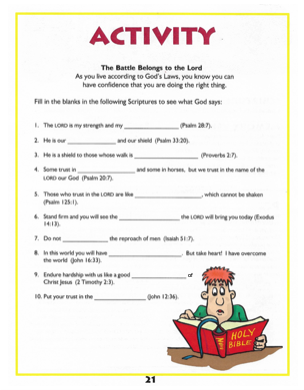
Activity (Student book): The Battle Belongs to the Lord - Time: 20 mins.
Extending the Lesson - REACH Activities:
*Back to the Bible: Consequences, Positive and Negative
*Journal Jot: Facing the Giants
*Word Study: love - agapē
*Just Toolin’ Around: Philistia
*Did you Know? Sticks and Stones
*Stretch It Out: Sword and Shield
*Music Notes: Stand Up, Stand Up for Jesus
*Questions? - Writing Prompt - 10 mins.
Student Prayer
Dear Father,
Help me to stand up for what I know to be right, according to the Bible. Help me to have courage to live as Your child, bringing glory and honor to You.
In Jesus' name.
Amen.
Daily Devotions
Sunday - 1 Corinthians 16:13-14
Monday - 2 Timothy 1:7
Tuesday - Acts 4:19
Wednesday - Acts 5:29
Thursday - Acts 20:22-24
Friday - Genesis 12:1-9
Saturday - Daniel 6:10
Objectives
At the end of this lesson, students will be able to:
1. Retell the story of David and Goliath.
2. Express confidence in doing what's right.
3. Develop a reminder that God is our shield.
Topics & Themes
Courage
David
God’s Protection
Goliath
Honor God
Philistines
Saul
Trusting God
Preparation
There are many misguided zealots in our world, people who are fighting for a cause that has very little to do with God and His ways. But they don't know that. "In fact, a time is coming when anyone who kills you will think he is offering a service to God" (John 16:2). Jesus' words should act as a caution sign for us; we have to stay so in tune with God that we are doing His will. Consistent Bible study, prayer, meditation, fellowship and counsel with godly believers must be a Christian's lifestyle. That way of life has a much better chance of being maintained if begun early. Our children must develop these habits. We have the responsibility to arm them with God and His ways, because the days are evil.
Plan to borrow a book on coats of arms from your local library. Many times the coat of arms was displayed on a shield that the person wore into battle. The family coat of arms told a lot about a family and what was important to them.
How to Teach This Lesson
After opening the class with prayer, follow the lesson plan.
Stand firm activity: In a pie plate, pour water until about half full. Then sprinkle in some salt and some pepper. Tell the students: In this demonstration, the salt represents those people who live by God's ways and who trust Him. The pepper represents people who may live by God’s ways, but who don't trust Him; people who don't live by God's ways; or people who don't know God. Now put one drop of dishwashing detergent in the center of the pie plate. The pepper should immediately scoot to the edges of the pan. Talk about it. Say: People who don't trust God run when trouble comes. That's the wise thing to do. But what did the salt, people who follow God and trust Him, do? The salt is precisely where we put it. God's people stay where God puts them, no matter what scary things come their way. Does that mean they never leave or move out of the way because of danger? No. But when God gives them a job to do, they stay and do it, regardless of what they may face.
David and Goliath: This is such a well-known story. Let the students tell the story. Add details as necessary. Ask: Why did David take five smooth stones from the brook? Commentaries indicate that Goliath had four brothers; David may have been expecting to have to fight them once he killed Goliath.
Personalize: Talk about our lives. How do we know when to run like the pepper and when to stay like the salt? We have to rely on God for direction, through Bible study, prayer, mediation, and counsel from godly people around us. The important thing is to be willing to take a stand for what is right, when God wants us to.
Why take a stand?: The bottom line is, what we do is for the glory of God. He doesn't need us to fight battles for Him. However, as Christians, we must live our lives standing for what is right, not compromising our faith because of peer pressure, fear, or laziness. It would be a very sad thing to live your life so that no one could say at your funeral that they knew you were a Christian. That's not bringing glory and honor to our Lord and King.
God is with you: Sometimes people take a stand, but not on God's side. How do you know when it’s something to take a stand for? Read your Bible, pray, meditate, and get godly counsel. The closer you stay to God, the more you will know what God's ways are and what to stand up for.
Review Questions
1. Who was Goliath?
2. What was the challenge he made to the Israelite army?
3. Why was David in the army camp?
4. What was David's reaction to Goliath's challenge?
5. How did David go armed for battle?
6. What did David tell Goliath?
7. What can we learn from David for living our own lives?
8. How do you know when to stand up for something?
Teacher-Directed Activity
God is My Shield - Psalm 3:3 and Ephesians 6:16 Give each student a full-sized posterboard. Have them design a shield to hang in their rooms at home to remind them to stand up for what is right, to live courageously, and to trust God, who is our shield. They may want to decorate it with Scriptures, especially those from their lesson. Once designed, decorated, and completed, have them cut it out.
Here are the answers to the activity in the Students' book (Scriptures taken from NIV):
1. Psalm 28:7 - shield
2. Psalm 33:20 - help
3. Proverbs 2:7 - blameless
4. Psalm 20:7 - chariots
5. Psalm 125:1 - Mt. Zion
6. Exodus 14:13 - deliverance
7. Isaiah 51:7 - fear
8. John 16:33 - trouble
9. 2 Timothy 2:3 - soldier
10. John 12:36 - light
REACH Activity
Back to the Bible: Consequences
A direct result of David killing Goliath was Saul’s decision to keep David near him permanently (1 Samuel 18:2). Why was Saul allowed to do this? Was there any warning that this could happen? Hint: Read 1 Samuel 8:10-18. Was this a good thing? Were there negative consequences to David living with Saul? What do you think? (This might be a great topic for Friday night family dinner discussion.)
Journal Jot: Facing the Giants
Do you ever feel like you have giants to face in your life? “Giants” can be health conditions (like asthma, blindness, diabetes, etc.), family problems (interpersonal or monetary), relationships with neighbors, or too many things to do. If you feel like you are facing a giant, what’s the first thing you should do? Write a plan of action of how to face your giant, starting with taking the situation to God first. Writing down the particulars of your situation can provide a great deal of clarity and peace as you purposefully turn it over to God.
Word Study: love - agapē
The Greek word translated love in 1 Corinthians 16:14 means “benevolent love. Its benevolence, however, is not shown by doing what the person loved desires but what the one who loves deems as needed by the one loved.” (Source: Zodhiates’ NAS Hebrew-Greek Key Word Study Bible, 1990, G#26). In other words, this kind of love means that you look at the person and give them what they need, not necessarily what they want. You are doing the thing that will benefit them the most in the long run. This is the kind of love that God has towards His people - and the kind of love that we are to have towards the people around us. Can you write about a time when you showed this kind of love to someone?
Then, in your Bible notebook, write this word, its definition, and scripture reference.
Just Toolin’ Around: Philistia
Do some research on the location of the Philistines and where this conflict between the Philistines and the Israelites occurred. Add the information to the map you started for lesson one, if you choose, or create a new map.
Did you Know? Sticks and Stones
When David approached Goliath, Goliath said, “Am I a dog, that you come to me with sticks?” (1 Samuel 17:43) Goliath probably didn’t see the true weapon - the sling. According to the ESV Study Bible footnotes (2008, p. 521), “Slings were known as weapons in Egypt from at least the beginning of the second millennium B.C., and slingers are pictured on the reliefs at Nineveh.”
Stretch It Out: Sword and Shield
In your sabbath lesson, you will likely be making a shield. A shield is a great defensive tool. But sometimes you need an offensive tool as well. David used a slingshot. In the story of Gideon, they used torches and trumpets. But most times, battles require a sword. When you think of the Bible and swords, what comes to mind? There’s a verse in Hebrews 4:12 that says, “For the word of God is alive and active. Sharper than any double-edged sword, it penetrates even to dividing soul and spirit, joints and marrow; it judges the thoughts and attitudes of the heart” (NIV). The Bible, God’s word, is sharper than any sword! What does that mean to you? Using posterboard, create a sword, cut it out, cover it with aluminum foil for the blade, paint the handle, then put your memory verse or the verse from Hebrews 4:12 (or another verse) on the sword to remind you to trust God for your protection and to show you how to fight your battles.
Music Notes: Stand Up, Stand Up for Jesus
This hymn is on page 23 of the CEM Hymnal.
There was a great revival in Philadelphia in 1858. One of the participating preachers was Dudley Tyng, a bold 29 year-old. He began holding noonday services at a YMCA in downtown Philadelphia. One Tuesday in March, over 5000 young men attended that meeting and 1000 of them committed their lives to Christ. Dudley Tyng was preaching on serving God. At one point he had said, “I must tell my Master’s errand, and I would rather that this right arm were amputated to the trunk than that I should come short of my duty to you in delivering God’s message.” The very next week, he was visiting in the country and watching a corn threshing machine. His sleeve was accidentally caught in the machinery between the cogs and his arm severely cut, including the main artery. Seriously injured, his friends surrounded his bed. Dudley feebly whispered, “Let us all stand up for Jesus.” The shock and loss of blood killed him. The following Sunday, his close friend, George Duffield, preached a sermon in tribute to Dudley. He closed the sermon with the poem that we now sing as “Stand Up, Stand Up for Jesus.” (Source: Amazing Grace, Kenneth Osbeck, 1990, p. 310)
As you sing this hymn, think of the passion this young man had in sharing the gospel of Jesus Christ with others. He was determined to make a difference in people’s lives by serving God wholeheartedly. Write down your favorite lines from this hymn in your Bible notebook.
Questions?
Write down any questions you have in your Bible notebook so that you can remember to ask your parents or your pastor.
Song
"Onward, Christian Soldiers" is on page 26 of Kids Classics Collection.
Note: See the REACH Music Notes for in the Junior book Building a Firm Foundation (YE3J), Lesson 8, for background information on “Onward Christian Soldiers.”
Closing Prayer
Lead the students in prayer asking God to help them discern what is good and right, what to stand up for, and to live courageously for God.
Printable Pages