YEA Lesson Library
Come A-Runnin’
About This Lesson
Using the story of God calling Samuel, the student will learn that obedience to parents and God is important and pleasing to God.
Scriptures
1 Samuel 3:1-21
Matthew 4:18-22
Mark 1:16-20
John 15:6
Acts 13:22
Romans 1:1-6
1 Corinthians 1:2-9
2 Thessalonians 2:13-14
Hebrews 12:1-2
Words to Know
PERSEVERANCE - to keep going even when things get tough
SUBMIT - to do what someone else wants when it's not what you want
ATTESTED - to state without doubt to be true or genuine
The Lesson
Patti watched as the puppies fell all over themselves as they played. They were so cute. But she was going to have to start working with them soon. She was going to have to teach them all sorts of things. Patti filled their water bowls and food dishes. Then she called the puppies. They ignored her. But Lady, the puppies' mother, came. When the puppies saw their mother get up, they followed. Patti knew it wouldn't be long before the puppies would learn to come when she called.
Samuel was growing up at the Tabernacle, serving God under the priest, Eli's, direction. If you remember, Samuel had been given back to God by his mother, Hannah, because Hannah had asked for a baby. God had answered Hannah. So Hannah kept her promise to the Lord. In those days, there were not many messages from God directly to his prophets and priests.
Very early one morning, Samuel was sleeping in the Tabernacle as usual, when God called to him. Samuel got up, ran to Eli, and said, "Here I am." Eli told Samuel he hadn't called him. Then he told Samuel to go lay down again. A second time, God called Samuel. Again, Samuel went to Eli, saying, "Here I am. You called me." Eli told him again that he hadn't called and that Samuel should go lay down. The third time God called Samuel, he went to Eli, saying, "Here I am; you called me.” This time Eli realized that God was calling Samuel. So he told Samuel that if He called again, Samuel was to say, "Speak, LORD, for your servant is listening." So Samuel did that. The Lord came and stood there, calling, "Samuel, Samuel." Samuel answered, “Speak, for your servant is listening.." Samuel was ready to listen to God.
What about you? Are you ready to listen to God? Before you answer yes or no, think about how you answer your parents. When your mom calls you in for supper, do you Come A-Runnin’? When your dad says, "Wash up. It's bedtime," do you obey immediately? Most children don’t. Many children are so busy doing whatever they are doing, they wait until they are ready to obey. What about at school? When the recess bell rings to go outside, you run, right? But what about when it rings to tell you recess is over? Do you run to get back to your classroom? Or do you walk as slowly as you can?
Think about what Samuel did. It was very early in the morning when God called him. He must have been sound asleep. But what did he do? He ran to Eli to see what he wanted. And he didn't go just once, he went three times!
If you are in the habit of obeying your parents and your teachers immediately, then there's a good chance you're ready to listen to God and to obey Him too. If you can't obey your parents and teachers, the people you can see, then there's not much chance you're going to obey God, who you can't see.
Okay. So what's the big deal about obeying immediately? It shows that you are completely willing to do what you are told. It is called submitting your will. If you practice submitting your will to your parents, then you will have a much easier time submitting your will to God. And God wants each one of His people to learn to submit to His will. He wants us to want to do things His way.
It is not easy to learn to submit your will to God's will. But it will be easier for you to learn to submit to God if you can submit to your parents now. Practice every day. When your parents ask you to take out the trash, do it. When your parents ask you to dry the dishes, do it. And, when you obey, do it without complaining!
Pretty soon, you'll find that you are obeying them before they even have to ask. You're ready to dry dishes after supper, before your Mom asks. And you surprise her by helping to clear the table too. You take out the trash before your Dad asks you to. You make your bed before you come to breakfast. Can you imagine the surprise and joy on your parents' faces? It is fun to please your parents.
It's a lot of fun to please your Heavenly Parent too. God is well pleased when we obey His commandments immediately. When we are willing to do as He says, He can use us in so many ways! Look at Samuel. Even though Eli was getting old and his sons were very wicked, Samuel continued to listen to God and follow God's ways. 1 Samuel 3:19-21 says “The LORD was with Samuel as he grew up, and he let none of his words fall to the ground. And all Israel from Dan to Beersheba recognized that Samuel was attested as a prophet of the LORD. The LORD continued to appear at Shiloh, and there he revealed himself to Samuel through his word."
In fact, Samuel was one of the greatest judges Israel ever had. Because he had the willingness to Come A-Runnin' when God called, he became a great leader for Israel.
What about you? Do you have willingness to Come A-Runnin' when your parents call? When God calls? If you do, you too could be a great leader in service to God.
Activity
Teaching the Lesson:
Legacy Lesson: Student book/Teacher book - Teaching Time: 25 mins.
Lesson Prep - Teacher book - Time: 30 mins.
Activity (Teacher book): Discussion - 20 mins.
Song: "Jesus Wants Me For a Sunbeam" - page 21 of Kids Classics Collection - Time: 5 mins.
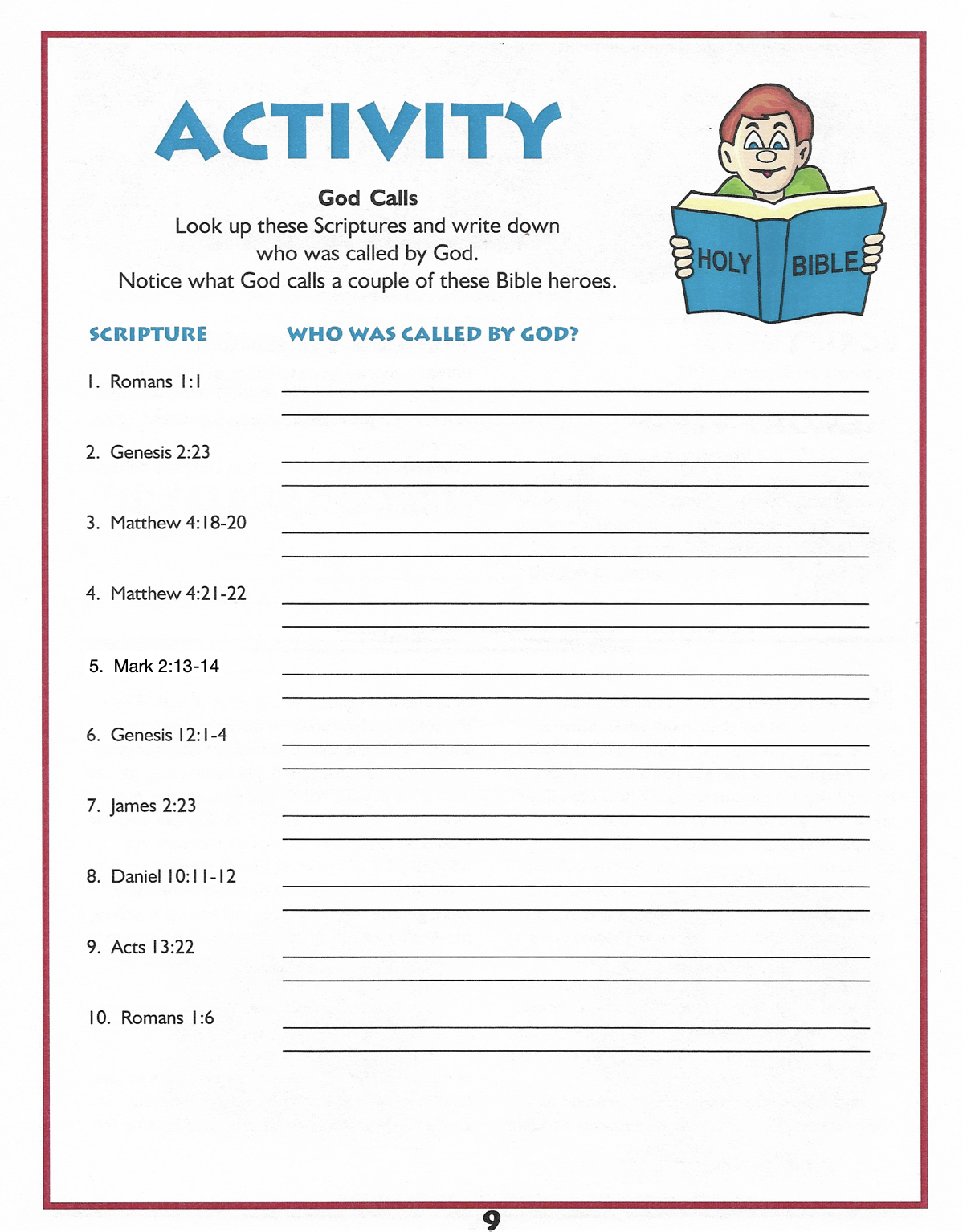
Activity (Student book): God Calls - 20-25 mins.
Extending the Lesson - REACH Activities:
*Back to the Bible: Come
*Journal Jot: Test of Relationship
*Word Study: race - agōn
*Just Toolin’ Around: Come
*Did you Know? Timing
*Stretch It Out: Scorecard
*Music Notes: Here I Am, Lord
*Questions? - Writing Prompt - 10 mins.
Student Prayer
Dear Heavenly Father,
Help me learn to obey my parents immediately and cheerfully. I want to learn to serve You too.
In Jesus' name.
Amen.
Daily Devotions
Sunday - Romans 1:1-6
Monday - John 15:6
Tuesday - Matthew 4:18-22
Wednesday - Mark 1:16-20
Thursday - 1 Corinthians 1:2-9
Friday - 2 Thessalonians 2:13-14
Saturday - Acts 13:22
Objectives
At the end of this lesson, students will be able to:
1. Describe Samuel's reaction to God calling him.
2. State the importance of obeying his/her parents immediately.
3. Explain why we obey God.
4. Explain how obedience leads to usefulness.
Topics & Themes
Attitude
Eli
God’s Commands
God’s Voice
Light
Obedience
Relationship With God
Samuel
Tabernacle
Preparation
Make a set of cards with parental directions and child responses emphasize attitude. Here are a few suggestions, and you may wish to add your own.
1. Parent: Take out the trash.
Child: Aw, Mom, I wanted to watch my video (grumbles).
2. Parent : Take out the trash.
Child: OK (but moves slowly and reluctantly).
3. Parent: Take out the trash.
Child: OK (but does so angrily, with noise and banging).
4. Parent: Take out the trash.
Child: OK, Mom (moves quickly, quietly, respectfully).
5. Parent: Take out the trash.
Child: Already done, Mom.
Variations: Make your bed, pick up your room, brush your teeth, get ready for bed, do your homework, take the dog outside.
How to Teach This Lesson
After opening the class with prayer, follow the lesson plan.
Role play with attitude - Using the cards from Preparation, ask for a volunteer to play "Mom" and one to play the child. Allow the same student to do each scene to get the feel for different responses. Switch off and run through another situation. After everyone gets to play the child and the parent once, debrief. Ask them what felt good for the child. Ask what the parent felt in each situation.
Retell Samuel's story - Remind the students that Samuel was still very young, and why. Talk about God calling him, how many times God called before Eli realized who it was, and what kind of attitude Samuel had when responding. Also talk about the fact that the lamp of the Lord had not yet gone out in the Temple. It was against God's law to allow the lamp to go out. That Eli was allowing it to go out is a strong indication that Eli was not as godly as he should have been. Eli's sons were definitely not righteous. It is interesting that, in that environment, Samuel grew up knowing and loving God, an attested prophet in Israel. Furthermore, he was one of the greatest judges that Israel ever had. Samuel's willingness to obey, to come when he thought Eli was calling him, is a strong indicator of Samuel's subsequent willingness to serve God wholeheartedly.
Obeying parents and authority figures - God gives us physical examples so we can understand our relationship with Him more fully. 1 John 4:19-21 says that we can't love God (who we can't see) if we don't love our brother (who we can see). Similarly, if we don't show love, honor, respect, and obedience to our earthly parents (who we can see and who can punish us immediately), we won't show love, honor, respect, and obedience to our Heavenly Parent (who we don't see and who doesn't punish us in obvious ways).
Benefits to obedience - Our willingness to obey our parents pleases them. They are likely to give us more responsibility and freedom. Our willingness to obey our Heavenly Parent pleases Him. He is then able to give us more responsibility in serving Him. Someday this age group will understand that anything outside of living for God is meaningless. They might not completely understand, but emphasize that even the wisest man outside of Jesus Christ, Solomon, tried it all and found that it is all meaningless, a chasing after the wind. Only God the Father and Jesus Christ, their will, and service to them are important.
Review Questions
1. What did Samuel do when he heard God calling him in the very early morning?
2. How many times did Samuel goto Eli before Eli realized it was God?
3. Why is it important to obey your parents and others in authority over you?
4. What does it mean to submit?
5. Why does our obedience make us so valuable to God?
6. What role did Samuel play in the lives of the Israelites?
Teacher-Directed Activity
In the Students' Activity, they looked up the following Scriptures and wrote down who God was calling in each instance. Some of the verses also talk about what God called the person. Talk about the calling each person received from God--the role each
played/is playing in God's plan.
1. Romans 1:1 (Paul)
2. Genesis 2:23 (woman - Eve)
3. Matthew 4:18-20 (Peter and Andrew)
4. Matthew 4:21-22 (James and John, sons of Zebedee)
5. Mark 2:13-14 (Levi, also called Matthew)
6. Genesis 12:1-4; Hebrews 11:8 (Abraham)
7. James 2:23 (Abraham called God's friend)
8. Daniel 10:11-12 (Daniel called Highly Esteemed, Greatly Beloved)
9. Acts 13:22 (David called a man after God’s own heart)
10. Romans 1:6 (YOU!)
REACH Activity
Back to the Bible: Come
The Hebrew words that are translated “Go” in Genesis 7:1 and Genesis 12:1 can both mean “go” or they can mean “come.” You have to figure out which word to use in translating them by the context. What if God told Noah to come into the ark, instead of go into the ark? What if God told Abram to “come to a place I will show you,” rather than “go to a place I will show you”? It changes the whole feeling, doesn’t it! What if God was telling Noah and Abram to come to Him? Now, read Matthew 11:28-30. Write a reaction to this in your Bible notebook.
Journal Jot: Test of Relationship
There was a story about a dog who had been stolen. When the real owner found the dog and the thief, it was his word against the word of the thief. The police officer used some of Solomon’s wisdom. He put the dog at one side of the yard and the two people on the other side. Then he told them to call the dog. The dog went directly to its owner. Why? The dog had a relationship with his owner. He wanted to go because of the bond they shared.
God wants a relationship with you. He blesses you and provides for you. He protects you and guides you. How do you respond? Do you just take everything He gives and ignore Him? Or do you value the relationship and seek to do His will. God wants you to seek Him in prayer and Bible study. If He called you, would you come? Write about this topic in your Bible notebook.
Word Study: race - agōn
The Greek word for race in Hebrews 12:1 means race, but with the connotation that it will be a struggle; it will require extreme effort; it will not be easy. (Source: Zodhiates’ NAS Hebrew-Greek Key Word Study Bible, 1990, G#73)
Following Jesus Christ requires effort and perseverance. It wouldn’t have been easy for Hannah to give up Samuel. It wouldn’t have been easy for Samuel to have been raised by Eli, instead of living with his family. But the end result was worth the effort. Similarly, we are called to run with endurance in order to reach the goal of living in God’s kingdom. Write this word, its definition, and the scripture reference in your Bible notebook.
Just Toolin’ Around: Come
Using a concordance or other reference tool, find other places in the Bible where God calls to His people or says “Come,” i.e. “Come, let us reason together” (Isaiah 1:18). Find at least five. They can be in the Old Testament or in the New Testament.
Did you Know? Timing
By putting various scriptures together, scholars have determined that Samuel’s birth was nearly 400 years after the Israelites had entered the Promised Land and begun its conquest under Joshua. Make a timeline which shows Joseph’s family moving to Egypt, being there for 400 years, 40 years in the wilderness, and 400 years from entering the Promised Land to Samuel’s birth. It’s hard to know the exact date. Estimates range from 1120 - 1070 B.C. for Samuel’s birth. Regardless, it’s important to get a general idea of when events happened.
Stretch It Out: Scorecard
If someone asked you how you respond when your parents ask you to do something, you might shrug and say that you do ok. But do you really? Sometimes it helps to create a scorecard to keep track of your own behavior. Make a chart - times along the left side, going vertically; chores along the top, going horizontally. Write down the things your parents ask you to do along the time. Document the time and your response going down. If you respond positively and immediately, give yourself an A, a smiley face, or two plus marks. If you agree and obey, but not enthusiastically, give yourself a B, a grimace face, or one plus mark. If you do it but grumble, give yourself a C, a sad face, or a checkmark. If you have to be reminded and you reluctantly obey, give yourself a D, a frowning face, or a minus sign. If you refuse to obey, give yourself an F, a mad face, or two minus sings. At the end of the week, look back. How well did you do? Did keeping track help you be more obedient?
Music Notes: Here I Am, Lord
This hymn is on page 134 of the CEM Hymnal.
This popular hymn was composed by Daniel Schutte in 1979. Mr. Schutte was a 31-year-old Jesuit studying theology in Berkeley, Calif., when one of his friends asked him to write a song for an upcoming diaconate ordination Mass. “I sort of had to catch my breath, because he was knocking on my door on Wednesday and I knew the ordination was on Saturday,” Mr. Schutte . . . “His friend wanted the song to include the images of the word of God, the light of Christ and the bread and wine— images that would eventually appear at the ends of the verses: “Who will bear my light to them?” “Who will speak my word to them?” At the time, Mr. Schutte had no idea how to work the images into the song. He recalled thinking, “Gosh, I don’t know what to do with that.” On top of the short notice, Mr. Schutte had been suffering from the flu for several days. He sat at his desk with his guitar and a blank sheet of staff paper in front of him, praying, “God, if I’m going to do this for my friend, you’re going to have to help me.” . . .Mr. Schutte sketched out “Here I Am, Lord” over the course of two days. On Friday evening, he walked to his friend’s house to deliver the song, pencil in hand, scribbling edits along the way. “At that point,” he told me, “I really had no sense that the song would be any good, and I was actually very nervous.” . . .Mr. Schutte said he does not remember much from the diaconate ordination, except that people seemed to relate to the song. “I couldn’t figure it out,” Mr. Schutte said. “If only they knew the story of the last two days of my life trying to make this work!”
(Source: https://www.americamagazine.org/faith/2017/10/12/here-i-am-lord-little-known-story-behind-catholic-hit)
What do you think of this hymn? Are you willing to come if God calls you to a certain job or service? Sing this hymn and think about your response.
Questions?
Write down any questions you have in your Bible notebook so that you can remember to ask your parents or your pastor.
Song
"Jesus Wants Me For a Sunbeam" is on page 21 of Kids Classics Collection.
Closing Prayer
Lead the students in prayer asking for God's help in learning to obey their parents and in learning to obey God.
Printable Pages