YEA Lesson Library
Keep Your Word
About This Lesson
Using the story of Hannah’s prayer for Samuel, this lesson teaches that we must be careful what we say and be sure we fulfill our promises.
Scriptures
1 Samuel 1:1-28
Psalm 15:4
Psalm 98:1-9
Psalm 109:13-16
Psalm 146:6-8
Ecclesiastes 5:2
Ecclesiastes 5:1-6
Titus 2:14
Hebrews 6:17-20
Revelation 19:7-11
Words to Know
INCONSOLABLE - not able to be comforted or to feel better
VOW - promise, your word
PURIFY - to make clean
HASTY - too quickly, without thinking through the consequences
UTTER - to speak, to say something
The Lesson
Jonathan and Christopher love to play outside together. But they often have trouble deciding what they are going to play first. Jonathan loves baseball. Christopher loves riding bikes, but baseball isn't very high on his list of things he likes to do. The other day the boys were outside. It was one of those very nice days in late fall - like a last chance to play before snow covered the ground. Jonathan wanted to play baseball so badly. The Cardinals had just won the World Series. He wanted to relive the whole experience in his own make-believe game. Christopher didn't. Finally, Jonathan said, "If you play baseball with me, I promise I'lI bike ride with you when the game is over." Christopher agreed. After playing for about 45 minutes, the boys headed for their bicycles - just as Mom called them inside. Christopher was inconsolable. He had played baseball! Jonathan had promised they would ride bikes! Now they couldn't because they had to go inside!
There's a story in 1 Samuel 1 of someone else who was inconsolable. Hannah wanted a baby. She had been married to Elkanah for many years, but she had never had a baby. What was worse, Elkanah was also married to Peninnah, and Peninnah had children! Every year when Elkanah would go up to Shiloh to sacrifice to God, he would give portions of the meat to his family. Because he loved Hannah, he would give her a double portion of the meat. But Peninnah would make fun of Hannah until she cried and couldn’t eat. Then Elkanah would ask Hannah why she was crying and was so upset. "Don't I mean more to you than ten sons?" he would ask.
One year when they all were at the Tabernacle, Hannah was so upset that she cried and prayed to God. She promised that if God would give her a son, she would give him to the Lord all the days of his life and, like Samson, a razor would never be used on his head. This was a vow that the baby would be in a special relationship with God all the days of his life. As Hannah prayed, her lips were moving because she was so intent on her prayer and promise to God. Eli, the priest, thought she was drunk and he told her to quit getting drunk and to get rid of her wine.
Hannah told Eli that she wasn't drunk. She told him she was deeply troubled, and was praying to God out of her anguish and grief. Then Eli told her to go in peace. He said, "May the God of Israel grant you what you have asked of him." Hannah left the Tabernacle with hope. When she and her family returned home, God remembered her. Hannah became pregnant. When the baby was born, she named him Samuel, and said, "Because I asked the Lord for him." Samuel sounds like Hebrew for "heard of God."
For a few years after Samuel was born, Hannah did not go up to Shiloh to worship with the rest of the family. She told Elkanah that she would take Samuel to the Tabernacle, present him before the Lord, and leave him there - but she wanted to wean him first. Elkanah told her that was okay, but he cautioned her that she had to fulfill her vow to God.
When Hannah had weaned Samuel, she took him along with an offering to God to Shiloh. She brought a very young Samuel to Eli, and told Eli the whole story. She told him that because God had given her what she had asked, she was now giving Samuel to the Lord for his whole life. And she left him at the Tabernacle with Eli.
It would be a very difficult thing to want a baby so badly and then have to give the baby up. But Hannah had promised God that was exactly what she would do. Do you think Hannah didn't love Samuel? Hannah did love Samuel, but she had made a promise and she had to keep it, even though it cost her son.
Does God really expect us to keep our promises? Yes, He does. Ecclesiastes 5:4-6 says, "When you make a vow to God, do not delay in fulfilling it. He has no pleasure in fools; fulfill your vow. It is better not to vow than to make a vow and not fulfill it. Do not let your mouth lead you into sin. And do not protest to the temple messenger, ‘My vow was a mistake.' Why should God be angry at what you say and destroy the work of your hands?" Why would God be angry when we do not keep our promises? First of all, God always keeps His promises. Psalm 146:6 says that the LORD "remains faithful forever." In fact, because it is impossible for God the Father and Jesus Christ to lie (Hebrews 6:18), one of the names of Jesus Christ is "Faithful and True" (Revelation 19:11). And that's what God wants from His people too. Our holy and righteous and good God is preparing a place for His people to live with Him forever. The good news is that God sent His Son, "Jesus Christ, who gave himself for us, to redeem us from all wickedness and to purify for himself a people that are his very own, eager to do what is good" (Titus 2:14). God is working in your life to teach you how to be like Him. Keeping your promises is one way to be like God.
It is sin to make a promise and then not keep it! So, think before you speak. And think very carefully before you promise anything. "Do not be quick with your mouth, do not be hasty in your heart to utter anything before God. God is in heaven and you are on earth, so let your words be few."
Activity
Teaching the Lesson:
Legacy Lesson: Student book/Teacher book - Teaching Time: 25 mins.
Lesson Prep - Teacher book - Time: 20 mins.
Activity (Teacher book): 20 mins.
Song: "I Will Sing of the Mercies of the Lord Forever" - page 17 of Kids Classics Collection - Time: 5 mins.
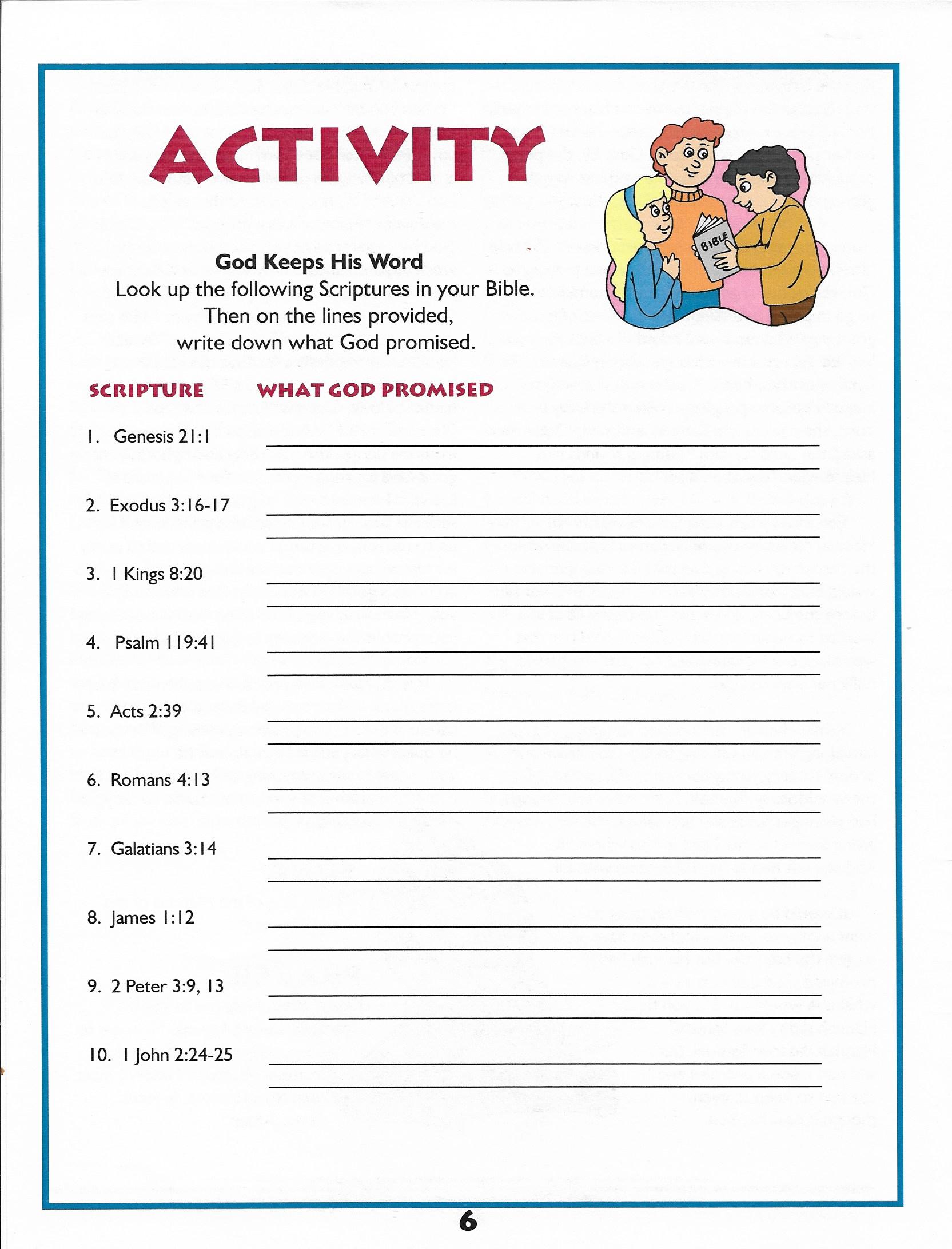
Activity (Student book): God Keeps His Word - Time: 20-25 mins.
Extending the Lesson - REACH Activities:
*Back to the Bible: The Rest of the Story
*Journal Jot: Keeping Your Promises
*Word Study: words - dâbâr
*Just Toolin’ Around: Ramah
*Did you Know? Childless
*Stretch It Out: Praising God
*Music Notes: In My Heart There Rings a Melody
*Questions? - Writing Prompt - 10 mins.
Student Prayer
Dear Father,
Help me to think carefully before I speak. Help me to be especially careful about what I promise - because I know I must keep my promises.
In Jesus’ name.
Amen.
Daily Devotions
Sunday - Ecclesiastes 5:1-3
Monday - Psalm 15:4
Tuesday - Psalm 146:6-8
Wednesday - Hebrews 6:17-20
Thursday - Psalm 98:1-9
Friday - Revelation 19:7-11
Saturday - Psalm 109:13-16
Objectives
At the end of this lesson, students will be able to:
1. Retell the story of the birth of Samuel.
2. Describe one of the character traits of God - faithfulness.
3. Explain the seriousness of making a promise.
4. Explain that God considers a promise binding.
5. Conclude that we all need to be very careful of what we say.
Topics & Themes
Children
Eli
God’s Promises
Hannah
Prayers, answered
Promises, Oaths
Samuel
Vow
Women
Hannah
Preparation
Most of us have been taught in the Greek style of education: sit and listen to the teacher. Unfortunately for most of us, that does not match our predominant learning style - the way in which we learn best. If we only get to learn one way, most of us are visual learners. We appreciate pictures and visual aids. But truly, we all learn best if we can get all of our senses involved: listening, seeing, touching, and moving. Because our children are so valuable to us, because we want them to really come to know Jesus and be in a covenant relationship with Him, please make every effort to get out of what may be your comfort zone of Greek style education: don't preach to the students. Get them involved.
Ten-Week Challenge: Challenge the students to read as many chapters of the Bible as they can in ten weeks. Then design a project to show how many books they've completed. It could be a drawing with the names hidden in the drawing; a mobile with each dangling piece bearing the name of a book; a jigsaw puzzle with the names of the completed books; a chart; etc. The presentation is not the big thing; the focus is on how many chapters and books they actually read. Plan to provide prizes.
How to Teach This Lesson
After opening the class with prayer, follow the lesson plan.
Establish the reason for keeping promises - Tell the students that in the settling of this country, an unspoken maxim (or rule governing everyday life) was that a man was only as good as his word. Tell them that you want to demonstrate what that means. Ask for a volunteer. Have the student grasp your hands and lean back as far as they can while you are holding their hands. Be sure to plant your feet and maintain a good grip. Once the student is completely off balance and is only saved from falling because you are holding on, tell them that keeping your promise, fulfilling your vow, living up to your word - those phrases all mean that the other person can trust that you will do what you say you will. Is there ever a time when it wouldn't matter if you kept your word? Not really. Say: Even if I was holding (student's name) inches from a couch, where he/she wouldn't be hurt, it is a matter of trust. After I've promised that I won’t let go, no matter what, if I do let go, it damages the trust. Then the next time we do this, (student’s name) won't trust me. In big projects, like the settlement of a country, when people depend upon each other daily - for their very lives - if you can't be trusted, you aren't worth very much as far as how valuable you are to the success of the project.
Hannah and Samuel - Ask the students to tell you the story of Samuel. Prompt them with leading questions, if necessary. Then ask: How could Hannah give up Samuel? Talk about how Hannah would have felt the next day, in ten years, in 20 years. Remind the students that Samuel became the last great judge in Israel; he anointed Saul and David as kings over Israel. He was very important to God and to God's people. By keeping her promise, Hannah greatly and positively impacted the entire nation of Israel for decades.
God's perspective - This may seem very harsh to you, but think about 1 Peter 1:19-20. Jesus was slain from the foundation of the world; that is, He and the Father planned when they were creating the world for Jesus Christ to become the Savior and be sacrificed for all who believe! That's a long time to watch the events of history before Jesus' birth and know that the sins would be laid upon Jesus' shoulders. Praise God that He keeps His promises!
To be like God - God is preparing for Himself a people. Titus 2:14 says He's purifying His people, that we will be eager to do what is right. God's definition of right includes keeping your promises. God keeps His promises - so much so that Jesus Christ is called Faithful and True, and the Way, the Truth, and the Life. Keeping promises--being faithful--is an integral part of God's character. And that's what He wants from His people too.
What about us? - Tell the students that you know some of them are probably thinking that because they are just kids, no one expects them to keep their promises. Yes! We do. And God does. Have them recite their memory verse. Those are good words to live by. "God is in heaven and you are on earth, so let your words be few."
Review Questions
1. Why was Hannah so upset at the beginning of 1 Samuel 1?
2. What did Hannah vow to God?
3. How did Hannah keep her promise to God?
4. How do we know that God keeps His promises?
5. What is one of the names of Jesus that shows that He keeps His promises?
6. How do we know that God wants us to keep our promises?
7. Is breaking a promise a sin?
8. What does Solomon say about making a vow?
Teacher-Directed Activity
Promise Perusal and Sword Search
In the Students' Activity, they were to have looked up Scriptures and written down a summary for each of the promises given by God. Use them as a sword drill. Everyone starts with their Bible closed. When the Scripture reference is called, everyone looks for that Scripture. The first student to get to the Scripture stands and reads it aloud. Once the Scripture is read, check the students' understanding of what it means.
Then continue with the next Scripture. Scriptures used in the Students' Activity: Genesis 21:1; Exodus 3:16-17; 1 Kings 8:20; Psalm 119:41; Acts 2:39; Romans 4:13; Galatians 3:14; James 1:12; 2 Peter 3:9, 13; 1 John 2:24-25
REACH Activity
Back to the Bible: The Rest of the Story
1 Samuel 1 is not the whole story. When you read 1 Samuel 2:1-10, you realize that Hannah has a different perspective. She is praising the Giver, not mourning that she’s lost the gift. In fact, read 1 Samuel 2:21. Because of her thankfulness towards God, what did He give her? Additionally, she was the mother of a man who was huge in Israel’s history. Write down several of the things Samuel did during his life in your Bible notebook.
Journal Jot: Keeping Your Promises
As upset as Christopher was about Jonathan not being able to keep his promise, it turned into a very good object lesson. We spent a long time talking about being careful with your words, i.e. not promising something you can’t absolutely do. The boys learned that their dad meant exactly what he said; if he said he would try to do something, that was about as good a guarantee as they could hope for. Rarely did their dad ever tell them that he would do anything - because he didn’t want to say something that he wouldn’t be able to fulfill. He would say, "I will try to do that" or "I intend to get that done." What about you? Do you tell people that you’re going to do something and then forget? Do you promise and then break that promise? The verses in Ecclesiastes 5 should serve as a warning to each of us to be very careful about what we say. Write about this in your Bible notebook.
Then write a follow-up. How could Jonathan have still kept his promise to his little brother?
Word Study: words - dâbâr
The word in Ecclesiastes 5:2 that is translated “words” occurs more than 1400 times in the Old Testament and is translated into 85 different English words, like word, saying, speech, news, command, promise, thing, incident, occurrence, history, concern, cause, question, and lawsuit. Sometimes it “is what is done, and sometimes it is a report of what is done, an account of the actions.” It essentially means “word” or “matter” or “thing.” And it is the same word that is used when speaking of the Ten Commandments, or Ten Words. In your Bible notebook, write this word, its definition, and where it is found.
Just Toolin’ Around: Ramah
Elkanah and Hannah lived in Ramah. Using a Bible map resource, print a map of Israel. Pinpoint where Ramah was/is in relationship to Shiloh, Jerusalem, and Bethlehem. File this map in your Bible notebook.
Did you Know? Childless
According to the ESV Study Bible (2001, p. 491), Hannah was likely married to Elkanah first because her name is listed first. “Presumably he married Peninnah because Hannah was barren; lack of an heir was a major problem in the ancient Near East, as in many other societies. Taking a second wife was one way to try to solve the problem . . . Elkanah’s pedigree suggests that it would be important to him to have an heir to continue the family and also that he was prosperous enough to afford a second marriage.”
In your Bible notebook, compare the value of children in that society to how much we value children today. Is there a difference? Why or why not? How important do you think children are to God? Can you think of a verse that would support your belief?
Stretch It Out: Praising God
Hannah gives us a remarkable example of praising God, the Giver, rather than focusing solely on the gift. Every day this week, write down five things that you praise God for. Make sure that each day, they are five new things. Remember to thank God for the blessings He has given to you.
Music Notes: In My Heart There Rings a Melody
This hymn is on page 127 of the CEM Hymnal.
This hymn was authored and composed by Elton M. Roth (1891-1951), a talented musician who was involved with music in some way all of his life. He directed church choirs, studied music, traveled with several evangelists as their song leader and choir director, and taught at several different Bible schools and colleges. Although he published several anthems and over 100 sacred songs, this one hymn is the one which is still sung in churches.
It was written in 1923 while Elton Roth was involved in evangelistic meetings in Texas. He wrote, “One hot summer afternoon, I took a little walk to the cotton mill just outside of town. On my way back through the burning streets of this typical plantation village, I became weary with the oppressive heat, and paused at a church on the corner. . . . The door being open, I went in. There were no people in the pews, no minister in the pulpit. Everything was quiet, with a lingering sacred presence. I walked up and down the aisle and began singing, “In My Heart There Rings a Melody,” then hurried into the pastor’s study to find some paper. I drew a staff and sketched the melody, remaining there for an hour or more to finish the song, both words and music. . . . That evening I introduced it by having over two hundred boys and girls sing it at the open air meeting, after which the audience joined in the singing. I was thrilled as it seemed my whole being was transformed into a song.” (Source: 101 More Hymn Stories, Kenneth Osbeck, 1985, p. 148)
Does your heart sing with a melody in thanksgiving to God? Write a poem of thanksgiving to God. If you feel so inspired, set your poem to music. Share it with your family.
Questions?
Write down any questions you have in your Bible notebook so that you can remember to ask your parents or your pastor.
Song
"I Will Sing of the Mercies of the Lord Forever" is on page 17 of Kids Classics Collection.
Closing Prayer
Lead the students in asking for God's wisdom in making promises and asking for His forgiveness for promises that they have hastily made and not kept.
Printable Pages