YEA Lesson Library
Changing of the Guard
About This Lesson
This lesson explains the transfer of leadership from Moses to Joshua and the reason behind the transfer.
Scriptures
Numbers 20:9-13
Deuteronomy 1:37-40
Deuteronomy 31-34
Daniel 2:20-23
Daniel 2:21
Words to Know
DEPOSE - to remove from a throne or other high position
PROSPEROUS - success or financial well-being
DISCERNING - to show understanding
TESTIFY - to bear witness, to show as evidence
The Lesson
Mary Ann was riding her favorite horse, Chip, when he suddenly shied at a tumbleweed. As Chip shot sideways, Mary Ann lost her balance and fell awkwardly to the ground. Pain radiated through her leg. She knew she'd probably broken a bone. She wiped the tears from her eyes and noticed Chip trotting towards home. When he showed up without her, someone would come looking for her. Hopefully soon!
Hours later, Mary Ann hobbled across the kitchen on her new crutches. There was no way she was going to be able to lead the youth hike up the mountain on Sunday. Who could take over for her? Quickly she bowed her head and prayed. "Dear Heavenly Father, I know that all things work together for the good for those who love You and are called according to Your purpose. I really wanted to lead the hike this Sunday. Would You please show me who will have to do it instead? Thank You for loving me. In Jesus' name. Amen." Many Ann was suddenly at peace.
Hours later, Mary Ann's older brother, Greg, grumbled loudly as he stomped into the kitchen. Mary Ann asked him what was wrong. He replied, "Our canoe trip for Sunday was canceled because the twins caught the flu. Now what am I going to do with my Sunday?" Mary Ann knew. Confidently, she asked her brother, "How would you feel about leading the youth hiking trip up the mountain?" Her peace couldn't have been any deeper when Greg agreed to take her place. God had provided the perfect person to take her place.
Moses was not going to be able to lead the children of Israel into the Promised Land. He was 120 years old. But it wasn't that Moses was too old or too weak. Moses had disobeyed God and had not upheld God's holiness among the people at Meribah Kadesh. So God told Moses, "Therefore, you will see the land only from a distance; you will not enter the land I am giving to the people of Israel" (Deuteronomy 32:52, NIV).
Before Moses died and the people crossed the Jordan River into the Promised Land, several things had to happen.
First, Moses told the people who God had chosen to lead them. God had chosen Joshua. Moses told the people, "Be strong and courageous. Do not be afraid or terrified because of them, for the LORD your God goes with you; he will never leave you nor forsake you." Then, Moses told Joshua also to be strong and courageous. He had to lead the people to divide the land among them.
Secondly, Moses gave the law to the Levites and the elders. He wanted them to read the law to the people every seven years during the Feast of Tabernacles. That way the people would hear it and learn to fear the LORD as long as they lived in the land.
Then Moses told the people it wouldn't be long before they would be so content and prosperous that they would turn from God and begin to sin against Him. So God gave Moses a song to write down and teach to all the people. It would testify against them, telling them that God knew they would turn from Him. The song would tell of the disasters that would come on them because of rejecting God.
After telling the people what they would do, Moses blessed each of the tribes. Then he climbed Mount Nebo. From there he could see the Promised Land. And there, Moses died.
The people mourned for Moses for 30 days. Then Joshua was filled with the spirit of wisdom because Moses had laid his hands on him (Deuteronomy 34:9). So the people listened to Joshua and did what he said.
But this is just a story about Moses' death. Right? It doesn't have anything to do with us today, does it? Well, there are at least a couple of things for us to learn.
First, just because God puts us in charge, we still have to be careful to do what He says. If we don't follow Him, He'll take us out of that leadership position. God does have other people who can be leaders, people who will follow Him.
So we need to be constantly on guard that we keep Jesus Christ first in our lives, especially when things are going well and we're on top of the world. That's when we have the greatest tendency to be careless about seeking God. When things are terrible, that's when we cry to God to help us. So, when things are good, make a special effort to read your Bible, sing hymns, pray to God, and thank Him for all of His goodness to you.
Lastly, if God wants us to go somewhere, He expects us to be strong and courageous. If He has given us a job to do, He'll be right here with us. He'll give us the tools we need to accomplish His purpose.
And, who is our Hero this week? God is. He is the One who provides leaders, gives us everything we need, and mercifully administers justice when it's for our good. Thank God we serve a good God!
Activity
Teaching the Lesson:
Legacy Lesson: Student book/Teacher book - Teaching Time: 25 mins.
Lesson Prep - Teacher book - Time: 30 mins.
Activity (Teacher book): Jigsaw Puzzles
Song: "God is So Good" page 87 of Kids Classics Collection - Time: 5 mins.
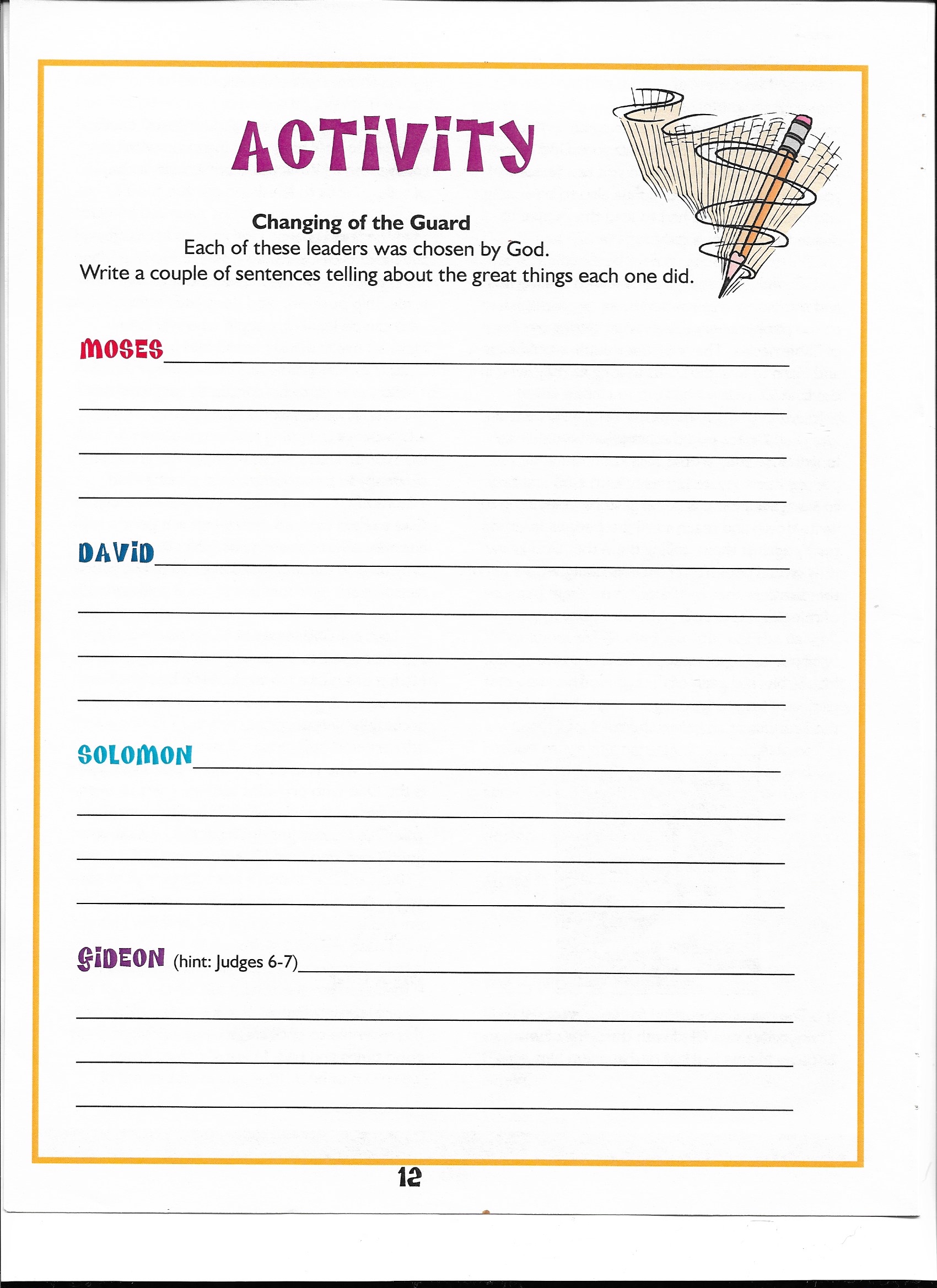
Activity (Student book): Changing of the Guard
Extending the Lesson - REACH Activities:
*Back to the Bible: Tell Me the Dream
*Journal Jot: Change
*Word Study: seasons - zemân
*Just Toolin’ Around: Succession of Kings
*Did you Know? Meribah
*Stretch It Out: Ceremony
*Music Notes: Surely the Presence of the Lord
*Questions? - Writing Prompt - 10 mins.
Student Prayer
Dear Heavenly Father,
Thank You for giving us this example to encourage us to follow You--in good times and bad.
In Jesus' name.
Amen.
Daily Devotions
Sunday: Daniel 2:20-23
Monday: Deuteronomy 32:48-52
Tuesday: Deuteronomy 34:1-8
Wednesday: Deuteronomy 34:9
Thursday: Deuteronomy 34:10-12
Friday: Deuteronomy 1:37-40
Saturday: Numbers 20:9-13
Objectives
At the end of this lesson, students will be able to:
1. Retell the events of Joshua succeeding Moses as leader.
2. State that God chooses leaders.
3. Describe the pitfalls of prosperity.
4. Give ways to combat the dangers of prosperity.
5. Tell about some biblical leaders and what they accomplished.
Topics & Themes
Authority
Change
Consequences of Sin
Joshua
Moses
Promised Land
Materials Needed
Bibles, YEA Students' and Teacher's books, pencils and pens, attendance and memory verse charts, stars, songbook, music player, cassette or CD, chalkboard and chalk, poster board jigsaw puzzles, markers and crayons, ziplock bags with the students' jigsaw puzzle pieces
Preparation
Change is never easy for us. We all get very comfortable with the familiar things around us. But things in our lives never stay the same. Change is inevitable. And it's important that our children realize change happens for many reasons.
Sometimes they have the mistaken idea that once a person has attained a position, they get to retain that position no matter what. That is inaccurate, as this lesson highlights. Because Moses did not obey God and uphold his holiness to the people, God did not allow him to enter the Promised Land. Deuteronomy 34:7 NIV says, "Moses was a hundred and twenty years old when he died, yet his eyes were not weak nor his strength gone." God took the leadership from him and gave it to Joshua.
Death is another change that students this age have trouble with. Typically around this age, for the first time they will experience the death of someone close to them. They need to know it's okay, and normal, to grieve. Yet our lives are in God's hands, and this life is not the end of the story for those who know and love God.
Do some basic research on the Changing of the Guard at Buckingham Palace.Try to get a photo/video of Buckingham Palace and the Changing of the Guard, if possible.
How to Teach This Lesson
Open the class with prayer and then begin the discussion.
Changing of the Guard - Each day the guards at Buckingham Palace in London, England are replaced. Because there is such pomp and ceremony, many tourists come to watch the event. Ask: Why do you think the guards are changed? (They cannot stay on duty constantly. They need to eat, drink, sleep, move.) In the same way, leaders are changed. Sometimes a new leader takes over because the present one is old, sick, or unable to lead anymore. Sometimes, a leader is not a good leader. Then a new leader has to take over. Sometimes, a new leader is chosen when the present leader's turn is up - like our government and voting system. Say: Let’s look at one example from the Bible of the Changing of the Guard and why it happened.
Ready to Enter the Promised Land - Set the scene for the students: The Israelites have been wandering in the desert for 40 years. Everyone who rebelled at going in the first time has now died. It is only Moses, Caleb, Joshua, and the children of Israel who now stand ready to enter the land. Only Moses is not going in. Ask: Why? Moses struck the rock twice (Numbers 20:9-13), breaking faith with God, and not upholding God's holiness before the people. God told Moses to climb Mt. Nebo; he would see the Promised Land, but would not enter with the people.
Joshua named leader - Ask: Who chose Joshua to lead the people? God did. (Deuteronomy 1:37-39.) Moses instructed Joshua to be strong and courageous. Why? He had to lead the people and divide the inheritance among them. But Moses also told Joshua that God would be with him to help. Then in Deuteronomy 34:9 we are told that Moses laid hands on Joshua, and Joshua was filled with the spirit of wisdom so that the people listened to him and did what he said.
Reading the Law - Levites and Elders were told to read the Law to the people every seven years at the Feast of Tabernacles, so that they would learn to fear and obey God.
The song of Moses - Why did God give Moses a song to teach the people? It would be a testimony against them when they followed the inclinations of their hearts towards evil and rejected God after they became prosperous. They would remember the song better than the spoken word. Ask the students their favorite hymn and to sing a few words. Then ask them what last week's sermon was about. Music is powerful.
Moses' death - Before Moses went up on Mt. Nebo to die, he blessed the people. Then the people mourned him for 30 days.
How does this apply to us? - We can learn a couple of things from this account. First, when God puts you in a leadership position, be careful to give God the glory and to uphold His holiness to the people around you. Secondly, it is easy to become lax in our relationship with God when things are going really well. Make an effort to spend more time reading your Bible, singing hymns, praying, and thanking God for the things He has given you. And remember, when God gives you a job, He's going to give you the tools you need to accomplish it, just as Joshua had to step forward and take over as leader after Moses died. He was given wisdom from God when he needed it.
Review Questions
1. Why was Moses not allowed to lead the children of Israel into the Promised Land?
2. Who chose Joshua to lead the people after Moses' death?
3. What do people normally do when things are going well? (The inclination of the heart.)
4. What should we do when things are going well in our lives to avoid becoming lax in seeking God?
Teacher-Directed Activity
Jigsaw Puzzle
Continue working on your jigsaw puzzle, using the pieces for Lesson Three. On one side, write "God." On the other, write "chooses leaders." Give the students their ziplock bags so they can continue with their jigsaw puzzle pieces.
REACH Activity
Back to the Bible: Tell Me the Dream
King Nebuchadnezzar was nobody’s fool! He’d had a dream and he didn’t have any idea what it could possibly mean. He needed someone to interpret it for him. But he wasn’t going to tell the so-called wise men his dream. They could make up any old interpretation that sounded good. Nope! King Nebuchadnezzar assembled the wise men and told them to tell him what his dream was and the interpretation of it. The wise men were more than dismayed! Who could possibly have any idea what the king had dreamt? It seemed impossible. But Daniel knew that nothing is impossible with our God. God gave Daniel the dream and the interpretation. And Daniel praised God for it - both to God and to Nebuchadnezzar. Daniel didn’t take any credit for knowing the dream’s interpretation. He gave all the glory to God. (Daniel 2)
The contrast between Daniel’s actions and Moses’ actions should serve as a strong example to each of us. The things that we do, the knowledge that we have, the abilities we possess - all of it is because God has enabled us! When He is with us, we succeed because of Him. We need to honor Him always, in all things.
Write about this topic in your Bible notebook.
Journal Jot: Change
We don’t like change. And the older we get, the less we like it. We like our comfy old clothes. We like to sit in the same place every Sabbath in church. We like to park in the same place when we go to the store. We don’t particularly like changing dentists or doctors or leaders. We got used to the way they did things. It might not have been perfect, but at least it was familiar.
What about you? How are you with change? What kinds of things are you okay with changing? Meals? Arrangement of the furniture in the living room? Sabbath school teachers? Pastors? What kind of food you eat when you go out? Write down the things you like the same and the things you like some variance in.
Then think about how difficult it might have been for the people to get used to Joshua. Do you think he ever heard someone say, “Well, Moses never did it that way”? Write about this in your Bible notebook.
Word Study: seasons - zemân
The word in Daniel 2:21 that is translated “seasons” is a Chaldean word which means “season, time, an appointed occasion” (Source: Zodhiates’ NAS Hebrew-Greek Key Word Study Bible, 1990, H#2166). It’s interesting that the NAS translates it as “epoch.” This means “a period of time in history or a person's life, typically one marked by notable events or particular characteristics.” (Source: https://www.encyclopedia.com/earth-and-environment/geology-and-oceanography/geology-and-oceanography/epoch)
The implication, then, from Daniel 2:21 is that God has a plan. There is a period of time that He ordains for a certain person to do something. And that’s the way it will happen.
Write this word, its definition, and scripture reference in your Bible notebook.
Just Toolin’ Around: Succession of Kings
Using a Bible reference tool, find out how many kings of Judah there were from Rehoboam to Zedekiah. Whose reign was the longest? Whose reign was the shortest? Then find out how many kings of Israel there were from Jeroboam to Hoshea. Whose reign was the longest? Whose reign was the shortest? If this topic really interests you, set up a timeline showing the reigns of the kings of Judah and the kings of Israel. You may eventually want to add more details to this timeline, like the prophets who prophesied during these reigning kings.
Did you Know? Meribah
The place where Moses struck the rock was called Meribah, which means “Quarreling.” Quarreling, bickering, complaining, grumbling, arguing - all of these negative verbs are the opposite of the actions which please God. Write these five verbs down in your Bible notebook in a column. Then, next to them, write an opposite word which would honor and please God.
Stretch It Out: Ceremony
Many times, we have a big ceremony to mark the change - a new king, a new president, a new governor, a new teacher, a new bed in your bedroom. We celebrate the old and we welcome the new. Watch a video of the changing of the guard at Buckingham Palace. It’s all done with pomp and precision. Write your impressions of the changing of the guard and then compare it to the change in leadership from Moses to Joshua. File this in your Bible notebook.
Music Notes: Surely the Presence of the Lord
This hymn is on page 192 in the CEM Hymnal.
This hymn was written by Lanny Wolfe “in Columbus, Mississippi, at a dedication service of a new church in 1977. Recalling this moment, Wolfe says that he remembered Jacob’s dream of a ladder with angels ascending to and descending from heaven: “Surely the Lord is in this place; and I knew it not” (Gen 28:16, KJV). His inspiration transformed that verse into the praise song, “Surely the Presence of the Lord is in this place.” Hearing chord progressions that he normally did not use, Lanny took a leap of faith and taught the song to his Trio onstage, and then invited the congregation to join! Hastily scribbled on notepad paper, the manuscript is now framed and enshrined in the foyer of that church.” (Source: https://www.umcdiscipleship.org/articles/history-of-hymns-surely-the-presence-of-the-lord)
The comfort that Joshua must have felt, knowing that God would never leave him or forsake him, gave him the courage to lead the children of Israel into the Promised Land. What would you feel empowered to do if you knew that God was with you always? Try turning Proverbs 3:5-6 into a daily prayer, seek to honor God is all that you do, and then rest assured that God is always with you no matter what difficulties you encounter.
Write about this in your Bible notebook.
Questions?
Write down any questions you have in your Bible notebook so that you can remember to ask your parents or your pastor.
Song
"God is So Good" is on page 87 of the Kids Classics Collection.
Closing Prayer
Ask for a volunteer to lead in prayer asking God’s help in keeping Him first, in good times and bad, no matter what.
Printable Pages