YEA Lesson Library
Stop This Plague
About This Lesson
Using Korah’s rebellion against Moses and Aaron’s leadership, this lesson shows Aaron and Moses’ intercession to prevent destruction of the Israelites by God - a picture of Jesus’ intercession on our behalf before the Father.
Scriptures
Numbers 16:1-50
Hebrews 7:23-25
Words to Know
CENSER - a metal cup for burning incense
INCENSE - a combination of spices which makes a fragrant smell when burned
CONTEMPT - open disrespect
ATONEMENT - to repair the relationship between God and man
PLAGUE - in Numbers 16, God's wrath caused widespread death - the plague
INTERCESSION - to intervene between people with a view to reconciling differences
The Lesson
One Thursday when Mark went to school, he had a big surprise waiting for him. He wasn't going to do the things he normally did as a fourth grader. He would get to be the Chief of Police for the day. And not only that, the regular Chief of Police, Chief Miller, was going to take Mark's place. They were going to switch! Mark was sure he was going to have the best day he'd ever had!
First he watched Chief Miller ace his spelling test and 5-minute multiplication timed test. Then he had lunch with the Chief and the entire police force in the police station. At 1:00, Mark stood before a room full of police officers. He was almost ready to read the daily briefing which Chief Miller usually did. Suddenly, a policeman burst into the room. There had been a terrible traffic accident on the highway. Then a voice boomed over the loudspeaker that a downtown bank had just been robbed and the robbers were holding hostages inside the bank. Almost before anyone could speak, the front clerk, followed by a very upset mother, ran into the room asking for help to find a missing three year-old.
What had started as a neat day was suddenly a nightmare of responsibility that Mark had no way of handling. It didn't really surprise him that Chief Miller started giving orders as if Mark wasn’t there. It was Chief Miller's responsibility to try to save as many lives as possible.
One day, Korah, Dathan, Abiram and On - along with 250 community leaders came to Aaron and Moses. These men accused Moses and Aaron of thinking they were better than the rest of the Israelites and setting themselves above the people. This was similar to what Aaron and Miriam had said about Moses in Numbers 13. The leaders were jealous of Aaron and Moses. They wanted the power and the position that Moses and Aaron had.
So Moses told Korah and all his followers to take censers the next morning, fill them with incense and fire, and offer them to the LORD. God would make it very clear who was holy.
Then Dathan and Abiram accused Moses of bringing them out of a land flowing with milk and honey to die in the desert. This made Moses very angry. Because he hadn't done anything wrong, Moses asked the LORD not to accept their offering.
The next day Korah and his followers brought their censers before the LORD in front of the Tent of Meeting. The LORD told Moses and Aaron to get away from the Israelites. God was ready to destroy all of the people. Moses and Aaron fell face down before God. They asked God not to be angry with all of the people for the sins of Korah and his followers. So God told Moses and Aaron to tell the people to move away from the tents of Korah, Dathan, and Abiram. Moses told the people if these men died as people normally do, then Moses had not been sent by God. But if they died a strange and sudden death, it would mean these men had treated God with contempt. Immediately, the ground opened and swallowed the three men, their families, and all their possessions. Then the earth closed up again.
Then God consumed with fire the 250 men who offered incense before Him. He told Moses to have Eleazar, Aaron's son and priest, hammer the bronze censers into sheets to overlay the altar because they had been presented before God and were now holy.
You might think this was the end of the grumbling. But it wasn't! The very next day the whole Israelite community grumbled against Moses and Aaron, saying that they had killed the LORD's people! God again told Moses and Aaron to get out of the way because He was going to destroy them all - right then. Moses and Aaron again fell face down before God.
Moses told Aaron to quickly fill his censer with incense and fire from the altar, then hurry to make atonement for the community. Wrath had already gone out from God and the plague had started.
Aaron ran to do what Moses said and offered incense to God in the middle of all the people. Aaron stood between the living and the dead and the plague stopped. However, 14,700 people still died from the plague.
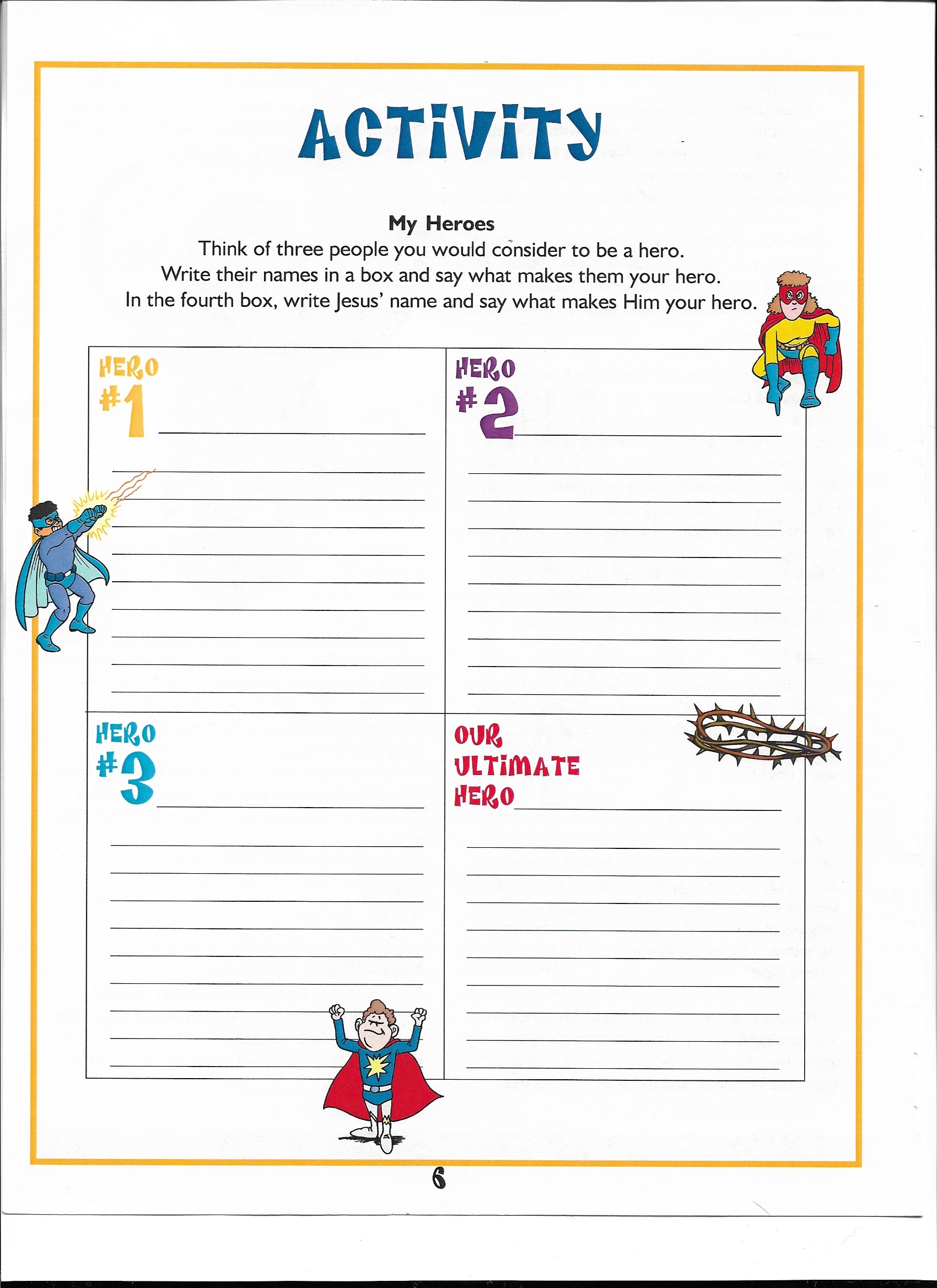
Moses and Aaron should have been heroes to the people. Twice in two days they saved the people from being totally destroyed.
These two heroes should remind you of another Hero. Who is it who stands between you and God the Father? Who ever lives to make intercession for us when we sin? (Hebrews 7:25). Jesus Christ is our Ultimate Hero. Praise God He is there to save us always.
Activity
Teaching the Lesson:
Legacy Lesson: Student book/Teacher book - Teaching Time: 25 mins.
Lesson Prep - Teacher book - Time: 20 mins.
Activity (Teacher book): Heroes and Their Characters Puzzle - Time: 20 mins.
Song: "Fairest Lord Jesus" - page 79 of Kids Classics Collection - Time: 5 mins.
Activity (Student book): Describing Your Heroes - Time: 20 mins.
Extending the Lesson - REACH Activities:
*Back to the Bible: Authority
*Journal Jot: Korah’s Rebellion
*Word Study: Stopped - atsar
*Just Toolin’ Around: Earthquakes and Sinkholes
*Did you Know? Authority
*Stretch It Out: Swallowed
*Music Notes: God of Our Fathers, Whose Almighty Hand
*Questions? - Writing Prompt - 10 mins.
Student Prayer
Dear Heavenly Father,
Thank You for giving me a Super Hero, Jesus, to save me from my sins. Help me to remember to always be thankful and not to grumble when I don't get my own way.
In Jesus' name.
Amen.
Daily Devotions
Sunday: Hebrews 7:23-25
Monday: Numbers 16:1-3
Tuesday: Numbers 16:4-7
Wednesday: Numbers 16:8-11
Thursday: Numbers 16:12-21
Friday: Numbers 16:22-30
Saturday: Numbers 16:31-40
Objectives
At the end of this lesson, students will be able to:
1. Give a definition of "hero."
2. Relate the events of Numbers 16.
3. Explain that Moses' and Aaron's actions should remind us of Jesus Christ.
4. State that Jesus Christ intercedes on our behalf.
Topics & Themes
Aaron
Authority
God’s Judgment
Grumbling
Intercessor
Jesus, High Priest
Jesus, Intercessor
Korah’s Rebellion
Moses
Plagues
Rebellion
Materials Needed
Bibles, YEA Students' and Teacher's books, pencils and pens, attendance and memory verse charts, stars, songbook, music player, CD or cassette, chalkboard, chalk, card stock pieces for each student, a large poster board, markers, crayons, ziplock bags
Preparation
The junior age group is normally a transitional age between seeing Mom and Dad and teachers as the best thing to emulate, to looking more towards peers, athletes, and other prominent personages. This can be disconcerting to parents, and should be, when their children's choices are less than ideal. These next two YEA books will focus on biblical characters and their strength of character which not only makes them Bible heroes, but points us to our real Super Hero, Jesus Christ. It is important that this age group comes to know Jesus Christ as an approachable Hero - not God who is just out there somewhere. God gave us great physical examples like Moses and Aaron to point us to different characteristics of Jesus Christ. These examples help all of us come to understand and know Him better.
Because each lesson in this book will give us a glimpse into the character of Jesus Christ, plan to make a huge poster board-sized puzzle. Before class, cut the poster board into ten jigsaw pieces. You'll use one each week for this book.
Ten-Week Memory Challenge - to memorize in order the books of the Old and New Testament.
Ten-Week Project Challenge - create a Hero Board Game. Encourage students to use biblical heroes, but leave it open to their discretion. Remind them when creating a board game, they should be sure to include directions and all pieces needed for play.
Note: As you prepare the lesson, read through Numbers 16 in different translations. I used the NIV when writing this lesson, but the KJV can give a slightly different flavor.
How to Teach This Lesson
After opening the class with prayer, ask: What is a hero? What does a hero or heroine do? How can you know if someone is a hero or heroine? Write the students’ answers on the board. Ask them to hang on to those thoughts for just a little while.
Review the story in Numbers 16 - explain who Korah, Dathan, and Abiram were, what their accusations were against Moses and Aaron, and if their accusations were true.
Moses' reaction - note that when charged with elevating himself over the people, Moses fell face down before God and made a way for Him to demonstrate who was holy. But to the accusation that he brought the Israelites out of Egypt to kill them in the desert, Moses got very angry and asked God not to accept their offerings of incense.
God's reaction- note that God had once again had enough of the rebellious community of Israel's grumbling and complaining. He told Moses and Aaron to move away from them so He could destroy them right there.
Integrity - Ask: How would you have reacted? What did Moses and Aaron do? God wanted to destroy all the people. They asked God not to destroy the people because of the sins of Korah and his followers. Even though the people had been a lot of trouble, Moses and Aaron pleaded with God not to destroy them. Thus, Moses and Aaron saved the lives of the whole community.
They showed great integrity - by firm adherence to what they believed was right, to the point of petitioning God to change His purpose.
The earthquake - Korah, Dathan, and Abiram, all of their families, and their possessions were swallowed by the earth. Then God immediately consumed with fire the 250 leaders who offered incense before Him.
An offering made to God - Note that once something has been offered to God, it is holy. Ask: What did God tell Moses to tell Eleazar to do with the censers? Where was he to put the hammered bronze? Why did God want the Israelites to see the metal from the bronze censers on the altar every time they brought a sacrifice to God?
No more grumbling, right? Not quite. Ask: Was there any more grumbling against Moses and Aaron? How soon? What was the accusation this time? What did God do?
Interceding for the people again - Moses and Aaron again fell face down before God. What did Moses tell Aaron to do? This is a good place to have students recite their memory verse.
Heroes - Moses and Aaron were heroes because they saved the people twice in two days. They picture the One who makes intercession for us (Hebrews 7:25). Ask: Who does that? Who saves us from the wrath of God?
Assignment - introduce the Ten-Week Memory Challenge and Ten-Week Project challenge (see Preparation).
Review Questions
1. What is a hero?
2. What was the Korah rebellion?
3. What happened when Korah and his followers offered incense before God?
4. What was Eleazar supposed to do with the bronze censers? Why?
5. When did the people grumble again? Why?
6. What happened when God became angry at the people?
7. What did Aaron do to stop the plague?
8. Aaron and Moses are heroes that should remind you of whom?
9. What does Hebrews 7:25 say Jesus does for us?
Teacher-Directed Activity
Heroes and Their Characters.
Take one of the poster board jigsaw pieces (see Preparation). On one side, write "Aaron" and "Moses." On the other side, write "Saved the People" and "Integrity." Give students an 8.5 x 11" piece of card stock. Tell them to cut their card stock into ten jigsaw-shaped pieces. On one piece they should do as you've done on yours, then decorate the front and back. Give each student a ziplock bag to store them for next week.
REACH Activity
Back to the Bible: Authority
Romans 13:1-7 talks about respecting authority. First, read this passage. Then, write down the key points of these verses. Finally, apply this passage to your life today. How do you view the authority that is in place over you? Do you submit willingly? Why or why not? Does it make a difference how you feel after reading verses 1-2? Why or why not?
Journal Jot: Korah’s Rebellion
When we have a leader (of a family, a club, an organization, a state, a country, etc.), they are human. Being human, they all make mistakes. They sometimes make choices that we believe are wrong. Nevertheless, we need to think very carefully about the disrespect (or outright rebellion) we express toward that person. Romans 13:1-7 and Titus 3:1 adjure us to respect those in authority over us. Nebuchadnezzar had to learn this lesson too. Daniel 4 records that story. What was Nebuchadnezzar’s conclusion? Read this chapter and write Nebuchadnezzar’s conclusion in your Bible notebook. Then write a paragraph response explaining how you see your response at this time in world history. How does God expect you to act? Why?
Word Study: Stopped - atsar
The word in Numbers 16:48 which is translated “stopped” is the Hebrew word which means “to restrain; to close; to stop; to prevent.” It’s found in Genesis 16:2 and translated as “has prevented.” In Deuteronomy 11:17, it’s the word which is translated as “shut up” - as in “God shut up the heavens.” This is a remarkable action from Aaron! Standing between the living and the dead with the censer in his hand, he stopped the plague. This is an incredible picture of Jesus Christ standing before God and interceding for us so that God doesn’t demand our lives for the sins we have committed. (Source: https://biblehub.com/hebrew/6113.htm)
Write this word, its definition, and where it is found in your Bible notebook.
Just Toolin’ Around: Earthquakes and Sinkholes
Research the difference between an earthquake and a sinkhole. Is there a difference in what causes each of them? What is most likely to occur in the Middle East? Look up how many earthquakes have been reported in your area/state this year. Are you surprised? Why didn’t you feel the earthquakes? How strong and how deep does an earthquake have to be to be felt? Write down all the interesting facts that you find about both earthquakes and sinkholes. Share what you have found with your family.
Did you Know? Authority
The seriousness of Korah’s rebellion is evidenced by God’s reaction to them! It is a serious thing to assume authority that you haven’t been given. Further evidence of God’s selection of Aaron is seen when Aaron’s rod budded. Read Numbers 17:1-11 and Hebrews 9:4
Stretch It Out: Swallowed Up!
Construct a flip book which shows the judgment against Korah, Dathan, and Abiram. A flip book is a small pad of paper (ideally about 3-inches square). Draw a simple sketch on each page. Change the movement just a little on each subsequent page. That way when you rifle through the pages, you’ll see the action. Here’s a video which demonstrates how to make a flip book:
https://l.facebook.com/l.php?u=https%3A%2F%2Fyoutube.com%2Fwatch%3Fv%3DUn-BdBSOGKY%26si%3DbNXAyCJ5cTSUYnUk&h=AT0Da14y5l1WlgUc1wlmyfcob-HutksvJgYLJASOfHcRvSy3CKc4rivNRti8zeSxG272QqH62qDVNKrL9fDOVxyaAxydHC8hNOKzYI-zcLdr3OrV4lm4Y4XWVe3N4n4soKETW2YPqA&s=1
Music Notes: God of Our Fathers, Whose Almighty Hand
This hymn is on page 11 of the CEM Hymnal.
The text for this hymn was written in 1876 for the centennial celebration of the signing of the Declaration of Independence. The music was written in 1888 for the centennial celebration of the adoption of the U.S. Constitution.
The author of the text, Daniel Crain Roberts, served with the 84th Ohio Volunteers in the Civil War. After the war, he was ordained in the Presbyterian Episcopalian church, serving as a deacon and then priest for the next thirty years. This is the only hymn for which he is remembered.
The composer of the music was George Warren. He originally pursued a career in business, but his natural music ability soon became so evident that he eventually became one of America’s premier organists. He played for various congregations, composed anthems, edited hymnals, and is also remembered as the composer for “Guide Me, O Thou Great Jehovah.” “When George Warren died in 1902, there was a feeling that no organist could play as well as he could, so not a single note of music was played at his funeral, which was attended by thousands.”
(Source: Then Sings My Soul, Robert Morgan, 2004, p. 165.)
Sing this hymn. Then write the lines in your Bible notebook which connect specifically to this lesson.
Questions?
Write down any questions you have in your Bible notebook so that you can remember to ask your parents or your pastor.
Song
"Fairest Lord Jesus" is on page 79 of the Kids Classics Collection.
Closing Prayer
Lead in prayer giving thanks for God giving them Jesus Christ, a real Hero.
Printable Pages