YEA Lesson Library
Two Great Heroes
About This Lesson
This lesson teaches why the Israelites wandered in the wilderness for 40 years - a direct consequence of rebellion against God.
Scriptures
Numbers 13
Numbers 14
Numbers 14:7-9
Words to Know
EXCEPTION - the one that doesn't fit all of the others
The Lesson
Once upon a time there was a man who owned a camel. This camel was absolutely amazing! He could carry more weight than any other camel anywhere in the desert. The man was very proud of the camel, so he fed him lots of good food, gave him special treats, and curried his coat every day.
One day, one of the man's friends was boasting about the camel. From the back of the crowd, a loud voice said, "I think you're just blowing hot air.” It wasn't long before a huge argument erupted. Soon, the man's friend had agreed to a contest to see how much weight the camel could actually carry. Although the man didn't like it, he agreed to the contest. Soon his favorite camel was loaded down with as much as could be tied on top of him. Loud cheers sounded. This camel was absolutely amazing. Then the man put one more straw on the load, and the camel collapsed. His back was broken and the camel had to be destroyed. It was the straw that broke the camel's back. The straw itself was not heavy. It was no big thing by itself. But it was just enough to be too much when added to everything else the camel was carrying.
In Lesson 2, “The Golden Calf,” and in Lessons 8 and 9, “On to the Promised Land” and “Expect to Respect,” we talked about the wailing, complaining, and grumbling of the Israelites after God brought them out of Egypt. God gave them everything: freedom, protection, clothing, money, food, water, and guidance. But they continually cried out and often wanted to go back to Egypt.
Finally the Israelites made it to the border of Canaan, the Promised Land, the land God promised to give them. God told Moses to send a man from each tribe to explore the land. Moses told them to look over the land, to see whether it was good or bad, what kind and how many people lived there, what kind of cities they lived in and if the cities were protected, if the soil was rich or poor, and whether there were trees. He also told them to try to bring back some of the fruit of the land.
It took 12 men 40 days to explore the land. They found it to be very good land, flowing with milk and honey. One amazing thing was a cluster of grapes they cut off the vine. It was so big it took two men to carry it between them on a pole. But that wasn't all. The people of the land were very big and strong, and the cities were large and well-protected. This caused ten of the men to become very afraid. They gave a bad report that spread through all the Israelites. The Israelites grumbled and wept and said it would have been better to have stayed in Egypt or to have died in the desert. They were sure their wives and children would be taken captive. They even thought it would be a good idea to find a new leader to take them back to Egypt.
Caleb and Joshua didn't agree with them. Caleb told the people, "The land we passed through and explored is exceedingly good. If the LORD is pleased with us, he will lead us into that land, a land flowing with milk and honey, and will give it to us. Only do not rebel against the LORD. And do not be afraid of the people of the land, because we will swallow them up. Their protection is gone, but the LORD is with us. Do not be afraid of them" (Numbers 14:7-9). Do you know what the Israelites thought about what Caleb said? They wanted to stone him to death!
God was angry that the Israelites refused to trust in Him. He told Moses He would kill them all and start over with Moses. But Moses said He shouldn't do that. If God did that, the Egyptians would hear about it and say that God wasn't able to take His people into the Promised Land as He had promised. Moses asked for God to forgive the Israelites. God said He had forgiven them as Moses asked, but they would be punished. The punishment would be on those who were 20 years and older. These Israelites saw the miracles and God's glory both in Egypt and in the desert. But they still disobeyed and tested God ten times!
Not trusting God once was bad enough, but ten times! It was much like the straw that broke the camel's back. God is extremely patient and long-suffering. But enough was enough! Those who were 20 years or older would die in the desert. Their children would be shepherds in the desert, suffering for their parents' unfaithfulness. They would wander in the desert for 40 years, one year for each of the days the 12 men explored the Promised Land. When the last of those who were 20 years or older died, then their children would go into the Promised Land.
Caleb and Joshua would be the exception. They trusted God. They had not disobeyed. They would go into the land with the children of Israel. But the ten who brought the bad report were struck with a plague and died.
When Moses told the people what God said, they mourned bitterly. They said, "We have sinned. We will go up to the land the LORD promised." Moses told them it was too late. It would be a mistake to go now, because God would not be with them. They didn't listen - as usual. While the Ark of the Covenant and Moses stayed in camp, the people went into the land. The people of the land, who were truly very large and powerful, attacked them and beat them all the way to Hormah.
It's a powerful lesson for each of us today. How many times does God have to do something for us before we will trust Him with all of our hearts? It's much better to respond as Caleb and Joshua did, believing that God is greater than any of our enemies, or problems, or fears. Caleb and Joshua are great heroes because they stood up and showed their belief in God. And you can too! There are lots of people around who don't know our great and awesome God. There are lots of ways you can tell them about Him. One way is by trusting God in everything.
Activity
Teaching the Lesson:
Legacy Lesson: Student book/Teacher book - Teaching Time: 25 mins.
Lesson Prep - Teacher book - Time: 30 mins.
Activity: Presentation of Projects/Party - Teacher book - Time: 30 mins.
Song: "Dare To Be A Daniel" - page 9 of Kids Classics Collection - Time: 5 mins.
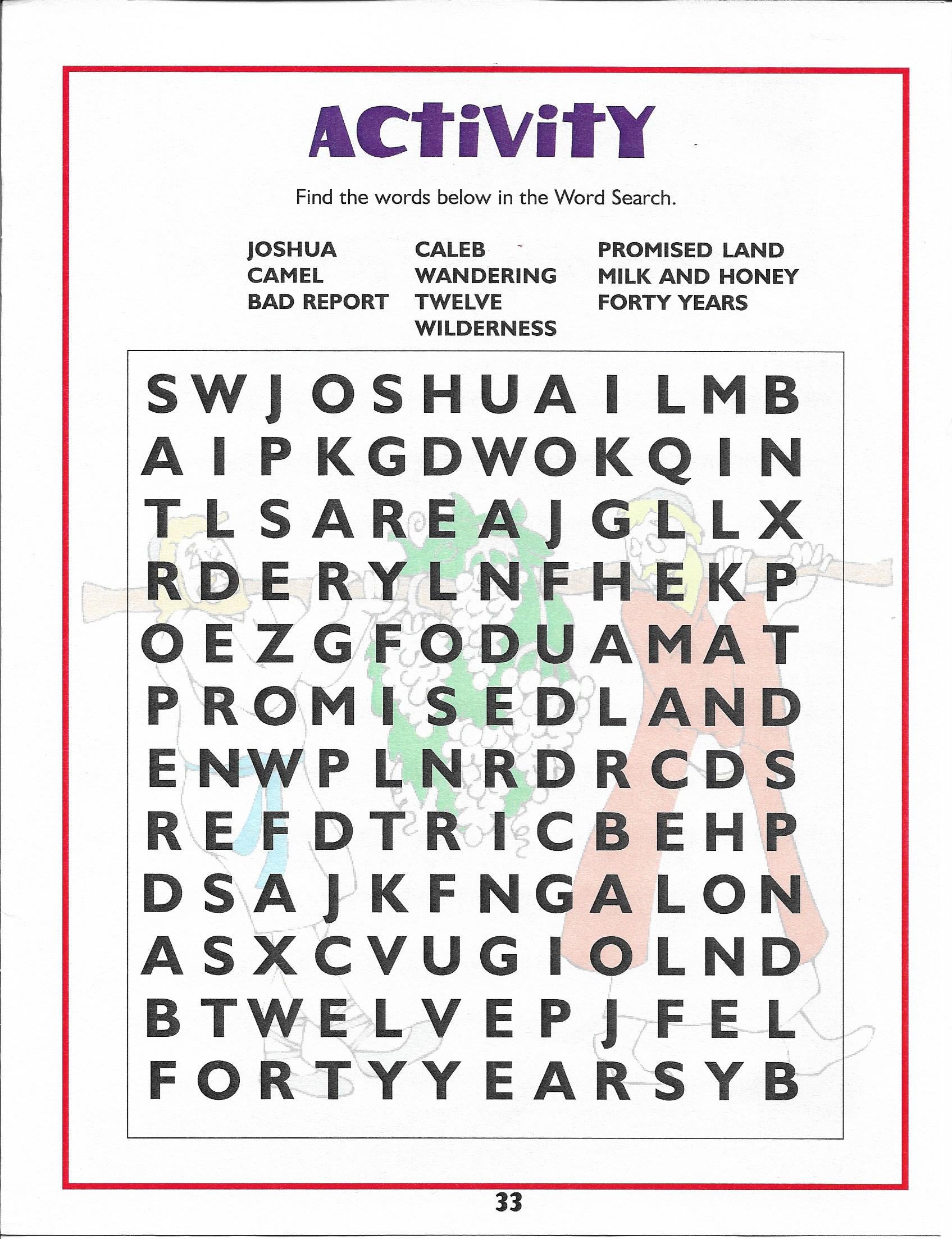
Activity: Word Search - Student book - Time: 10-15 mins.
Extending the Lesson - REACH Activities:
*Back to the Bible: Daniel
*Journal Jot: A Rewarder
*Word Study: is pleased - châphêts
*Just Toolin’ Around: Honey In The Rock
*Did you Know? What Tribes?
*Stretch It Out: The Report
*Music Notes: O For a Closer Walk With God
*Questions? - Writing Prompt - 10 mins.
Student Prayer
Dear Heavenly Father,
Help me learn from the mistakes of the Israelites. Help me trust You no matter what.
In Jesus' name.
Amen.
Daily Devotions
Sunday: Numbers 14:1-2
Monday: Numbers 14:3-5
Tuesday: Numbers 14:6-8
Wednesday: Numbers 14:9-10
Thursday: Numbers 14:11-12
Friday: Numbers 14:13-14
Saturday: Numbers 14:15-20
Objectives
At the end of this lesson, students will be able to:
1. Relate the events of Numbers 13 and 14.
2. State that God wanted to destroy them and start over with Moses.
3. State that although God forgave them, there were consequences to their rebellion.
4. Transfer the idea of trusting God to his/her own life.
Topics & Themes
Caleb
Consequences of Sin
God’s Judgment
Israelites
Joshua
Promised Land
Rebellion
Spies
Trusting God
Wandering
Materials Needed
Bible, YEA Students' and Teacher's books, attendance and memory verse charts, pencils and pens, stars, songbook, music player, cassette or CD, blackboard and chalk, rewards for projects (ribbons, certificates), party items (cookies, juice, popcorn, whatever), new YEA books.
Preparation
Plan to have a celebration in class for successfully completing another YEA book. Bring cookies and juice boxes, a small cake, or whatever you wish. Also plan to have ribbons or certificates for completed 10-week project (models of the Tabernacle in the wilderness). You may also have certificates for attendance and memory verse memorization.
Remember to bring the next YEA books in this series, Bible Heroes book three, and introduce them to the students at the end of class.
How to Teach This Lesson
After opening the class with prayer, follow the instructions below to teach this lesson.
Role Play, Part 1 - Send your class off on an imaginary exploration of the Promised Land. Tell them to pretend they have a cell phone. You're going to call every once in a while and ask them a question. Ask them: 1) What is the land like? 2) Are the people strong or weak and how many are there? 3) Describe the land - if it's good or bad. 4) Describe the towns, explain if they are unwalled or fortified. 5) Tell if the soil is poor or fertile. 6) Tell if there are any trees. Tell them they are to find some fruit of the land and bring it back to camp. If they haven't read the lesson and are not responding properly, go over the lesson and redo the role play.
Role Play, Part 2- Tell the class that they are going to give an informed recommendation about whether to enter the land or not. Split the class into appropriate numbers; i.e., there should only be one or two who are positive about going into the land. Have the ones who are against going into the land state their reasons. Have the ones who are positive about going into the land state their reasons.
Trust God - This is a good place to talk about trusting God. How many times had God provided for the Israelites? How many things had He given them? Had He ever not kept His word? Had He ever allowed them to be hurt or to die when He told them He'd keep them safe?
When enough is enough - God was so angry He wanted to destroy the Israelites and start over with Moses. Ask: What was the reason Moses gave to show God He shouldn't do that? What was the consequence God decreed? Who were the two exceptions? Why didn't God just forgive them and give them another chance? How does this relate to the straw that broke the camel’s back? How do we know that God accurately determined that the Israelites would continue to rebel against Him? When Moses told them God's decision, they decided to go up and take the land anyway, even though Moses told them not to do it. He explained that God wouldn't be with them.
Two Great Heroes - Ask: What did Caleb tell the people? (Recite memory verse.) Ask: How can you be like Caleb and Joshua in your every day life?
Trust God - Some people say that you should just trust God, but that is not possible if you don't have a good relationship with Him. And you can’t have a good relationship if you don't really know God. Spend time reading your Bible, going to church and YEA classes, praying, and thinking about God. Then, when you need to trust Him, it will be like second nature.
Review Questions
1. When the people got to the border of Canaan, what did God tell Moses to do?
2. What kinds of things were they supposed to look for in the Promised Land?
3. How long did the 12 men explore the land?
4. What did they bring back with them?
5. What report did the 12 men give?
6. What was the reaction of the Israelites? What did they want to do?
7. What did Caleb tell the people?
8. What did the people want to do to Caleb?
9. What was God's reaction?
10. Why did Moses talk God out of killing all the Israelites and starting over?
11. What did God say would happen to all Israelites over 20 years of age?
12. What was the reaction of the people to God's decision?
Teacher-Directed Activity
Allow the students to present their ten-week project in class - their Tabernacles in the wilderness. Give rewards (ribbons, certificates, etc.) to those who successfully complete a project. Then have a little celebration for completing this YEA book.
REACH Activity
Back to the Bible: Daniel
Daniel is a great example of a Bible hero who trusted God no matter what. Read Daniel chapter 6. Outline it in your Bible notebook - writing down key events of the story. Then rewrite the story in your own words.
Journal Jot: A Rewarder
When you read your memory verse, it’s a great encouragement to do whatever you can to please God. What pleases God? Obedience. God says that if we love Him, we will keep His commandments. (John 14:15) But is obedience enough? You can go through the motions and your behavior isn’t pleasing to God at all. In one place (Isaiah 1:13-17), God said that he hated their new moons, Sabbaths, and holy day assemblies. On one hand, these people were observing God’s law, but they were not exhibiting the love of God to those who desperately needed it. So obedience isn’t enough.
Hebrews 11:6 says that we must have faith that God exists and that He is a rewarder of those who diligently seek Him. If diligently seeking Him is more than just obedience, what does it entail? Talk about this with your family. Then write a paragraph about what would be pleasing to God in your life.
Word Study: is pleased - châphêts
In Numbers 14:8, Joshua and Caleb tell the people that if God is pleased with them, He will give them this exceedingly good land. The phrase “is pleased” is the Hebrew word châphêts, which means “to find pleasure in, to take delight in, to be pleased with, to have an affection for, to desire, to choose, to bend, to bow. The main meaning is to feel a strong positive attraction for something. Unlike other synonyms for this emotion, this word connotes subjective involvement. This root is used a total of 123 times in all its derivatives. Either God or man can have this feeling. It means to like someone or something very, very much.” (Source: Zodhiates’ NAS Hebrew-Greek Key Word Study Bible, 1990, H#2654.)
Write this word, its definition, and the scripture reference in your Bible notebook.
Think about this! It would definitely be in your best interest to have God pleased with you!!
Just Toolin’ Around: Honey In the Rock
There’s a contemporary Christian song which talks about God promising that He would give the Israelites honey from the rock. Look up Deuteronomy 32:13 and Psalm 81:16. What other descriptions can you find about the Promised Land? Listen to the song, “Honey In The Rock.” What do you think the message was for the Israelites and for us today? Write about this in your Bible notebook.
Did you Know? What Tribes?
There were twelve spies sent into the Promised Land by Moses - one from each tribe. Caleb was from the tribe of Judah. Joshua was from the tribe of Ephraim. These were the only two men who returned with a good report of the land.
Find the names of the other ten men (and their tribes) in Numbers 13:4-16. Write them in your Bible notebook.
Stretch It Out: The Report
Pretend that you are one of the men coming back out of the Promised Land with a report for all of the Israelites. What are you telling them? Use your Bible (Numbers 13:21-33) to find accurate information. Using the information you find, write a report. Read it aloud to your family. Based on your report, would they have trusted God to lead them into the land?
Music Notes: O For a Closer Walk With God
This hymn is on page 205 of the CEM Hymnal.
The text for this hymn was written by William Cowper (pronounced “koo-per”), who battled with melancholia and deep depression. He was continually troubled by “the lack of assurance of his own salvation.” Nevertheless, the son of the chaplain to King George II, he is best remembered for his work with John Newton to produce a hymnal called the Olney Hymns Hymnal. Of the 349 hymns in the songbook, 67 of them were his; the rest were John Newton’s.
William Cowper wrote the text for this hymn in 1769 while staying in Olney with Mrs. Unwin, who had become seriously ill. William Cowper wrote, “She is the chief of blessings I have met with in my journey since the Lord was pleased to call me . . . Her illness has been a sharp trial to me. Oh, that it may have a sanctified effect, that I may rejoice to surrender up to the Lord my dearest comforts, the moment He may require them . . . I began to compose the verses yesterday morning before daybreak but fell asleep at the end of the first two lines: When I awakened, the third and fourth were whispered to my heart in a way which I have often experienced.”
William Cowper’s text was paired with John Dykes’ tune “Beatitudo,” which means “the condition of blessedness.” (Source: 101 More Hymn Stories, Kenneth Osbeck, 1985, pgs. 208-210)
As you sing this hymn, think about the choices in your life which will draw you closer to God so that you might say this of yourself: “calm and serene my frame.” Write your thoughts about this hymn in your Bible notebook.
Questions?
Write down any questions you have in your Bible notebook so that you can remember to ask your parents or your pastor.
Song
"Dare To Be A Daniel" is on page 9 of the Kids Classics Collection.
Closing Prayer
Lead the children in prayer asking for God's help in showing them how trustworthy He is and how they can show their trust in God to others.
Printable Pages