YEA Lesson Library
On To The Promised Land!
About This Lesson
This lesson teaches how Moses organized the Israelites to march and how the Israelites continued complaining.
Scriptures
Numbers 10-11
Numbers 10:35-36
Words to Know
QUAIL - a wild, edible bird, like a chicken
ORGANIZE - to make a plan to do something and follow it
WAILING - loud crying
The Lesson
Kevin and Liz invited the church youth group to their house for a scavenger hunt one Sunday. Soon after everyone arrived, their friends chose Kevin and Liz as their team captains. Kevin gathered his group, handed out the scavenger lists, and told them to hurry and find everything on the list.
Liz also gathered her team together, but she told them to spend time working out a plan so they would have a much better chance of finding everything on the list. Liz's team read the items on the list: a feather, a blue balloon, a paper clip, plastic cup, a small rock, a button, an oak leaf, and a wildflower. She asked if anyone knew where they might find each of these items. When someone did, she put their name by the item until every item was assigned to a person. Liz's teammates were eager to be on their way, but Liz reminded them that spending time getting organized wasn't wasted time; it could make all the difference. They could, and probably would, win. Kevin and Liz only had a few friends doing the scavenger hunt with them. So taking time to organize them would really pay off. How much more does organization help when you’re dealing with a large group? A lot!!
There is a major example of organization in the Bible. It was moving the many thousands of Israelites from the Desert of Sinai towards the Promised Land. When the cloud lifted, the people set out, at the LORD's command. But everyone didn't get up and move at once. That would have created an incredible traffic jam. And it would have been very difficult to keep track of children and animals.
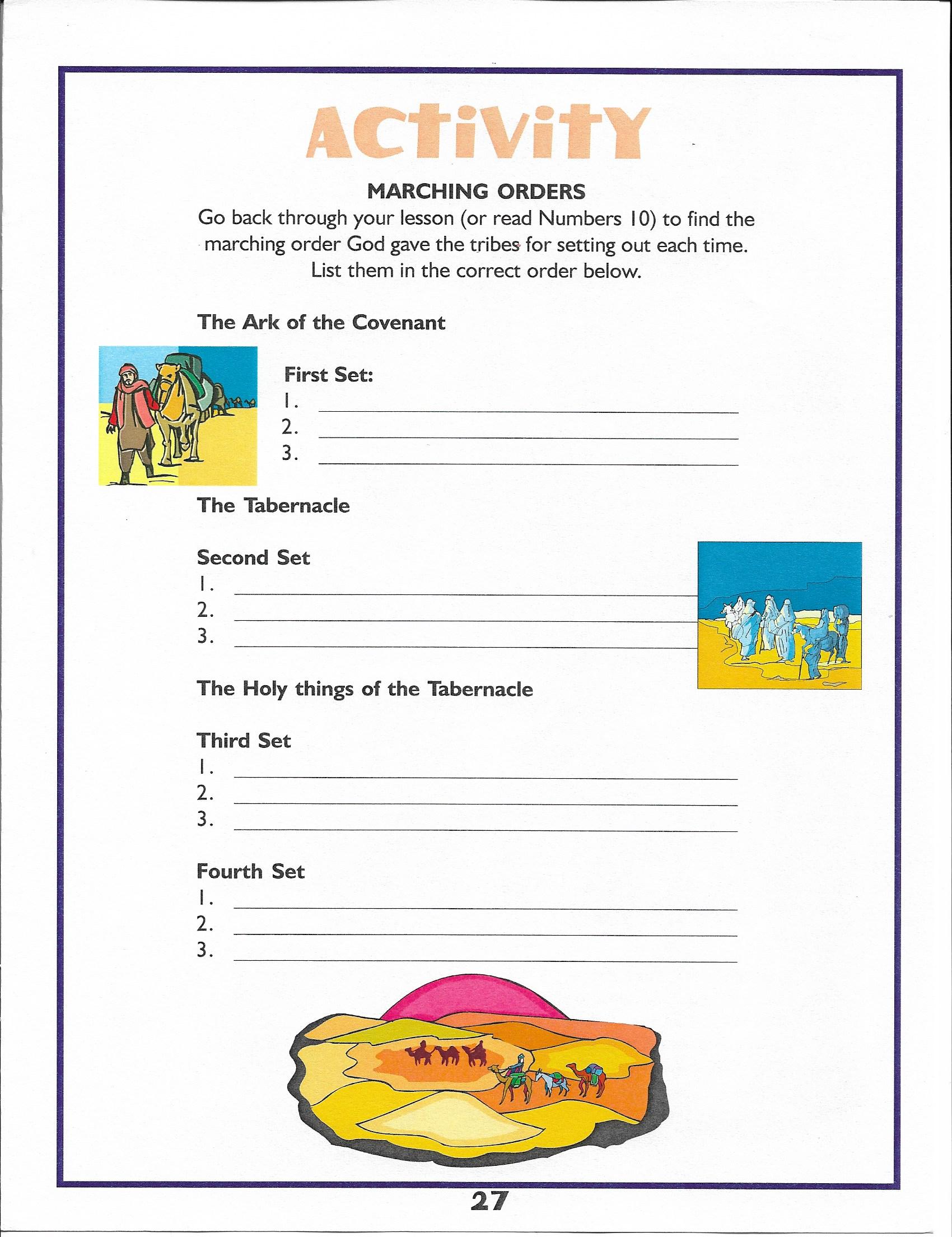
So God said that the tribe of Judah would go first, followed by the tribes of Issachar and Zebulun. Next the Tabernacle was to be taken down and would follow these first three tribes. The tribes of Reuben, Simeon, and Gad would go next. Then the holy things of the Tabernacle would follow this second set of three tribes. That way the Tabernacle could be set up and waiting when the holy things arrived at the next camp. The tribes of Ephraim, Manasseh, and Benjamin came next. The rear guard were the three tribes of Dan, Asher, and Naphtali. Whenever the Israelites set out, this was the marching order.
When they set out that first morning, the Ark of the Covenant went before them. And the cloud of the LORD was over them.
The Israelites had been moving for only three days before the people started complaining about how hard it was. God was very angry! "Then fire from the LORD burned among them and consumed some of the outskirts of the camp." Moses prayed to the LORD, and the fire died down (Numbers 11:1b). You would think the people would have trusted God after having been out of Egypt for over a year. But the Israelites complained many times after Moses brought them out of Egypt. And the fire from the LORD didn't slow them down very much either. Soon every family started wailing! Yes, that's what the Bible says! Why were they wailing? "If only we had meat to eat! We remember the fish we ate in Egypt at no cost - also the cucumbers, melons, leeks, onions, and garlic. But now we have lost our appetite; we never see anything but this manna!" (Numbers 11:4-6).
Moses didn't know what to do with the people. There were so many of them to deal with. So God had Moses call 70 of the elders to the Tent of Meeting. God put His Spirit on these elders to help Moses lead the people of Israel.
God also told the people that He would give them meat to eat, until they hated it, because the people had rejected God and wailed that they would rather have stayed in Egypt. Then God sent a strong wind from the sea that brought quail until they surrounded the camp about three feet deep! People gathered quail, about 60 bushels for each person! While they were still eating, God sent a plague. Many people died because they wanted food other than what God was providing them.
This was not a good start to their journey to the Promised Land. And you'll learn in the next week's lesson, the people weren't yet done complaining.
Activity
Teaching the Lesson:
Legacy Lesson: Student book/Teacher book - Teaching Time: 25 mins.
Lesson Prep - Teacher book - Time: 25 mins.
Activity: Moving Day - Time: 15 mins.
Song: "Onward Christian Soldiers" - page 26 of Kids Classics Collection - Time: 5 mins.
Activity: Marching Order - Student book - Time: 15 mins.
Extending the Lesson - REACH Activities:
*Back to the Bible: Time Frame
*Journal Jot: Complaining
*Word Study: Rejected - mâ’aç
*Just Toolin’ Around: Who Carried the Tabernacle
*Did you Know? Quail
*Stretch It Out: Marching Order
*Music Notes: Onward, Christian Soldiers
*Questions? - Writing Prompt - 10 mins.
Student Prayer
Dear Heavenly Father,
Please teach me to be grateful for the things You give me. Please stop my mouth before I complain against You.
In Jesus' name.
Amen.
Daily Devotions
Sunday: Numbers 11:1-5
Monday: Numbers 11:4-9
Tuesday: Numbers 11:10-11
Wednesday: Numbers 11:12-15
Thursday: Numbers 11:16-17
Friday: Numbers 11:18-20
Saturday: Numbers 11:21-23
Objectives
At the end of this lesson, students will be able to:
1. List the marching order of the tribes as they set out from camp.
2. State that the Ark of the Covenant went before them.
3. State that the cloud of the LORD was over the people as they set out.
4. Relate that the people began complaining after just three days.
5. State that God punished them with fire until Moses prayed.
6. Relate how the people wailed for the delicacies of Egypt instead of God's manna.
Topics & Themes
Belief/Believe
Giving Thanks to God
God’s Presence
Grumbling
Promised Land
Quail
Rebellion
Tabernacling
Trouble
Trusting God
Unbelief
Materials Needed
Bible, YEA Students' and Teacher's books, pencils and pens, attendance and memory verse charts, stars, songbook, music player and cassette tape or CD, blackboard and chalk, paper clips, markers, crayons, timer, little things (See Preparation.)
Preparation
Have a bunch of little stuff to move from one part of the room to another to let students experience working without a plan. (Use little things such as: pencils, crayons, paper clips, stickers, etc. - things you would have to bring to class anyway.)
The repetitive example of the Israelites wanting to return to Egypt, and therefore, rejecting God's plan for them, should be caution to us today. Think about, specifically, the ways God has blessed each of the students in your classroom. Help them start a thanksgiving list with the things you have thought of for each of them.
How to Teach This Lesson
After opening with prayer, begin the lesson as follows:
Moving Day - This will be the Activity. When the students assemble for class, tell them that you have set everything down in the wrong place. Instruct them to move everything to the other side of the room. Start the timer when you first instruct them to move everything. Then walk away and time how long it takes them to complete the job.
Moving Day, Part 2 - Once the students have moved everything to the other side of the room, tell them how long it took them to do the job. Tell them you're going to start the timer again when you tell them to move everything back. But this time, you will assign specific jobs to certain people. Start the timer, assign jobs, and let them move in an orderly fashion.
Debrief - Ask: Do you feel things moved easier the first or second time? Why do you think that? How difficult do you think Moses’ job was to move perhaps one or two million people from the Desert of Sinai to the Promised Land? What did you learn from your second move that would have helped Moses move all of those people? (There had to be organization.) Can anyone tell us how the Israelites were organized for this move?
First - The Ark of the Covenant went before them with the cloud of the Lord over them.
Second - The first tribes followed. Ask: Can anyone tell us who they were? Judah, Issachar, and Zebulun).
Third - The Tabernacle
Fourth - The second group of the tribes of Israel - Reuben, Simeon, and Gad.
Fifth - The holy things of the Tabernacle.
Sixth - The third group of the tribes of Israel - Ephraim, Manasseh, and Benjamin.
Seventh, the rear guard tribes- Dan, Asher, and Naphtali.
Camping and Marching Order - The marching order correlated with the camping order. This made for an easy progression of moving out and setting up camp.
East side of the Tabernacle - Judah, Issachar, and Zebulun.
South side of the Tabernacle - Reuben, Simeon, and Gad.
West side of the Tabernacle - Ephraim, Manasseh, and Benjamin.
North side of the Tabernacle - Dan, Asher, and Naphtali.
Complaints - Ask: How many days did it take before the people started complaining? (Three). What was God's reaction? (He set fire on the outside of the camp.) What happened next? (Every family began to wail.) Who started the complaining? (The people who were not Israelites, but were traveling with them from Egypt.) Did the Israelites ever complain? (Yes, the complaining and wailing about their food and wishing they were back in Egypt spread to every family.)
Moses' reaction - Moses didn't know what to do with these complaining people. God set His Spirit on 70 elders to help Moses lead His people.
God's reaction - God sent the people so much meat that they began to abhor it. Quail were stacked three feet deep all around the camp. They gathered about 60 to 100 bushels of quail per person. Because of their strong desire for meat, God struck them with a plague that caused many to die.
Summary - God provided everything the people needed. Yet they still complained. Their trip to the Promised Land did not get off to a good start.
Thanksgiving list - Explain that being thankful is the opposite of complaining. Ask them to think about the things for which they are very thankful because they will be starting a thanksgiving list next week.
Review Questions
1. As the people set out from camp, what went first?
2. Who were the first three tribes to go?
3. What went between the first and second sets of tribes?
4. Who were the second three tribes to go?
5. What came between the second and third sets of tribes?
6. Why did the Tabernacle components go first?
7. Which three tribes were in the third set?
8. Which three tribes came in last, as the rear guard?
9. Where was the cloud of the LORD when the people set out?
10. When did the people start complaining and what did they complain about?
11. How did God punish the people for complaining?
12. What did Moses do? What did God do?
Teacher-Directed Activity
Moving Day
See How To Teach This Lesson
REACH Activity
Back to the Bible: Time Frame
There are many clues in the Bible that we have to put together to figure out exactly what happened. Numbers 10:11 tells us that the Israelites had been camped at the foot of Mount Sinai for almost a year! Exodus 19:1 tells us that they set up camp at Mount Sinai on the third new moon. Deuteronomy 2:14 says that the Israelites wandered an additional 38 years before finally entering the Promised Land. So it took this group of people two full years to travel from Egypt to Kadesh-barnea on the edge of the Promised Land.
Journal Jot: Complaining
What does God think about complaining? Read 1 Corinthians 10:11 and Exodus 16:8 and Numbers 11:20. Why do you think the complaining is so offensive? Read Hebrews 3:12-19 and Hebrews 11:6. God promises good to those who love Him - and you must believe this, thoroughly, completely. When you start complaining about things in your life, you are saying that you know better than God or that God isn’t doing it right. It is a very serious thing to find fault with God. Our job is trust Him and believe that He is working all things out for our good (Romans 8:28). Think seriously about these concepts. Write about them in your Bible notebook.
Word Study: Rejected - mâ’aç
Read the entire chapter of Numbers 11. God characterized the people’s complaining as rejection of Him. Verse 20 says, “ . . . because you have rejected the LORD who is among you and have wept before him, saying, ‘Why did we come out of Egypt?’” The word “rejected” here is the Hebrew word mâ’aç - which means “to melt, to feel undone; to melt away, to dissolve. It has the sense of flowing or running out.” In this context, then, the people’s faith in God had completely melted away. They had no conviction; they were completely drained of belief that God would provide for them - even though He was right there with them! They could see the pillar of cloud by day and the pillar of fire by night. They saw the provision of manna day by day! (Source: Zodhiates’ NAS Hebrew-Greek Key Word Study Bible, 1990, H#3988)
What do you think? Can you cite examples in your life of God’s provision and protection? How do you react when things are difficult? Write this word, its definition, and where it is found in your Bible notebook.
Just Toolin’ Around: Who Carried the Tabernacle
Numbers 4 details who carried the different pieces of the tabernacle. Look at verses 4-20 for what the Kohathites carried. Look at verses 21-28 for what the sons of Gershon carried. Look at verses 29-33 for what the sons of Merari carried.
Ready for some more research? At what age did they start their service? What tribe did Kohath, Gershon, and Merari belong to? Moses and Aaron were from which of these three men? Who was the oldest of these three: Kohath, Gershon, or Merari? Is there anyway of knowing? Write down what you find out in your Bible notebook.
Did you Know? Quail
According to the NIV Archaeological Study Bible (2005, p. 212), “Large numbers of quail migrate each year across the Sinai Peninsula from Africa on their way to Europe and Asia. Since these birds have heavy bodies and do not fly well, they partly depend on prevailing winds to assist their flight, and [they often] become exhausted on long journeys. During the 1900s Arabs living in northern Sinai used nets to catch between one and two million low-flying quail.”
Something similar happened in the United States with the passenger pigeon. “Just five hundred years ago, passenger pigeons comprised about 40% of all birds in North America. Literally billions of these birds lived throughout the eastern half of North America. . . . Passenger pigeons were extremely gregarious birds, flocking and nesting together in huge numbers. Early settlers tell of witnessing flocks up to a mile wide and hundreds of miles long, so dense that they actually darkened the sky for hours upon hours as they flew overhead. They bred in large colonies that could cover hundreds of square miles of forest and they could pack up to one hundred nests in a single tree. . . . Unfortunately, the fact that passenger pigeons flocked and nested in very large groups made them easy targets for humans. Hunters originally killed the birds for food, but by the 19th century it had changed over to sport, if you can call it that. Pigeoneers set traps to catch hundreds at a time during the nesting season. Hunting competitions only encouraged the excess. In one contest, a participant had to kill 30,000 passenger pigeons just to be considered for a prize.” (Source: https://hoardmuseum.org/passenger-pigeon/)
Write a poem comparing the flock of quail on the Sinai Peninsula with the flocks of passenger pigeon in the eastern U.S. File it in your Bible notebook.
Stretch It Out: Marching Order
Draw a series of diagrams like a modified cartoon strip. The first frame shows the camp with the various tribes around the Tabernacle. Be sure to label which tribe was on which side. The next frame shows what led the way out of camp. The next frame shows which tribes came next. You’ll need eight frames to properly diagram the marching order. If you do your diagram on drawing paper, you may wish to mount the pages on cardstock and then tape the pages together to make one long strip which can be folded, accordion-style.
Music Notes: Onward Christian Soldiers
This hymn is found on page 26 of Kids Classics Collection and page 155 of the CEM Hymnal.
The text for this hymn was written in 1864 by a Church of England minister, Sabine Baring-Gould. On Whitmonday, a day when schools would traditionally have festivals in Yorkshire, “it was arranged that our school should join forces with that of a neighboring village. I wanted the children to sing while marching from one village to the other, but couldn’t think of anything quite suitable, so I sat up at night resolved to write something myself. “Onward, Christian Soldiers” was the result. It was written in great haste, likely in less than 15 minutes.” (Source: Amazing Grace, Kenneth Osbeck, 1990, p. 308)
Sing this hymn. Knowing this song was originally written for children to sing, does it make you like it more? What is your favorite line? Write it in your Bible notebook.
Questions?
Write down any questions you have in your Bible notebook so that you can remember to ask your parents or your pastor.
Song
"Onward Christian Soldiers" is on page 26 of the Kids Classics Collection.
Closing Prayer
Ask for a volunteer to lead in prayer asking God to help them to be thankful and not complain.
Printable Pages