YEA Lesson Library
Jubilee!
About This Lesson
This lesson teaches that the Sabbatical Year is a time of rest pointing to the rest with have in Jesus Christ. The Year of Jubilee points to the freedom, physically and spiritually, that comes through a relationship with Jesus Christ.
Scriptures
Leviticus 25
Leviticus 25:10
Isaiah 61:1-3
Matthew 11:28-30
Luke 4:18-19
Words to Know
CONSECRATE - to set apart, to devote to God
JUBILEE - every 50th year, according to God's plan
PROCLAIMED - to be announced
LIBERTY- the state of being free
ALIEN - a foreign-born resident who has not been naturalized and is still a subject or citizen of a foreign country
TENANTS - people who pay rent to live in a place
The Lesson
When Bill and Sally bought a new home, they also bought a little over two acres. The children were excited. There was a lot of room to run and play, a barn with all kinds of nooks and crannies, a huge hill behind the house to slide down after a snowstorm, and lots of room for a big garden. The first six years, the garden did really well. In fact, the fifth year they canned more tomatoes than they would use for a couple of winters. When the seventh year came, Bill and Sally didn't plant a garden. That was okay with the kids! They were very tired of weeding, harvesting and canning - all of the work that goes with a big garden.
But they did have one question: How did Bill and Sally know that was the seventh year, according to Leviticus 25? Bill and Sally didn't know, the kids were told. But the principle in Leviticus 25 of letting the land rest for a year is a good principle. Besides, having the summer off from the garden work would be a good rest for the family too. God had blessed the garden the past several years. There would be enough until the next year. And then, everyone would be ready to work again. Well, at least maybe the weeding wouldn't seem so bad.
Leviticus 25 talks about giving the land a Sabbath rest every seven years. The people were allowed to eat whatever came up voluntarily, but they weren't allowed to weed or harvest the fields or vineyards like they would in the first six years.
Then, in the 50th year - after seven Sabbaths of years - the people sounded the trumpet on the Day of Atonement. It was the Year of Jubilee! They proclaimed liberty throughout the land.
The way God set it up, if a person became poor and had to sell his property to get money to live, he would get his land back in the Year of Jubilee. Why? Because God said the land belongs to Him. The people are aliens and tenants. That means, according to God, the people didn't really own the land. They were only there because God gave it to them. In a similar way, if a person became so poor that he sold himself as a slave, he would again be free in the Sabbatical year. Why? Because the people belong to God as servants (verse 55). After all, it was God who rescued them from Egypt.
If someone from one of the countries around Israel sold himself as a slave, he would be a slave forever. He wasn't released during the Sabbatical year. Why? Because that person wasn't one of God's people. God had a very special relationship with Israel. They were His chosen people. That wasn't something the nations around Israel could claim. If an alien or temporary resident bought an Israelite, the Israelite would again be free the seventh year. He would be allowed to go back to his land in the Year of Jubilee. It didn't matter who owned the Israelite, he would be free.
God's plan is full of meaning. Think about counting seven sets of seven years each. In the Bible, the number seven seems to picture completeness. This can be seen from Creation all the way to Revelation with the seven trumpets. So why did the Jubilee Year start after seven sets of seven years?
Well, think about when the Year of Jubilee and the Sabbatical years started. The trumpets were blown on the Day of Atonement! That's the tenth day of the seventh month. That's not the first day of the year. That's not even the first day of a month. Why in the world would God start the Year of Jubilee and the Sabbatical Year on the Day of Atonement? Think about what else happened on the Day of Atonement. The High Priest went into the Holy of Holies and made atonement for the sins of the entire community of Israel. All of their sins were forgiven! Their spiritual debts were forgiven on this day. Since this was also when the Year of Jubilee and the Sabbatical Year began, it was also the day their physical debts were forgiven.
Talk about complete freedom. They were free from slavery. They were free to live on their own land. And they were free from their sin! No wonder God told them to proclaim liberty throughout the land! They were free in every possible way. They were free to make a clean start.
When you keep the Sabbath this week, think about how wonderful it is to be free to rest! When you observe the Day of Atonement next time, think about the Year of Jubilee and how wonderful it is to be free in Jesus Christ. Completely.
Activity
Teaching the Lesson:
Legacy Lesson: Student book/Teacher book - Teaching Time: 25 mins.
Lesson Prep - Teacher book - Time: 30 mins.
Activity: Proclamation - Teacher book - Time; 30-40 mins.
Song: “I Will Sing of the Mercies of the Lord Forever" - page 17 of Kids Classics Collection - Time: 5 mins.
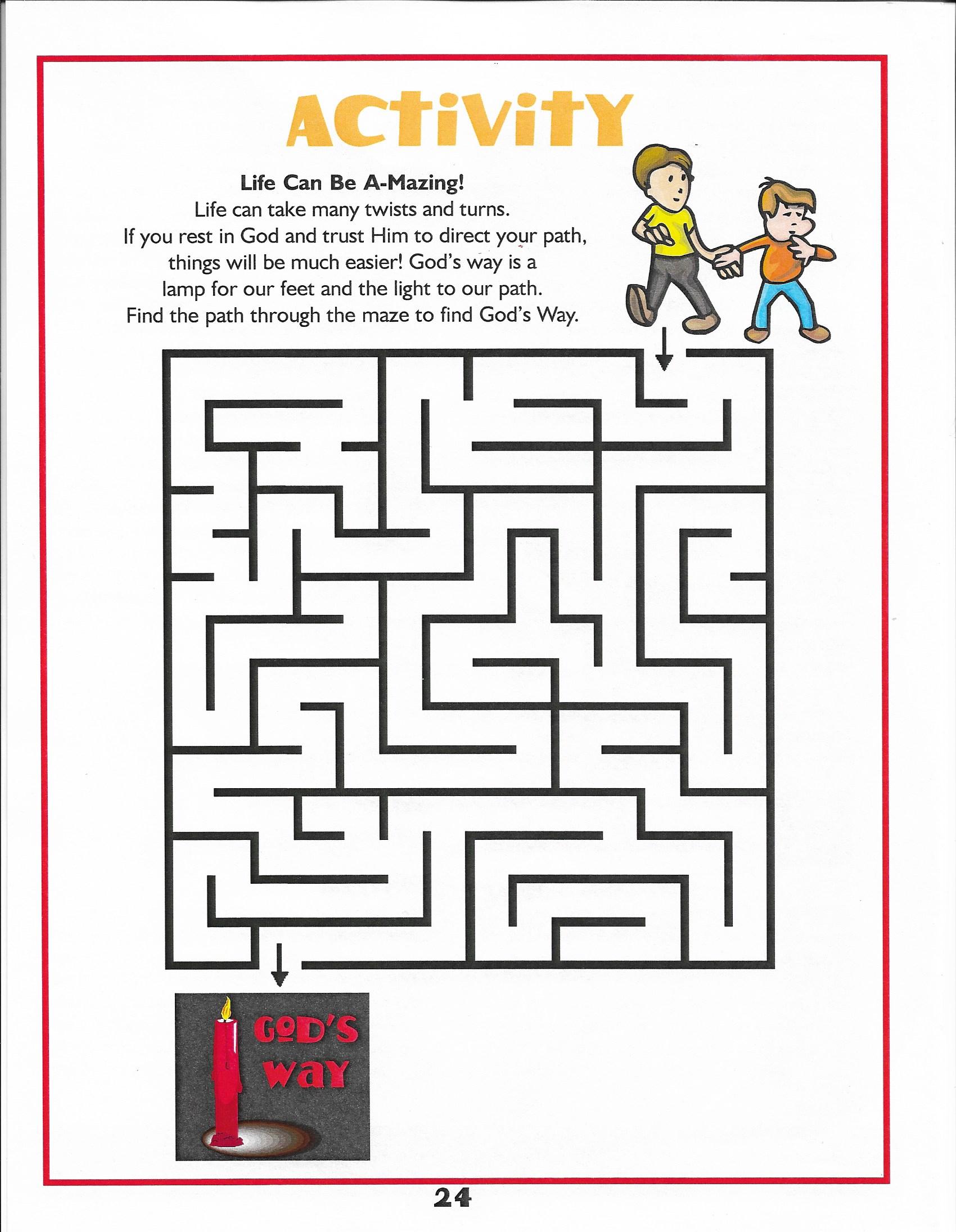
Activity: Life Can Be A-Mazing - Student book - Time: 5-7 mins.
Extending the Lesson - REACH Activities:
*Back to the Bible: Matthew 11:28-30
*Journal Jot: Let Freedom Ring
*Word Study: Seven and Oath - sheba and shaba
*Just Toolin’ Around: Give You Rest
*Did you Know? Jubilee
*Stretch It Out: Jesus is Our Jubilee
*Music Notes: On Jordan’s Stormy Banks
*Questions? - Writing Prompt - 10 mins.
Student Prayer
Dear Father,
Please teach me to value the rest and freedom there is in being Your child.
In Jesus' name.
Amen.
Daily Devotions
Sunday: Isaiah 61:1-3
Monday: Luke 4:18-19
Tuesday: Matthew 11:28-30
Wednesday: Leviticus 25:1-7
Thursday: Leviticus 25:8-12
Friday: Leviticus 25:13-17
Saturday: Leviticus 25:18-22
Objectives
At the end of this lesson, students will be able to:
1. Recite Leviticus 25:10 and explain its meaning.
2. Explain what the Year of Jubilee is.
3. State when the Year of Jubilee began.
4. Explain the cycle of seven Sabbaths.
Topics & Themes
Day of Atonement
Debt
Freedom
Holy Days, Atonement
Jubilee
Redeemer
Rest
Sabbath
Materials Needed
Bible, YEA Students' and Teacher's books, pencils and pens, attendance and memory verse charts, stars, songbook, music player, cassette or CD, songbook, blackboard and chalk, poster paper, markers, scrolls (see Preparation), sticks or dowels, glue, tape, stapler.
Preparation
Make a scroll using poster paper. Write on it Isaiah 61:1-3. Highlight the portions Jesus read that are cited in Luke 4:18-19. Have this ready for class. Spend some time reading Leviticus 25, Isaiah 61:1-3 and Luke 4:18-19. Be prepared to talk with the students about the seven-year cycle, the 50 year cycle, and the freedom that we ultimately have in Jesus Christ. He is our Jubilee.
How to Teach This Lesson
After opening the class with prayer discuss the following with the students:
Scroll - Stand up with the scroll you made before class for the students to see. Read the portion Jesus read in Luke 4:18-19 and sit down. Then talk with the students about the reaction of the people in the synagogue and about Isaiah 61, where Jesus read from. Ask: What was Jesus talking about? (Answers may include: the Year of Jubilee, Christ's first coming, the second coming of Jesus. Be prepared to show how the Old Testament points to Jesus' coming.)
Sabbatical year - Have a student read Leviticus 25:1-7. Chart on the board how often it occurred and what happened every seventh year. Ask: Of what does the sabbatical year remind you?
The Year of Jubilee - Ask a student to read Leviticus 25:8-12. Again chart when the Jubilee occurred, when it started, and what happened during that year.
Property - Talk about property returning to its original owner. Read verses 13-17.
Harvesting - Ask: What were the Israelites to do for food to eat since they weren't allowed to plant or harvest during the seventh year? Read verses 18-22.
Tenants - Ask: Why wasn't the land sold permanently? Why was the land returned to the original family? Read verse 23. God wants us to remember that the land belongs to Him.
Redemption of land - Ask: Could the person get his land back before the Year of Jubilee? Yes. God made provisions for how this was to be done. Read verses 25-34.
What belongs to God? - Verse 23 says that the land belongs to God. Ask: What else belongs to God? The people. Read verses 54-55.
Redemption of people - Ask: What happened if the person became so poor that he sold his land and then sold himself to be a slave? Was there a difference between an Israelite and an alien in this case? Could the Israelite be redeemed before the Sabbath year? Read verses 35-53.
Sevens - Talk about the sevens found in the Bible: seven days of creation, seven cows/sheafs of grain in Pharaoh's dreams, seven things God hates in Proverbs, seven trumpets of Revelation, seven weeks leading up to Pentecost, the seventh month, the seven cycles of seven years leading up to the Year of Jubilee. Seven is a number of completion. Ask: Why God would ordain the Year of Jubilee and the Sabbatical Years to be connected with such a number of completion? It is a time of complete freedom: from all debts physical and spiritual, through Jesus Christ, our Lord.
Summary - Each Sabbath we have been given a gift from God. It is a time to worship God and rest in Him. Every seventh year, God told the Israelites to give the land a rest. Every 50th year God told the Israelites to proclaim the Year ofJubilee - freedom from debts - physical and spiritual. That's a great thing to remember about the Day of Atonement.
Review Questions
1. What does Leviticus 25:10 say?
2. What does it mean to proclaim the favorable year of the Lord?
3. What happened in the seventh year?
4. What happened in the Year of Jubilee?
5. When did the Year of Jubilee begin?
Teacher-Directed Activity
Give each student a piece of paper and pencil. Have them make their own scrolls. Let them choose their text, but encourage them to relate it to Leviticus 25.
REACH Activity
Back to the Bible: Matthew 11:28-30
After you have read your lesson and read through Leviticus 25, then read Matthew 11:28-30. Do you see a connection between the sabbath year, the Year of Jubilee, and Jesus our Savior? What was supposed to happen on the Sabbath year? The land was supposed to rest. Debts were cancelled. Who cancels our sin debt? In whom do we find rest? What happened during the Year of Jubilee? People were allowed to go back to their inheritance, the land that belonged to their family. What is our inheritance as children of God? When do we receive that inheritance? As you write the answers to each of these questions, find the scripture to back up your answers. Then write a summary paragraph about what you have learned. File it in your Bible notebook.
Journal Jot: Let Freedom Ring
In 1751, the Speaker of the Pennsylvania Assembly ordered a new bell for the State House. He asked that a Bible verse be placed on the bell: Proclaim Liberty throughout all the Land Unto all the inhabitants thereof—Leviticus 25:10. Between 1753 and 1846, the Bell tolled for many people and occasions. It rang to mark the signing of the Constitution, and the deaths of Benjamin Franklin, George Washington, Alexander Hamilton, and Thomas Jefferson. (Source: https://constitutioncenter.org/blog/10-fascinating-facts-about-the-liberty-bell)
It is interesting that a crack developed in the bell and it is now very seldom even tapped. But someday freedom will ring throughout our land. I can imagine that bells will ring, trumpets will sound, and people will shout a great shout of joy! What does this description sound like to you? Does it sound like any of the holy days of God? Write in your journal your thoughts about true Godly freedom and what that would look like - and what it would feel like.
Word Study: Seven and Oath - sheba and shaba
In Leviticus 25, there are multiple times that the word “seven” is used. It is the Hebrew word sheba and refers to a number. It is Strong’s #7651. The word “oath” is the Hebrew word shaba (Strong’s #7650). It is a denominative verb from sheba. That means it is the verb form of the noun. In other words it is the same word meaning - just one is the noun and one is the verb. So when the verb says, “I swore to you” or “I took an oath to you,” you could just as easily say, “I sevened you.” Do you understand the implications of this? Every time God ordains something with a seven, it’s the same as God swearing an oath that He’s going to do something. The sabbath is the seventh day - He will give us rest. The fall holy days are in the seventh month - Jesus will come back again and set up His kingdom. In the case of the Year of Jubilee, you count off seven times seven years - what’s coming next is beyond amazing! And that’s what we will have in Jesus Christ, our Jubilee!
Write about this in your Bible notebook!!
Just Toolin’ Around: Give You Rest
Using a concordance or other Bible reference tool, find out how many times God says that He will give us rest. Write down some of your favorites. Then share what you’ve found with your family.
Did you Know? Jubilee
We have come to think of a jubilee as a great celebration, usually of a wedding anniversary or the reign of a monarch.
25 years is a silver jubilee
30 years is a pearl jubilee
35 years is a coral jubilee
40 years is a ruby jubilee
45 years is a sapphire jubilee
50 years is a golden jubilee
60 years is a diamond jubilee
65 years is a blue sapphire jubilee
70 years is a platinum jubilee
80 years is an oak jubilee
(Source: https://www.caketoppers.co.uk/page/wedding-anniversary-names)
Think for a moment. Why would 80 years be celebrated at the Oak Jubilee? Write your thoughts in your Bible notebook.
Stretch It Out: Jesus is Our Jubilee
Michael Card sings a song about Jesus as our Jubilee. Look up the song. Write down the lyrics in your Bible notebook. How does it make you feel to know that Jesus Christ is the One, the Only One, who can free us from our sins and give us rest? Does it make you rejoice?
Music Notes: On Jordan’s Stormy Banks
This hymn is on page 144 of the CEM Hymnal.
The text for this hymn was written by Samuel Stennett (1727-1795). He was the son of the pastor of Little Wild Street Church in London. As a Seventh-Day Baptist, it was difficult to get a university education; they were not easily available to anyone who did not swear allegiance to the Church of England. However, Samuel Stennett did study at the academy at Miles End. Interestingly, he was a personal friend to the reigning monarch, King George III, and was honored with a doctor of divinity degree from King’s College. Samuel assisted his father in the little church and when his father retired, he became pastor, preaching there for the next 20 years. Incidentally, his grandfather was also a Seventh-day Baptist pastor. Among his other accomplishments, Samuel wrote more than 38 hymn texts.
The music originally paired to his text was in a minor key and sounded much different from what we sing today. His text was eventually paired with the melody called “The Promised Land,” although nothing is known about the composer, Miss M. Durham, other than her name. (Source: https://www.umcdiscipleship.org/resources/history-of-hymns-on-jordans-stormy-banks-i-stand)
As you sing this hymn, does it excite you to know that it was written by someone who observed the Sabbath? What are your favorite lines in the hymn? Write them down and share them with your family.
Questions?
Write down any questions you have in your Bible notebook so that you can remember to ask your parents or your pastor.
Song
“I Will Sing of the Mercies of the Lord Forever" is on page 17 of Kids Classics Collection.
Closing Prayer
Ask for a volunteer to lead in prayer thanking God for providing rest and redemption for all of us.
Printable Pages