YEA Lesson Library
What are YOU Eating?
About This Lesson
This lesson explains God’s dietary laws and highlights other unclean things that we shouldn’t put in our bodies, i.e. from books, music, television.
Scriptures
Genesis 7:2
Leviticus 11
Ephesians 6:13-17
1 Thessalonians 4:7
Words to Know
CHEW THE CUD - when an animal chews its food more than once
FINS - the outside membranes of a fish used in propelling or guiding the body
SCALES - the small, clearly defined plates which form the outer covering on a fish
SCAVENGERS - an animal (bird, fish, etc.) which eats garbage or dead and decaying animals
CEREMONIAL - having to do with a ceremony or religious service
RIGHTEOUS - acting according to God's Law
CARCASS - a dead body: corpse; especially: the dressed body of an animal
The Lesson
“Hey, Cassie! Come play Dungeons and Dragons with us," Tara called to her best friend.
"No, thank you," Cassie gently, but firmly, replied.
"Come on, Cassie!" her friend persisted.
"I'm not interested," said Cassie quietly.
Tara walked over to Cassie to ask, "Why won't you play with us, Cassie? Really?"
Sighing, Cassie said, "It has to do with the clean and unclean meat laws in Leviticus 11. Still want to know?"
Tara nodded. "You know I do. Tell me abut Leviticus... what was it?”
Leviticus 11 gives several rules for which animals, birds, fish, and insects may be eaten. Any animal that has a completely split hoof and that chews the cud is clean. That means it is okay to eat. Any animal that does not have a split hoof and does not chew the cud is unclean. That means God told the Israelites they couldn't eat those animals. In fact, they weren't even supposed to touch their carcasses, which means their dead bodies.
Animals such as dogs and cats with paws are unclean. Rodents such as weasels, rats, rabbits, and squirrels are unclean.
The rule God gave for water animals is that fish must have both fins and scales to be clean and something we can eat. If it doesn't have both, it is unclean. All scavengers in the bird families are unclean. That means all of the eagles, vultures, owls, kites, herons, etc. are not allowed to be eaten.
There are also clean insects and unclean insects. The ones that have jointed legs for hopping on the ground are clean, even if they also had wings. All other flying insects and other insects are unclean.
This is very important to God. In Leviticus 11:44-45, God says twice, "I am the LORD your God. . . be holy, because I am holy." God doesn't want His people to eat unclean animals or touch their dead bodies.
"But Cassie," Tara protested, "that was for the Israelites! They had to do all sorts of ceremonial things.”
"Tara, read Genesis 7:2 with me. You'll see that God told Noah to take seven pairs of clean animals and two unclean animals on the ark. Noah knew what that meant."
"But it really goes deeper than that, Tara. The clean and unclean meat laws are all good lessons that there are certain things in this world that are not good for you to have in your body. They can make you sick. They can even kill you. We're not just talking about food either. Games like Dungeons and Dragons, R-rated movies, Harry Potter books or Goosebump books - these are all thing that many children's minds feed on. Do you understand why these things are not good for you? Your mind is like a filing cabinet. Everything you ever see, read, do, or experience is filed away and becomes part of you whether you like it or not. And secondly, those games, movies, and books are not godly. They are just the opposite. They are against God. When we take them into our minds, we have made a huge hole in our armor.
“Remember the Armor of God in Ephesians 6:13-17? One of the pieces Paul told us to put on is the breastplate of righteousness. Ungodly books, movies, and games are not righteous. And, think about it, it's not a good idea to have a hole in your armor right over your heart!
"Tara, I guess the best way to answer you would be to quote 1 Thessalonians 4:7: 'For God did not call us to be impure, but to live a holy life.’ And I think playing Dungeons and Dragons would be impure.”
"You know what, Cassie? I think you're right. Do you want to ride our bikes to the park?”
"You bet."
Activity
Teaching the Lesson:
Legacy Lesson: Student book/Teacher book - Teaching Time: 25 mins.
Lesson Prep - Teacher book - Time: 45 mins.
Activity: Clean and Unclean - Teacher book - Time: 25 mins.
Song: "Dare to Be a Daniel" - page 9 of Kids Classics Collection - Time: 5 mins.
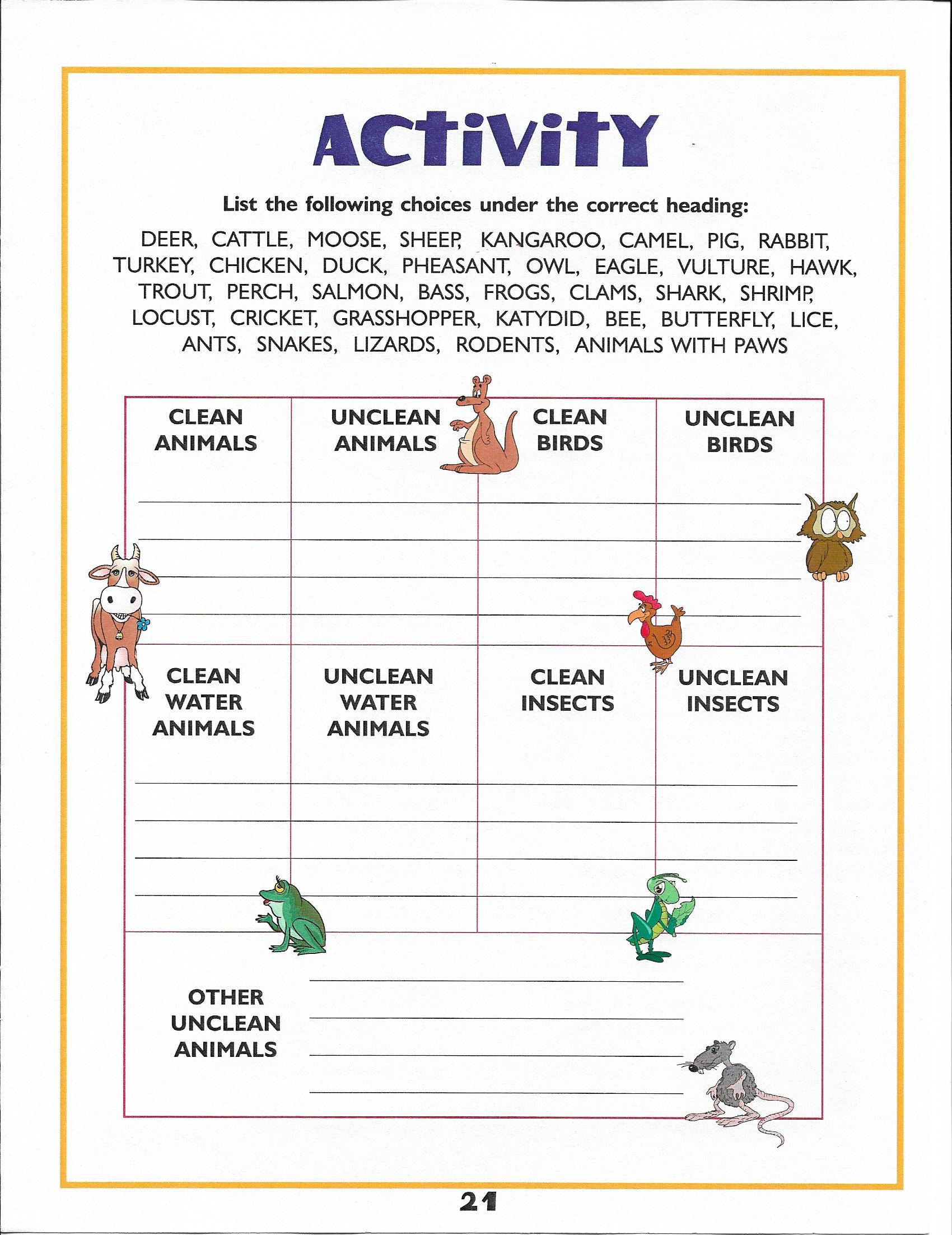
Activity: Sorting It Out - Student book - Time: 20 mins.
Extending the Lesson - REACH Activities:
*Back to the Bible: Leviticus 11
*Journal Jot: Answering the Legalists
*Word Study: impure - akatharsia
*Just Toolin’ Around: A Filing Cabinet
*Did you Know? Food vs. Meat
*Stretch It Out: A Closet Never Cleaned Out
*Music Notes: How I Love Thy Law, O Lord!
*Questions? - Writing Prompt - 10 mins.
Student Prayer
Dear Heavenly Father,
Help me to be more aware of the choices I make every day - whether they are healthy for me physically and mentally.
In Jesus' name.
Amen.
Daily Devotions
Sunday: 1 Thessalonians 4:7
Monday: Genesis 7:2
Tuesday: Ephesians 6:13-17
Wednesday: Leviticus 11:1-8
Thursday: Leviticus 11:9-12
Friday: Leviticus 11:13-20
Saturday: Leviticus 11:21-28
Objectives
At the end of this lesson, students will be able to:
1. Find the description for clean and unclean meats.
2. Recite the rules for which foods are clean and which are unclean food.
3. Transfer the principle of clean and unclean foods to other behaviors and choices.
Topics & Themes
Choices
Food Laws
Holy Conduct
Purity
Unclean meat/food
Materials Needed
Bible, YEA Students' and Teacher's books, pencils and pens, attendance and memory verse charts, stars, songbook, cassette or CD and music player, blackboard and chalk, poster paper, markers, pictures cut out of magazines
Preparation
Spend some time cutting out pictures of lots of different animals from magazines such as your state conservation magazine, National Wildlife, International Wildlife, Ranger Rick, Your Big Backyard, etc. You may also have some old calendars with animal pictures on them that you can use. If you don't have any magazines you can cut up, find a children's animal encyclopedia at the library. Put post-it notes on different pages to bookmark the animals you want to talk about with the students. You may want to color code animals for the different categories; i.e., mammals, birds, those with split hooves that chew the cud, jointed legged insects, scavengers, etc.
How to Teach This Lesson
After opening the class with prayer begin the discussion as follows:
Clean and Unclean Meats - Ask if the students know what this is. If they don't, give a brief definition: God gave us all kinds of animals. Some of them are good for food. Others are not. We would not eat dirty things because we don't want to get sick. We don't want to eat unclean meats because we want to obey God. There are other reasons too - such as learning to avoid all things that are not good for us.
Leviticus 11 - Walk straight through Leviticus 11 with the students. As you come to each grouping, stop and look at the animal pictures you’ve collected for the students to examine. Since most people are visual learners, this will make much more of an impact than only reading Leviticus 11 and discussing it. This part of the lesson will take quite a while.
Applications - Tell the students that food is just one thing we take into our bodies. Ask them to name something else. (Water, drinks, medicines, drugs, and all mental things: books, movies, music, games, activities, etc.) Just as dirty water can make you very sick, you have to make sure what you're putting in your body and your mind is clean. Make wise choices about the things you choose to do.
1 Thessalonians 4:7 - Have the students recite their memory verse. Then ask them if they understand why this memory verse goes along with the clean and unclean meat topic.
In Real Life - Ask: How many of you have had a situation where your friends at school asked about why you don't eat certain foods? Allow students to tell stories of discussing the subject of clean and unclean meats with their friends.
Ask: How many of you feel this lesson will help you in talking with your friends? How will this lesson give you ways of explaining your behavior to others? If they are still unclear how to explain their belief about the foods they eat, help them work out what to say.
Review Questions
1. Where would you find the list of clean and unclean meats in the Bible?
2. How would you know if an animal was clean and could be eaten ?
3. How would you know if a bird was clean?
4. How would you know if a fish was clean?
5. How would you know if an insect was clean?
6. What else do we take into our bodies that can make us unclean?
Teacher-Directed Activity
Clean and Unclean. Split up the group. Make two columns on a piece of poster paper: clean and unclean. Give students 10 minutes to write down everything they can think of for both columns. Remind them that they are not just limited to food. Debrief - Ask: How many of these things did you already know without the help of others in your group? How will this help you to remember what is clean and good to eat and what is not? Why do you think God does not want us to eat certain animals, birds, and water animals? What are some other things we can take into our bodies that are not good for us?
REACH Activity
Back to the Bible: Leviticus 11
Read this entire chapter. Then make a chart to summarize each different category. For example, verses 1-8 specify only eating animals that both chew the cud and have a split hoof. This eliminates kangaroo, pig, rabbits, and camelids. Do the entire chapter this way. It will help you to understand what God says are clean to eat and what is not clean to eat.
Journal Jot: Answering the Legalists
There have been many times when I was accused of being legalistic because I observe the dietary laws of the Bible. The funny thing is that people who say that don’t really know what legalism is!! Legalism is trying to earn your own salvation. We aren’t doing that! We are honestly relying on Jesus Christ for our salvation. Keeping God’s laws, including the dietary laws, is how we demonstrate our love and faith in Him. That’s a totally different thing than trying to earn our salvation! I suspect that you will run into someone who says this to you at some point. Ask them if they think we should obey God’s law not to murder. Or to refrain from stealing. Or to honor Him as the One and Only God. It’s very good to keep all of God’s commandments because He gave them to us for our good. This is a big topic. Talk about it with your parents. Then write a reflection in your Bible notebook.
Word Study: impure - akatharsia
This Greek word (from 1 Thessalonians 4:7) means “uncleanness, filth . . . moral uncleanness, lewdness, incontinence in general” (Source: NAS Hebrew-Greek Key Word Study Bible, 1990, G#167).
There’s a picture we gain from the Greek of something that is disgusting. Why in the world would we want to have anything to do with that kind of filth?! Yuck! This is how we should feel about eating anything that is unclean as defined by God. It’s absolutely revolting to think of putting it into our mouth. If we understand that feeling, we need to apply it to our choice of television shows, music, books, and other activities that likewise are revolting as defined by God.
Write this word, its definition, and where it is found in your Bible notebook.
Just Toolin’ Around: A Filing Cabinet
One of the most fun things to do is to sit with a grandparent or great-grandparent and talk about their experiences. When I was eleven, I never grew tired of hearing their stories. But they told me the good things, the fun times, the exciting adventures. I don’t remember hearing any stories about living through two world wars and the wars after them. My uncle would share bits and pieces of culture in Vietnam when he was there during the war, but he never talked, ever, about any of his war experiences. But that doesn’t mean that the bad stories, the mistakes made, the regrets and sorrows aren’t all there. Everything goes into your mind and is filed away. With the passage of time, the details can blur, but the memories are there. It’s very wise to think about what you do because your actions today will be the memories you look back at tomorrow. Write about this in your Bible notebook. Then go ask a parent, grandparent or older neighbor to share their favorite memory with you.
Did you Know? Food vs. Meat
The words you choose really do matter. I never say that it is “unclean food;” food is something eaten, implying that God created it to be eaten or that someone should eat it. I always refer to those items as “unclean meat." Meat is flesh, as in “You have a lot of meat on your bones.” “Meat" is not automatically considered something you eat like “food” is.
Stretch It Out: A Closet Never Cleaned Out
Ron Dart once gave a sermon entitled “A Closet Never Cleaned Out.” It’s well worth your time to listen to this message and to think seriously about what you put into your mind. The clean and unclean laws are for more than just what food you eat.
Music Notes: How I Love Thy Law, O Lord!
This hymn is on page 101 of the CEM Hymnal.
The words are from Psalm 119, adapted into the 1912 Psalter. This was a collection of metrical psalms published by the old United Presbyterian Church. This hymnal pairs the words with music arranged (or harmonized) by David Evans. The tune is known as “Spanish Hymn” or “Madrid.”
As you sing these words, find the exact verses from Psalm 119 which are used in the hymn. Then find words which explain how important it is to obey all of God’s laws, dietary laws included, in order to be blessed.
Questions?
Write down any questions you have in your Bible notebook so that you can remember to ask your parents or your pastor.
Song
"Dare to Be a Daniel" is on page 9 of the Kids Classics Collection.
Closing Prayer
Ask for a volunteer to lead in prayer asking for God's help in remaining pure and undefiled.
Printable Pages