YEA Lesson Library
Priestly Garments
About This Lesson
This lesson describes the priestly garments and ties them to the full armor of God.
Scriptures
Exodus 28-29
Psalm 62:2
Romans 13:14
Galatians 3:27
Ephesians 6:10-11
Ephesians 6:13-17
Colossians 2:12
Words to Know
VESTMENT - piece of clothing
BREASTPIECE - the outer vestment set with precious stones, used for for making decisions
EPHOD - a sleeveless linen vestment
ROBE - a long, flowing outer garment
TUNIC - a simple, slip-on garment, made with or without sleeves, usually knee length or longer
TURBAN - a cap around which is wound a long cloth, to be worn on the head
SASH - a band worn around the waist or over one shoulder
The Lesson
Cathy and Lisa could hardly wait for the wedding. They were to be junior bridesmaids for their older cousin Janice's wedding. Their moms were making new dresses for them to wear. The long flowing dresses were beautiful. It was going to be such fun to wear these special dresses. Cathy and Lisa were sure they would feel as happy and beautiful as Janice.
Think about all of the different reasons for wearing special clothes: weddings, police or firefighter uniforms, astronauts, divers, race car divers, nurses, surgeons... the list goes on and on. Why, even you get to wear special clothes. You have school clothes, play clothes, pajamas, and church clothes. You wear your best clothes to church. Why? You should wear your best clothes to honor God, to show your love and respect for Him. Also, your best clothes should not be a distraction to other people. A halter top, short shorts, mini-skirt, a loud T-shirt, or a tank top with your favorite gym shorts could be a distraction to others. They are also not clothes to be worn when we appear before God. God really cared about the clothes that Aaron, the High Priest wore. God was very detailed about just what He wanted the High Priest to wear (Exodus 28-29).
The Ephod was of gold, blue, purple, and scarlet yarn and finely twisted linen. It had two shoulder pieces with onyx stones set with the names of the 12 tribes of Israel. It also had a woven waistband.
The Breastpiece was used for making decisions. It was to be square, made similarly to the Ephod, with four rows of precious stones, symbolizing the 12 tribes of Israel. The Breastpiece was attached to the Ephod. Under the Ephod was a robe, made entirely of blue. On its hem "a golden bell and a pomegranate, a golden bell and a pomegranate, all around on the hem of the robe. And it shall be upon Aaron when he ministers: and its tinkling may be heard when he enters and leaves the holy place before the LORD, that he may not die" (Exodus 28:34-35 NASB).
On Aaron's head was a turban. Attached to the turban with a blue cord was a pure gold plate that said "Holy to the Lord." "And it shall be on Aaron's forehead, and Aaron shall take away the iniquity of the holy things which the sons of Israel consecrate, with regard to all their holy gifts" (Verse 38 NASB). After Aaron died, every High Priest after him was to wear this.
The High Priest and other priests were to have tunics, sashes, and headbands to give them dignity and honor as they served before God. God wanted the priests to present the various offerings and sacrifices wearing these clothes. They were not to wear just any old thing. God was very specific about the design of the clothes He wanted them to wear. Why do you suppose that was?
Everyone around them saw what they were wearing, just as everyone around you sees your actions. People know whether you are acting like a Christian. Colossians 3:12 says: "Therefore, as God's chosen people, holy and dearly loved, clothe yourselves with compassion, kindness, humility, gentleness and patience." People see you choosing to act as Jesus would. They can also see how you make your decisions. This is much like using the Breastpiece for making decisions. Your friends and family know if you are making decisions based on the Bible, your parents' religion, peer pressure, a TV show, or your own desires.
But we need to go further than just acting as a Christian would. We need to "put on Jesus Christ" (Romans 13:14). Do you know what that means? Paul gives us a clue in Galatians 3:27: "For all of you who were baptized into Christ have clothed yourselves with Christ." We know that a change in your heart and mind happens at baptism.
Then in Ephesians 6:13-17, we have Paul's beautiful word picture of putting on the full Armor of God. We want to put on the Armor of God to stand firm against the devil's schemes. First we stand with the belt of truth buckled around our waist. Does that make you think of the sash the priest wore? Then we have the breastplate of righteousness. It reminds us of making decisions. Our feet are to be fitted with readiness that comes from the Gospel of Peace. Next we are to take up the shield of faith, like the Ephod. We put the helmet of salvation on our heads. Do you remember that the plate on the turban worn by the High Priest said, "Holy to the Lord"? The sword of the Spirit was the last part of the armor. It is the Word of God - the Bible.
Now notice: Truthfulness, righteousness, peacefulness, faithfulness, holiness are not just characteristics worn on the outside. They are more than clothing. They go right to your heart. When you put on the whole Armor of God it is not just covering you; it goes deep into who you are. The last part of the Armor is the Word of God. It is also called the Sword of the Spirit. It is only an effective Sword if you know the Word of God. To do this you need to read the verses in your daily devotionals every day, memorize your Bible verses, and live by them.
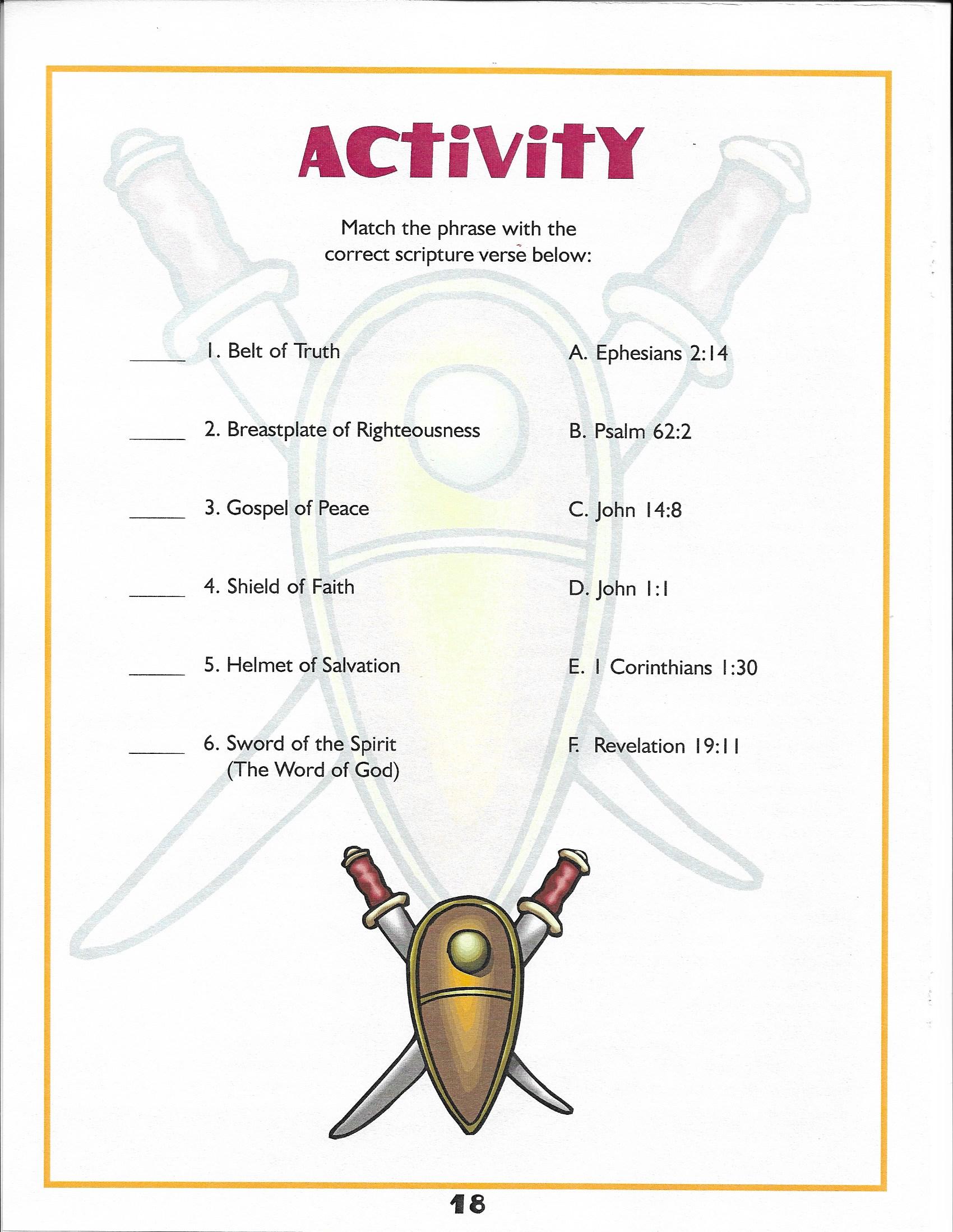
Here's the cool part. As you do your activity below, you'll find the scriptures which show that it is Jesus Christ who is the Armor of God. So, the clothing of the High Priest ultimately pointed to Jesus Christ, as did the Tabernacle, the sacrifices, and the High Priest himself. God's design is so complex, detailed and wonderful! The next time you get dressed, remember that what we wear really does matter to God.
Activity
Teaching the Lesson:
Legacy Lesson: Student book/Teacher book - Teaching Time: 25 mins.
Lesson Prep - Teacher book - Time: 45 mins.
Activity: Sword Drill - Teacher book - Time: 20 mins.
Song: "Fairest Lord Jesus" - page 79 of Kids Classics Collection - Time: 5 mins.
Activity: Matching Full Armor of God - Student book - Time: 10 mins.
Extending the Lesson - REACH Activities:
*Back to the Bible: Inside and Out
*Journal Jot: What You Wear
*Word Study: schemes - methodeia
*Just Toolin’ Around: methodeia
*Did you Know? Urim and Thummim
*Stretch It Out: Paper Dolls
*Music Notes: Fairest Lord Jesus
*Questions? - Writing Prompt - 10 mins.
Student Prayer
Dear Father,
Help me learn to dress to please You, in my actions, and in my heart.
In Jesus' name.
Amen.
Daily Devotions
Sunday: Ephesians 6:10-11
Monday: Romans 13:14
Tuesday: Galatians 3:27
Wednesday: Colossians 2:12
Thursday: Exodus 28:34-35
Friday: Ephesians 6:13-17
Saturday: Psalm 62:2
Objectives
At the end of this lesson, students will be able to:
1. Describe the garments of the High Priest.
2. Explain what it means to put on Jesus Christ.
3. Explain the connection between actions and outward appearances.
4. Find scriptures which show the Armor of God.
Topics & Themes
Armor of God
Baptism
Day of Atonement
Godly Character
High Priest
Priestly Garments
Materials Needed
Bibles, YEA Students' and Teacher's books, pencils and pens, attendance and memory verse charts, stars, songbook, music player, CD or cassette tape, blackboard and chalk
Preparation
Although this age group is a little young to be aware of the sexual overtones present in many commercials and ads, they are nevertheless drawn into society's way of thinking about dress. It is not too early to begin talking with them about modest and proper dress as Christians. Church clothes should be our best, not to impress other people, but out of honor and respect for our God.
We want our children to believe the Bible rather than such things as Jewish tradition. Translations and commentaries often shed a different or more complete light on the Scriptures. Since we don't have the original translation and most of us don't know Hebrew and Greek, we often go to those who do to help us understand difficult scriptures. Exodus 28:33-34 is a case in point. The Expositor's Bible Commentary says, "The bells, which jingled as the high priest served in the tabernacle, assured all who listened that he had not died in the Holy Place and that he continued to minister on their behalf" (v. 35).
Scriptures tell us that only the High Priest was allowed in the Holy of Holies, and only on the Day of Atonement. Any breach of this would be instant death. The bells may have been a means for the priests to know that the High Priest hadn't died in the Holy of Holies. Jewish tradition says a small rope was tied to the leg of the High Priest. In the event the priests could no longer hear the bells jingling, they would pull on the rope. If this is true, perhaps this was also a way to pull him out of the Holy Place in the event he died in there. Otherwise, it appears he would have to remain in there until the next Day of Atonement. But again, this is tradition. We simply are not told by God while there were to be bells.
Find numerous magazine pictures of people dressed in different ways: for their job (firemen, business suits, etc.); for sports (swimming, golfing, running, etc.); for formal occasions (weddings, receptions, etc.); for leisure (casual clothing); etc. Cut them out to launch the discussion of clothing in class.
How to Teach This Lesson
After opening the class with prayer, begin the discussion with the following:
The clothes we wear - Show the magazine pictures to the students. Have them guess what activity the person is involved in. Ask them why they think so. Tell them that God is interested in what they wear. How do we know that? Let's start with the garments worn by the High Priest.
The Ephod - made of gold, blue, and scarlet yarn and finely twisted linen. It had two shoulder pieces with onyx stones, set with the names of the 12 tribes of Israel. It also had a woven waistband, probably to hold it together at the waist.
The Breastpiece - used for making decisions: square, made similarly to, and attached to, the Ephod, with four rows of precious stones, symbolizing the 12 tribes of Israel.
Robe - under the Ephod, made entirely of blue; the hem had embroidered pomegranates and gold bells. "When he ministered: and its tinkling may be heard when he enters and leaves the holy place before the LORD, that he may not die" (Exodus 28:35 NASB).
Tunic - under the robe, woven of fine linen.
Undergarments - Aaron and all the priests had to wear them whenever they entered the Tent of Meeting, so they didn't incur guilt and die. The undergarments were probably for modesty.
Turban - attached to the Turban by a blue cord was a pure gold plate, inscribed with "Holy to the Lord." “It shall be on Aaron's forehead, and Aaron shall take away the iniquity of the holy things which the sons of Israel consecrate, with regard to all their holy gifts..." (v. 38 NASB).
Priestly Garments - worn by all the priests, for dignity and honor, as they presented various offerings and sacrifices. Why? This could be a symbol for us today regarding what we wear. What do we wear? Yes, our clothing. Colossians 3:12 says we also wear actions.
Others see - our actions and decisions are influenced by friends, the Bible, our parents' religion, TV, peers, etc.
Not-so-visible - what's deep inside our hearts and minds. Have the students read Ephesians 6:10-11, 14-17. Talk about truthfulness, righteousness, peacefulness, faithfulness, holiness as deep character traits that are hard to fake.
The full Armor of God - Read Galatians 3:27. Then check the Activity in the Students' book. Help students make the connection that the full Armor of God is Jesus Christ, whom we put on at baptism. These deep character traits become part of us as we choose God through repentance and baptism.
Summary - What we wear is important to God. Think about it the next time you get dressed.
Review Questions
1. What were the garments of the High Priest?
2. What do our actions say about us?
3. What does it mean to put on Jesus Christ?
4. Who is the Armor of God?
5. Why does it matter what you wear?
Teacher-Directed Activity
Do a Sword Drill.
Say, "Attention." Students are to line up and stand at attention with their Bibles closed at their left side. Say, "Draw swords." Students are to raise their Bible in front of them and rest it on their left hand, with the right hand ready to open it. Say the scripture, then say, "Charge." The first to find the scripture is to take one step forward and read the verse aloud. Use these scriptures: Ephesians 2:14; Psalm 62:2; John 14:6; John 1:1; 1 Corinthians 1:30; Revelation 19:11. Give an award to the student who loves God enough to know their Bible and is able to find the most scriptures first.
REACH Activity
Back to the Bible: Inside and Out
Your lesson does a nice job of drawing the analogy of the priestly garments symbolizing putting on Jesus Christ. In your Bible notebook, make a chart with three columns. The first column is titled “Priestly Garments.” The second column is the piece of the armor of God which relates to each piece of the priestly garments. The third column is the scripture which refers to Jesus Christ as our peace, as our righteousness, as our source of salvation, etc. (Hint: you may use your student activity to help you find scriptures. But you may wish to find more than one.) As you do this project, it will help solidify the details of the priestly garments and the full armor of God in your mind. Share your finished chart with your sabbath school teacher.
Journal Jot: What You Wear
What is acceptable to wear in public changes over time. At one time in this country, it would have been totally unacceptable for a woman’s skirts to be so high that a man might be able to see her ankle. There was a time when everyone who booked a flight on the airlines wore their best clothes - suits and ties, dresses and heels. There was a time when bathing suits covered a woman from neck to ankle. There was a time when a woman would not have dared go to church without a hat on her head or to be seen in public with less than three petticoats.
Having said all of that, when you choose what you’re going to wear to church, remember that you are not going to church to be seen by other people; you are going to church to worship God and give Him the glory and honor. If the clothes you choose are a distraction to the rest of the congregation, you need to choose something else. Obviously a bathing suit is not appropriate, but neither is a full-length ball gown. Wear clean, neat clothes that you save for the best occasions.
Write your thoughts about this topic in your Bible notebook.
Word Study: schemes - methodeia
This is the Greek word found in Ephesians 6:11. It means “method, the following or pursuing orderly and technical procedure in the handling of a subject.” . . . In the New Testament, it is “connected with evil doing, a device, artifice, art, artificial method, or wile” (Source: Zodhiates’ NAS Hebrew-Greek Key Word Study Bible, 1990, G#3180)
Do you understand the implications of the meaning of this verse? Satan systematically sets up a plan to harm you, to cause you to sin, or to challenge your faith in God. If you are going to resist his schemes, you cannot do it through your own efforts; you have to put on the full armor of God.
Write about this in your Bible notebook. Be sure to write this word, its definition, and where it can be found.
Just Toolin’ Around: methodeia
Using a concordance, find other places where this word is used. Is it always connected with evil doing? You may need a center reference Bible to find synonymous words in the Old Testament. Write down what you find in your Bible notebook.
Did you Know? Urim and Thummim
Exodus 28:30 talks about putting the Urim and the Thummim in the breastpiece. The breastpiece was, according to verse 30, “the means of making decisions for the Israelites.” But we don’t have any real idea of what the Urim and the Thummim were. The NIV Archaeological Study Bible says, “The Urim and Thummim may have been small metal objects or stones or sticks inscribed with symbols, possibly the 22 letters of the Hebrew alphabet based on the fact that the first letter of Urim (aleph) and the first letter of Thummim (tau) are the first and final letters of this alphabet, respectively.” (2005, p. 136) We know that they were cast as lots in order to get a yes or no answer from God. Read Leviticus 16:8; Numbers 33:54; Proverbs 16:33; Acts 1:26.
Write a paragraph in your Bible notebook detailing what you have discovered about the Urim and the Thummim.
Stretch It Out: Paper Dolls
You are likely thinking, “I’m not playing with paper dolls!” Hang on! Let me explain the reasoning: If you make a person (like a miniature YOU) on card stock, and cut it out, you have the perfect way to learn each of the pieces of the armor of God more easily (an easier way to memorize each of them). It is also the perfect way to introduce the full armor of God to younger children - which is also a great way for you to fix them more solidly in your own mind. Be sure to add bright colors to each of the pieces.
Music Notes: Fairest Lord Jesus
"Fairest Lord Jesus" is on page 79 of the Kids Classics Collection and page 49 of the CEM Hymnal.
No one knows who originally penned the words to this hymn. It was found in a manuscript in 1662 and found in a 1677 Jesuit hymnbook in Germany with six verses. It is a hymn that emphasizes that Jesus Christ was both human and divine. The music was written by Richard Willis in the 1800s. Although born in Boston, Richard moved to Germany to study music and became friends with the great German composer Felix Mendelssohn. (Sources: Then Sings My Soul, Robert Morgan, 2003, p. 17 and Near to the Heart of God, Robert Morgan, 2010, February 10)
Sing this hymn with your family. Ask them what their favorite line is.
Questions?
Write down any questions you have in your Bible notebook so that you can remember to ask your parents or your pastor.
Song
"Fairest Lord Jesus" is on page 79 of the Kids Classics Collection.
Closing Prayer
Lead the students in prayer asking for God's guidance in making sure their armor is secure.
Printable Pages