YEA Lesson Library
The Most Holy Place
About This Lesson
This lesson continues the description of the Tabernacle and draws the analogy that God’s people are the temple of God.
Scriptures
Exodus 25-27, 35-40
2 Corinthians 6:16-7:1
2 Corinthians 7:1
Ephesians 3:17
Hebrews 8:5
Hebrews 9:24
Hebrews 10:20
Words to Know
CONTAMINATE - to make dirty, stain, corrupt, or infect; contact with dirt or foulness from an outside source
PURIFY - to free from guilt, dirt, or imperfection
HOLINESS - state of being set apart for God
REVERENCE - honor or respect felt or shown
The Lesson
Jonathan and Christopher were so excited! They were finally going to get to see what was behind the counter at the post office. The postmistress had agreed to give them a tour. It was very interesting to see how the mail dropped from the slots into the baskets, how the mail was sorted, how the
postage meter worked, how the mailboxes were filled, and how the postmistress collected mail from the big blue boxes outside. This had been a really good day. After all, it's not every kid who gets to go behind the counter at the post office to see how things work.
There are many places in our world where we're not allowed to go. They are off limits to us, just as behind the counter at the post office is off limits to most of us most of the time. That's how it was in the Tabernacle too. We've already talked about the courtyard (with the bronze altar and the
bronze basin) and the Holy Place in the Tent of Meeting (with the lampstand, the table, and the altar of incense). But we didn't get to the most important part of the Tabernacle - the place that only the High Priest was allowed to go. He was only allowed to go into the Holy of Holies once a year on the Day of Atonement.
The last third of the Tent of Meeting was the Holy of Holies, or Most Holy Place. It was separated from the Holy Place by a curtain of finely twisted linen and blue, purple, and scarlet yarn, with a cherubim worked into its design. The Most Holy Place was a ten by ten cubit square.
The Ark of the Covenant was inside the Holy of Holies. It was a chest made of wood, covered with pure gold both inside and out. The Ark had a top called the Atonement Cover, which was made of pure gold. Two cherubim hammered out of gold were placed, one at each end of the cover. The cherubim faced each other, looking at and overshadowing the cover, with their wings spread out.
This was also known as the Mercy Seat. God told Moses to put the Stone Tablets into the Ark.
Wow! God gave Moses instructions for building the Tabernacle and all of its furnishings in great detail. God told Moses to build it exactly as He described it. Hebrews 8:5 and 9:24 tell us that this Tabernacle is a copy of the sanctuary in heaven - a copy of the throne room of God! That's one reason why God warned Moses to be exact (Hebrews 8:5). Stop and think for a moment.The Tabernacle was built as a place for God to dwell with the people. Where does God dwell today? He dwells in each of us, through the Holy Spirit (Ephesians 3:17). That is why we are called the temple of the living God (2 Corinthians 6:16).
If God was very precise, and He was, in the building of the Tabernacle in the wilderness, don't you think He is very concerned about building you? He wants you to seek Him and look to Him for guidance in laying a firm foundation. He wants to see you walk in His ways and live a godly life of doing quality work that will last. He wants you to make wise choices, like building with pure gold.
The Courtyard and the Holy Place were visible to many people. In the same way, your actions are visible to many people. They know whether you act like a Christian or not. That's why it is so important to stop and think before you say or do anything. What you say and what you do are two of the building blocks in what you are constructing - a life that is pleasing to your Heavenly Father.
The Most Holy Place was only visible to the High Priest, once a year. It was where God would dwell. When Jesus Christ died, the curtain between the Holy Place and the Most Holy Place was torn from top to bottom. Now everyone could go directly to God because of Jesus Christ. No longer did anyone have to go to the High Priest for access to God. Instead, we have a new High Priest, Jesus Christ, who goes to God the Father on our behalf.
But the Holy of Holies is kind of like what goes on inside you - the stuff that only God knows about - when you tell Him your thoughts and what's in your heart. And that's the hardest place for us to be like Christians if we really aren't. Because God knows. You can clean up the outside, but inside, God knows what's really there. That's why Paul encourages us to purify ourselves from everything that contaminates us (2 Corinthians 7:1).
So you have your assignment before you. You want God to dwell within you. You want to serve Him. Let's start building according to God's plan.
Activity
Teaching the Lesson:
Legacy Lesson: Student book/Teacher book - Teaching Time: 25 mins.
Lesson Prep - Teacher book - Time: 25 mins.
Activity: Oral Tour - Teacher book - Time: 20-30 mins.
Song: "One Door and Only One”- page 4 of the Kids Classics Collection - Time: 5 mins.
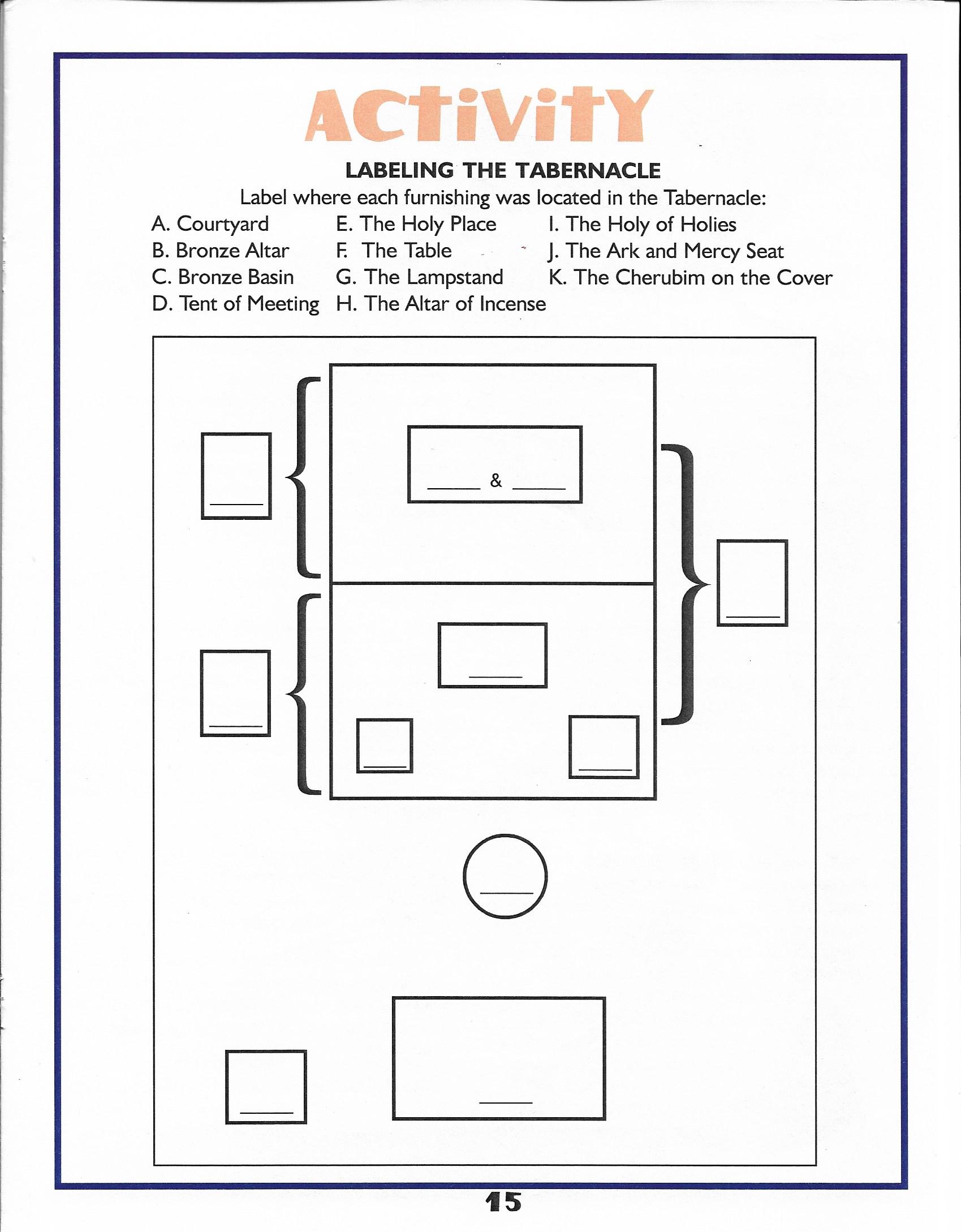
Activity: Labeling the Tabernacle - Student book - 10 mins.
Extending the Lesson - REACH Activities:
*Back to the Bible: The Throne Room of God
*Journal Jot: Coming Boldly Before God
*Word Study: contaminates - molusmos
*Just Toolin’ Around: The Heavenly Throne Room
*Did you Know? Cherubim
*Stretch It Out: Do It and Do It Right
*Music Notes: Holy, Holy, Holy
*Questions? - Writing Prompt - 10 mins.
Student Prayer
Dear Heavenly Father,
Thank You for giving me Your Son, Jesus Christ, so that I can go to You directly. Help me to learn how to purify myself out of reverence to You.
In Jesus' name.
Amen.
Daily Devotions
Sunday: Ephesians 3:17
Monday: 2 Corinthians 6:16-18
Tuesday: Hebrews 8:5
Wednesday: Hebrews 9:24
Thursday: 2 Corinthians 7:1
Friday: Exodus 25:1-9
Saturday: Exodus 26:33-34
Objectives
At the end of this lesson, students will be able to:
1. Describe all three parts of the Tabernacle.
2. Explain that the Holy of Holies was only entered once a year by the High Priest.
3. Say that they are the temple of God today.
Topics & Themes
Holy of Holies
Tabernacle
Temple
Materials Needed
Bible, YEA Students' and Teacher's books, paper, pencils and pens, attendance and memory verse charts, stars, songbook, music player, CD/music tape, basket, tissue paper, figurine or fragile glass, box, colorful wrapping paper
Preparation
Before class, carefully wrap a fragile glass dish or figurine in tissue paper. Place it in a box and wrap it in colorful paper. Place this box in a larger box with real or synthetic popcorn. Close the box and place it in the classroom where it will draw your students’ attention as they enter.
Write the Review Questions on separate pieces of paper and put them in a basket. Do further research on the Holy of Holies and the New Jerusalem that is to come down from heaven in Revelation 21:16 in preparation for this lesson.
How to Teach This Lesson
When all of the students are assembled for class, open with prayer. Begin the class discussion with the following:
The box - Show the students the box. Remind them that the Tabernacle had three parts. The courtyard was the outer part where everyone could go. The Holy Place, or Tent of Meeting, was inside the courtyard, past the bronze basin. Open the box and allow the students to see the packing materials and the brightly-colored box. Set the brightly-colored box aside and continue with the lesson.
Holy of Holies or Most Holy Place - Explain that the Holy of Holies was a room in the Tabernacle separated from the Holy Place by a curtain of finely twisted linen and blue, purple, and scarlet yarn, with a cherubim worked into its design. The curtain was hung with gold hooks on four posts of acacia wood overlaid with gold and standing on four silver bases.
The Most Holy Place was very special - Ask: Can anyone tell us why you think the Most Holy Place was so special? In what way was the Most Holy Place like the post office that Jonathan and Christopher visited? (Not everyone could go in that portion of the post office.) Who could go into the Most Holy Place? (Only the High Priest could go inside.) How often could the High Priest go into the Most Holy Place? (Only once a year.) What day of the year could he go into the Most Holy Place? (The Day of Atonement.) What would happen to him if he went into the Most Holy Place any other time during the year? (He would die.)
Ark of the Covenant - Ask: What was the Ark of the Covenant? It was a chest. What did it look like? It was made of wood, covered with pure gold both inside and out. The Ark had a top Atonement Cover, which was made of pure gold. Two cherubim hammered out of gold were placed one at each end of the cover. The cherubim faced each other and overshadowed the cover with their wings spread out. Does anyone know the other name for the Atonement Cover? It was also known as the Mercy Seat. Ask: Where was the Ark of the Covenant kept? (Inside the Holy of Holies.)
Inside the Ark of the Covenant - Ask: Does anyone know what was placed in the Ark of the Covenant? (Aaron's rod that budded, some manna, and the tables of stone.) Ask: What was written on the two stone tables? The Ten Commandments. Ask a student to read Hebrews 9:4.
The Temple in Jesus's day - Explain that the Tabernacle in the wilderness was temporary and portable. The Israelites moved it with them as they journeyed to the Promised Land. Years later Solomon built a Temple, a more permanent house for God. Later the second Temple was built. Jesus worshiped there. At the moment Jesus died, the curtain in the Temple was torn in two from top to bottom. Read Hebrews 10:20. This shows access was given to God through the Son, Jesus Christ, our High Priest. Refer back to the brightly-colored box. No one was allowed to see inside the Most Holy Place, except the High Priest, just as no one can open the box except the owner.
What this means to us - Read Ephesians 3:17 and 2 Corinthians 6:16. Discuss how we are the temple of God. God is building us by His plan to become like Him. Compare our actions being seen by others to how the courtyard and Holy Place were seen. Our thoughts and desires are hidden as the Most Holy Place and the inside of the brightly-colored box. But God sees inside. Open the brightly colored box to show the students the fragile glass. What is inside us is much like the glass; it is easily damaged. God wants to get rid of anything that can hurt us and for us to seek God's protection for our hearts and minds.
Review Questions
Have the students draw one of the questions you wrote on slips of paper before class to answer.
1. Name three items that were kept in the Ark of the Covenant.
2. Explain the difference between the Tabernacle and Temple.
3. What was between the bronze altar and the Tent of Meeting?
4. What happened to the curtain in the Temple at the exact moment that Jesus died?
5. What part of the Temple would you compare with actions that are visible?
6. What part of the Temple would you compare with thoughts and desires that are not visible?
Teacher-Directed Activity
A Verbal Description of the Tabernacle. Have the students take turns giving oral tours through the courtyard and the Holy Place.
Student's Book Activity Answer Key from top to bottom, left to right:
I, J & K, D, H, E, G, F, C, A, B
REACH Activity
Back to the Bible: The Throne Room of God
The Apostle John gives us a glimpse of God’s Throne Room in heaven in Revelation 4. Read the entirety of this chapter. Is there anything in this chapter that reminds you of what you learned about the Holy of Holies? Think about what happened at Jesus’ death - the curtain between the Holy Place and the Holy of Holies was torn in two - signifying our ability to come before God the Father because of the sacrifice of Jesus Christ. Then read Romans 8:1. What do all of these have in common? Think about it. Have a discussion about this with your family and then write your thoughts in your Bible notebook.
Journal Jot: Coming Boldly Before God
Read Hebrews 4:16. What has made it possible for us to come boldly before God? And not only can we approach God, we are able to find what? How is this possible? If we decided to knock on the door of the King of England, we’d find ourselves stopped before we ever got into the building or perhaps before we ever got in the gate. And he’s just a person! How is it possible that we can come boldly before the Great God of the Universe? How does this make you feel? Write your answers to these questions and your thoughts about your attitude towards God in your Bible notebook.
Word Study: contaminates - molusmos
The word in 2 Corinthians 7:1 that is translated “contaminates” comes from the Greek word molusmos, and means “filthiness, from the verb molunō, the act of defilement produced by the body.” (Source: Zodhiates’ NAS Hebrew-Greek Key Word Study Bible, 1990, G#3436) Do you understand what this means? This is not contamination by playing outside in the dirt. This is not getting dirty with oil or grease when you’re helping your dad change the oil in the car. This is literally becoming defiled by what your body produces. The Apostle Paul, then, is comparing the carnal choices we make to the excrement in our toilets. And, if we desire to show honor and reverence to God, we will cleanse ourselves from these disgusting choices and behaviors. Obviously, we are not talking about using the bathroom because that is a normal, healthy human activity. But the sinful choices we make are as disgusting as spreading feces across our bodies. That’s how we should view them.
Write this word, its definition, and where it is found in your Bible notebook.
Just Toolin’ Around: The Heavenly Throne Room
You have been learning about the furnishings of the Tabernacle. Did you know that there are ties to the throne room of God in heaven? Look up these passages:
* lamps - Revelation 4:5
* the altar - Revelation 6:9
* the altar of incense - Revelation 8:3
the ark of the covenant - Revelation 11:19
Add these notes to your Bible notebook to any notes you have made about the tabernacle.
Did you Know? Cherubim
Cherubim had been stationed in the Garden of Eden to guard the way to the Tree of Life after Adam and Eve sinned. (Genesis 3:24) It’s very interesting that the cherubim are on the lid of the ark of the covenant. What was in the ark? The Ten Commandments, signifying not only the laws of God, but the covenant God made with His people. They had promised to do everything God commanded them to do. (Exodus 19:8) Then God placed the law in the ark of the covenant and put a lid on it called the Mercy Seat. God knows our humanness and frailties (Psalm 103:14) and He is “a God, merciful and gracious, slow to anger, and abounding in steadfast love and faithfulness” (Exodus 34:6). The cherubim were also woven into the veil between the Holy Place and the Most Holy Place (Exodus 26:31). What do you think? Were the cherubim on the Mercy Seat and woven into the veil reminders of the consequences of sin separating mankind from life or a reminder that God is the source of life? What do you think? Or do you think it’s something else? Talk about this with your parents. Write your thoughts in your Bible notebook.
Stretch It Out: Do It and Do It Right
You know you have the privilege of coming before the Great God of the Universe in prayer because of the sacrifice of Jesus Christ. That should be incredibly scary because we’re talking about God - the Holy Creator! And yet, Jesus told us to call Him “Our Father” and if we have been blessed to have a great physical dad, we know that we can talk to our Heavenly Father and expect a loving reception. So do you pray? Do you make it a priority to talk to your Father in heaven? Do you read your Bible to see what He has to say to you? Or are you too busy with other things? Reality check time! What could be more important than building the relationship with your Heavenly Father? Approach Him with reverence and honor in prayer - every day. Read your Bible with the mindset that He has something to say to you - every day. You have the incredible privilege of boldly going before the Holy Creator God. Do it!
Make a post-it note reminder (or several) so that you remember to take the time to talk with God and to listen to God. Post them where you can see them.
Music Notes: Holy, Holy, Holy
This hymn is on page 15 of the CEM Hymnal.
The words to this hymn were written by Reginald Heber. He initially served as an Anglican pastor in England in a small village. He wrote several hymns, but hymn singing was frowned upon by the established church, so “he stored his hymns in an old family trunk.” Later, he was assigned to serve as the Bishop of Calcutta, which he did for three years. He died at age 43 after suffering stroke in India. His widow later came across Reginald’s hymns. “Holy, Holy, Holy” was published thirty-five years after his death. (Source: Near to the Heart of God, Robert Morgan, 2010, April 21.)
Many people in our church tradition are bothered by this hymn, thinking that it refers to the Trinity Doctrine. However, this hymn was based on Revelation 4:8. Read this scripture and then sing this hymn. Write your response in your Bible notebook.
Questions?
Write down any questions you have in your Bible notebook so that you can remember to ask your parents or your pastor.
Song
"One Door and Only One" is on page 4 of the Kids Classics Collection.
Closing Prayer
Lead the students in prayer thanking God for this lesson and asking Him to help each student to remember they are the temple of God, and to conduct themselves accordingly.
Printable Pages