YEA Lesson Library
The Tabernacle is Built
About This Lesson
This lesson gives a general description of the Tent of Meeting and its furnishings.
Scriptures
Exodus 25-27, 35-40
Exodus 25:8-9
2 Corinthians 6:16
Hebrews 8:5
Hebrews 9:24
Words to Know
CUBIT - a unit of measurement; 1 cubit was about 1.5 feet
LINEN - cloth woven from flax
FURNISHINGS - things that go into a place to be used
INCENSE - a special combination of fragrant spices, ground into powder
CHERUBIM - spirit beings who serve God
TABERNACLE - temporary dwelling
The Lesson
A couple of years ago, Ron and Cynthia decided to build a log home. They decided on a floor plan and ordered the logs. Soon two long, flatbed semis arrived loaded with bundles of uniformly-cut logs from the factory. As the forklift unloaded the bundles of logs, it was Ron's job to check to make sure all of the logs were in the bundles and all of the bundles were there. Then the fun started.
The carpenter, Bill, and his crew had three sets of directions to help them. The blueprints showed the overall instructions for building the house. The diagram pages showed where each numbered log went. Each log had its own place. The bundle sheets showed where each numbered log was in the bundles. The carpenters would figure out which log they needed from the diagram and then go to the bundle sheets to figure out where to find that log. It was like a huge jigsaw puzzle! When the crew became frustrated and tried to use a log that looked like it would work, but wasn't the right number, they would often end up taking it apart. It wouldn't work without the exact log.
The blueprints, diagrams, and bundle sheets were detailed, but nothing like the instructions God gave to Moses for building the Tabernacle. He gave exact measurements, materials, and even colors they were to use. Here's a brief description of the Tabernacle and the furnishings.
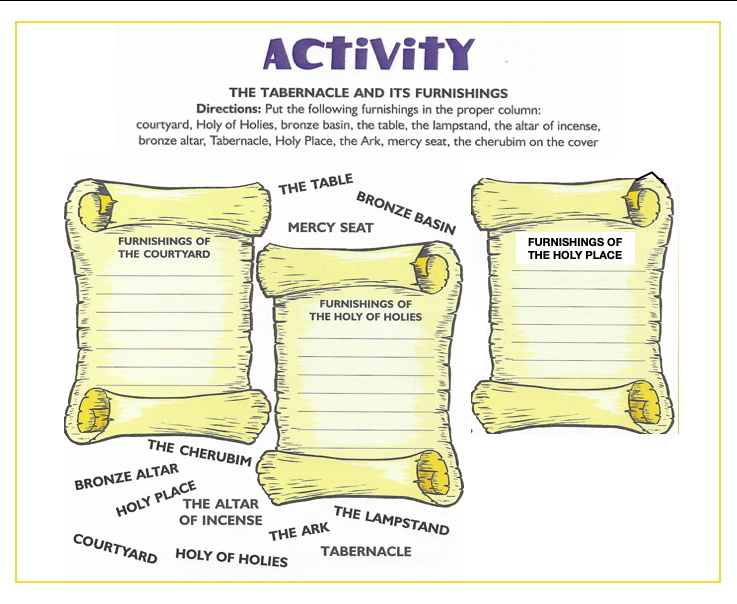
The courtyard was made by setting up curtains of finely twisted linen. These curtains formed a rectangle, about 100 cubits long and 50 cubits wide. The entrance was made on the east side. So as you walked into the courtyard, you would be looking towards the west.
The first Tabernacle furnishing you'd have seen would have been the bronze altar, or altar of burnt offering. This was made of wood covered with bronze. The four horns at each corner of the altar were made so that the altar and the horns were one piece. All the altar utensils were also made of bronze: pots to remove ashes, shovels, sprinkling bowls, meat forks, and fire pans. The bronze altar was used for presenting burnt offerings to God.
Past the bronze altar, before you would have come to the Tent of Meeting, was the basin for washing. It was made of bronze, with a bronze stand. They made it from the mirrors of the women who served at the entrance to the Tabernacle. The priest had to wash his hands and feet in the water of the bronze basin before going into the Tent of Meeting and also before presenting an offering on the bronze altar.
Past the bronze altar was the Tent of Meeting. It was also made of curtains of finely twisted linen and blue, purple, and scarlet yarn. It was covered with a curtain of goats' hair. This was covered with a covering of rams' skins dyed red. Over that was a covering of hides from sea cows, possibly manatees or dugongs.
When it was finished, the Tent of Meeting was 30 cubits long and 10 cubits wide. The Tent of Meeting was divided into two parts: the Holy Place and the Most Holy Place. When you walked past the bronze basin into the Tent of Meeting, you would have been in the Holy Place. It was 20 cubits long and 10 cubits wide. Here you would have seen three important furnishings.
The table was to the right as the High Priest walked into the Holy Place - the north side. The table, holding the bread of the presence or showbread, was made of wood, covered with gold. All of its plates, dishes, pitchers and bowls were to be made of gold. The pitchers and bowls were used to pour out the drink offerings. The bread of the presence, or showbread, was always on the table.
The lampstand was to the left, on the south side, as the High Priest walked into the Holy Place. The lampstand was made of pure gold. All the cups, buds, blossoms, and branches were made of one piece. Three branches came from one side and three came from the other side. Each branch had three cups shaped like almond flowers, with buds and blossoms. The center of the lampstand also had four cups shaped like almond flowers, with buds and blossoms. On this lampstand, they set the seven lamps.The wick trimmers and trays were also of pure gold. About 75 pounds of gold was used in making the lampstand, lamps, trimmers and trays. The lamps were to always be kept burning from evening to morning.
The altar of incense, also made of wood overlaid with gold, was in between the lampstand and the table, right in front of the curtain to the Most Holy Place. Here the priest was to burn a special incense each morning when he tended the lamps, and again at twilight when the lamps were lit. Nothing but special incense (the recipe given by God) was to be burned on this altar. Like the bronze altar, the altar of incense had four horns, one at each corner, which were part of the altar. Atonement was made on its horns once a year on the Day of Atonement.
Are you getting an idea of how detailed and special God's instructions were? There was a very good reason for it.
Activity
Teaching the Lesson:
Legacy Lesson: Student book/Teacher book - Teaching Time: 25 mins.
Lesson Prep - Teacher book - Time: 30 mins.
Activity: Watch Tabernacle video - Teacher book - Time: 30 mins.
Song: "Come Bless the Lord" - page 85 of the Kids Classics Collection - Time: 5 mins.
Activity: The Tabernacle and Its Furnishings - Student book - Time: 15 mins.
Extending the Lesson - REACH Activities:
*Back to the Bible: 2 Corinthians 6:16
*Journal Jot: Lively Stones
*Word Study: dwell - shâkan
*Just Toolin’ Around: Tabernacle and Temple
*Did you Know? Fine Linen
*Stretch It Out: A Tabernacle Model
*Music Notes: The Church’s One Foundation
*Questions? - Writing Prompt - 10 mins.
Student Prayer
Dear Heavenly Father,
Help me to understand why You gave Moses such detailed instructions for building the Tabernacle. Help me understand what it means to me.
In Jesus' name.
Amen.
Daily Devotions
Sunday: Exodus 26:1-2
Monday: Exodus 26:3-6
Tuesday: Exodus 26:7-10
Wednesday: Exodus 26:11-14
Thursday: Exodus 26:15-19
Friday: Exodus 26:20-25
Saturday: Exodus 26:26-30
Objectives
At the end of this lesson, students will be able to:
1. Diagram the Tabernacle.
2. Relate a basic description of each furnishing and its use.
Topics & Themes
Holy of Holies
Tabernacle
Materials Needed
Bibles, Students' and Teacher's books, pencils and pens, attendance and memory verse charts, stars, songbook, cassette or CD, music player, blackboard and chalk, TV, VCR, and Tabernacle video
Preparation
Obtain a copy of the video presentation of the Tabernacle tour in Eureka Springs, AR (1-800-882-7529). This will be a wonderful way of presenting the Tabernacle; the Holy Land Tour has tried to be as biblically accurate as possible. Also, since many students are visual learners, watching the video will make much more of a lasting impression than reading the biblical account. You will want to read through the descriptions of the Tabernacle found in Exodus 25-27and 35-40 several times in order to be prepared to answer any questions the students may have.
How to Teach This Lesson
After opening the class with prayer, play the Eureka Springs Tabernacle video mentioned under Activity. If not possible, create a mental picture of the Tabernacle and its furnishing. Go through each part of the Tabernacle. Draw a very rough drawing as you go through to help students visualize the position/arrangement of the furnishings. Emphasize that you are not being exact. However, God gave very precise instructions. Our goal is to understand what was there and its purpose - not to create an exact visual picture.
Courtyard - made by setting up curtains of finely twisted linen. These curtains formed a rectangle, about 100 cubits long by 50 cubits wide. The entrance was made on the east side. As a person walked into the courtyard, he would be looking towards the west.
Bronze Altar or Altar of Burnt Offering - made of wood, covered with bronze. The four horns at each corner of the altar were made so that the altar and the horns were one piece. All of the altar utensils were also made of bronze: its pots to remove the ashes, its shovels, sprinkling bowls, meat forks and fire pans.The bronze altar was used for presenting burnt offerings to God.
The Basin - past the bronze altar, before a person would come to the Tent of Meeting the basin was made of bronze with a bronze stand. It was made from the mirrors of the women who served at the entrance to the Tabernacle. The priest had to wash his hands and feet in the water of the bronze basin before going into the Tent of Meeting and also before presenting an offering on the bronze altar.
Tent of Meeting - past the bronze altar, it was covered with a curtain of goats' hair, curtains were also made of finely twisted linen and blue, purple and scarlet yarn. This had a covering of rams’ skins dyed red. Over that was a covering of hides from sea cows, possibly manatees or dugongs. When it was finished, the Tent of Meeting was 30 cubits long and 10 cubits wide.
Two parts of the Tent of Meeting - the Holy Place and the Most Holy Place. Past the bronze basin in the Tent of Meeting was the Holy Place. It was 20 cubits long and 10 cubits wide. There were three important things here.
The Table - was to your right as a person walked into the Holy Place (north side). The table, holding the Bread of Presence or Showbread, was made of wood, covered with gold. All of its plates, dishes, pitchers and bowls were made of gold. The pitchers and bowls were used to pour out the drink offering. The bread of presence, or showbread was always on the table.
Lampstand - was on the left, or south side as a person walked into the Holy Place. The lampstand was made out of pure gold. All of the cups, buds, blossoms, and branches were made of one piece. Three branches came from one side and three came from the other side. Each branch had three cups shaped like almond flowers, with buds and blossoms. The center of the lampstand also had four cups shaped like almond flowers, with buds and blossoms. Seven sets of lamps were on this lampstand. The wick trimmers and trays were also pure gold. About 75 pounds of gold was used in making the lampstand, lamps, trimmers and trays. The lamps were to always be kept burning from evening to morning.
Altar of Incense - was made of wood overlaid with gold. It was between the lampstand and the table, right in front of the curtain to the Most Holy Place. Here the priest was to burn a special incense each morning when he tended the lamps, and again at twilight when the lamps were lit. Nothing but the special incense (the recipe given by God) was to be burned on this altar. Like the bronze altar, the altar of incense had four horns, one at each corner, which were part of the altar. Atonement was made on its horns once a year on the Day of Atonement.
Details - Emphasize that God was very detailed in His instructions for the construction of the Tabernacles and its furnishings. Ask: Why do you think that was?
Review Questions
1. What was the outer part of the structure called?
2. What would you have seen first in the courtyard?
3. What was between the bronze altar and the Tent of Meeting?
4. Inside the Holy Place, what would you have seen? Where?
Teacher-Directed Activity
At the beginning of class, watch the 30-minute Tabernacle video available from the Eureka Springs, AR Holy Land Tour.
REACH Activity
Back to the Bible: 2 Corinthians 6:16
God gives us physical examples so we can understand spiritual concepts. The Apostle Paul gives us a huge clue in this verse about why God gave so much detail about the construction of the temple. After you read 2 Corinthians 6:16, look back at the furnishings of the Tabernacle. Do you see anything that you could apply to your own life?
The Lampstand: Read Psalm 119:105 and John 8:12
The Table of Showbread: Read John 6:35 and Romans 8:11
The Altar of Incense: Read Revelation 5:8
The Tabernacle: 2 Corinthians 5:1
Write about what you find in your Bible notebook. Look for other connections and add them to your list.
Journal Jot: Lively Stones
Read 1 Peter 2:4-5. How do you think this verse connects to your lesson? Do you see any parallels? If God is so concerned about the construction of the Tabernacle, how much more would He be concerned about your development as a child of God? Write about this in your Bible notebook. If you have questions, ask your parents.
Word Study: dwell - shâkan
This Hebrew word found in Exodus 25:8 means “to reside, permanently stay - either figuratively or literally.” This is very interesting because this is the same word that is used of the pillar of cloud and the pillar of fire in Exodus 24:16, where it is translated “rested.” The terminology makes us realize that God was dwelling with His people, providing for them, guiding them, blessing them. Their unbelief and rebellion, then, is that much harder to ignore. What a slap in the face to Almighty God - who was with them - and they not only knew He’d delivered them, they saw the pillar of cloud and the pillar of fire and the daily provision of manna!
In the New Testament, Jesus is called Emanuel, which means “God With Us.” Do we understand better than the Israelites did that God is with us, providing for us, guiding us, and blessing us?
Write about this in your Bible notebook.
Just Toolin’ Around: Tabernacle and Temple
The description of the Tabernacle is different from the description of Solomon’s temple. Look up the description of each and then write five similarities and five differences.
Did you Know? Fine Linen
“The term ‘fine linen’ refers to an exceptionally high quality cloth that was often used by Egyptian royalty. It was made from thread spun from the fibers of flax straw. Excellent examples of unusually white, tightly woven linen have been found in ancient Egyptian tombs. Some are so finely woven that they cannot be distinguished from silk without the use of a magnifying glass.” (Source: NIV Archaeological Study Bible, 2005, p. 132.) Sometimes we read the passages and don’t realize the quality of the workmanship! The curtains of the tabernacle would have looked and felt like silk!
Stretch It Out: A Tabernacle Model
To help you understand and remember how the tabernacle was laid out with its furnishings, do some research with various Bible references - an encyclopedia, a study bible, a Bible resource. Draw your model to scale; include a key with the scale. Make notes about the size and placement of each of the furnishings. File in your Bible notebook.
Music Notes: The Church’s One Foundation
This hymn is on page 25 of the CEM Hymnal.
The text for this hymn was written by Samuel J. Stone, a pastor of the Anglican Church in England. During a period of time when liberal ideology was warring against the traditional doctrines of the church, he wrote a series of hymn texts refuting what he considered heresy. The text for this hymn was designed to reaffirm that Jesus is the foundation of the Church and the head of the Body. Samuel Stone was “the poor man’s pastor.” He lived out his belief that the church was meant to be Christ’s hands ministering to the poor and downtrodden, making the church a welcoming place of light in an otherwise dark and depressing world. (Source: Amazing Grace, Kenneth Osbeck, 1990, p. 264)
As you sing this hymn, pick out your favorite line. Do you believe that Jesus is the Church’s one foundation? Could you find a scripture to support this? Write your favorite line and the scripture in your Bible notebook.
Questions?
Write down any questions you have in your Bible notebook so that you can remember to ask your parents or your pastor.
Song
"Come Bless the Lord" is on page 85 of the Kids Classics Collection.
Closing Prayer
Lead students in prayer that God will teach them to understand the significance of the Tabernacle and what it means to them today.
Printable Pages