YEA Lesson Library
Giving is Good
About This Lesson
Using the example of the Israelites who generously gave for the construction of the Tabernacle and its furnishings, this lesson teaches that we each should be willing to give generously to glorify God.
Scriptures
Exodus 25:1-2
Exodus 25 - 31
Exodus 36:3-7
Psalm 24:1
Matthew 6:1-4
Matthew 6:19-21
2 Corinthians 9:6-7
1 Peter 3:15
Words to Know
ELABORATE - with a lot of detail and very complex
DETAILED- with attention even to the smallest parts
FURNISHINGS - what is put into a place so that it can be used
POSSESSIONS - what is yours, your belongings
SPARINGLY - not generously
RELUCTANTLY - not willingly
UNDER COMPULSION - someone makes you do something
The Lesson
I wanted to teach my 16-month old daughter, Jennifer, to share. So one day I gave her two M&Ms. I told her she could eat the first one. The second one I told her to give to her older brother Jonathan. Jennifer looked at me like I'd lost my mind. She loves chocolate! She couldn't imagine why I would give her a piece and then ask her to give it up. With much coaxing and scolding, she finally decided to give the M&M to Jonathan. He thanked her and praised her. I praised her and gave her another M&M, which I told her she could eat.
I repeated this several times. Then suddenly, she changed her behavior. When I gave her the two M&Ms, she hurried both of them over to Jonathan to give to him. She liked the praise so much she was willing to give up the treasured candy she loves. I was amazed!
Then it was Jonathan's turn to surprise me. He graciously took both M&Ms from Jennifer, thanked her, ate one, and then gave one of them back.
The Israelites had just come out of Egypt. God had freed them from being Pharaoh's slaves. God had saved them from the Egyptian army. He had miraculously opened the Red Sea for the Israelites to walk across on dry ground. He gave them water in the wilderness twice. He gave them manna and quail. God had defeated the Amalekites who attacked them. Then He gave them the two stone tablets of the Ten Commandments. This whole time, God went before them in a pillar of cloud by day and a pillar of fire by night to guide them. God did many miracles for the Israelites. They had water and food. God protected them from their enemies. The Israelites knew God was with them all the time. He had given them so much!
Then God gave Moses the instructions for building the Tabernacle in the wilderness. This was to be a place where God would dwell with the people. It was a large tent that could be taken down and moved as the Israelites moved.
God also gave Moses detailed directions for building the Ark of the Covenant, the table, the lampstand, the incense altar, the altar of burnt offering, the courtyard, the oil for the lampstand, the priestly garments, including the breastpiece and other garments, the basin for washing, the anointing oil, and the incense. Wow! This was not just a hastily-built tent. It was elaborate and detailed, made from the finest of materials exactly as God described it to Moses.
It was going to cost a lot of money to build God's Tabernacle. So where did all of the money come from to buy all of the materials it would take to build this beautiful building? God told Moses, “Tell the Israelites to bring me an offering. You are to receive the offering for me from each man whose heart prompts him to give" (Exodus 25:2). The Israelites were in the desert far away from stores. Money wouldn't do them a lot of good. What they needed were the materials for building the Tabernacle.
When the Israelites left Egypt they brought all of their possessions with them. But do you remember the night the Israelites left Egypt? They went to the Egyptians and asked them for gold and silver and other things. The Egyptians wanted to get rid of them so badly that they were very generous with their gifts - gold, silver, fine fabrics, flocks, and herds. Now these things were coming in handy. They could be used in building and furnishing the Tabernacle. Their gold and silver could be used to make furnishings for the Tabernacle. They could use animal skins to make the Tabernacle and wool from sheep for weaving cloth. They gave so much for the building of the Tabernacle that Moses had to tell them to stop giving (Exodus 36.3-7).
So what about you? What has God given to you? Has He given you good health? A nice place to live? Great parents? Lots of toys? Talent to do math or write good stories? The food you eat? The air you breathe? What is it that God has given to you? Everything! God has made it all. It all belongs to Him (Psalm 24:1). God has given you everything you have. So, now He wants to see what you're going to do with it. Will you share with others? Will you use what God has given you to bring glory and honor to Him?
How can you give? You can make sure you share with people who do not have as much as you. Perhaps you want to start a food drive once a month in your church. Perhaps you and your Sabbath School class can organize it and find a food pantry that needs donations. It doesn't have to be food. It could be toys. It could be school supplies or clothes. It could be coats, blankets, and gloves. It could be fans. Get an adult to help you organize and share what you have with others who need it.
Are there other ways that you can give? You can make sure you share your talents for God's glory. If you sing beautifully, sing songs of praise to God. If you have a talent to write, write encouraging stories and notes that remind people to depend upon God. Send cards to people who are sick. Draw pictures for people who have been in the hospital. Pray for people who are hurt. Shovel snow from the sidewalk for someone who can't. Make a casserole for a sick family. Volunteer to walk the dog for the person who broke his leg. There are lots of ways to give of yourself and your time to make God and others happy. Remember, the Bible says "It is more blessed to give than to receive." “Giving is Good!”
Activity
Teaching the Lesson:
Legacy Lesson: Student book/Teacher book - Teaching Time: 25 mins.
Lesson Prep - Teacher book - Time: 30
Activity: What Will You Choose - Teacher book - Time: 15 mins.
Song: "Jesus Bids Us Shine" - page 37 of Kids Classics Collection - Time: 5 mins.
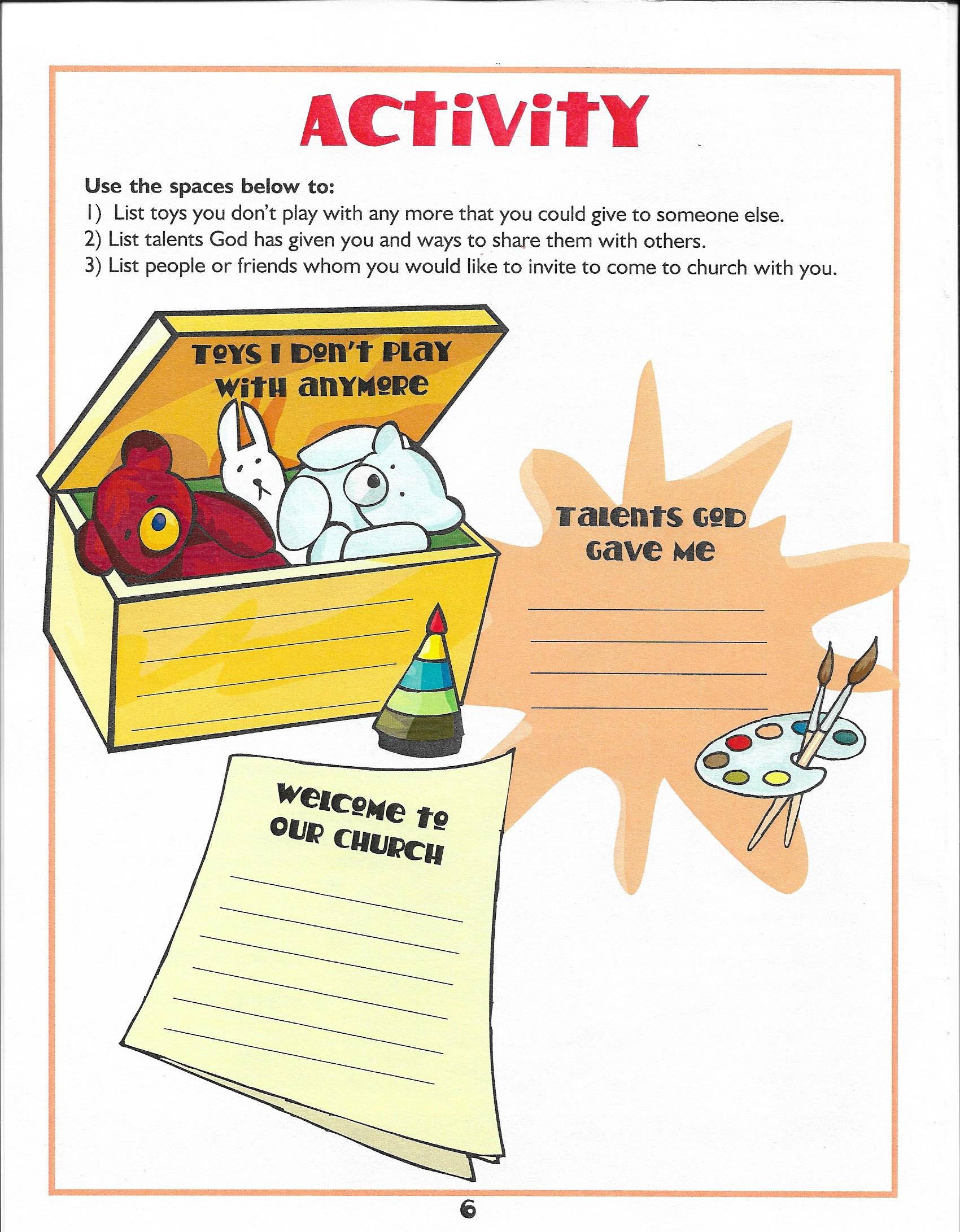
Activity: Making a List - Student Book - Time: 15 mins.
Extending the Lesson - REACH Activities:
*Back to the Bible: In Proportion
*Journal Jot: Generous
*Word Study: Generously - eulogia
*Just Toolin’ Around: All Good Gifts
*Did you Know? A Bowling Ball Gift
*Stretch It Out: The Five Love Languages
*Music Notes: More Love To Thee
*Questions? - Writing Prompt - 10 mins.
Student Prayer
Dear Heavenly Father,
Help me to be generous with what You have given to me.
In Jesus' name.
Amen.
Daily Devotions
Sunday: Psalm 24:1
Monday: 1 Peter 3:15
Tuesday: 2 Corinthians 9:6-7
Wednesday: Matthew 6:19-21
Thursday: Exodus 36:3-7
Friday: Exodus 25:1-2
Saturday: Matthew 6:1-4
Objectives
At the end of this lesson, students will be able to:
1. Explain that God made everything and everything belongs to Him.
2. Tell where the Israelites got the silver and gold for the Tabernacle furnishings.
3. Explain that God wanted the people to give only as much as they wanted to.
4. Transfer the idea of giving to God to their personal lives - possessions, talent, faith.
Topics & Themes
Blessings
Generosity
God’s Gifts
Gratitude
Offerings
Sacrifice and Offerings to God
Tabernacle
Tithes
Treasure
Materials Needed
Bibles, YEA Students' and Teacher's books, pencils and pens, attendance and memory verse charts, stars, songbook, music player and music tape or CD, blackboard and chalk, goody bags, ziplock bags
Preparation
For the Activity - What Will You Choose?
Fill quart-size ziplock bags (see-through bags are preferable to gift bags) with an assortment of candy, stickers, small toys, pennies, pencils, erasers, etc. Make one bag for each student in your class.
For the Ten Week Project - You may wish to have the students construct a model of the Tabernacle. If, however, you feel uneasy doing that - because God was so very specific about its dimensions, you may choose to have the students do a booklet of each of the furnishings of the Tabernacle instead. The Holy Land Tour in Eureka Springs, AR has a video of their full-scale model of the Tabernacle, which you can order by calling 1-800-882-7529.
How to Teach This Lesson
Real Life Examples of Sharing - Ask the students to talk about sharing. Why do they share? Who do they share with? Who makes them share? Does it feel different if they voluntarily share or if it is done under compulsion?
Tabernacle Sharing - One of the first examples of sharing, or giving, on a huge scale is found in Exodus 25. God gave Moses detailed instructions on the building and furnishing of the Tabernacle. But, the materials were to come from the people - voluntarily.
Recap Israel's History - I) Delivered from Egypt - after plundering the Egyptians; 2) Crossing at the Red Sea; 3) Bitter water made sweet: 4) Given manna and quail; 5) Water from the Rock; 6) Amalekites defeated; 7) Ten Commandments given; and 8) God's presence in the pillar of cloud and fire.
Psalm 24:1 -The earth is the LORD’s and everything in it." Exodus 13-20 is a profound example of God's provision. Everything that the Israelites had and needed was provided by God.
Voluntary Giving - Ask: Why didn't God demand that the Israelites give enough for the Tabernacle? Why was the giving voluntary? God wanted to see the thankfulness in the hearts of His people, for whom He had done so much. He wanted evidence that He was more important to them than their possessions.
What about us? - Just as everything the Israelites had came from God, everything we have also comes from God. List some of the things: be sure to include life, health, talents, forgiveness, eternal life. Just as God wanted to see the thankfulness in the Israelites, He wants to see what is most important to us today. Are we willing to give what we have back to Him? Are we willing to share what we have for His glory and honor? What do we value most?
Review Questions
1. Who made everything?
2. To whom does everything belong?
3. There is only one thing God doesn't own. What is it? (Possible answers:
your free will, love, loyalty to Him, preference for Him over all else.)
4. Where did the Israelites get the silver and gold for the Tabernacle furnishings?
5. What kind of attitude was God looking for when the people were giving to Him?
6. What does this lesson mean to us? What should we be willing to do for God?
7. Who should we always give to first? How much?
Teacher-Directed Activity
What Will You Choose? - Give each student a bag of goodies (see Preparation). Talk about the goodies in it briefly. Then ask the students, one by one, if they will willingly give the bag back to you for these situations:
1) To spend a day with their best friend.
2) To give it to their best friend.
3) To give it to someone who doesn't have any of these things, is very poor.
4) In order to tell someone about how great Jesus Christ is.
For the student who will not give up their goody bag for any of the above, ask if there's anything that they would give up their bag for.
Debrief - Talk about where the goody bags came from. They did not earn the bags; they were given the bags. God expects our reaction to be
thankfulness, not possessiveness. Talk about immediate material possessions vs. the greater gain of giving and sharing. Quote Matthew 6:19-21: "Do not store up for yourselves treasures on earth, where moth and rust destroy, and where thieves break in and steal. But store up for yourselves treasures in heaven, where moth and rust do not destroy, and where thieves do not break in and steal. For where your treasure is, there your heart will be also." Then ask each student to recite their memory verse for this lesson.
REACH Activity
Back to the Bible: In Proportion
Deuteronomy 16:17 is the verse that comes right after the verse which is read in most offertory sermons. Deuteronomy 16:16 says, “Three times a year all your males shall appear before the LORD your God at the place that he will choose: at the Feast of Unleavened Bread, at the Feast of Weeks, and at the Feast of Booths. They shall not appear before the LORD empty-handed.” God expects that each person will come before Him with an offering - not a tithe - a free-will offering. What do we do with this? We know that a tithe is 10% of what we have made during the year. We can figure out how much we need to give to God to be obedient to Him. But what is this offering? The next verse explains it: “Each of you must bring a gift in proportion to the way the LORD your God has blessed you.” Did you get this? You are to bring a gift to God, not your tithe, a gift which reflects how much God has blessed you.
Ummm. That should be shocking to you. How in the world can you bring a gift to show God how very much you appreciate life, food, family, knowledge of Him, a relationship with Him? And there’s all of the times you don’t know about - times when God protected you, caused trouble to go around you, or caused unexpected blessings. How are you going to bring a gift in proportion to the way that God has blessed you?! Keep in mind that God doesn’t need your money. He is interested in the gratitude in your heart expressed through the giving that you do.
Write about this in your Bible notebook. Then have a conversation about this topic with your parents. Maybe as a family you can come up with a good way to express your gratitude to God.
Journal Jot: Generous
Would people call you generous? Are you generous with your possessions? Are you generous with your time? Your smiles? Your friendship? What do you value most? Is it possessions or people?
Answer these questions in your Bible notebook. Really think about them and then ask yourself honestly if you should be more generous. Could you be more generous and still do it willingly?
On the other hand, God does not call us to give away everything we have to people who don’t really need it. A person who has lots of money doesn’t need you to give him the $20 you worked so hard for last weekend. Be very honest with yourself about the need to be generous. You are not obligated to give just because someone asks you. You are also called to be a wise steward of the resources God has put in your care. Write about this aspect of generosity in your Bible notebook too.
Word Study: Generously - eulogia
Look up 2 Corinthians 9:6 in several different translations. How many different English words are translated from the Greek word eulogia? This word means “blessing” or “beneficence.” (Source: Zohdiates’ NAS Hebrew-Greek Key Word Study Bible, 1990, #2129.) “Beneficence” is “the quality or state of doing or producing good” (Source: https://www.merriam-webster.com/dictionary/beneficence). In other words, your giving is good or produces something good. Think about hypothetical examples which would illustrates each. Write them in your Bible notebook.
Write this word, its definition, and where it is found in your Bible notebook.
Just Toolin’ Around: All Good Gifts
Look up James 1:17. Based on this verse, what other verse can you use to support the idea that we are to give generously (without using 2 Corinthians 9:6)? Write an apologia (reasoned argument) explaining why a Christian will give. Share it with your family before putting it in your Bible notebook.
Did you Know? A Bowling Ball Gift
A bowling ball gift is a present you buy for somebody, but it’s rally intended for yourself. For example, if you buy your mom a ticket to go to Six Flags (knowing that she hates rollercoasters), there’s a good chance she’ll give it to you, insisting that you’ll have more fun than she will. In essence, you’ve bought yourself a gift, not her. If your older sister can’t eat chocolate and you buy her a big box of chocolates, chances are you’ll get to eat them. If your dad buys your mom a chainsaw, what are the chances that he’ll use it before she does? It sounds silly, but people often don’t stop and think about what someone else will really like; they buy what they would like for themselves. Spend some time thinking of the most unlikely gifts to give your family. Then next to this list, write down things they’d actually really love.
Stretch It Out: The Five Love Languages
When you’re thinking about giving gifts, remember that giving actual physical gifts is only one way to show that you love someone. There are also Acts of Service, Quality Time, Words of Affirmation, and Physical Touch. Maybe your mom would really like a new necklace (Gifts). But maybe she’d rather you do something nice for her, or tell her how much she means, or give her a back rub, or plan a special outing with her. For each person in your family, think about what they like most and then, with some planning and preparation, you can give them a gift that really shows your love for them.
Keep in mind, your action has to be done from your heart. I once had a fourth grader who was making a Mother’s Day card for her mom. It looked terrible. I told her to start over, that I would help. She said, “It doesn’t matter. Mom will like anything I give her.” What a terrible attitude!! Yes, Mom will appreciate your gifts, but she knows when you’re doing it because you really want to or when you’re doing it because someone told you that you should. Think about it!
Music Notes: More Love to Thee
This hymn is on page 86 of the CEM Hymnal.
The author of the words of this hymn was Elizabeth Prentiss, the wife of a Presbyterian pastor. On one occasion, she wrote, “To love Christ more is the deepest need, the constant cry of my soul . . . out in the woods, and on my bed, and out driving, when I am happy and busy, and when I am sad and idle, the whisper keeps going up for more love, more love, more love!” In 1856, two of her children died. “For weeks, Elizabeth was inconsolable, and in her diary she wrote, ‘Empty hands, a worn-out, exhausted body, and unutterable longings to flee from a world that has so many sharp experiences.’ ”
During this time of grief, she wrote the words to this hymn, but for whatever reason she showed them to no one for the next 13 years. Eventually, William Doane, who wrote more than 2000 gospel song tunes, set her words to music. (Source: 101 More Hymn Stories, Kenneth Osbeck, 1985, p. 184-185.)
As you sing this hymn, think about the grief Elizabeth must have been feeling, at the same time she was expressing her trust in God. Write your favorite lines in your Bible notebook.
Questions?
Write down any questions you have in your Bible notebook so that you can remember to ask your parents or your pastor.
Song
"Jesus Bids Us Shine" is on page 37 of Kids Classics Collection.
Closing Prayer
Lead the students to ask for God's assistance in becoming more giving, more willing to share what He has given to them.
Printable Pages