YEA Lesson Library
That’s Not True!
About This Lesson
This lesson teaches the importance of not bearing false witness against anyone - through jumping to conclusions, attributing wrong motives, or intentionally lying about them.
Scriptures
Genesis 39:13-20
Exodus 20:16
Deuteronomy 7:9
Deuteronomy 19:15-21
2 Samuel 7:28
Psalm 135:6
Proverbs 6:16-19
Proverbs 19:5
Proverbs 25:18
Isaiah 59:12-13
Jeremiah 9:4-5
John 8:44
John 14:6
1 Corinthians 10:13
Hebrews 6:18
Revelation 19:11
Revelation 21:8
Words to Know
FALSE- not true
TESTIMONY - what you say, usually as a witness in a courtroom
PREDICTIONS - saying what someone thinks may happen
REPUTATION - what people believe about a person and about what that person will do
JUMPING TO A CONCLUSION - deciding a thing without facts to support that decision
The Lesson
Peter, Alan, and Ryan were walking to Peter's house after school for a free-throw championship. All three were pretty good shots, but Peter was confident he was going to win. As the boys walked along, they boasted about their abilities and made predictions about the outcome of the championship. Suddenly, Alan turned and ran down a side street, calling, "I'll see you guys later."
Peter and Ryan were so astonished they stopped and stared as Alan disappeared around a corner. Ryan said, "Where do you think he's going?"
Peter, disappointed that they weren't going to have a championship after all, growled, "He's probably going home. The fraidy cat! He couldn't stand having us beat him, so he just took off."
"I could have beat him; that's for sure," seconded Ryan.
The next day Ryan and Peter told Steven and Mike about Alan's running off. By the time Alan got to school, it was all over the playground that he was a coward, a fraidy cat, a chicken. Alan was surprised and hurt, and then he was angry. Alan had run home to get his new basketball for the contest. By the time he got to Peter’s house for the contest, Peter’s mom had told Alan that Peter and Ryan had gone to the mall with Peter's older sister. They simply hadn’t thought Alan was coming.
Peter and Ryan were bearing false witness against Alan. Alan probably could set them straight, but it was going to take a long time to let everyone know. In fact, Alan probably wasn’t going to be able to straighten out his reputation with everyone, the rumor had spread too far too fast.
Unfortunately we do things like this all the time. We see someone do something. We don't understand why they did what they did. So we guess. We come up with possible answers as to why they might have done it. Once we figure out a plausible reason, we decide that's probably THE truth. And we act based on that supposition, only we conveniently forget that we were just guessing. And we ignore the very real fact that we could be very wrong.
Best friends do it to each other, and sometimes stop talking to each other for weeks. Brothers and sisters do it to each other, and get each other in trouble with Mom and Dad. Adults do it to each other, even when they are church members and should know better. Even Mom and Dad do it to each other. So, if almost everyone does it, why is it such a bad thing? And why don't we just realize that people often jump to the wrong conclusion and make it a habit to check our facts first before spreading our wrong suppositions?
Jumping to a conclusion is a bad habit that many people find hard to break. Many times people don't realize until much later that theydid jump to a wrong conclusion. By that time, the damage is done. What damage? Oh, spreading the wrong information (the wrong conclusion they've imagined) about someone.
Telling lies, also known as bearing false witness, about someone else can hurt them in several ways. It can hurt their reputation so that people don't trust them or don’t have the right idea about what kind of person they are. This is like our story about Alan. Lying can get someone into a lot of trouble when they are innocent. A biblical example is when Potiphar’s wife lied about Joseph. Because of this lie, Potiphar had Joseph thrown into prison even though he was innocent.
Bearing false witness against someone can also get them killed. That's why God says, "A matter must be established by the testimony of two or three witnesses" (Deuteronomy 19:15-21). God also wanted to keep people from bearing false witness on purpose, just to get someone in trouble. So God set up consequences for bearing false witness. Why?
God wants people who are holy and righteous and just. God wants people whose character looks like His character. It is no wonder that God hates lies! Satan is a liar and the father of lies. Jesus is called the Truth (John 14:6). Hebrews 6:18 says it is impossible for God to lie. We are told over and over again in the Bible that God is trustworthy. A liar is neither trustworthy nor faithful. God does not want to spend eternity with someone He can't trust. That's why Revelation 21:8 says all liars will find their place in the fiery lake of burning sulfur. They will not be in God's Kingdom.
So carefully watch your tongue. Don't bear false witness against anyone. Don't do it for the littlest thing or for a really big thing. Don't ever bear false witness on purpose. Be careful not to accidentally bear false witness. Be very careful to always speak the truth. You want to spend eternity with God.
Activity
Teaching the Lesson:
Legacy Lesson: Student book/Teacher book - TeachingTime: 25 mins.
Lesson Prep - Teacher book - Time: 45 mins.
Tell the Truth Activity - Teacher Book - Time: 40 mins.
Song: "One Door, And Only One" - page 44 of Kids' Classics Collection - Time: 5 mins.
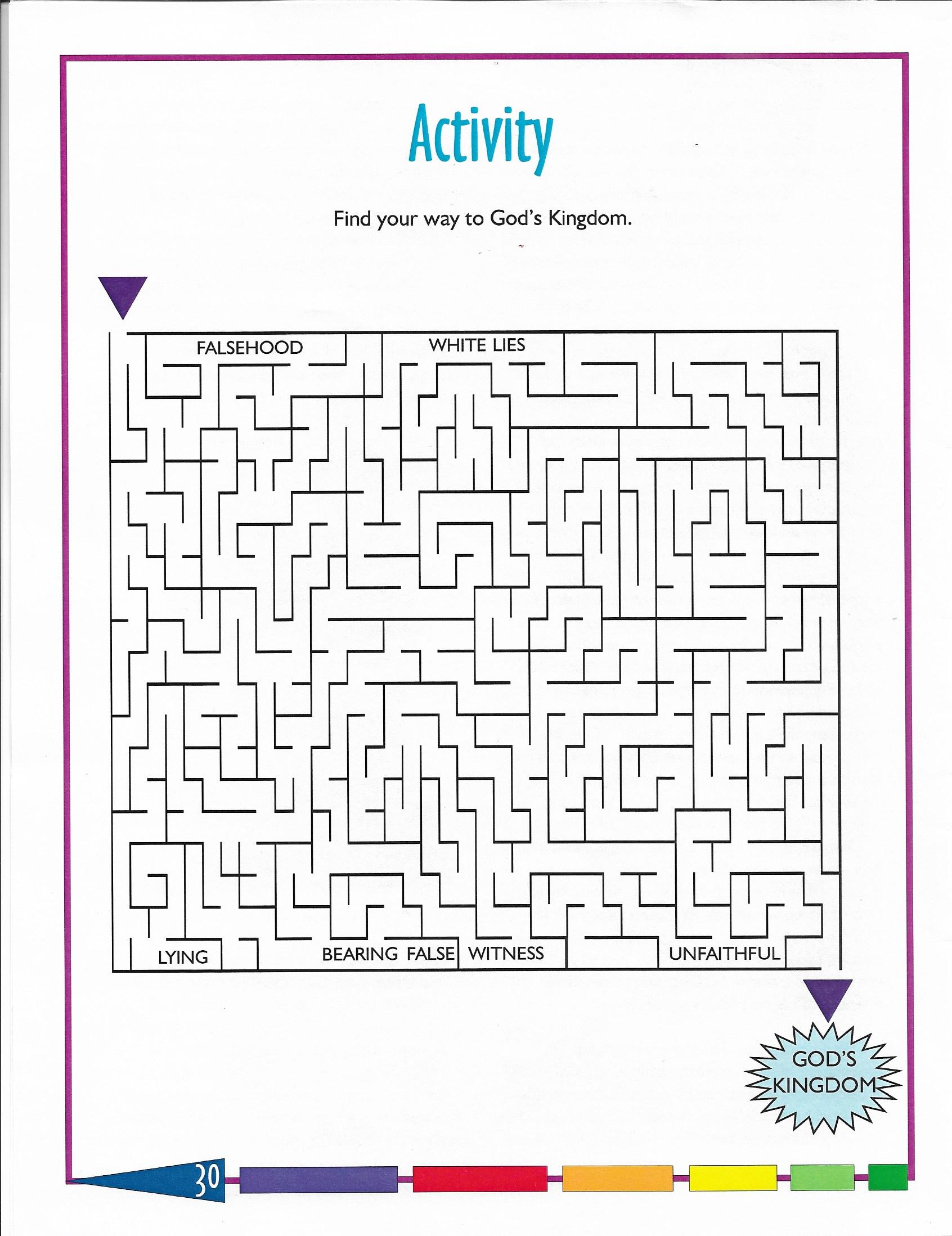
Kingdom Maze - Student book - Time: 5 mins.
Extending the Lesson - REACH Activities:
*Back to the Bible: Rahab
*Journal Jot: A Little White Lie
*Word Study: sheqer
*Just Toolin’ Around: Lies
*Did you Know? Lying In TV Shows
*Stretch It Out: A Pledge
*Music Notes: I Would Be True
*Questions? - Writing Prompt - 10 mins.
Student Prayer
Dear Heavenly Father,
Help me to only speak the truth. Show me if I have borne false witness
against someone.
In Jesus' name.
Amen.
Daily Devotions
Sunday - Deuteronomy 19:15
Monday - Revelation 21:8
Tuesday - Proverbs 6:16-19
Wednesday - Proverbs 19:5
Thursday - Proverbs 25:18
Friday - Jeremiah 9:4-5
Saturday - Isaiah 59:12-13
Objectives
At the end of this lesson, students will be able to:
1. Recite the Ninth Commandment.
2. Explain what it means to bear false witness.
3. Distinguish between bearing false witness and lying in general.
4. Explain why it is wrong to bear false witness
5. Cite examples in the Bible when someone lied and what the consequences were.
6. State that God cannot lie.
7. Explain that no liars will be in God's Kingdom.
Topics & Themes
God’s Kingdom
Lying
Potiphar’s Wife
Ten Commandments
Lying
Truth
Materials Needed
Bible, Students' and Teacher's books, pencils, pens, attendance and memory verse charts, stars, songbook, CD or cassette tape, music player, chalkboard and chalk, index cards
Preparation
Our children are constantly bombarded with the idea that lying is not such a bad thing, if it gets you what you want, or if it is done with the right heart. But lying is wrong, as Revelation 21:8 indicates. Little white lies are still lies. Bearing false witness is a specific type of lying and one that specifically hurts another person. Sometimes we can't see the outcome and can’t predict what our actions will do. Children are especially short-sighted about consequences of actions. It's important to get across to them the far-reaching consequences of bearing false witness against another person.
Plan to spend as much class time as possible doing the Activity. Make some cards describing a situation in which someone lies or bears false witness. Possibilities: 1) four girls mad at a teacher, get together and decide to accuse him of making rude comments to them to get him into trouble; 2) Two brothers don't want to get into trouble for not cleaning their room, so they decide to tell Mom that they did it; 3) Two brothers don't want to get into trouble for not cleaning their room, so they tell Mom they did clean it, and then blame their little sister when it is discovered still messy; 4) A co-worker for your Dad tells the boss that your Dad was the one who did all the work on the successful project (It's a lie, even if the co-worker intends good); 5) Your friend assumes that Bob was the one who took his basketball. You know Bob didn't do it, but you say nothing.
How to Teach This Lesson
After opening the class with prayer, define: lying, bearing false witness, reputation, testimony, and white lies.
Ask: - What is the difference between bearing false witness and lying? Why do you think God might have made the Ninth Commandment a command not to bear false witness instead of a command against all lying?
Consequences - Ask: What happens if you lie? What happens if you get caught? What happens to your reputation? If you are caught bearing false witness, what happens to that person's reputation? What is the difference?
Scripture Race - Have students line up against one wall with their Bibles in their hands. After you give one of the scriptures in today's lesson, say "go." The first person to find that scripture is to step forward and read it. The following are scriptures to use: Exodus 20:16; Genesis 39:13-20; Deuteronomy 7:9; Deuteronomy 19:15-21; 2 Samuel 7:28; Psalm 135:6 John 8:44; John 14:6; Hebrews 6:18; 1 Corinthians 10:13; Revelation 19:11; Revelation 21:8.
Review Questions
Ask: What is the Ninth Commandment? What does it mean to bear false witness? How is bearing false witness different from lying? Why is bearing false witness wrong? Give a Bible example of someone who bore false witness.
Teacher-Directed Activity
Tell the Truth, the Whole Truth and Nothing But the Truth using the cards described in Preparation. Have the students discuss each situation. Decide whether the situation described is lying or bearing false witness. Also discuss whether it is right or wrong (i.e. if someone lies for your benefit, is it still wrong?) Then discuss lies of commission vs. omission. Talk about how each situation should be handled as a Christian. If time allows, let the students develop their own situation cards to share with the class.
REACH Activity
Back to the Bible: Rahab
We know that liars will not be in God’s kingdom, so why was Rahab commended? Read the story in Joshua 2:1-24. Was she commended for her lying? No. Read Hebrews 11:31. What was she commended for?
Journal Jot: A Little White Lie
Caitie didn’t want to tell her friend’s mom that she didn’t like lasagna - especially after all the work Mrs. Saladin had spent on making a special meal. So when Caitie was asked if she liked it, she said yes. She figured it was a little white lie that didn’t hurt anybody. But Caitie’s friend knew better. And Mrs. Saladin knew something was up by the expressions on their faces. Caitie admitted that she didn’t like the lasagna. Mrs. Saladin explained that Caitie was the one who would suffer from the little white lie because she’d have to eat lasagna every time she came to visit.
Have you ever told a little white lie to keep from hurting someone’s feelings or to keep yourself out of trouble? A little white lie is still a lie. It’s always better to tell the truth. Write about this topic.
Word Study: sheqer
This word is translated “false” in Exodus 20:16. It means deception, disappointment, falsehood. It is translated elsewhere as deceitful, deceiving, false, liar, lie, lying visions, perjury, slander, vain, wrongfully. “It is an untruth, a sham, a lie, lying words . . . deceit, unreliable thing . . . It is a way of life which goes completely contrary to God’s Law. It describe groundless words or activities which have no basis in fact or reality - completely worthless.” (Source: Zodhiates’ NAS Hebrew-Greek Key Word Study Bible, 1990.) Do you understand what this means? It means that the commandment not to bear false witness includes any lie or falsehood about anything.
Write this word, its definition, and where it is found in your Bible notebook.
Just Toolin’ Around: Lies
The word for “false” in Exodus 20:16 is found 113 times in the Old Testament. Find five times where it is used. Write them in your Bible notebook. Are they all lies concerning people? What kind of lies/falsehoods are they?
Did you Know? Lying in TV Shows
Years ago, my husband and I were struck by how often the characters in Little House on the Prairie and Andy Griffith lied. A person got into trouble and tried to lie their way out of it. In the end, everyone saw that they didn’t really mean to be bad, the lie was forgiven, and everything turned out right. But time after time, lying was promoted as the way to solve a problem. So we challenged our children: every time they pointed out a lie, we would give them 5¢. It worked well. Pretty soon the children were picking out wrong choices consistently. Next time you’re watching television, watch for the characters lying. Keep track of how frequently it happens. It’s good training.
Stretch It Out: A Pledge
Have you seen the movie Courageous? In it, the four men sign a contract or covenant with each other and God. They promise to live as men of honor and integrity. It’s a very powerful part of the movie, but the reality is that each person who claims to be a Christian should have already promised God that he (or she) would be a person of honor and integrity. Using the Courageous pledge as a model, write your own covenant/promise to God. Remember to sign your name to it. But! Don’t write anything you don’t fully intend to keep. Once you have written the pledge, frame it, and hang it on your wall - like the men did in the movie - to remind yourself of your desire and determination to live a God-honoring life.
Music Notes: I Would Be True
This hymn is on page 125 of the CEM Hymnal.
The words to this hymn were written by a young man, Howard A. Walter, who went to Japan to teach English. He wrote the poem to send to his mom and entitled it “My Creed.” He was 23. He showed his text to a friend, Joseph Yates Peek, who really had no musical expertise. However, Joseph immediately began whistling a tune for the poem. In turn, Joseph then asked another friend who did have some musical ability to put the melody on paper and add harmony to it. Grant Colfax Tullar was known as an organist and song-writer. Several years later, Howard added a fourth stanza, which is not in our hymnal, to the hymn. He died at age 35 in the flu epidemic of 1918. (Source: 101 More Hymn Stories, Kenneth Osbeck, 1985, p. 103.)
As you read these words, are you determined to be true? Why? What’s your motivation? Make a list of each of the characteristics that Howard Walter aspired to attain. Do you plan to likewise act in this way? Why or why not? How can you achieve this kind of behavior in your life?
Sing the hymn and write your favorite words in your Bible notebook.
Questions?
Write down any questions you have in your Bible notebook so that you can remember to ask your parents or your pastor.
Song
"One Door, And Only One" is on page 44 of Kids' Classics Collection.
Closing Prayer
Ask for a volunteer to lead in prayer asking God's discernment for the students to see where they may have borne false witness without being aware of it and ask for God's forgiveness.
Printable Pages