YEA Lesson Library
It’s Murder
About This Lesson
This lesson defines murder.
Scriptures
Exodus 20:13
Exodus 21:24
Numbers 35:16-33
2 Samuel 12:14
Ecclesiastes 9:4
Matthew 5:21-22, 38-39
Romans 12:19
Romans 13:4
James 1:19-20
1 Peter 2:14
1 John 3:15
Words to Know
MURDER - intentionally kill someone
INTENTIONALLY - to mean to do something; not an accident
MANSLAUGHTER - when someone is killed unintentionally
CAPITAL PUNISHMENT - a government putting a person to death because of their crime
PREMEDITATED - to plan ahead of time
MALICE - intent to cause someone to suffer without legal justification or excuse
The Lesson
Matt and his friends spent Saturday evening playing Clue. (This game is called Cluedo in England.) This is the board game where you have
to figure out who committed the murder, using what weapon, in what room. There were a lot of comical combinations over the next couple of hours, and everyone went to bed laughing. But, as Mat settled under his covers, he thought, "Murder is no laughing matter."
His last thoughts were about the different kinds of murder. Premeditated murder means that someone sat down and figured out a way, a time, and place to kill someone else. It is the most serious kind of murder because the person spends time thinking about it ahead of time.
Planning to murder someone involves malice. It often involves another crime, like assault, and is called first-degree murder. Second-degree murder is still intentional, but it isn’t planned ahead of time. This happens when someone gets very angry over a situation and murders because of their sudden anger. Road rage, family arguments, and boyfriend/girlfriend situations can all cause such violent anger that a person commits murder.
Then there are other kinds of murder. Abortion is the murder of an unborn baby. Suicide is also murder - self murder. Genocide is the murder of a racial, political, or cultural group of people. Euthanasia is the killing of a hopelessly sick or injured person.
Murder involves motive (the reason or desired outcome), opportunity (having the right time in the right place for the killing to happen), and means (the ability or weapon used). If all three things are not involved, then it is not murder. For example, in a car accident when someone is killed, the driver who is responsible for the crash had the opportunity and the means, but not the motive. If the driver was responsible because he or she was careless, it is called manslaughter. Because of careless behavior, it is still punished. If someone is not careless and a person dies, it is neither murder nor manslaughter. It was simply an accident.
Sometimes it is very difficult to decide whether someone is guilty of murder or manslaughter - especially in cases of repeat DWI (Driving While Influenced by drugs or alcohol). When someone knows that the risk is very high they will kill someone if they drive and they have killed someone in a previous DWI accident, a prosecuting attorney may argue that they committed premeditated murder just by making the decision to drive while under the influence. That’s why there are juries to help decide murder and manslaughter cases. Juries have to decide if a person had motive, opportunity, and means.
This leads to another form of death - capital punishment. Capital punishment is when a jury decides someone is guilty of murder and deserves to be put to death for the crime. God says that when someone intentionally takes the life of another person, he should be put to death (Numbers 35:16-21, 30-31, 33). God has set up the government as the way to punish people who do wrong things. The government is the agent of God's wrath to punish the wrongdoer (Romans 13:1-4). So capital punishment is not murder according to the Bible. It is a necessary part of justice.
The key word is intention when deciding whether someone is guilty of murder. If it is not murder, a person may be sentenced to life in prison. They still have killed someone and must be punished for it, but it is not as serious as deciding ahead of time to murder. In the Old Testament God commanded that if someone unintentionally, or accidentally, killed someone they had to go to a City of Refuge. But they had to stay in that city. They could not go home again, not until the High Priest died. (Numbers 35:22-28, 32).
Taking a life is serious - and not just because a person doesn't get to enjoy this life. Solomon says "Even a live dog is better off than a dead lion!" (Ecclesiastes 9:4). Why? As long as you are living, you have the opportunity to build your relationship with God the Father and Jesus Christ, His Son. Living in a fancy home, having new clothes, and owning lots of toys is not really important. Knowing Jesus Christ as your Savior is the only truly important thing in this life, because He holds the key to eternal life with Him. You could have everything else, and it wouldn't matter. So guard your heart from anger, hatred, and thoughts of killing your little brother (even jokingly).
Remember the sixth commandment, "You shall not murder," as a reminder to do the opposite - to seek life, to seek Jesus Christ. Seek Jesus for yourself, and seek to show Jesus and eternal life to people around you.
Activity
Teaching the Lesson:
Legacy Lesson: Student book/Teacher book - TeachingTime: 25 mins.
Lesson Prep - Teacher book - Time: 1 hour
Bible Races - Teacher book - Time: 15 mins.
Song: "Wonderful Words of Life” - page 78 of Kids Classics Collection - Time: 5 mins.
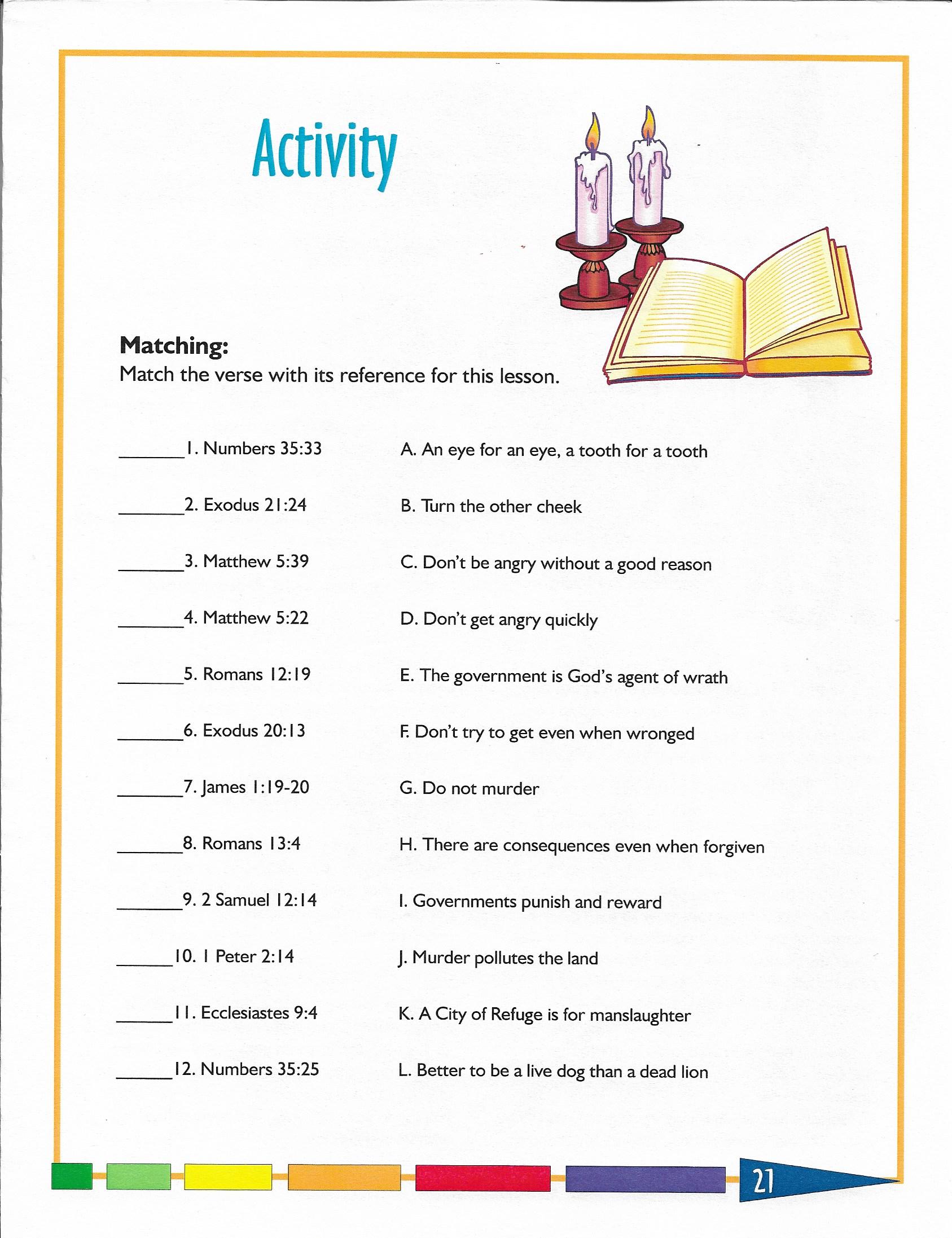
Murder Matching - Student book - Time: 15 mins.
Extending the Lesson - REACH Activities:
*Back to the Bible: Murder Pollutes the Land
*Journal Jot: Witnesses
*Word Study: râtsach
*Just Toolin’ Around: Vengeance
*Did you Know? Be Angry and Don’t Sin
*Stretch It Out: Dealing With Anger
*Music Notes: It Is Well With My Soul
*Questions? - Writing Prompt - 10 mins.
Student Prayer
Dear Father,
I know that murder is wrong. Please keep my thoughts from emotions and ideas which can lead to murder. Instead, teach me to share the message of eternal life through your Son, Jesus Christ.
It's in His name I pray.
Amen.
Daily Devotions
Sunday - Exodus 20:13
Monday - Matthew 5:21-22
Tuesday - 1 Peter 2:14
Wednesday - 1 John 3:15
Thursday - James 1:19-20
Friday - Romans 12:19
Saturday - Numbers 35:30
Objectives
At the end of this lesson, the student will be able to:
1. Recite their memory verse: Exodus 20:13.
2. Give examples of murder, i.e. abortion, suicide, genocide.
3. Distinguish between murder and manslaughter.
4. Define capital punishment.
5. State that God establishes governments.
6. Explain that governments have the responsibility to punish wrongdoers.
7. State that our goal is to share Life in Jesus Christ, not murder.
Topics & Themes
Anger
Justice
Life
Murder
Ten Commandments
Murder
Trusting God
Materials Needed
Bibles, Yea Students and Teacher's books, pencils, pens, attendance and memory verse charts, stars, songbook, music player and music tape or CD, blackboard and chalk, newspaper items
Preparation
Many people, including Christians, have strong feelings about capital punishment. Call CEM at 1-888-BIBLE 4 and order Mr. Dart's booklet, Capital Punishment, A Christian Dilemma and read it, if possible, prior to class to prepare you to answer students' questions. Also, it will help to be familiar with a few biblical examples of governments imposing punishment. (Examples: Roman government - Matthew 27:38; Church government - 1 Corinthians 5:1-5.)
Clip newspaper articles of murder and manslaughter for class discussion. Try to get examples of first and second-degree murder, abortion, suicide, genocide, manslaughter (voluntary and involuntary), and capital punishment. This can be a really heavy topic; try to focus on the last portion of the lesson - to seek Jesus personally and to share Him with others.
How to Teach This Lesson
Open the class with prayer and then follow the lesson below:
Clue - Ask: Has anyone ever played the game Clue? Explain that this game deals with the who, where, and with what. Ask: What element is missing? Why? (The motive is missing.)
Chart the types - Make seven columns on the board: First-degree, second-degree, abortion, suicide, genocide, manslaughter, capital punishment. Discuss the differences. Then use the newspaper clippings to give specific examples of each category.
A. First-degree: premeditated, often with malice, often involves another felony, like assault
B. Second-degree: not premeditated, but still intentional and with malice (either express or implied), i.e. road rage, family disputes, crimes of passion
C. Abortion: intentional murder of an unborn baby
D. Suicide: intentional murder of yourself
E. Genocide: intentional murder of a racial, political, or cultural group
F. Euthanasia: killing of a hopelessly ill or injured person
G. Manslaughter: unintentional killing of some one due to carelessness or impulse
H. Capital Punishment: the government's God-given right and responsibility to punish a murderer.
Life in prison vs. Capital punishment - discuss God's laws which required capital punishment for intentional murder, but provided cities of refuge for manslaughter. Note that the cities of refuge spared the life of the person who killed someone, but did not eliminate the punishment. That is, they were not allowed to leave the city of refuge and go back home until the High Priest died. Also note that Numbers 35:31-32 states that you must not accept a ransom for either a murder or a manslayer. Taking the life of another person is serious, whether it is intentional or unintentional.
Live dog vs. dead lion - Life is precious, not for what we can accumulate in this life, but for the possibilities for relationship with Jesus Christ. In Christ, as a new creature, we have the opportunity for eternal life. This is invaluable. Our goal should not be what we can get materially, but what we can become as a child of God.
Black and white - Exodus 20:13 says "Do not murder." The opposite then would be to share the Gospel with others - that they may have life eternally.
Review Questions
Ask: What is the Sixth Commandment? What is an example of murder? Is abortion murder? If you kill someone accidentally, is that murder? What is capital punishment? Who has the responsibility to punish people for their wrong-doing? Who gave the governments the right to punish and reward people? What is the opposite of murder? Can you think of a scripture which encourages us to share the gospel (life) with others?
Teacher-Directed Activity
Bible Races
Using the lesson scriptures, have the students start with their Bible closed. You state the verse reference. The first one there, stands and reads the scripture. Check the activity in the student workbook as you progress through the scriptures. (Answers: I-J; 2-A; 3-B; 4-C; 5-F; 6-G; 7-D; 8-E; 9-H; 10-I; 11-L; 12-K)
REACH Activity
Back to the Bible: Murder Pollutes the Land
Numbers 35:33 refers to the pollution of the land because of murder. How does God feel about that? What is the reason God gives for not polluting the land? (vs. 34) Can you think of a king who spilled so much innocent blood that the whole nation was punished for it? Do you know who committed the first murder? Do you know what God says will happen to all murderers? What does Jesus say about murder in the Sermon on the Mount? See what you can find in your Bible. Ask someone for help, if you have trouble finding the answers. Write down what you find in your Bible notebook.
Journal Jot: Witnesses
Numbers 35:30 says that you can’t convict someone on the basis of only one witness. Why? Does this just apply to murder? Read Deuteronomy 19:15 and Matthew 18:16. Why is it important to have more than one witness? Write what you find in your Bible notebook.
Word Study: râtsach
This Hebrew word can mean to murder or to commit manslaughter. It can also mean to destroy, to crush, to assassinate, or to kill a person with an animal. It can refer to unplanned, accidental death as well as unlawful killing of a human being with malice aforethought. (Source: Zodhiates’ NAS Hebrew-Greek Key Word Study Bible, 1990.)
Since this one Hebrew word covers all of these causes of death, how do we know which one is meant in Exodus 20:13? Here’s where logic comes in. The commandment is not to murder someone. This means you are not allowed to premeditated it. You are not allowed to have thought it all out (first-degree murder). You also must not murder someone in a fit of rage (second-degree murder). Abortion, suicide, genocide - those are also out. Manslaughter implies that it was accidental. There are still consequences for accidentally killing someone, but logically speaking, this isn’t what the commandment was referring to. Here’s why: How would you make a commandment against something that is an accident? Nevertheless, carelessness that leads to death can sometimes be ruled second-degree murder because of the negligence of the responsible party.
Write this word, its definition, and scripture reference in your Bible notebook.
Just Toolin’ Around: Vengeance
When a person murders someone you love, it’s natural to want revenge. You want them to be punished. You want justice. The problem is that no amount of punishment is going to bring the murdered person back to life. In your grief, you want the death of the person responsible. God, in His righteous wisdom, designed governments to apply capital punishment. It’s the government’s duty to punish evil-doers and murder is punishable by death. Why do you think God wouldn’t allow families to seek vengeance? What do you learn about trusting God if you leave the vengeance, justice, and punishment to Him? Look up three verses about God’s vengeance. Write them in your Bible notebook. Then talk with your family about this topic.
Did you Know? Be Angry and Don’t Sin
Ephesians 4:26 says, “Be angry and do not sin; do not let the sun go down on your anger.” Anger, then, doesn’t always have to be a sin. In fact, we know that there is a righteous indignation and anger that is not sinful because Jesus was angry when He drove the money changers out of the Temple. Similarly, God was angry at people at various times. We would never accuse God of sinning! That would be ludicrous.
The second half of the verse helps us to understand how to be keep from sinning in our anger; we have to let go of it and not let it fester in our minds. Don’t let the sun go down on your anger. Write about this in your Bible notebook.
Stretch It Out: Dealing With Anger
If you let your anger fester in your mind, it will continue to grow. Anger, that grows larger and larger with no release or outlet, results in violent actions, including murder. So how can you let go of your anger in a productive way? If you’re upset with your sister, that’s not the best time to talk with her; you’re likely to say things you can never unsay. The best option is to walk away before you say those angry words. But just walking away doesn’t deal with the anger. What can you do? Here’s the start of a list. Add to it.
*Go take a nap.
*Go do something physically hard (running around the block, chopping wood, pulling weeds). Expend some energy in good physical action.
*Go say a prayer.
*Write down exactly what you are angry about in a letter to the person.
If you deal with anger a lot, copy your list down neatly on a sheet of paper and post it next to the mirror in your bedroom. Do what you can to head off anger before it becomes a raging fire.
Music Notes: It Is Well With My Soul
This hymn is on page 60 of the CEM Hymnal.
Horatio Spafford had been a very successful, wealthy attorney in Chicago. The 1871 Chicago fire nearly wiped out his investments in real estate. He decided to send his wife Anna and four daughters Maggie (7 years old), Tanetta (18 months old), Annie (12 year old), and Bessie (4 years old) on an ocean liner to Europe. He would join them later for a vacation. As they crossed the Atlantic, they were struck by another ship. His four daughters were among the 226 who died. Anna was found, nearly unconscious, clinging to a piece of the wreckage. When she arrived in Wales, Anna sent a cable to her husband with two words: “Saved Alone.” Horatio immediately boarded another ship to join her. When they passed over the spot where the ocean liner had sunk, the captain told Horatio. Out of this tragic event, Horatio penned the words to “It is Well With My Soul.” (Source: Then Sings My Soul, Robert J. Morgan, 2003, p. 89.)
We cannot control many of the things that happen to us, but we can control our reaction to them. Whether you are overcome with grief or anger at the events in your life, seek God and the comfort He can give you. Trust Him with your life.
Sing this hymn. Does knowing the story behind the words make it more powerful? Make a bookmark with some of your favorite lines from the hymn. Keep it in your Bible to remind you to trust God always.
Questions?
Write down any questions you have in your Bible notebook so that you can remember to ask your parents or your pastor.
Song
"Wonderful Words of Life” is on page 78 of Kids Classics Collection.
Closing Prayer
Lead the students in prayer asking God to help them avoid thoughts which can lead to murder, but rather to have thoughts which lead to life in Jesus Christ. Also, ask God for guidance in sharing the Gospel with others, that they may have life too.
Printable Pages