YEA Lesson Library
Loving Your Parents
About This Lesson
This lesson teaches God’s command to honor and obey your parents. This is the first commandment with a promise.
Scriptures
Genesis 22:1-19
Exodus 20:12
Deuteronomy 5:16
Proverbs 1:8-9
Proverbs 6:20-22
Proverbs 22:1
Matthew 26:39, 53
John 5:30
Ephesians 6:1-3
Words to Know
OBEY - to do what you are told
HONOR - to treat with respect
RESPECT - to hold in high regard or esteem
The Lesson
Daniel didn't know what to do. His fourth grade teacher, Mrs. Saladin, had just assigned the class to watch a TV special on Lewis and Clark. Daniel really liked history. He thought Lewis and Clark were true American heroes. But his family didn't have a television. His parents believed that TV is just plain bad for the family. Daniel didn't know about that, but he had to figure out something for that assignment. So he talked to his best friend, Mike. That was a big mistake!
Now the whole class was buzzing about Daniel not having a television. Some of the kids were laughing at him and calling him names. Some of them felt sorry for him and were trying to figure out how to get a TV into his home. Finally, Kayla took matters into her own hands. She went straight to Mrs. Saladin and told her the problem.
Mrs. Saladin felt badly that she hadn't known that Daniel didn't have a television before she made the assignment. But Mrs. Saladin also felt very proud of Daniel. He had taken a lot of heat for not having a TV. Still he never once called his parents "stupid" or "mean." He never once tried to find a way to watch the program without his parents knowing about it. He simply tried to find a way to do what had to be done, even as he obeyed his parents. Mrs. Saladin was very proud of Daniel for showing such honor to his parents and their wishes.
If someone asked you if you love your parents, what would you say? Most kids your age would say that they love their parents. But you are getting to the age where sometimes you think the decisions Mom and Dad make are dumb, or mean, or just plain wrong. What do you do when you disagree with a decision your parents have made? Do you still show them the love, honor, and respect that you should? Do you ever wonder what God wants you to do when you believe your parents are wrong?
Look at your memory verse. God says to honor your father and your mother. But He doesn't stop there. He tells you why. He says that honoring your parents will let you live a long life wherever God puts you. How does honoring your parents do that?
Think about the decision Daniel's parents had made about television for their family. It may not have been something that Daniel thought was right, but he knew why they did it. They hadn't made the "no TV" rule to be mean or to punish their family. They wanted the very best for their children. It is the same with your parents. They love you very much. Since your parents have been alive a lot longer than you have, they have made a lot more mistakes than you have. They want to keep you from making similar mistakes. They want to save you from the pain and problems that come from making wrong decisions. They make rules for you to obey because they want you to be safe and to grow up in the most pleasing way to God. It is when children don't obey their parents that they can end up in a lot of trouble.
The fifth commandment is more than just obeying your parents. God says to be respectful to them, to honor them. Let's look at two examples. Remember, when Abraham was told to sacrifice Isaac, we are not told that Isaac resisted or disagreed. The only comment Isaac made was a respectful question, "Where is the lamb for the burnt offering?" The story (told in Genesis 22:1-19) shows Isaac respectfully obeying his father, even though his father tied him on the altar! That is honor.
In the same way, Jesus Christ knelt in the Garden of Gethsemane and asked, respectfully, if there was any other way. Jesus knew the suffering He was going to go through. But even though He was earnestly asking, He still did what God the Father wanted. We know this because Jesus told His disciples that He could have called 12 legions of angels to save Himself from being taken by the soldiers (Matthew 26:53), but He chose to do God's will (Matthew 26:39).
That's your goal. Even when you really don't want to do what they say, obey your parents. Sometimes just obeying Mom and Dad is hard. But once you can obey them, all the time, concentrate on honoring and respecting your parents. That's what God, your Heavenly Father, wants you to do.
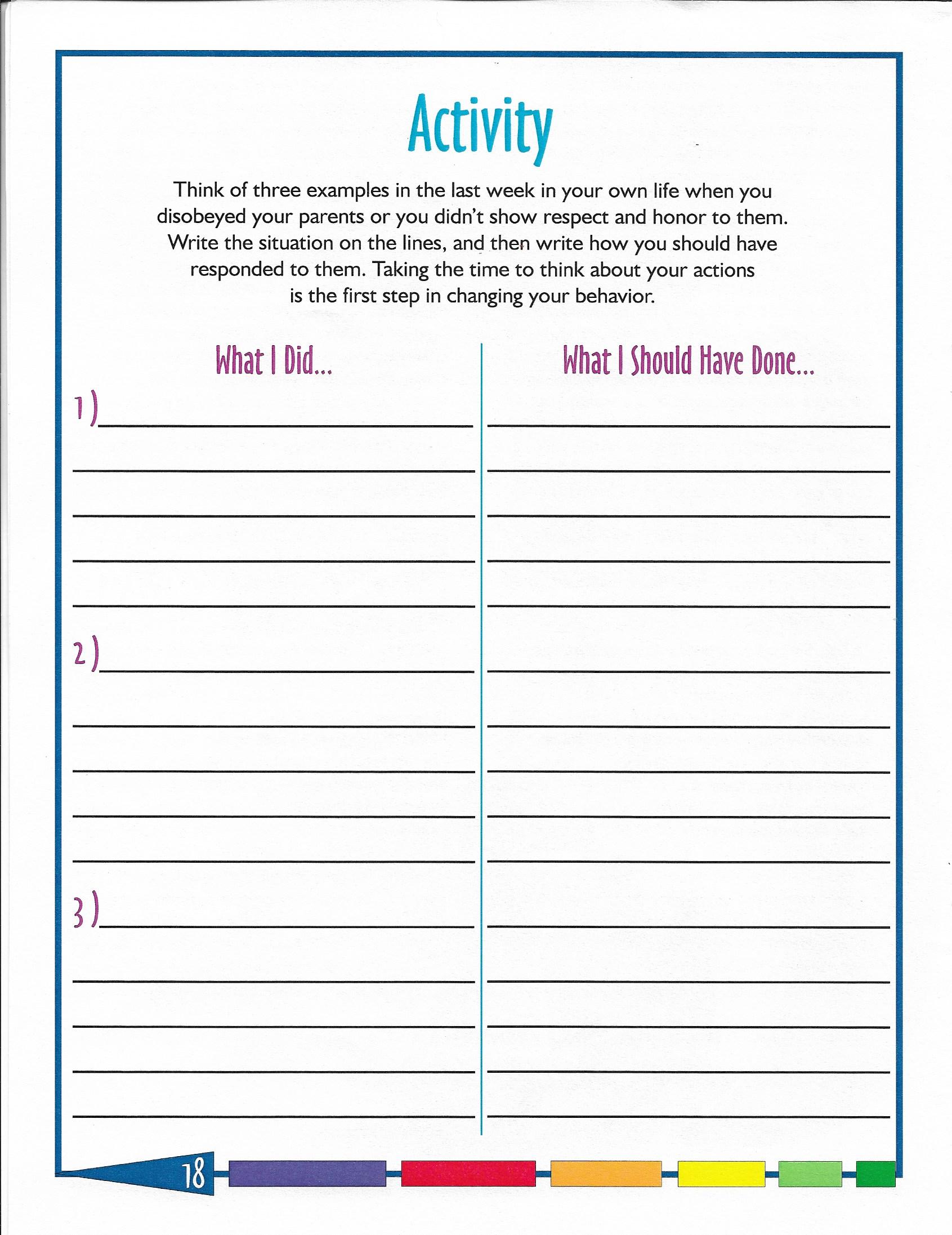
Activity
Teaching the Lesson:
Legacy Lesson: Student book/Teacher book - Teaching Time: 25 mins.
Lesson Prep - Teacher book - Time: 1 hour
What’s the Response? Activity - Teacher book - Time: 12-15 mins.
Song: "Heavenly Father, I Appreciate You" - page 82 of Kids Classics Collection - Time: 5 mins.
Think about It Activity - Student book - Time: 20 mins.
Extending the Lesson - REACH Activities:
*Back to the Bible: Honoring Your Parents
*Journal Jot: Peer Pressure
*Word Study: kâbad
*Just Toolin’ Around: Parents and Children
*Did you Know? Your Part of the Deal
*Stretch It Out: Thank You
*Music Notes: The Statutes of the Lord
*Questions? - Writing Prompt - 10 mins.
Student Prayer
Dear Father,
Please teach me to obey my parents in everything with honor and respect, even when I disagree with them.
In Jesus' name.
Amen.
Daily Devotions
Sunday - Exodus 20:12
Monday - Ephesians 6:1-3
Tuesday - Deuteronomy 5:16
Wednesday - Proverbs 22:1
Thursday - Proverbs 1:8-9
Friday - Proverbs 6:20-22
Saturday - John 5:30
Objectives
At the end of this lesson, the students will be able to:
1. Recite the Fifth Commandment.
2. Define obey, honor, and respect.
3. Give biblical examples of obeying and honoring a parent.
4. Design a plan of how to better obey, honor, and respect his/her parents.
Topics & Themes
Honor Your Father and Mother
Obedience
Ten Commandment
Honor your Father/Mother
Materials Needed
Bibles, YEA Students' and Teacher's books, pencils and pens, attendance and memory verse charts, stars, songbook, music player and music tape or CD, chalkboard and chalk
Preparation
Television is the worst culprit used for undermining the family. Make a list as you go through the week of the places and ways you see the family (and especially parental authority) undermined. Cite specific television shows, magazine articles, commercials, other media, etc. Take your list to class. An awareness of negative influence will help students to guard against it.
Make five situation cards (A,B,C,D,E) for the Activity in class. Then make four response cards for each situation.
A. Parent says, "Clean your room." Response Cards: 1) Ignore parent; 2) Respond, "I'm not your housekeeper"; 3) clean your room; 4) Respond, "Okay, Mom" and do it.
B. Parents' rule: No friends over without your parents being home. Response Cards: 1) Friend stops over and you invite him/her in to show your new toy; 2) You invite your friend to come home with you after school when you know your parents will be out; 3) You don't invite your friends over without your parents being home; 4) When a friend stops by, you politely tell them that you're not allowed to have visitors until whatever time your parents will be home.
C. Parents' rule: Homework before TV. 1) You walk by your brother's room and see your favorite show on. You stop to watch; 2) You sneak into your parents' room to watch your favorite show, with the sound turned down so they won't catch you; 3) You get your homework done and then watch TV; 4) You tell your parents that your favorite show is on TV, and you have a page of math problems to do. Politely ask if they will make an exception, just this once, or if they will record the program for you to watch later.
D. Parents' rule: Wear your bicycle helmet. 1) You forget your helmet, but don't go back when you remember that you don't have it on; 2) You throw your helmet in the back of your closet and tell your mom you couldn't find it when she asks why it's not on; 3) You wear your helmet when riding, but grumble about having to do it; 4) You wear your helmet and plan to ask your parents why they have made that rule.
E. Parents' rule: Do your chores after school. 1) You don't do your chores; 2) You don't do your chores and you tell your parents that you're not their slave; 3) You do your chores, complaining the whole time; 4) You do your chores and tell your parents you appreciate how much they do for you.
How to Teach This Lesson
Open the class with prayer and then follow with questions/discussion below:
Parental decisions - Ask for a show of hands ONLY, of those students whose parents have made, in the student's opinion, a bad decision recently. Then ask how many of the students have made a bad decision recently. Point out that everyone makes mistakes, even parents.
God-given authority - Ask: Who gave your parents the right to make decisions for you? If they respond, "God," ask for a specific verse. (Proverbs 13:24, 22:6, 29:17; Ephesians 6:4; and others.)
Experience is the best teacher - Ask: Have you ever heard the phrase "Experience is the best teacher?" What does it mean? Who, if experience is the best teacher, has been learning the longest - your parents or you? Talk about learning from mistakes. Ask: What is an example of something you've done wrong that you will never do again? Would you be wiling to share that experience with someone else if it meant that other person wouldn't have to suffer as you did.
Parents' rules - Ask: Do you think your parents make rules to be mean, to punish, to ruin all your fun? Why do you think your parents make rules? (Lead students to conclude that rules are made so that they won't get into trouble, will be healthy and safe, and will grow up knowing and loving God.).
Obeying the rules - Ask: If the rules are for our own good, why don't we obey them? We want our own way - sometimes regardless of the consequences, sometimes because we are unaware of the consequences. This rule applies to our parents or our Heavenly Parent.
Honor and respect - Say: If we know the rules are for our own good, we know our parents love us and want the best for us, and we know that God has put our parents in authority over us. Ask: How should we respond to the rules and decisions our parents make? What is the definition of "honor?" What does respect mean? Discuss the practical application in the Activity section.
Exodus 20:12 - Why does honoring our parents help us to live long in the land? Honor assumes obedience. Obeying our parents' rules directs our paths away from trouble and towards God.
Review Questions
1. What is Exodus 20:12?
2. What does "obey" mean?
3. What does "honor" mean?
4. What does "respect" mean?
5. What are two biblical examples of honoring parental wishes?
6. What can you do to begin showing more honor to your parents?
Teacher-Directed Activity
Make a chart on the blackboard with the following headings: Disobedience, Defiance, Obedience, Honor. Read a situation card (See Preparation). Then read each of the response cards for the given situation. Have the students take turns placing the responses in the correct columns. Discuss as you go. Once you've worked through all of the situations, give the students the opportunity to come up with their own situations and responses.
REACH Activity
Back to the Bible: Honoring Your Parents
Children, obey your parents in the Lord, for this is right. “Honor your father and mother”—which is the first commandment with a promise—“so that it may go well with you and that you may enjoy long life on the earth.” (Ephesians 6:1-3)
Did you ever notice that there’s a promise attached to this commandment? That’s what the apostle Paul told the Ephesians! And what is that promise? That it may go well with you and that you may enjoy long life on the earth.
Why do you think God was specific in giving the reason why it’s important to honor your father and your mother? Do you think people have trouble honoring their parents? Does our human nature naturally cause us to rebel against what our parents say?
Read Proverbs 20:20 and Proverbs 30:11-13. What do these verses say about dishonoring your parents? Write about this topic in your Bible notebook.
Journal Jot: Peer Pressure
When I was teaching fourth grade, I saw a lot of peer pressure, but Daniel’s story is a great example of standing your ground and honoring your parents. As a family which celebrates God’s holy days and doesn’t celebrate the world’s holidays, you likely have lots of opportunities to stand your ground and honor your parents when your friends ask you why you’re going to be gone for a week and then again when you don’t celebrate Christmas. What do you tell them? Write about this in your Bible notebook. Then think about your interactions with your friends. Do you think you could do a better job of honoring your parents when you’re with your friends? Write about this too - and then be intentional about honoring your parents.
Word Study: kâbad
The Hebrew word for “honor” in Exodus 20:12 is kâbad. It means “to be heavy, weighty, or burdensome.” Think of this, then, as a verb which has great significance. Honoring your parents is weighty; it means something. It’s not something to be taken lightly.
Write this word, its definition, and the scripture reference in your Bible notebook. Then find three other places where this word is used.
Just Toolin’ Around: Parents and Children
There are some great verses about parent/child relationships. There are verses which talk about the consequences of dishonoring your parent. There are verses about listening to your parents’ instructions. Find five of your favorite and write them in your Bible notebook.
Did you Know? Your Part of the Deal
Think of Ephesians 6:1-3 as God’s instruction to you about how you are supposed to treat your parents. Do you see any “if” in that instruction? No, this is what God expects from you, regardless of anything else. Now obviously, if your parents are committing a crime or disregarding God’s law, that’s another conversation. But you don’t get to decide that you don’t have to obey your parents if they are not keeping their part of the bargain (Ephesians 6:4). God tells parents not to exasperate their children. Other translations say “Do not provoke.” In other words, your parents are not supposed to be trying to make you angry on purpose. But, and here’s the kicker, you don’t get to decide whether they are provoking you on purpose. God is the judge of that! Sometimes children think their parents are intentionally poking and provoking them and they are thoroughly exasperated. In reality, the parents are doing their job in good faith; they are trying to obey God in the second part of Ephesians 6:4 - “bringing [you] up in the training and instruction of the Lord.” You can’t look at your parents and decide that their behavior excuses yours. It doesn’t work that way! Write about this in your Bible notebook.
Stretch It Out: Thank You
Everyone appreciates a thank you note. So think about something specific that your parents have done that you really appreciate, make a nice thank you note, and give it to them. Now, as you were making the thank you note, were you doing it because it was an assignment or because you really do appreciate what your parents do. If you really appreciate what they do, then your appreciation will show in your behavior towards them. You will become more respectful towards them and show them honor. If you’re just doing it as an assignment, your parents might appreciate the card, but they will know it doesn’t mean much because your appreciation doesn’t show in your conduct. And you have some work to do. Think about it!
Music Notes: The Statutes of the Lord
This hymn is on page 100 of the CEM Hymnal.
This hymn was written by James McGranahan, who had a remarkable musical talent. Although his father encouraged James’ musical education, he also had concerns about the value of a musical education. James persevered. He honored his father by not only earning the money he needed to continue his musical studies, but also employing someone to do the work on the family farm while he was studying. As he grew more and more accomplished, James had another big decision to make: would he become an opera star or would he use the gift God had given him to glorify and honor God? James chose to honor God and spent eleven years working with Major D.W. Whittle in evangelistic work in the U.S., Great Britain, and Ireland. “That his father later revised his notions about the value of a musical education was very evident when no one rejoiced more than he that his son was being so marvellously used of God in winning souls through the power of persuasive song.” (https://www.wholesomewords.org/biography/bmcgran.html)
You may wish to read more about how James came to work with Major Whittle. You may also wish to look at some of the other hymns he wrote. (Look at “There Shall Be Showers of Blessings” or “Sometime We’ll Understand.”) God certainly blessed his desire to be used for His glory.
After you sing this hymn, write your favorite lines in your Bible notebook.
Questions?
Write down any questions you have in your Bible notebook so that you can remember to ask your parents or your pastor.
Song
"Heavenly Father, I Appreciate You" is on page 82 of Kids Classics Collection.
Closing Prayer
Lead the students in prayer asking for God’s help in obeying, honoring and respecting their parents.
Printable Pages