YEA Lesson Library
Rest!
About This Lesson
This lesson teaches two aspects of the Fourth Commandment: physical rest and resting in Jesus. The physical rest every Sabbath is an object lesson which helps us learn to trust God no matter what (that is, resting in Jesus).
Scriptures
Exodus 20:9-11
Exodus 33:14-15
Exodus 35:2
Job 2:10
Job 13:15
Psalm 16:8-9
Psalm 116:6-7
Mark 2:27
Hebrews 4:9-11
Words to Know
BENEFIT - something that is for your good
REST - to stop working; to stop worrying; to be still
TRUST - to believe, to rely on, to depend, to expect with confidence
BOIL - a painful skin infection
The Lesson
Mandy watched her mom cooking tacos for supper. Everything looked like a normal evening in the Walters’ household, but Mandy felt there was something not quite right. Finally, she had to ask, "Mom? Is something wrong?"
Mandy's mom stopped shredding lettuce to look at Mandy. She simply said, "Your dad is a little late tonight. I'm beginning to worry some."
Now that Mandy knew what was wrong, she could see the worry coming through in what her mom had been doing. She was tense. The whole room seemed to vibrate with stress.
Suddenly Mandy said, "Mom, let's pray for God's protection on Dad."
"That's a good idea," Mrs. Walters said, with a smile.
They grabbed each others' hands and quietly asked God to protect Mr. Walters and bring him home safely, and to give them peace while they waited for him. Both felt much better.
Twenty minutes later, Mr. Walters walked into the kitchen. Mrs. Walters gave him a quick hug and kiss before Mandy came over for her hug.
"We were worried about you,"she told her dad.
"I knew you would be," he responded. "I had a flat tire on the way home. I was having a lot of trouble getting the lug nuts off. Then about 20 minutes ago, a big guy stopped and helped me get the tire changed. Together we had it done in nothing flat. It was amazing.”
Mandy and her mother looked at each other and smiled. You couldn't prove it to anyone, but they were certain that God had immediately answered their prayer and sent Mr. Walters the help he needed so he could get home safely. They both silently thanked God for answering their prayer.
Many people have had experiences like this, where they were worried about something, so they prayed. They felt much better having asked God for His blessing in the situation, because they trusted God with it. Sometimes what you worry about comes true, but many times God works things out, and there's evidence that the prayer actually helped the situation. Regardless of what happens, the real benefit is in trusting God with the situation. It is called resting in Him, and we all need to learn how to do it! Resting in God means we tell Him our problems and we trust Him to take care of them.
There was a man named Job who was blameless before God. Satan told God that Job only did what was right because God had blessed him. Satan said that if Job experienced some hard times, he would turn away from God. God allowed Satan to take all of Job’s livestock and all of his children. Then he allowed Satan to cause boils to break out all over Job’s body so that he was feeling very sick and miserable. Job said, “Shall we accept good from God,
and not trouble?" And later: "Though He slay me, yet will I hope in Him."
That's amazing! Job had lost everything. He was hurting all over. But still, he was able to say, “Even if God kills me, I will trust Him!” How do we get to that place? How do we learn to trust God - no matter what?
Well, we start with the Sabbath day every week. That's right! God has given us one day a week to rest. Look at your memory verse. The commandment says we are not to work. But it is not just a physical rest. It is not just the day we
are not allowed to earn money or to go do whatever we want to do. It is a day to learn to rest in God - completely. You see, God knew that we would never learn to rest in Him, to trust completely in Him, if we never learned to rest first. Once we learn to set aside one day to rest and worship God, then we can really begin to learn to trust God with our whole lives, no matter what is happening.
What a great blessing the Sabbath day is! We are so busy with our lives that if God didn't command that we take one day to rest, we probably wouldn't. Then look at what we would miss! Hebrews 4:1 tells us "God's promise of enjoying His rest still stands. So be careful that none of you fails to receive it." The rest that Paul is talking about here is the millennium, or 1000 years in God’s Kingdom. That’s our goal! Let's make every effort to enter into that rest. But does that mean that we should not rest on the Sabbath day each week? No! Verse 9 says, “So there is still a Sabbath rest for God’s people" (NIV Kids' Devotional Bible). One of the things we learn from keeping God's Sabbath is how to rest in God. We learn to trust Him completely no matter what.
Activity
Teaching the Lesson:
Legacy Lesson: Student book/Teacher book - Teaching Time: 25 mins.
Lesson Prep - Teacher book - Time: 45 mins.
Activity - Resting on His Promises - Teacher book - Time: 45 mins.
Song: "Whisper a Prayer" - on page 57 of Kids Classics Collection.
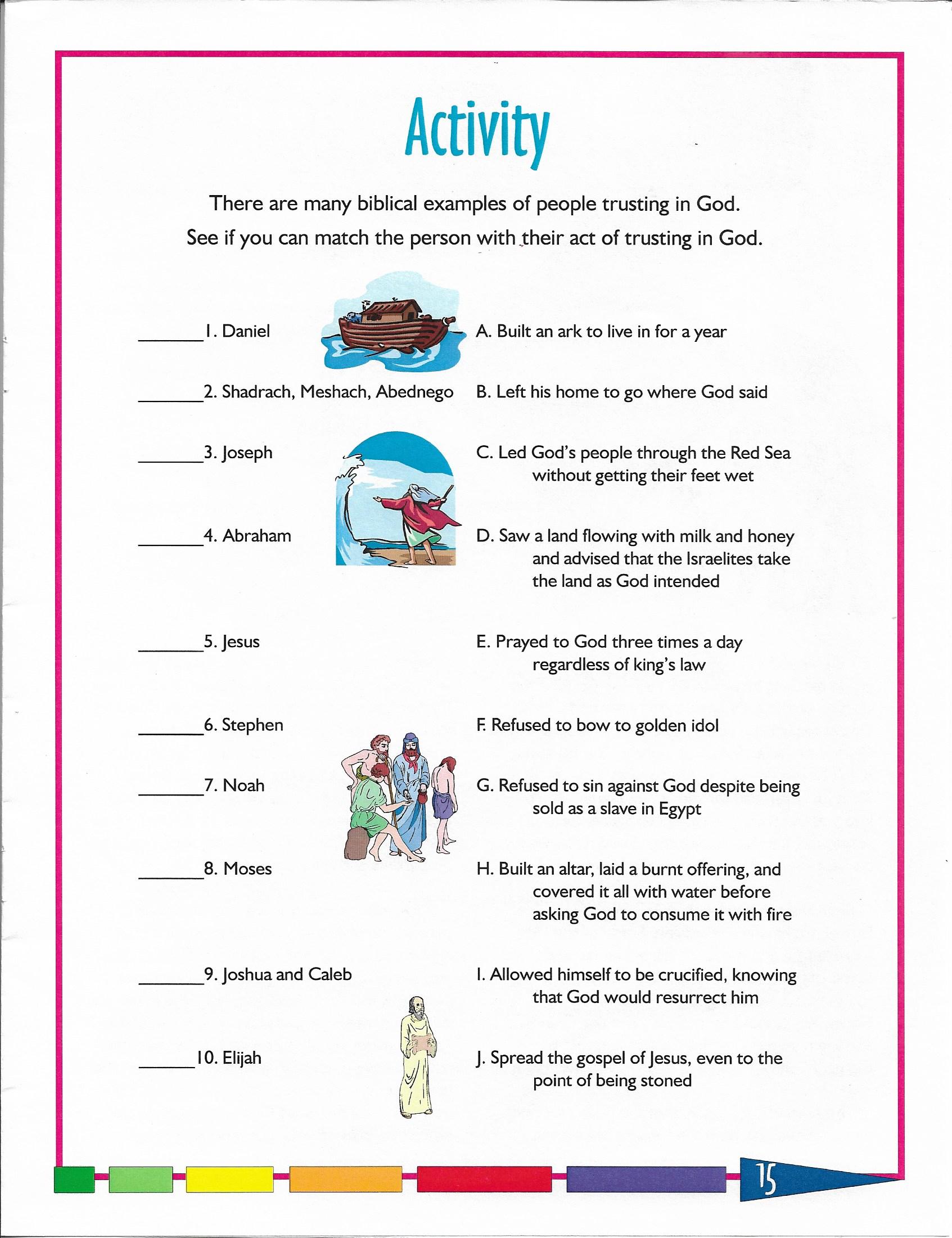
Activity - Trust Matching - Student Book - Time: 20 mins.
Extending the Lesson - REACH Activities:
*Back to the Bible: Asleep in the Storm
*Journal Jot: Resting
*Word Study: shabbath
*Just Toolin’ Around: Rest
*Did you Know? Don’t Worry
*Stretch It Out: Exhortation
*Music Notes: He Hideth My Soul
*Questions? - Writing Prompt - 10 mins.
Student Prayer
Dear Father,
Help me learn to appreciate the Sabbath more and more. I want to learn what it means to completely trust and rest in You.
In Jesus' name.
Amen.
Daily Devotions
Sunday - Exodus 20:9-11
Monday - Hebrews 4:9-11
Tuesday - Exodus 35:2
Wednesday - Mark 2:27
Thursday - Exodus 33:14-15
Friday- Psalm 16:8-9
Saturday - Psalm 116:6-7
Objectives
At the end of this lesson, students will be able to:
1. Recite the Fourth Commandment (Exodus 20:9-11).
2. Contrast physical and spiritual rest.
3. Give biblical examples of resting in God (trusting no matter what).
4. Create a goal in their personal life to enter into the rest of God.
Topics & Themes
Job
Rest
Sabbath
Ten Commandments
Sabbath
Trusting God
Materials Needed
Bibles, YEA Students' and Teacher's books, pencils, pens, attendance and memory verse charts, stars, songbook, music player and music tape or CD, chalkboard and chalk, poster board and/ or construction paper, calendar pictures, magazines, glue, glitter, scissors, markers, black permanent markers, tape, hymnals, poetry books.
Preparation
Prior to class, find at least one hymn, poem, or psalm that has to do with trusting God, preferably your favorite. Refresh your memory, if necessary, so that you are ready to present it at the beginning of class. You may want to put it on a poster and decorate it. You may want to do a slide show of God's creation while you read a poem. Be creative. The students will build on this idea for the Activity in class. Plan to devote more time to the Activity than normal this week.
Also, think of a time when you know God answered a prayer for you. Be ready to share with the class how that answer affects your trust in God now. (If you don't have a personal experience, chose a biblical example, i.e. Hannah or Elijah.)
Here are some suggestions for hymns, poems, or psalms:
Hymns: “'Tis So Sweet to Trust in Jesus," "Trust and Obey", "You Are My Hiding Place", "Tis Sabbath in My Soul", "Til The Storm Passes By, "Thy Word", "On Eagles’ Wings", "O Worship The King", "Love Divine Al Loves Excelling", "His Eye is on the Sparrow", "He Leadeth Me", "He is Able to Deliver Thee”.
Poems: "The Crooked Footpath" by Oliver Wendell Holmes; "The Tempest" by James .T Fields; "The Eternal Goodness" by John Greenleaf Whittier
Psalms: 69, 91, 103, 107, 118,121, 125, 136, 138, 146 (There are so many!)
How to Teach This Lesson
After opening the class with prayer, begin the class with a:
Trust presentation - Present a hymn, poem, or psalm to the students. Then ask the students to pick out the theme or topic for today's discussion from the presentation.
Answered prayers - Talk about Mandy Walters (from the student lesson book). Ask if situations like this really happen. Encourage the students to share their experiences; be prepared to share one of your own.
Trusting God - Discuss with the students a result of answered prayers: trust in God. That is, when we know He hears us and have the evidence in our own lives, our faith and trust in Him is strengthened. This leads us to obey Him even more in our lives.
Obeying God - Discuss with the students the Fourth Commandment. The commandment requires resting from our labors. Why? Exodus says "because God finished creation and rested from His labors. Therefore, He blessed the Sabbath day and made it holy." It is a memorial of God's work of creation. A weekly reminder of God as the Author and Creator of this world also strengthens our trust and faith in Him.
Physical rest - Discuss the definition of physical rest with the students. We are not to work as we would on any other day of the week. We shouldn't be working and doing activities that do not honor God. (However, the Sabbath should be a joy. If time permits, discuss the difference between taking your own pleasure and calling the Sabbath a delight.) Why do we rest? God gives us physical examples so that we can understand the spiritual lesson. If we never take time out from our busy lives to rest, we might very well never take time out from our busy lives to trust and rest in God. The physical rest helps us learn to rest spiritually in God.
Spiritual rest - Discuss the definition of spiritual rest with the students and how the millennium is a spiritual rest for this world. We must learn to take no anxious thought, to bring every thought into subjection to Christ, and to trust God wherever He may lead us. That is something which takes a lot of prayer, practice, and faith. A good place to start is by keeping the Fourth Commandment.
Review Questions
What is the Fourth Commandment, as given in Exodus 20:9-11? What does it mean to rest physically? What does it mean to rest spiritually? Who is a good biblical example of resting in God? What can you do in your life to make every effort to enter into the rest of God?
Teacher-Directed Activity
Resting on His Promises
Have the students create a decorative poster around a hymn, poem, or psalm about trusting God. It works really well to use calendar pictures of God's creation and then write a short poem or stanza from a song in bold, black permanent marker over the top of the picture. However, if you have brought poster board, they may wish to use the pictures as cut-out decorations around their inspirational piece. Encourage them to use their imagination in creating a poster to help them remember to trust God no matter what.
REACH Activity
Back to the Bible: Asleep in the Storm
There’s a contemporary Christian song which exhorts the listener to trust God so much that they can sleep when life is storming around them. (https://genius.com/Unspoken-sleep-in-the-storm-lyrics)
Read the story of Jesus sleeping in the bottom of the boat during the storm. (Luke 8:22-25; Matthew 8:23-27; Mark 4:36-41) Is there anything about this story in these three gospels that really stands out to you? Can you sleep when you’re worried about something? What did Jesus do - instead of worrying about the difficulty? What example did He give us? What should we do next time we’re worried about something? Write about this in your Bible notebook. You can also write down some of your favorite lyrics from “Sleep in the Storm.”
Journal Jot: Resting
If you are at rest, you are not anxious or worried about anything. When was the last time you felt completely at rest? Do you find yourself worrying a lot of the time? How do you combat worrying? Do you talk with your parents or a friend? Do you know that you can talk with Jesus. Jesus said in Matthew 11:28, “Come to me, all who labor and are heavy laden, and I will give you rest.” (ESV) If worrying is something you battle, write this verse in your Bible notebook. If worrying is not something you battle, thank God for giving you peace.
Word Study: shabbath
In Exodus 20:10, the word “Sabbath” is the Hebrew verb shabbath - which means “to rest from labor.” It was first instituted in the Garden of Eden, when God rested from His creation. It is “a day of rest and refreshment for the body and of blessing to the soul.” (Source: https://www.kingjamesbibledictionary.com/Dictionary/sabbath)
Write this word, its definition, and where it is found in your Bible notebook. Then find three other scriptures where it is used. It is the same word that is used for each of the Holy Days in Leviticus 23? Write down what you discover.
Just Toolin’ Around: Rest
If you notice, the command is rest for people and for animals - one day out of every week - on the Sabbath. But did you know that God wanted the land to enjoy a sabbath rest as well? Using a concordance or Bible resource, look up land rest. What happened every seven years? What were people allowed to do with their land on the seventh year? Write down what you find in your Bible notebook, including references. Then share what you have found with your family.
Did you Know? Don’t Worry
It has been said that there are 365 verses in the Bible that say not to worry - one for every day of the year. God knew that we (as humans) have a tendency to worry and not to trust Him. So God gives us the encouragement to trust Him, don’t worry, don’t fear, don’t be afraid, don’t be anxious. You might start your own list as you find them in the Bible. How many can you find?
Stretch It Out: Exhortation
Using your five most favorite rest verses (or trusting God verses), make five greeting cards that you can send to people. You can take photos to print on the front cover. You can do leaf rubbings. You can dehydrate flowers to glue. You can use stickers. You can find pretty pictures from old calendars or magazines. Using a variety of resources (color tools, paper, ribbon, stickers, flowers, pictures, etc.), spend some time making quality cards to brighten someone’s day.
Music Notes: He Hideth My Soul
This hymn is on page 128 of the CEM Hymnal.
Fanny Crosby was a blind American poet. She “did not begin writing gospel texts until her mid-forties. But from then on, inspiring words seemed to flow constantly from her heart, and she became ‘the happiest creature in all the land.’ ” This is in spite of three great losses in her life: her sight, her marriage, and her infant child. Despite these tragic events, “all who knew Fanny Crosby spoke of her energy, her zest for life, her joy. One biographer said, ‘Even in extreme old age, she would tire out people twenty or thirty years her junior.’ ” Because of her zest for life and her prolific writing, people often stopped by asking for her to write something for them. “One day Fanny was visited by William Kirkpatrick, a talented gospel musician who had just composed a new melody that he felt needed suitable words to become a singable hymn. As William sat at the piano and played the tune for Fanny, her face lit up. She knelt in prayer, as was always her custom, and soon the lines to this lovely hymn began to flow freely from her heart.” (Sources: Amazing Grace, Kenneth Osbeck, 1990, p. 214. and Then Sings My Soul, Robert Morgan, 2004, February 27.)
Wouldn’t it be amazing to have people talk about you like this long after your death!? It would wonderful to be the kind of person who trusted in Jesus so much that that’s what people remembered about you!!
Questions?
Write down any questions you have in your Bible notebook so that you can remember to ask your parents or your pastor.
Song
"Whisper a Prayer" is on page 57 of Kids Classics Collection.
Closing Prayer
Lead the students to ask God's guidance and strength in learning to trust Him in every area of their lives, to truly come to know what it means to rest in Christ.
Printable Pages