YEA Lesson Library
Worshipping Our God
About This Lesson
This lesson introduces the second of the Ten Commandments and explains some of the reasons why it is wrong to have an image which you say represents God.
Scriptures
Exodus 20:4-6
Exodus 32:2-5
Exodus 34:14
Leviticus 19:4
Deuteronomy 4:15-19
Deuteronomy 27:15
1 Chronicles 16:24
2 Chronicles 7:19-20
Daniel 3:4-6
Romans 1:25
1 Corinthians 13:12
Words to Know
PORTRAIT- drawing or painting of someone
IDOL - an object which you call God or a god; something you worship and/or serve as a god or as God.
ADAMANT - feel very strongly about
REPRESENT - to stand for, to take the place of
CHARACTER - the qualities in a person, like gentleness, kindness, patience
The Lesson
Jeremy and Alexa were shopping with their mom in the Christian bookstore. They saw a large portrait hanging on the wall of a man with long hair.
"Mom," Jeremy asked, "who is that? Why is it in the Christian bookstore?" Both children were shocked and amazed when she told them that was a picture someone had made of Jesus.
"But," Alexa protested, "we don't know what Jesus looks like! How did he make that picture?”
Mom explained that it was only what one artist thought Jesus looked like. Then she asked, "Why do you think we don't have a picture like that in our house?"
Alexa said, "Because no one really knows what Jesus looked like and we shouldn't make pictures of Him.”
You're right," their mother told them. "The people who paint pictures of what they think Jesus looks like, probably don't understand that they are breaking the second commandment."
"Mom, what does the second commandment say?"
"You shall not make for yourself an idol in the form of anything in heaven above or on the earth beneath or in the waters below. You shall not bow down to them or worship them; for I, the LORD your God, am a jealous God, punishing the children for the sin of the fathers to the third and fourth generation of those who hate me, but showing love to a thousand generations of those who love me and keep my commandments" (Exodus 20:4-6).
Shadrach, Meshach, and Abednego were commanded by King Nebuchadnezzer to bow down and worship the idol of gold that he had made. They refused. They knew the second commandment. The three young men respectfully told King Nebuchadnezzar that they would not bow down to the idol, even if it meant they would be thrown into the blazing furnace. They also told the king that God could rescue them from the fire. But even if God didn't rescue them, they would not bow down to the idol.
We might wonder why God was so adamant about idols. We might also wonder how this is different from the first commandment of not having any gods before God. Let's look at the story in Exodus 32:2-5.
While Moses was on Mt. Sinai talking with God, the people became very impatient. They decided to make some gods from the gold earrings they were wearing. Aaron took the gold earrings and made an idol in the shape of a calf. Then the people said that this calf was the god who brought them out of Egypt. Aaron even called the calf by God's name and said they would have a feast the next day to the golden calf.
The Israelites didn't just make an idol. They made an idol and said that it was God. They called it by His name. They didn't even know what God looked like. This is like having a picture of what someone thought Jesus looked like and calling it Jesus.
You have no problem seeing that making a calf and worshiping it is wrong. You can also see that saying it is God is wrong. God is not a calf. The calf might in some way act like God acts. But that doesn't mean that God always acts like the calf does. That is the problem with making any idol or drawing of God. It might look like God looks sometimes - but not all the time. In fact, there is nothing you could make or draw that would be God. Anytime you make an idol, a statue, or a drawing and say that is God, you are breaking the second commandment. You have made something to represent God. Just because you call it God, it doesn't make it God. Even if your drawing or statue showed part of God's character, it would leave out so much that it would be absurd. That drawing or statue limits and diminishes God. Our God is much greater.
The other important thing to remember is that once you have something to represent God, you stop seeking and learning more and more about who God is. If you had a picture of Jesus with children kneeling around Him, you might think He is always gentle and quiet. But do you remember that Jesus drove the money changers out of the Temple with a whip?
Right now, we have a limited idea of God. 1 Corinthians 13 tells us we see through a glass darkly - like trying to look into a car with tinted glass. But we will see God face to face. Then we will be like Him because we will see Him exactly as He is. We can't do that now.
There may be lots of reasons why God tells us not to make an idol and worship it. The most important thing is that God commanded us not to. God said it. We obey Him. End of story.
Activity
Teaching the Lesson:
Legacy Lesson: Student book/Teacher book - TeachingTime: 25 mins.
Lesson Prep - Teacher book - Time: 15 mins.
Activity - Clay Figures - Time: 20 mins.
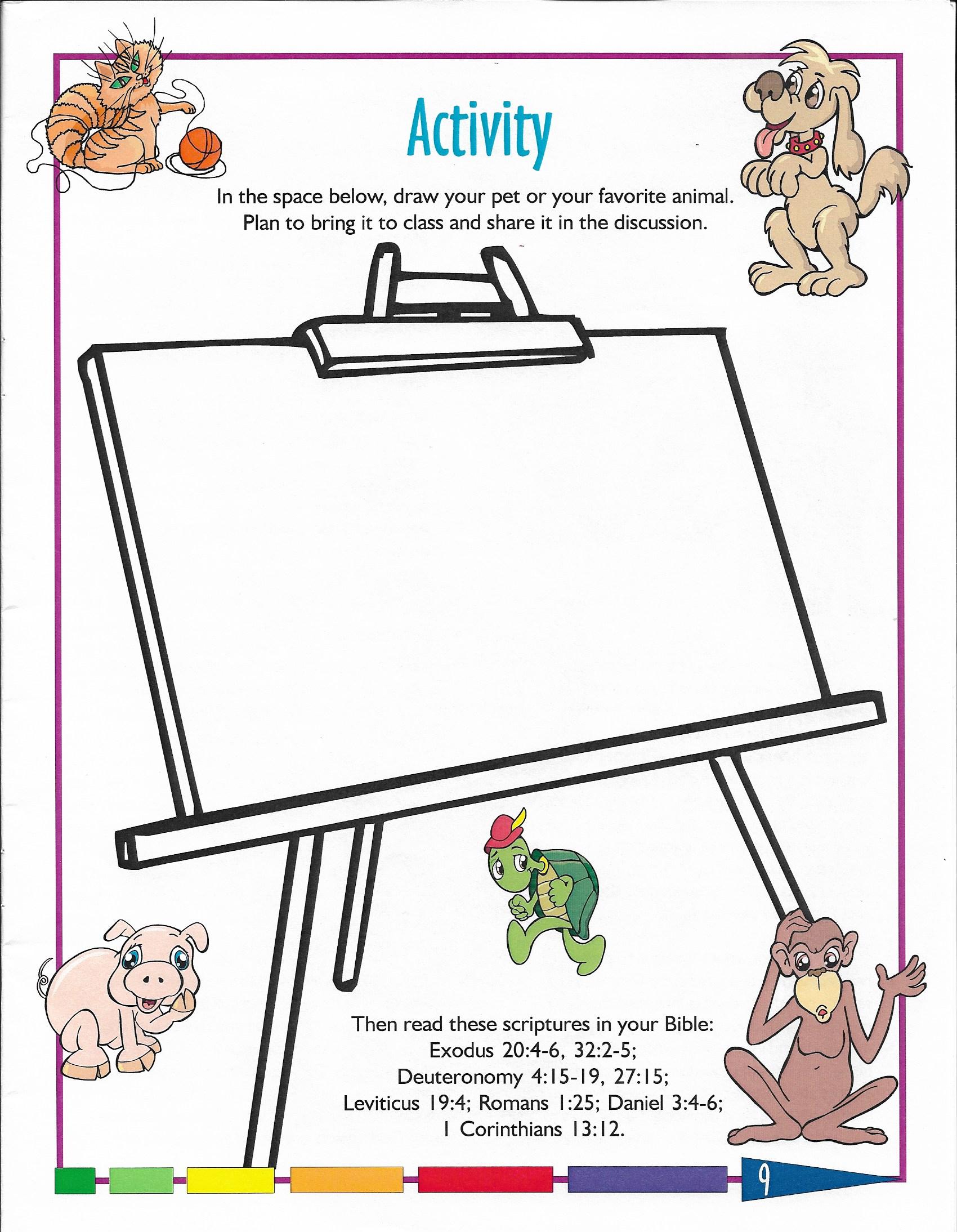
Activity (Student book) - Drawing of Your Pet - Time: 20-30 mins.
Song: “My God is So Big” - Time: 5 mins.
Extending the Lesson - REACH Activities:
*Back to the Bible: The Bull
*Journal Jot: In My Mind’s Eye
*Word Study: Qannâ
*Just Toolin’ Around: Jealous
*Did you Know? Sculpture and Idolatry
*Stretch It Out: No Idols Here
*Music Notes: From All That Dwell Below the Skies
*Questions? - Writing Prompt - 10 mins.
Student Prayer
Dear Father,
Help me to understand who You really are. I don't want to worship something that is not God. Please keep me from making any kind of idol.
In Jesus' name.
Amen
Daily Devotions
Sunday - Exodus 20:4-6
Monday- Deuteronomy 4:15-19
Tuesday - Deuteronomy 27:15
Wednesday - Romans 1:25
Thursday - 1 Chronicles 16:24
Friday - 2 Chronicles 7:19-20
Saturday - Exodus 34:14
Objectives
At the end of this lesson, the students will be able to:
1. Recite the Second Commandment.
2. Define idol.
3. Explain some reasons why making an idol is wrong.
4. Tell two examples in the Bible of idols.
Topics & Themes
God’s Likeness/Image
Golden calf
Idols/Idolatry
Obedience
Shadrach, Meshach, Abednego
Ten Commandments
No Other Gods (Idolatry)
Worship God
Materials Needed
Bibles, YEA Students and Teacher's books, pencils and pens, attendance and memory verse charts, stars, songbook, cassette tape or CD, Music player, chalkboard and chalk, pictures of animals, clay
Preparation
Sometimes it is really difficult to get our minds around the difference between the First and Second Commandments. Perhaps that is because when you break the Second Commandment, you are breaking the First as well. Spend some time thinking and praying about the difference so that you are clear in your own mind before doing this lesson with the students. God gives the Second Commandment with this reason attached: "for I the LORD your God, am a jealous God, punishing the children for the sin of the fathers to the third and fourth generation of those who hate me, but showing love to a thousand generations of those who love me and keep my commandments." That's a really strong statement from our God. He is adamant about not making and worshiping idols. We need to understand what it is that He truly wants from us.
How to Teach This Lesson
Open the class with prayer then start the lesson.
Student Preparation - The students should have drawn a picture of their pet or favorite animal. Have them share just the picture with the class. Ask the students not to say anything about the animal as they are sharing the picture. Have everyone share. Then go back and have the students begin asking what questions they might have, i.e. What is its name? How old is it? What does it like to eat? Does it bark, meow, neigh a lot? Is it gentle or high-strung? Can you sleep with it? Does it bite? List the different questions on the board.
Character - Discuss with the students how the picture gives a rough idea to the rest of the class about the animal. But it doesn't tell us anything about the character, likes and dislikes, and behavior of the animal.
Square and Rectangle - Draw a square and a rectangle on the board. Define each. A square is a four-sided figure with all right angles whose sides are all the same length. A rectangle is a four-sided figure with all right angles. Explain that a square is a rectangle, but a rectangle is not always a square. In the same way, God may act like a certain thing, but that doesn't make Him that thing.
Memory Verse - Have the students recite their memory verse.
Second Commandment - Discuss the commandment based on the animal drawings and the square and rectangle. Explain that a representation of God doesn't truly show God. It may show a part of Him, but it doesn't show all of Him. God is so awesome no picture could show all of Him.
Daniel 3:4-6, 17-18 - Talk about Shadrach, Meshach, and Abednego. Show that even though the calf was called God (Exodus 32), it wasn't God any more than the idol in Daniel 3.
Picture of Jesus - Talk about what's wrong with the popular picture of Jesus. Explain that it can be an idol just as in Exodus 32. The portrait of a man is just as close a representation of our awesome God as the golden calf is. Both are wrong.
God is adamant - Have the students recite the second part of their memory verse again. Ask them if it sounds like God is going to waver on this one. He is very adamant about not making any idols. We need to listen.
Review Questions
1. What is the Second Commandment?
2. What is an idol?
3. What are some of the reasons why making an idol is wrong?
4. What example does the Bible give about making and worshiping an idol?
Teacher-Directed Activity
Give each student some clay. Tell them you are going to describe an animal and they are to make what you describe out of the clay. Describe a dog (or something similarly familiar). Have the students share what they’ve each made. Talk about how each person brings their own ideas to the creation. Each person modifies the description. Yet each sculpture was supposed to be the same. They are all making the same thing, supposedly.
Then describe a duckbill platypus (or something similarly unfamiliar). Again have the students share their sculptures. Talk about the differences again. Reinforce to the students that making an idol of God - one that would truly depict Him is impossible. We each modify the description in our minds. Then, as our initial discussion showed, the idol shows nothing of the character of God. And finally, it pictures a false impression because while God may sometimes resemble that idol. He doesn't always look exactly like that idol any more than a rectangle is always a square.
REACH Activity
Back to the Bible: The Bull
“When the Israelites turned away from the Lord to worship a golden calf, they were doing what their former Egyptian neighbors had done many times before. The Apis bull figure was among several cow and bull deities worshiped by the Egyptians. . . . The bull has been worshiped throughout history as a symbol of strength, rich crops, and fertile harvests. Even today, in countries such as India, the bull is considered sacred and is never killed.” (Source: The Victor Journey Through the Bible, V. Gilbert Beers, 1996, p. 70.) Isn’t it interesting that the bull was the offering God prescribed for a high priest, a leader/king, or an entire tribe of Israel?! Write about this topic in your Bible notebook.
Journal Jot: In My Mind’s Eye
Humans want to be able to see what they’re talking about. When you’re reading a book and a place is described, you start imagining it in your mind. Being able to visualize what is being described is a skill that is very valuable. But God is so far beyond what we can imagine that the picture we create is wholly inadequate and frankly an insult to his glory and majesty. It’s also disobedient! God says not to create an idol and worship it. We are not to create something and say that that thing is God or represents God. Think about this topic. After you read your lesson, write your reaction in your Bible notebook.
Word Study: Qannâ
This word, which is translated "jealous" in Exodus 20:5, is a Hebrew adjective which means that “God permits no rivals. He is the sole Object of human worship.” (Source: Zodhiates’ Hebrew-Greek NAS Key Word Study Bible, 1990.)
Think about this for a minute. There is One God who created everything that is. He is all-powerful. He is unwilling to let anyone else take the credit for what He alone has done and is able to do. Any other thing (which is, by definition, part of God’s creation) is not God. It doesn’t have His powers. Why in the world would we worship it? Why would we choose something God made and worship it instead of the One who made it?
Write this word, the translation, and where it’s found in your Bible notebook. Write about the importance of not worshiping anything but God.
Just Toolin’ Around: Jealous
There are six occurrences of the word “jealous” (qannâ) in the Bible. Using a concordance, find all six. Are they all talking about God? Write down the verses and their scripture references in your Bible notebook.
Did you Know? Sculpture and Idolatry
There are some people who believe that you should not even make any representation of anything. They believe creating a sculpture is wrong. But that’s not what we find in the Bible. In fact, when God gave the instructions for creating the tabernacle and its furnishings, there were cherubim sculptures overlaid with gold and overshadowing the ark of the covenant. The priestly garments had bells and pomegranates attached to the hem. When the snakes bit the people, Moses was told to make a bronze serpent that the people had to look at to be healed. The image is not the problem! The problem is when people decide to worship the image. Hezekiah ended up destroying the bronze serpent on the pole because the people were worshiping it. (2 Kings 18:4) Write about the difference between making a sculpture or drawing and creating an idol to worship.
Stretch It Out: No Idols Here
Design a sticker that says “No Idols Here.” Scan it into a computer. Duplicate the design to fit on a page eight times. Then print your stickers on a page of pre-cut shipping labels. Cut the labels apart so that you can share your sticker with your friends and your family.
Music Notes: From All That Dwell Below the Skies
This hymn is on page 32 of the CEM Hymnal.
The CEM Hymnal has a note in the composer spot “Geistliche Kirchengesang, Cologne, 1623.” This doesn’t appear to be the name of a person, but rather a hymnbook. Geistliche Kirchengesang translates to “Spiritual Church-Songs.” The tune has been used for the hymn “All Creatures of Our God and King” as well as this one by Isaac Watts.
The first and third verses were penned by Isaac Watts, who paraphrased psalms into hymns. When Isaac was a young man, the church tradition was that Christians should only sing psalms and the music sounded more like a funeral dirge than something uplifting and joyful. Isaac’s father challenged him to do something about that! (Source: Mr. Pipes and the British Hymn Makers, Christian Liberty Press, 1999.)
The second verse is a variation of an addition made by John Wesley (Source: https://hymnary.org/text/from_all_that_dwell_below_the_skies):
“Your lofty themes, ye mortals, bring,
In songs of praise divinely sing;
The great salvation loud proclaim,
And shout for joy the Saviour's name:
In ev'ry land begin the song;
To ev'ry land the strains belong;
In cheerful sounds all voices raise,
And fill the world with loudest praise.”
After you sing this hymn, draw a picture inspired by the words. Once your drawing is completed, superimpose some of the text over your drawing. Frame and display your artwork to remind you to praise our Creator God.
Questions?
Write down any questions you have in your Bible notebook so that you can remember to ask your parents or your pastor.
Song
“My God is so Big" is on page 14 of the Kids Classics Collection, and "The Ten Commandments" song if you can find a copy of it.
Closing Prayer
Lead the students in prayer asking that God will help them to understand the importance of the Second Commandment better on a daily basis and not make any thing an idol.
Printable Pages