YEA Lesson Library
Promise Keeper
About This Lesson
This lesson uses the story of God delivering the Israelites from slavery in Egypt to teach that God always keeps His promises. The student is taught to keep his promises too.
Scriptures
Exodus 12:1-51
Numbers 23:19
Romans 4:20-21
2 Corinthians 1:20-22
2 Timothy 1:9
Hebrews 6:18
2 Peter 1:4
2 Peter 3:8-14
Jude 1:5
Words to Know
COVENANT - an agreement, a pact
DESCENDANTS - children, grandchildren, and so on, born to a family
DESTINY - fate, something that is predetermined to happen
FAMINE - a severe shortage of food
TREATY- a formal agreement between nations
The Lesson
The battles had been fierce. Many thousands of lives were lost on both sides. But in the end, a peace treaty was signed between Mexico and the United States. Mexico agreed to turn over the lands of California, New Mexico, Arizona, Utah, parts of Colorado and Wyoming to the U.S. The treaty established the Rio Grande River as the official boundary between Mexico and the U.S. It also granted Texas the right to choose its own destiny in becoming part of the United States.
A peace treaty is a pact or agreement between governments, signed by officials of those governments agreeing to the terms written in the treaty. A treaty is a promise these terms will be kept.
Throughout history many treaties have been made. American Indians and Pilgrims agreed to trade, and protect each other from their enemies. We know that some of these treaties were not kept - the promises were broken. But, today's lesson is a success story. Today's promise was made by God - and God keeps His promises!
God made a covenant with Abraham. He told him that he would be the father of many nations and God would give him a land where his descendants could live. God renewed this promise to Abraham's son, Isaac, and to his grandson, Jacob.
Joseph, one of Jacob's sons, was sold by his own brothers. He was taken as a slave to Egypt. But, then famine came to the land. God used Joseph to provide food for his family and all of Egypt. Joseph brought his family to live in Egypt. They lived there for 430 years.
Egypt had a new ruler. He saw how Joseph's family was growing in numbers. He was afraid there would be so many Israelites that they would take over the land. So, he made the Israelites work like slaves. He mistreated them. He even killed the Israelite baby boys in the Nile River. He wanted to find a way to keep these people few enough that he could keep them under his control.
God saw what was happening to His people. He had promised to bless these people and give them their own land - a rich land He had promised. We read in Numbers, "God isn't a mere man. He can’t lie. He isn't a human being. He doesn't change his mind. He speaks, and then he acts. He makes a promise, and then he keeps it." God kept His promise by sending Moses to Pharaoh to tell him, "Let my people go." He kept His promise by sending plagues on Egypt. The plagues kept coming until Pharaoh's hard and stubborn heart was broken and he said the Israelites could at last go out of Egypt and keep a feast to God.
Careful instructions about how to keep the Passover were given by God to Moses. Moses told the people that each family was to choose a perfect year-old male sheep or goat on the tenth of the first month. They were to kill it on the 14th of that month. Some of its blood was to be placed on two side-frames of the door of every home and above the door. The Destroyer would pass over their homes that night. When he saw the blood, all the people in that house would live. If the blood was not there, the firstborn male would die.
Then they were to roast the lamb that night and eat it with unleavened bread and bitter herbs. Everyone was to eat this Passover meal hurriedly, dressed to travel, with their walking shoes on, and carrying a stick in their hands. God was about to keep His promise and deliver the Israelites from Egyptian slavery. This would be such an important event that God commands His people to celebrate this night year after year even to this day.
After the Passover, Moses led the Israelites out of Egypt. There were more than 600,000 men, plus women, children, and a mixed multitude, along with their animals! The Israelites had been saved from the cruel Egyptians. God had kept His promise. That night they left Egypt. They marched towards the Promised Land with their unleavened bread dough in a bowl wrapped in spare clothing. They were free at last!
Has anyone ever made you a promise and not kept it? You have probably broken promises, too. Maybe you forgot. Maybe you got too busy. Or, maybe you just lied.Think how perhaps 2.5 million people would have felt if G o d had broken His promise. But, God never breaks His promises. He is not like us. When God says He will do something, you can count on it! You may have to wait a while, like Abraham and the Israelites did. But, God is faithful. He is a Promise Keeper!
Do you keep your promises? How many times have you made a promise to your parents, then broken it? Have you ever made a promise to God, then broken that promise? Maybe you promised to read your Bible every day. Or, maybe you promised to keep God's Sabbath holy. God wants us to keep our promises. He even says that it is better not to make a promise, than to make one and not keep it. Where would the Israelites have been if God had broken His promise? Where would you be if God broke His promises?
Student Prayer
Dear Heavenly Father,
Thank you for keeping your promises to Abraham, Isaac, Jacob, and the Israelites.You blessed them and made them great. You gave them their own land, like you promised. You keep every promise you make. Help me learn to keep all of my promises.
In Jesus’ name.
Amen.
Daily Devotions
Sunday - 2 Peter 1:4
Monday - Romans 4:20-21
Tuesday - 2 Peter 3:9-10
Wednesday - 2 Corinthians 1:20-22
Thursday - Jude 1:5
Friday - Hebrews 6:18
Saturday- 2 Timothy 1:9
Objectives
At the end of this lesson, the students will be able to:
1. Explain that a covenant is like a promise.
2. Relate reasons why promises are sometimes broken.
3. Recite their memory verse that tells that God doesn't break His promises.
4. State that God wants them to keep the promises they make.
5. Tell the story of Israel leaving Egypt.
Topics & Themes
Covenant
Egypt, Coming Out
Famine
God’s Promises
Joseph
Passover
Plagues
Promises, Oaths
Wait on God
Materials Needed
Bible, YEA Students' and Teacher's books, attendance and memory verse chart, stickers, music player and CD or tape, songbook, promise land map, small box, wrapping paper, tape, marker, index cards, poster board
Preparation
Promises and trust bind God to His people. They also bind people to each other. When promises are broken, that trust is broken, fellowship is also broken. Since relationships are central to the existence of preteens, these broken promises can be devastating.
Everyone has felt the sting of broken promises. But there is One who never breaks His promises (Numbers 23:19). God is unwavering in His faithfulness to us. It gives us confidence and stability to know that He will never fail.
Cover a small box with colored wrapping paper. (A cube shaped Kleenex box will work well.) Write on one side of the box: Bible Promises. Write out the following scriptures on index cards and place them inside the box (one reference per card): Genesis 9:11; Psalm 145:8-9; Isaiah 9:6; Isaiah 26:3; Jeremiah 29:11; Matthew 28:20; Luke 11:9; Revelation 21:4; John 14:2-3. Also include the verses from the Students' Book Activity. Write the heading, God Keeps His Promises on a large sheet of poster board. Make two subheadings - Fulfilled and Future.
How to Teach This Lesson
Sealing a Promise - Ask the students to think of as many ways as they can of how people seal a promise (Handshake, sign a contract, raising their right hand, etc.). Explain the American Indian custom of making a small cut in their arm or finger and mixing the blood of both parties, making them blood brothers, and thereby sealing the promise. One Bible custom for sealing an agreement involved taking off one shoe and giving it to a neighbor as confirmation (Ruth 4:7).
God's Promise to Israel - God promised Abraham, Isaac, and Jacob that He would bless them and give them their own land. Ask: How would you feel about that promise had you been an Israelite living then and your descendants had been a slave in Egypt for more than 400 years? God hadn't forgotten His promise. He was waiting for the right time (Isaiah 55:8-9).
Broken Promises - Ask: How do you feel when someone makes a promise to you, then breaks it? The Israelites probably didn't understand why they were slaves in Egypt. They may have even thought God had forgotten them and His promise. Ask: When you don't understand why things happen in your life, do you ever wonder if God has forgotten you? Read Hebrews 13:5 and Romans 11:33. Discuss how God must feel when we don't keep our promises to Him?
The Exodus - Retell the events leading up to the Exodus that are mentioned in the Students' Book and the Bible. After that Passover night the Egyptians were anxious to have the Israelites leave. They gave them jewels and clothing, everything they asked for. What a sight, as over 600,000 men plus women, children, animals, and a mixed company of people left Egypt. (Do a little addition on a chalkboard or newsprint pad - write 600,000 men, plus at least 600,000 women. If each family had only 2 children that would be 1,200,000 children.) They took wagons loaded with household items. They drove sheep and cattle. It was no easy task to lead such a large number of people from Rameses to Succoth and on through the wilderness. (Show them the path of their departure on the map.) Ask: How do you think the Israelites felt about God at last keeping His promise?
Promise Keeper - Some promises are broken because the person simply forgot. Sometimes the person making the promise changes his mind. Other promises are broken because of greed or selfishness. But, God is not like you and I- He keeps all His promises (Numbers 23:19).
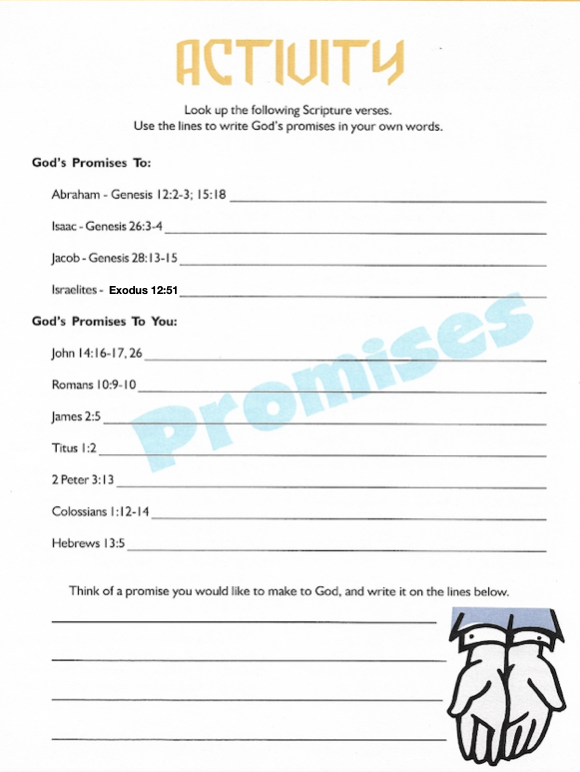
Activity- Do the Activity at this point.
Review Questions
1. What was the covenant, or promise, God made to Abraham, Isaac, and Jacob?
2. Was God breaking His promise when the Israelites were slaves in Egypt? Explain.
3. When we don't understand why things happen, does that mean God has forgotten us? Why?
4. Describe the scene as the Israelites left Egypt. How was this a fulfillment of God's promise?
5. How long are we to celebrate the night that Israel left Egypt?
6. Give examples of God's promises which have been kept.
Teacher-Directed Activity
Allow each student to draw a card from the Bible Promises box. One at a time have the students read their promise and tape it to the poster board under Fulfilled or Future.
REACH Activity
Back to the Bible: Keeping Promises
You might think that if someone deceives you, you don’t have to keep your promise to them. But that’s not how it works. Even if someone tells you a lie, you are responsible for what you say. Here’s a Biblical example: Joshua 9. The Gibeonites saw Joshua leading the Israelites into the Promised Land. They saw how the Israelites were conquering all of the inhabitants. So they pretended to live far away and came to the Israelites and asked to make a treaty so that the Israelites wouldn’t kill them. Later, when the Israelites realized they’d been deceived, it didn’t change the fact that they had promised not to kill them. (Joshua 9:20). Read the whole chapter. Then write about it in your Bible notebook. Answer these questions: Have you ever experienced something like this? Why do you think God requires you to keep your promises? What do you think about your promises not being conditional on someone else’s behavior? How can you phrase your promises so that you don’t end up making a promise you can’t keep?
Journal Jot: Keeping Your Promises
Have you ever experienced someone making you a promise that they didn’t keep? It doesn’t feel very good, does it. You were counting on that person doing what they say they would. When they don’t, you stop trusting them quite so much. If they continue to break their promises, you don’t trust them at all.
Have you ever promised someone that you would do something? Did you keep that promise? Why or why not? Write about this in your Bible notebook. Think about what you could do differently so that you don’t break your promises.
Word Study: God’s Promises
Your memory verse is stated a little differently in the various translations. Write down your memory verse from the NIrV in your Bible notebook. Then write this verse from four other translations in your Bible notebook. Look at how they are the same and how they are different. What do you learn about God’s words? Think about how important it is to carefully consider what words you speak.
Just Toolin’ Around: Being Careful About Your Words
Using a concordance, find scriptures which talk about guarding your tongue, making vows, and the words you speak. Write down ten of them on index cards in neat lettering. Then mount those index cards on colored construction paper pieces that are just a little bit bigger than the index cards. Post the verses around your house where you will see them.
Did you Know? Promises
God doesn’t take our promises lightly. He expects that if we say we will do something we do it. Look at Ecclesiastes 5:4-6. Then back up and read Ecclesiastes 5:2. It is a good thing to be very careful about your words. Copy Ecclesiastes 5:2, 4-6 into your Bible notebook in your neatest handwriting to help you remember to guard your tongue.
Stretch It Out: Egyptian History Paper
Take all of the notes you collected from the previous lesson’s REACH activities. Write a report on ancient Egyptian history. Be sure to include a bibliography with your report. Include a title page with a drawing - maybe of a pyramid. Print your paper and bind it in a report folder. Ask your parents if you can leave it on the coffee table in the living room for visitors to see.
Music Notes: Thy Word is a Lamp
This hymn is on page 190 of the CEM Hymnal.
This hymn by Michael W. Smith and Amy Grant is based on Psalm 119:105. Because God’s word is trustworthy and true, we can depend upon it to guide us faithfully. We don’t have to wonder if God will keep His promises. We don’t have to wonder if God means what He says. God does not lie; He always keeps His promises.
As you sing this song, think about things that you sometimes fear. What does the song indicate is the remedy for being afraid? Getting as close as you can to God! Does that mean that nothing bad will ever happen to you? No, but it does mean that you can trust God to work all things for your good (Romans 8:28), even if it’s not until God’s kingdom (Hebrews 11:13).
Questions?
Remember to write down any questions that you think of as you are reading your lesson, daily devotionals, or doing the REACH activities. Plan to ask your parents or your pastor these questions.
Song
"Every Promise InThe Book is Mine" is on page 15 of Kids Classics Collection.
Closing Prayer
Lead the students in prayer, thanking God for the way He kept His promises to Israel, and to us. Ask Him to teach the students to keep their promises, especially to Him.
Printable Pages