YEA Lesson Library
Serious Consequences
About This Lesson
This lesson teaches about the tenth plague on Egypt: the death of the firstborn on Passover. The student learns what this means to him and how Jesus is the Passover lamb for all who believe.
Scriptures
Exodus 11:1-10
Exodus 12:1-30
John 1:29
Romans 6:23
Ephesians 1:6-7
2 Thessalonians 1:6
Hebrews 2:2-3
Hebrews 10:30-31
1 Peter 1:17-19
Words to Know
CONSEQUENCES - the results for one's actions
DELIBERATELY - carefully planned out, on purpose
DETENTION - punishment of having to stay after school
SACRIFICE - an offering given to God
YEAST - used in bread to make it rise
The Lesson
Robert sat outside the principal's office. He was nervous and trying not to cry. He knew he was in big trouble. His teacher warned Robert about picking on the girls in his class. But, Robert didn't listen. One day he took Susan's lunch and ate it. The next day he called Betty names and made her cry. Then today Robert took his pen and wrote in Marianne's math book. Now he had to face the music!
Robert needed to learn an important lesson - our actions carry consequences.When we deliberately disobey rules, punishment will follow. A letter was sent home to Robert's parents. The principal made Robert apologize to all three girls.One day he had to buy lunch for Susan. Robert had to pay for a new math book for Marianne. And he had detention for two weeks. Robert learned his lesson and promised to stop picking on people.
Pharaoh had been like Robert - he didn't listen. Now it was time to face the consequences. God told Moses to strike the water in the Nile and it would change to blood. The very first plague God sent on Egypt was turning the Nile River into blood. Do you remember in Lesson One how Pharaoh demanded that every boy baby be thrown into the Nile River? This river was home to crocodiles and it meant certain death to these babies. God didn't forget this evil crime. Do you think God will forget a little innocent baby being killed or when a mother has her unborn baby killed?The Bible says that children are a gift from God that we should thank Him for. We should appreciate them. And we should take care of them.
Pharaoh still didn't listen to Moses and Aaron. He wouldn't let the Israelites go into the desert to worship Him with a Feast. Seven days after the Nile turned to blood, God sent a plague of frogs. Then He sent a plague of gnats and then flies.Then God sent a plague on all of the Egyptian animals, but not on one of the Israelites' animals. The next plague God sent was painful boils on the Egyptians and their animals. Pharaoh still hardened his heart and would not let God's people go. So God sent a plague of hail, then locusts. He made everything as dark as midnight without a moon or stars. After sending nine awful plagues, stubborn Pharaoh still hardened his heart and wouldn't let them go.
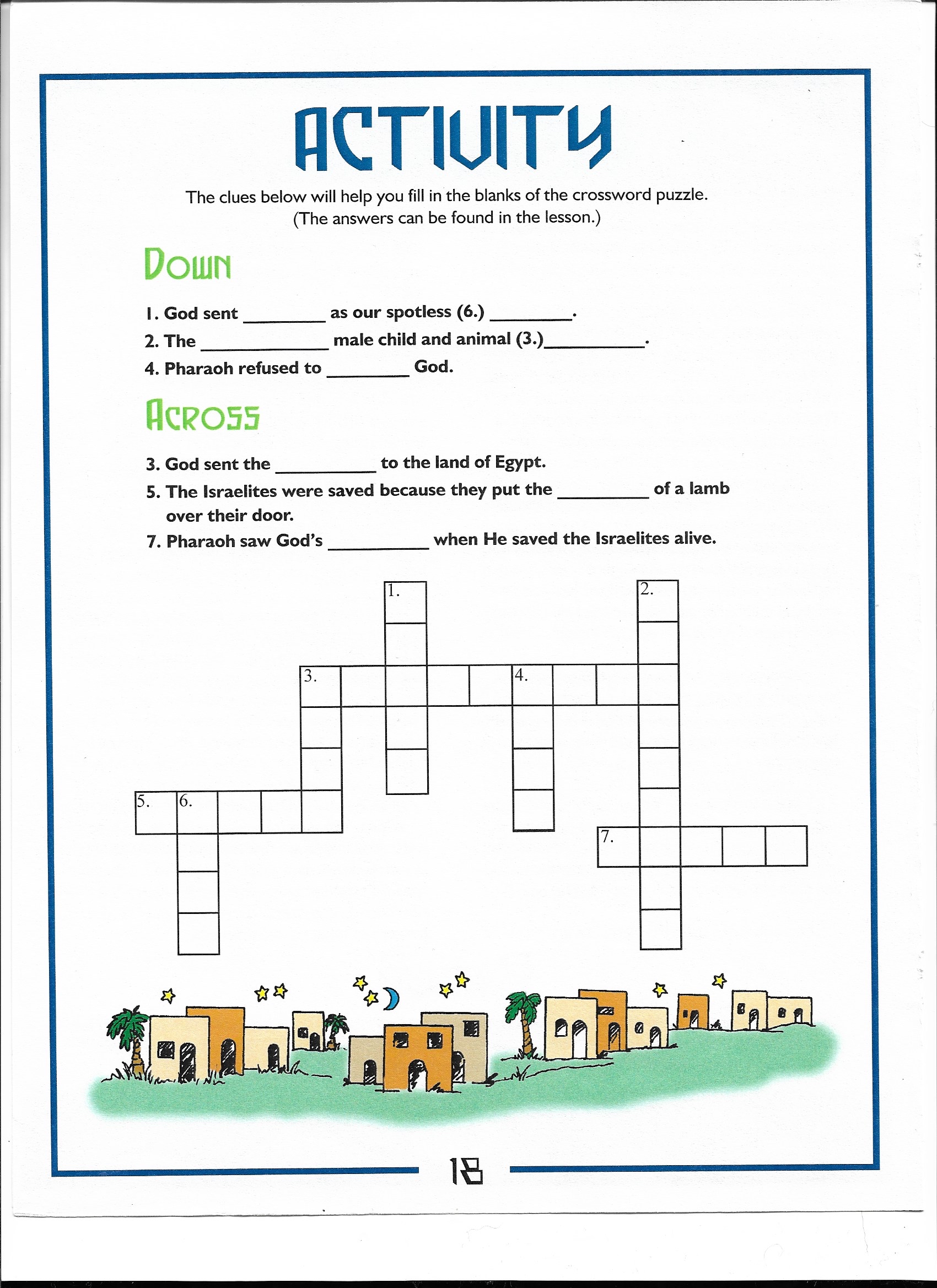
God gave Pharaoh nine chances to obey - but he refused. But God was not finished. This time God sent the most terrible judgment on all of Egypt. He sent the Destroyer into the land. Every firstborn male child and animal would die - even in the palace of Pharaoh! God had a plan to protect His people. But, they had to obey Him in order to be safe.
God was ready for the Israelites to leave Egypt. He gave instructions to Moses, and Moses told the Israelites to ask their Egyptian neighbors for clothes and costly gold and silver jewelry.The Egyptians gladly gave these things to them. There had been so many plagues. The Egyptians had grown tired of them and wanted the Israelites out of their land - now!
Moses told the Israelites to sacrifice a perfect lamb and sprinkle some of the blood over the top and on the sides of their doorways. This must have seemed like a strange thing to do. But, God's people obeyed.
What a terrible night for the Egyptians! There was crying in all of Egypt. The Destroyer had passed through. In every house without the blood of a lamb on the doorway, the firstborn animals and male child in each family were dead.
Pharaoh woke up in the night. His firstborn son was dead. He was angry and called for Moses. He said, "Get out of here! You and the Israelites, leave my people! Go. Worship the Lord, just as you have asked.”
At first, Pharaoh didn't believe in God. He even made fun of God by having his magicians try to do the same miracles Moses did. But now he saw God's power. God had saved the Israelites alive while the firstborn Egyptians died. "It is a terrible thing to fall into the hands of the living God." The consequence for not obeying God was death. But the reward for obeying is life!
A perfect lamb had to die so the Israelites could live. That lamb's blood was used to save the lives of the Israelites. This was God's plan.
God has a plan for you, too. He wants you to live with Him forever in His Kingdom. But, because of sin a Perfect Lamb had to die. That Lamb was Jesus. His blood was shed as payment for your sins. Just as the Israelites had to obey, you must obey. You must believe that Jesus died for you. You must admit that you have sinned. And, you must ask God to forgive your sins and believe that He will. Then, God will help you obey Him.
God wants us to remember this night. He told the Israelites to roast the lamb and eat it with bread made without yeast. God said to eat this special Passover meal every year forever! It is a reminder to Israelites and to Christians of God’s power and what He did that night.
Student Prayer
Dear Father in Heaven,
Help me learn to obey you so I will not suffer the consequences.Thank you for sending your Son as the Lamb to take away my sins. May I remember what you did each time we celebrate the Passover.
In Jesus' name.
Amen.
Daily Devotions
Sunday - Romans 6:23
Monday - 2 Thessalonians 1:6
Tuesday - Hebrews 2:2-3
Wednesday - Ephesians 1:6-7
Thursday - 1 Peter 1:18-19
Friday - Exodus 12:12-13
Saturday- John 1:29
Objectives
At the end of this lesson, the students will be able to: I.
1. Define what "consequences" are.
2. Describe the most terrible judgment God sent on Egypt.
3. Tell how the Israelites were able to be saved from the judgment.
4. Name the Spotless Lamb of God and tell how He saves us.
Topics & Themes
Aaron
Abortion
Blood
Consequences of Sin
Angel, Death
Egypt
Firstborn
God’s Judgment
God’s Law
God’s Plan
Jesus, Lamb of God
Jesus, Savior
Lambs
Moses
Murder
Obedience
Passover
Pharaoh
Plagues
Materials Needed
Bible, YEAStudents' and Teacher's books, attendance and memory verse chart, stickers, music player and CD or cassette, songbook, butcher's paper, crayons or markers, paper
Preparation
Today, fewer and fewer parents set actual boundaries and rules for their children to follow. The desire to be a buddy to their child has led parents to renege on this most important responsibility. Children need boundaries in order to feel secure. When these boundaries are crossed and guidelines are disregarded, appropriate consequences should be administered. God set boundaries for us in Scripture. There are advantages for following God's guidance.
In today's lesson God's power is demonstrated in an awesome way. The death of the firstborn, and the saving of the Israelites emphasize the importance of obedience to God. He could have immobilized the forces of Egypt and set His people free. God was teaching both the Egyptians and Israelites that He was the one true God. This was a foreshadowing of Jesus' death as the Spotless Lamb of God.
Before you come to class, write one of the following Scripture passages, along with a set of the questions, on three separate sheets of paper: Joshua 6:1-5, 20; I Samuel 17:45-49; Daniel 6: 16-22. Describe God's power - I) Who did He help? 2) What did He do? 3)Why did God do it? (You will need butcher's paper, markers or crayons available for the students choosing to draw their scene.)
How to Teach This Lesson
Activity - Have your class number off - one, two, three, one, two, three. Have all the ones sit together in one part of the room, all the twos in another part, and all the threes in still another part of the room. Give each group a sheet of paper with the questions and the Scripture verses written on it. The students should first read the portion of Scripture, then answer the questions listed. They can then choose to draw a picture depicting God's show of power, act out the incident, or elect someone to tell the class about their Bible passage. Be aware of time constraints. When they are finished, bring all the groups together again. Ask each group to present their project. Explain that in today’s lesson you will see God's power demonstrated to both Egypt and the Israelites.
Serious - When something is serious, it is important, not a joking matter, and is sometimes even dangerous. In the story about Robert in your Students' Book, he thought it was funny to pick on the girls in his class. Ask: Why do you think he was nervous as he sat in the principal's office? What made his actions serious instead of funny? When you deliberately disobey it is no longer funny, it becomes serious (Deuteronomy 11:26-28).
Consequences - Whether you do something good or bad, they all have consequences. Consequences are the results of your actions. Ask: What were the consequences of Pharaoh refusing to obey God? (Discuss.) If you touch a hot stove, what will be the consequences? What could be the consequences if you cheat on a test?
Sacrifice - After repeated warnings and miracles, Pharaoh still refused to obey God.The final judgement on Egypt was the worst of all. The firstborn male child and animal in each household would die. But, because of His love, God provided a way for those who loved Him to be spared. (Discuss the lamb and the blood over the door. Tie in the first and the last plague to Pharaoh killing babies in the Nile River. Relate it to abortion today.) Ask: What do you think the consequences will be on our nations?
God's Perfect Lamb- At His baptism in the Jordan River, John called Jesus"... the Lamb of God, which taketh away the sin of the world" (John 1:29). Ask: In what ways was Jesus like the lamb that was sacrificed by the Israelites in Egypt? Because of God's love for us, He sent His perfect Son to die for our sin (Romans 5:8-9). Jesus became our sacrifice. Ask: What will be the consequences if you turn your back on what Jesus did for you? What is the consequence if you trust Him as your Savior?
God's Power - God demonstrated His power that night to both the Egyptians and to the Israelites. Pharaoh witnessed God's power with the death of his firstborn son, and the deaths in every family in Egypt. They also saw how God saved His people alive. Pharaoh was now ready to let the Israelites go.
The Passover - Passover Day started with sacrificing a lamb, putting the blood on the door posts and lintels of their houses, roasting the lamb and eating it with unleavened bread. The Destroyer passed over the houses where he saw the blood. Passover ended with the Israelites leaving Egypt - just as God had promised! Ask: Why do you think God tells us to celebrate the Passover every year? Why do we celebrate the Night to be Much Observed? (Exodus 12:6; 12:22; 12:37; 12:41-42)
Review Questions
1. Tell what consequences are, give an example from everyday life.
2. Why were the consequences to Pharaoh and Egypt so serious?
3. What was God's plan for saving the firstborn of the Israelite families?
4. Who was God's Perfect Lamb?
5. What would the Egyptians remember about this?
6. How did God tell us to remember this night?
7. Why do you think theIsraelites ate flat bread with their meal?
REACH Activity
Back to the Bible: Complete Obedience
The Bible is full of stories which demonstrate the need to obey God’s commands completely - even when those commandments don’t make sense to us in our human thinking. The Israelites might have wondered why they had to paint the sides of their doorways and the lintels with blood from a year-old lamb (Exodus 12:6-7). It would have been a powerful and extremely painful lesson for those who did not obey: their firstborn son would have died that night!
Another example is Naaman. He had leprosy. The whole story is found in 2 Kings 5 (and is a very interesting story)! Naaman came to Elisha to be healed by God of his leprosy. Elisha didn’t even come out to meet Naaman; he just told his servant to relay the message! Naaman was supposed to go wash in the Jordan River seven times. Naaman was angry! He’d come all this way! For what?! To go wash in a muddy river?! One of his servants pointed out that this was not a hard thing to do; just do it. When Naaman obeyed, he was cleansed of the leprosy. But it didn’t happen after the first time, or the second, or the third. Naaman had to plunge into the Jordan River seven times, like God said, for the healing to occur.
There are some other incredible pieces to this story, but think about just this: When God tells you to do something, He means it. Observe the Sabbath from Friday night to Saturday night. Don’t cut off an hour on either end! Obey God completely!
In your Bible notebook, write down three examples of things you know God wants you to do. Then resolve to do them - completely!
Journal Jot: Serious Consequences
We humans like to test the boundaries. How close can we get to the edge without falling over? How much can we pester our younger sister before Mom punishes us? How many times can we pull the dog’s tail before he bites us? Why do we do that?! Romans 8:7 tells us the our human nature is hostile to God. We act as if God is the enemy. We might do what He says, kind of go through the motions, but our heart is not in it.
But! Once God changes our heart, then we want to obey God. We still fight against our human desires and wishes, but we have the power of the Holy Spirit working with us to do what is right.
Are there things in your life that you know you should be doing or should not be doing? Write about these in your Bible notebook. Then write a prayer to God, asking for His help to overcome the wrong actions.
Word Study: kurios
Look at your memory verse. What word would you look up? What word seems to be most important? Maybe you are thinking “judge” or “terrible” or “living.” What about “Lord?” Here the Greek word for “Lord” is kurios, which means “supreme in authority.” What the author of Hebrews is telling his readers is that this person who judges His people has the absolute authority to do so. The Lord is the supreme ruler. He gets to decide what the laws are. He gets to apply consequences. He is the highest authority - and we are so incredibly blessed that our Lord is good and merciful and just! There would be nothing we could do if God were not good - because He has absolutely power and authority. There is no other! But He is good!
After you write this word, its meaning, and scripture reference in your Bible notebook, take a few minutes to kneel before God and thank Him for His goodness!
Just Toolin’ Around: Ancient Egyptian History
Using a Bible encyclopedia, study Bibles, books on Egyptian history, and/or reputable websites, research Egyptian history. Make notes of places and dates of events. Be sure to write down the source of the information you find so that you can give credit to the source. You’ll use all of this information in the next lesson to compose a written report on Egyptian history.
Did you Know? Firstborn
Archaeological evidence confirms widespread death in Egypt at the time of the Passover. Some scholars have attributed it to bubonic plague. There’s a problem with this theory. Do you know what it is? Why would bubonic plague only affect the firstborn? It wouldn’t. That theory doesn’t make good sense. (Source: NIV Archaelogical Study Bible, 2005, p. 105.)
This is a good example of the need to think critically about what the “experts” say. Just because they are “experts” doesn’t mean they are always right. Can you think of another example when the experts proposed a theory that turned out to be false? Write about this in your Bible notebook. Talk about it with your family.
Stretch It Out: Timeline
Using the information you have accumulated in “Just Toolin’ Around,” construct a timeline of ancient Egyptian history. You can use the timeline as an illustration for your written report that you do as part of the next lesson’s REACH activities.
Music Notes: Nothing But the Blood
This hymn is on page 114 of the CEM Hymnal.
The words and music for “Nothing But the Blood” were both written by Robert Lowry, a Baptist pastor, who lived from 1826-1899. Published in 1876, it had a scripture attached to it: “Without shedding of blood there is no remission. Hebrews 9:22” - and two additional verses that most hymnals omit:
Now by this I’ll overcome - Nothing but the blood of Jesus,
Now by this I’ll reach my home - Nothing but the blood of Jesus.
Glory! Glory! This I sing - Nothing but the blood of Jesus.
All my praise for this I bring - Nothing but the blood of Jesus.
As you sing this hymn, think about God’s rescue of His people from Egypt because of the blood of the lamb. There was nothing else that would save the firstborn from death - just as there is nothing else that will save us from dying eternally because of our sins, nothing but the blood of Jesus. (Source: Then Sings My Soul, Robert Morgan, 2004, pgs. 162-163.)
Questions?
Remember to write down any questions that you think of as you are reading your lesson, daily devotionals, or doing the REACH activities. Plan to ask your parents or your pastor these questions.
Song
"I Will Sing Of The Mercies Of The Lord Forever" is on page 17 of Kids Classics Collection.
Closing Prayer
Have the students stand in a circle holding hands. Ask if one of them would like to lead in prayer, thanking God for saving the Israelites from death that Passover night. Ask someone else to thank God for sending Jesus as our Lamb of God. Close the prayer by asking God to help them remember whatGod did each Passover.
Printable Pages