YEA Lesson Library
Don’t Give Up
About This Lesson
The lesson teaches about the plagues on Egypt and uses Moses’ perseverance in following God’s directions as an object lesson for the student to emulate.
Scriptures
Exodus 6:6-8
Exodus 7:1-25
Exodus 8:1-32
Exodus 9:1-35
Exodus 10:1-29
Deuteronomy 11:1-3
1 Thessalonians 5:24
James 1:12
Words to Know
IMPRESSED- strongly affected
PLAGUE - to torment with a calamity, like sickness
The Lesson
Scott loved football! Now he had a chance to play on a real team. There was practice every day after school. Running laps was hot, hard work. The equipment was hot and heavy. Scott often came home sore and bruised. Sometimes he wondered if all the work was worth it. But he didn't give up!
God told Moses to go to Pharaoh and say, “God said, ‘Let my people go into the wilderness to worship me.’” Moses didn’t want to do that. He made excuses. He told God that he couldn’t speak very well. He said that Pharaoh wouldn’t listen to him. God promised to be with Moses. He sent Moses’ brother, Aaron, to speak for him. God took away all his excuses.
Moses and Aaron stood before Pharaoh and said, “God said, ‘Let my people go into the wilderness to worship me.’” But Pharaoh refused to obey God. He didn’t believe in God. Instead of letting the Israelites go, Pharaoh made life harder for them. He demanded they make more bricks and made them find their own straw to do it. Even his own people were angry with Moses.
Moses and Aaron went to Pharaoh again - this time with a miracle! God told Moses to throw down his rod before Pharaoh. When he did, it turned into a snake. But, Pharaoh was not impressed. His magicians were able to do the same trick. Then to show God's power, Moses' snake ate up all the other snakes. It was no trick!
The next day God sent Moses to Pharaoh again - this time with a warning and a plague! Moses said, "Let the Israelites go or your water will turn to blood." Again, Pharaoh refused. When Moses held his rod over the Nile River, all the water in the river turned to blood.The water in the lakes turned to blood. There was no water anywhere for the people or animals to drink. But Pharaoh still refused to let the people go.
Again God sent Moses to Pharaoh. This time He sent a plague of frogs to the land of Egypt. They were in their beds and their food. They were in the ovens and the cupboards. Frogs were everywhere!
Pharaoh wanted the frogs gone. He said, "I'll let the people go if you will get rid of the frogs." Moses prayed to God and the frogs died. Now there were piles of dead frogs everywhere. Pharaoh changed his mind. He refused to let the people go.
God sent Moses to Pharaoh again. Moses must have thought, "What's the use? He won’t listen to me." But, the next plague was worse. God told Moses to hit the ground with his rod, and the dust turned into lice! Itchy, crawly, biting bugs! People scratched. Animals scratched. But, still Pharaoh wouldn't listen.
God sent flies to Egypt - thousands and thousands of flies! They were in all the houses. They were even in the palace. But there were no flies where the Israelites lived. God protected His people. Pharaoh swatted at the flies and said he would let the people go. But he lied!
Then the animals got very sick and started dying. Next the people and animals got big sores all over their bodies. But Pharaoh’s heart was still hard against God. Hail was the next plague God sent. It beat on the houses, plants, and animals. Fire mixed with the hail. Pharaoh said, “That’s enough! I’ll let you go.” But he lied.
God wanted Pharaoh to know that He had sent the plagues on Egypt. This time He sent locusts. They were like big, fat grasshoppers! They ate everything green in the gardens and trees. There was nothing left to eat. Even the houses were filled with the hopping critters! Pharaoh's heart was hardened again.
The ninth plague was the worst of all. God told Moses to hold his rod toward the heavens. Egypt became dark. People couldn't even see their hands in front of their faces. There was no light in the houses or anywhere for three days. It was terrible! Pharaoh got mad and threatened to kill Moses.
The job God set before Moses wasn’t easy. His own people had gotten mad at him. The Egyptians had gotten mad at him. Pharaoh wouldn't listen to him. But Moses didn't give up. He knew God was in control, and God wasn't done yet. We will read about an even worse plague to come in our next lesson.
Student Prayer
Dear Heavenly Father,
Help me not be stubborn like Pharaoh, but listen and obey you - even when the going gets tough. I know you are in control of everything. And you know what is best for me.
In Jesus' name.
Amen.
Daily Devotions
Sunday - Exodus 6:6-8
Monday - Exodus 7:2-4
Tuesday - Exodus 7:17-18
Wednesday - Exodus 8:5-6
Thursday - Exodus 8:16-18
Friday - 1 Thessalonians 5:24
Saturday - Deuteronomy 11:1-3
Objectives
At the end of this lesson the students will be able to:
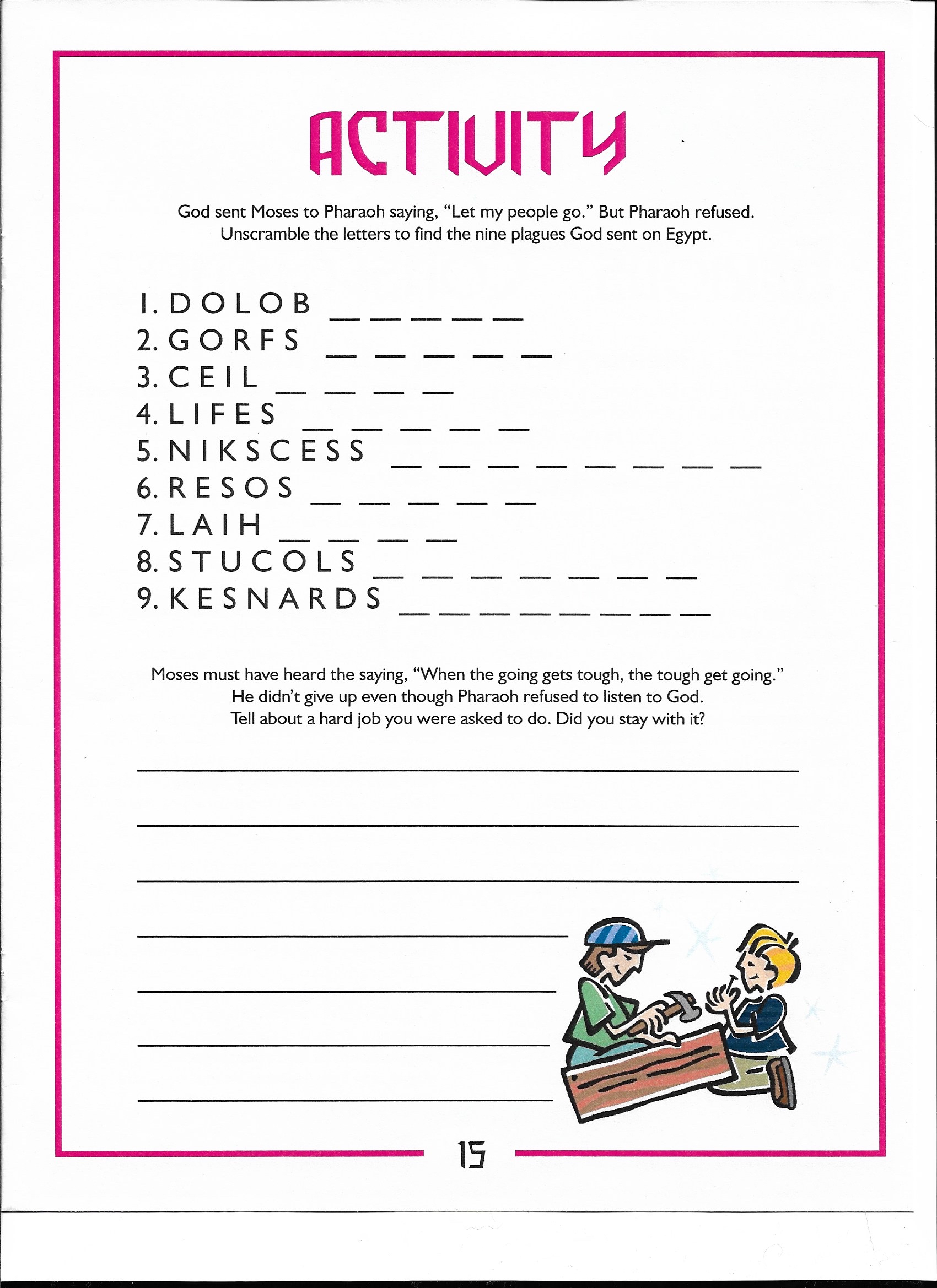
1. Name the first nine plagues mentioned in this lesson.
2. Tell about some challenges Moses faced.
3. Use their memory verse to tell why they shouldn't give up.
Topics & Themes
Aaron
Egypt
Moses
Perseverance
Pharaoh
Plagues
Reward
Materials Needed
Bible, YEA Students' and Teacher's books, attendance and memory verse chart, stickers, music player and CD or tape, paper bag, magazine pictures or sport cards, drawing paper, crayons or colored markers
Preparation
In today's society, where most children are given everything they want, very few learn the value of working and perseverance. They grow up thinking everything in life will come to them easily. That is not the case in the real world. Some things come to us only by hard work and "sticking to it." Today's lesson shows that Moses had to endure some pretty heavy opposition, but he persevered in obedience to God. And when "God is for us, who can be against us?" (Romans 8:31).
Collect magazine pictures or trading cards of people in interesting and challenging professions, like a football player, lawyer, ballerina, figure skater, astronaut, etc. Place the pictures in a paper bag You will need one picture for each student).
How to Teach This Lesson
Ask each student to reach into the bag and pull out a picture. One at a time, have the kids identify the profession of the person. Ask: How do you think this person got to be (an astronaut)? What are some problems they may have faced?
Standing Before Pharaoh - (Read Esther 4:11 . Discuss how going before a king or Pharaoh without being summoned could be dangerous. Explain that Moses had been brought up in the palace and knew the customs. God had prepared him for this challenge.
God's Demand - "Let my people go.” Ask: Why do you think Moses was reluctant to make such a demand of Pharaoh? (Allow the kids to reason this out for themselves.) How did Pharaoh respond? ("Who is this God? Why should I obey him.")
Israel Complains - Instead of letting the Israelites go, Pharaoh made life harder for them. Ask: What did he do that made life harder for the Israelites? Discuss why the Israelites got mad at Moses.
God In Control - Ask the students to describe the miracle Moses did to show God's power to Pharaoh. (Rod turned to snake.) Did this convince Pharaoh? What did he think it was? What was the outcome?
The Plagues - (As these are named, write them on a chalkboard or newsprint pad.) Ask: What was the first plague that affected all the Egyptians and their animals? Discuss what life would be like where all the water was turned to blood (Exodus 7:2l). Have the students name the next three plagues (Frogs, lice, flies). Ask: How were the Israelites affected by these plagues? Name the next four plagues. Discuss what it must have been like in Egypt after all these plagues. The ninth plague was worst plague so far. Ask the students to describe it. Ask: What do you think kept Moses going back when Pharaoh kept refusing to listen?
When The Going Gets Tough - Talk about the example of Scott in the Student's book. Ask the students to give examples of times when they were faced with something that was hard to do.
Ask: Was it worth all the hard work? Why? There are reward in life for “sticking with it.” Those rewards might be making the team, earning enough money to buy the new bike, getting an A on your report card, etc. God also promises rewards to those who keep going when times are hard. Ask: What does your memory verse say about God's reward?
Review Questions
1. What were the nine plagues that we learned in today's lesson?
2. Why do you think the ninth was the worst so far?
3. Why was it such a challenge for Moses to make demands of Pharaoh?
4. Why do you think Moses kept going to Pharaoh?
5. Why is it worth it to stick to the job?
Teacher-Directed Activity
Give each student a sheet of drawing paper. Tell them to think of a time when they were tempted to give up and quit trying. Have them draw a poster that will remind them that God will be with them - Don’t Give Up!
REACH Activity
Back to the Bible: Perseverance
In the Revelation letters to the seven churches of Asia, these churches are exhorted to “endure to the end.” What does that mean? It means that, if God has given you a job to do, do it until it’s done or you can’t do it anymore. For most Christians, that means to live as a Christian, following God’s laws regardless of the pressure and persecution you experience. It’s a really interesting study to look up all the instances of where the word “endure” is found in the Bible. Find out the kinds of instances it is used. For instance, God’s love endures forever. It never ends. Make notes about your findings. Then write an essay about persevering and enduring. Share it with your family. Or take your favorite verse about enduring/persevering and make a greeting card to encourage someone who is going through something very difficult.
Journal Jot: Perspective
Have you ever thought, “I wonder what Pharaoh was thinking”? Now’s your opportunity to write a series of journal entries based on Exodus 7—10, from Pharaoh’s perspective. Remember, this is the ruler of one of the most powerful countries in the world. He thought he could do anything. His culture told him that he was a god. He was ambitious and wanted to build great cities. He thought he got to make up the rules for everyone to follow. Who was going to stop him? He was wealthy. He had a lot of power. He wanted to do what he wanted to do. With all of this in mind, write a series of journal entries - possible entries - that Pharaoh might have written.
Word Study: hupomenō
Perseveres, keeps on going, continues on, endures to the end - all of these words indicate a determination to work very hard to reach a goal. This particular word means “to endure or sustain a load of miseries, adversities, persecutions or provocations in faith and patience.” This means that the person must continue fighting to reach the goal; it’s not going to be easy.
Write this word in your Bible notebook, with its definition and scripture reference.
Just Toolin’ Around: Egypt
We have an idea that Egypt is a barren desert with a pyramid or sphinx rising out of the sands. But the Nile River brings much needed water to the region. People and animals cannot live without water. We know they were growing crops because the locusts ate the crops and the hail broke down the trees. Incidentally, trees need a lot of water. So find some photos online. Create a map of Egypt with photo inserts at various locations of what it actually looks like. Print a copy of your map and place it in your Bible notebook.
Did you Know? Egyptian gods and goddesses
Egyptian culture included the worship of many gods and goddesses. Oftentimes these pagan deities were associated with animals or nature. For instance, the Egyptians worshipped a frog god and a cattle god. The ninth plague of three days of darkness “proved that as the Creator of sunlight He was more powerful than the Egyptian sun-god, Amon-Ra.” The plagues demonstrated unequivocally that God is more powerful than any manmade, so-called god. (Source: The Victor Journey Though the Bible, V. Gilbert Beers, 1996, p. 59.)
Stretch It Out: Plagues in Order
Create a mobile of the plagues. Choose shapes appropriate for each plague, i.e. the first plague shape could be a red water drop, the second plague shape could be a frog. Write the plague on the shape, and the scripture reference, if you wish. Hang your shapes from a hanger. For the first plague use a short string. For each successive plague, use a longer string. When you are finished, you will have a visual reminder of the order of the plagues on Egypt.
Music Notes: This is My Father’s World
This hymn is on page 150 of the CEM Hymnal.
When you consider that God is the Creator of everything, it is crazy to consider something of His creation to be a god - like a frog or a bull or a snake or the Sun!! Why is it that people worship the Creation instead of the Creator?
Maltbie D. Babcock was the author of this hymn text. He was a recognized Presbyterian minister as well as a skilled athlete. He “especially enjoyed his early morning walks. He would always comment, ‘I’m going out to see my Father’s world.’ Since Dr. Babcock was an accomplished performer on the organ, the piano, and the violin, we can see why nature seemed to him to be ‘the music of the spheres.’” (Source: Amazing Grace, Kenneth Osbeck, 1990, p. 137.)
As you sing this song, pick out the line that you like the most and write it down in your Bible notebook.
Questions?
Remember to write down any questions that you think of as you are reading your lesson, daily devotionals, or doing the REACH activities. Plan to ask your parents or your pastor these questions.
Song
"My God Is So Big" is on page 14 of Kids Classics Collection.
Closing Prayer
Lead the students in prayer, asking God to help them obey Him and keep trying, even when it is hard.
Printable Pages