YEA Lesson Library
An Angry Attack
About This Lesson
This lesson teaches about Moses’ anger at the mistreatment of the Israelites, causing him to murder an Egyptian. The student learns that usually there’s a better response than anger to a situation.
Scriptures
Exodus 2:11-22
Psalm 37:7-11
Psalm 145:8-9
Proverbs 15:1-3
Proverbs 15:18
Proverbs 16:32
Proverbs 22:24-25
Ecclesiastes 7:9
Matthew 5:21-22
Ephesians 4:26
Ephesians 4:30-31
Hebrews 11:24-26
Words to Know
ERUPTED - to explode, to burst out
LASH OUT - to speak angrily, to strike out violently
LUXURY - enjoying the best, most expensive things
QUOTA - the specific number assigned
The Lesson
The students in Mrs. Murphy's class were watching a science film. Hawaii’s Kilauea volcano erupted. Red hot lava exploded from the top of the volcano. It was a fiery display. The steaming river of ooze burned trees and grass and threatened to wipe out houses and even towns.The destructive power of the volcano left black scars across the land.
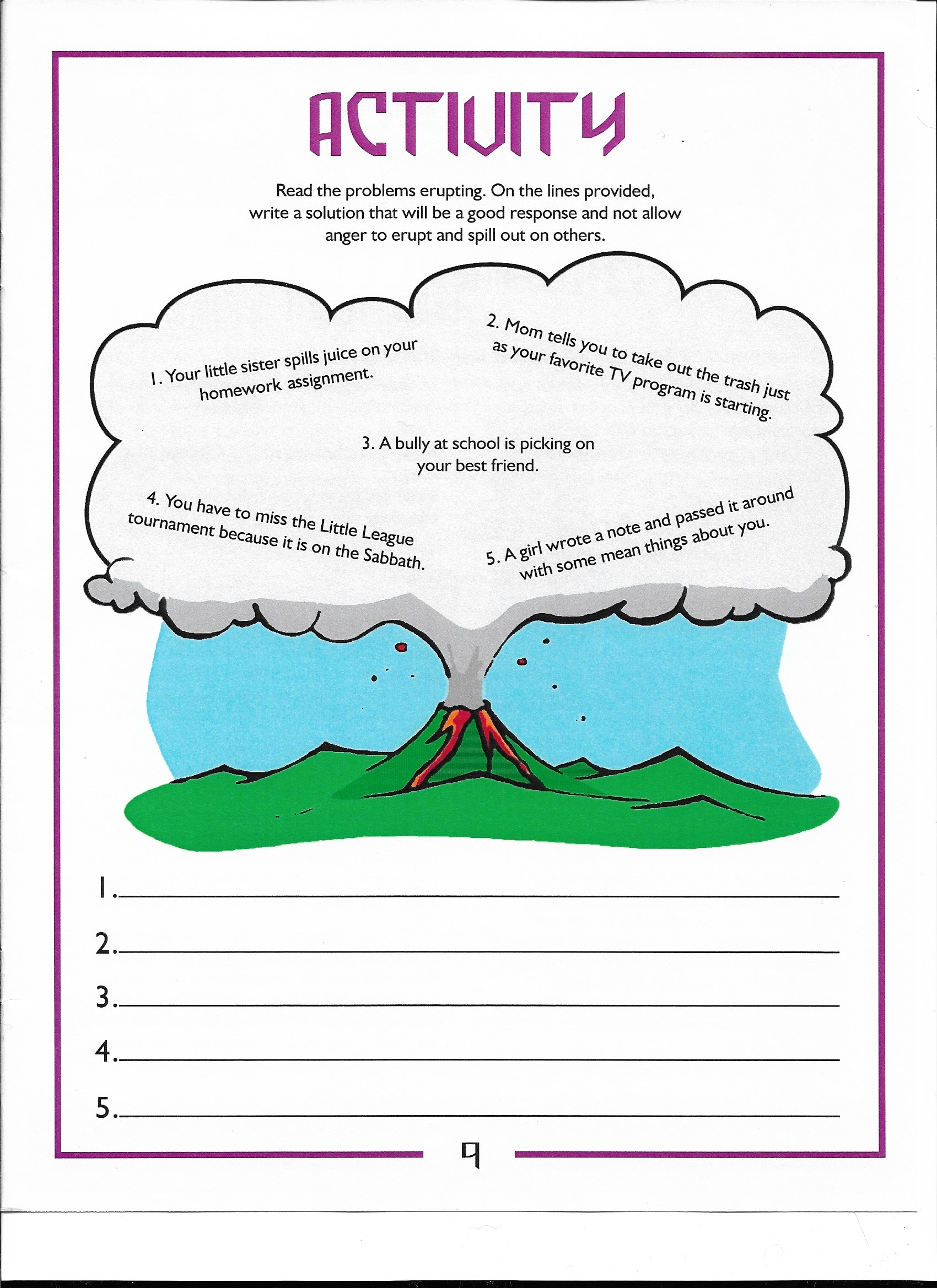
Anger is much like a volcano. It often explodes in a display of emotion. It oozes into our homes and affects our families. Its hateful words burn as we lash out at others. Anger is destructive. It hurts the one who is angry and the one to whom the anger is directed. And anger leaves ugly scars.
Moses grew up in Pharaoh's palace. Pharaoh's daughter, a princess, found him as a baby. She took him home and raised him as her own son. He had the finest education. He became well-known in Egypt. Moses, the man, looked and sounded like an Egyptian. But his heart was not Egyptian. Moses knew that his real people were Israelite slaves who were suffering.
The taskmasters were cruel. They required the slaves to make bricks. Then they took away the materials needed to make the bricks. They forced the Israelites to find their own straw needed to make bricks. And when the quota of bricks was not met on time, the taskmasters beat the Israelites with a whip.
One day, Moses decided to leave the safety and luxury of the palace. He went out to visit his own people, the Israelites. He saw the terrible conditions they were under. During his visit he saw an Egyptian knock a Hebrew to the ground - one of his own Hebrew brothers! “How could he do such a thing to another human?” Moses thought. He looked around to see if anyone was watching. Anger was boiling in Moses' heart! He killed the Egyptian and buried his body in the sand.
The next day Moses saw two Israelites arguing. Moses tried to break up the fight. They questioned Moses’ authority, “Who made you a rule and judge over us?” Then they let Moses know that they saw him kill the Egyptian. Moses’ anger and the ugly scar it left had become known.
Pharaoh heard what had happened. Now his anger began to spill out. "How could Moses turn his back on all l've done for him?" Pharaoh was so angry, he wanted to kill Moses!
Moses ran away from Pharaoh, the Egyptian palace, its riches, and the fame. Anger had left ugly scars on Moses, on Egypt, and on the Israelites.
When you are angry, do you explode like the Kilauea volcano? Do you erupt with angry words? Do those angry words burn and hurt the feelings of others? Does your anger spread to others like the hot lava?
Once a volcano erupts, there is no stopping the destruction. And, if you let your anger explode, it will also do a lot of damage.The solution is not to let anger explode!
Your memory verse says, “A man who is patient calms things down." It says in Ephesians, "Don't give the devil a chance . . . Get rid of all hard feelings, anger and rage." Replace anger with forgiveness. Let God turn that anger into patience and kindness. You'll be surprised how things will calm down!
People like friends who are kind, helpful, patient, and happy. Do you want lots of friends? Think about this when you become angry and put a smile on your face. Ask God to help you be a loving, forgiving, and kind friend.
The easiest place to lose your temper is in your own home. Your Mom and Dad have done more for you than anyone else. Speaking kindly to your siblings won't hurt your tongue. And remember anger leaves ugly scars. Be kind, for everyone you meet is fighting a hard battle. God loves them too.
Student Prayer
Dear Father in Heaven,
You made volcanos, with all of their power. You also made me. But, you don’t want me to blow my top like a volcano. Help me replace my anger with forgiveness. Give me patience, and kindness instead of anger.
In Jesus' name I pray.
Amen.
Daily Devotions
Sunday - Psalm 145:8-9
Monday - Proverbs 15:1-3
Tuesday - Proverbs 16:32
Wednesday - Ecclesiastes 7:9
Thursday - Ephesians 4:30-31
Friday - Proverbs 22:24-25
Saturday - Matthew 5:21-22
Objectives
At the end of this lesson, the students will be able to:
1. Describe how anger is like a volcano.
2. Tell what caused Moses' anger to erupt.
3. Explain how Moses killing the Egyptian caused the Israelites and Pharaoh to react.
4. Tell how God wants them to deal with anger.
Topics & Themes
Anger
Egypt
Forgiveness
Israelites
Kindness
Moses
Murder
Patience
Pharaoh
Pharaoh’s daughter
Slaves
Suffering
Materials Needed
Bible,YEA Students' and Teacher's books, attendance and memory verse chart, stickers, music player and CD or cassette, songbook, bottle with a cork stopper, vinegar, baking soda, plastic tub, towels
Preparation
The junior aged child is interested in fairness. But, they have lived long enough to be aware that life is not always fair. And when faced with circumstances that do not seem fair, they can be quite passionate. They often feel helpless to do anything physically about their problems, and instead, internalize and become angry. In today's lesson, Moses witnessed the unfair treatment of his fellow Israelite by a cruel taskmaster. He became angry, and his anger controlled his actions. The resulting eruption took the life of the Egyptian, spilled over onto his fellow Israelites, caused Pharaoh to also erupt in anger, and left ugly scars on everyone
involved. The goal of this lesson is to teach the students how to STOP ANGER and allow God to fill them with forgiveness, patience, and kindness.
For the opening object lesson, you will need a plastic tub, a bottle with a cork stopper, vinegar, baking soda, and towels to clean up spills. Place the bottle inside the plastic tub to catch the mixture as it bubbles out. Fill the bottle a quarter of the way with vinegar. Add 1⁄2 to I teaspoon of baking soda. Cover quickly (but not too tightly) with the cork. Keep the bottle in an upright position. As the chemicals react, they will build up pressure which will pop the cork. Keep students at a distance to protect them from the cork. (Practice this at home.)
Dramatic pictures of volcanos can be found in magazines, like National Geographic, or on the internet. These will add interest to your lesson.
How to Teach This Lesson
What Happens Under Pressure? - Pretend the ingredients inside the bottle are circumstances such as those listed in the Students' Book Activity. When you mix these ingredients together and allow them to build up pressure, what do you think will happen? (Wait long enough for the cork to pop and the liquid to run over.) If we didn't have the plastic tub, the liquid would spew out of the bottle, onto the table. It would make a mess.
Volcanic Action - Under the surface of the earth red hot magma begins to rise and collect in storage regions, much like the substance in the bottle. Pressure builds in these storage regions from gas and steam. Finally the magma (hot lava) looks for a way to escape. Sometimes it explodes, blowing off the top of a mountain and sending ash, rock, and hot lava high into the air. Other times the lava escapes silently through vents already present. When a volcano erupts, people and property are put in danger. The explosion of the hot ash or lava leaves its mark on the landscape. Lava turns forests into charred skeletons. Ash covered trees and shrubs look like ghosts. Houses and even towns can be swallowed up by fast moving lava flows.
Anger's Explosive Action - We witnessed what happens when pressure built up inside the bottle. The pressure caused it to blow its top! The liquid inside bubbled up and spilled out into the tub. If we weren't careful, the cork could have hurt someone in class. The liquid could have made a mess on the table and even damaged it. This is what happens when anger explodes. Ask: When Moses saw the Egyptian beating an Israelite slave, how did he react? His anger hurt someone else - he killed the Egyptian.
Anger's Effect on Others - Like hot lava creeping slowly down a mountain, anger leaves its ugly scars on everyone in its path. Moses thought he got away with murder. But there were witnesses. Ask: How did the Israelites react when Moses tried to break up a fight between them? They were angry! They questioned his authority. Moses didn’t control his anger; it led to murder. So who was he to correct them?! Later Pharaoh heard about Moses’ anger and subsequent murder. Ask: What was Pharaoh’s reaction?
Stop The Explosion - In order for the bottle or a volcano to explode there must be pressure inside. Anger explodes in the same way. Pressure from bad thoughts builds up inside. (Ask the students to give an example where bad thoughts build up to an angry explosion.) Ask: What if there were no pressure inside the bottle, do you think it would explode? How can we prevent our bad thoughts from exploding in anger? (Get rid of the bad thoughts - Matthew 12:34-35; Ephesians 4:29-3 I.) God wants to put His thoughts into your heart (Galatians 5:22-25).
Review Questions
1. Name some ways that anger is like a volcano.
2. Why did Moses get angry with the Egyptian?
3. Who else was affected by Moses' anger? What happened?
4. Name some things that happen when you explode in anger.
5. What does God want us to do with our anger?
6. What should we have in our hearts to replace anger?
Teacher-Directed Activity
With the students’ help, repeat the opening activity. This time fill the bottle with water and vinegar (no baking soda). Put the cork on and wait a few minutes to see what happens. Explain that the water is like putting God's thoughts in our hearts. When we fill our hearts with God's thoughts, we will not explode in anger.
REACH Activity
Back to the Bible: Anger
Mark 3:5 relates that Jesus was angry. We also know that Jesus never sinned (Hebrews 4:15). So is there a situation when you could be angry and it not be wrong? Ephesians 4:26 says, “Be angry and sin not.” Look up a couple of the different stories about anger. Look up the word for “angry” or “anger.” See if there are different kinds of anger. Write about what you find.
Journal Jot: Anger
Have you ever gotten really, really angry at someone? Why? Did they deserve your anger? How did you handle your anger? Have you resolved the problem? Write about this in your Bible notebook.
Word Study: calms
This is another instance when looking up a word in various translations can give you a pretty good idea about the meaning - if you don’t want to look it up in a lexicon. Using a Bible app (or actually use multiple translations), look up Proverbs 15:18. What is the word that is used in place of “calms” in the various versions? Write it in your Bible notebook.
Just Toolin’ Around: Anger
The Bible has a lot to say about anger. Look up anger in a concordance and write down some of the verse that you find.
Did you Know? Moses’ Education
“Stephen, in his address to the Sanhedrin (Acts 7:22), asserted that Moses was not only instructed in the science and learning of the Egyptians but also was endowed with oratorical ability and distinctive leadership qualities. The court of Egypt provided educational facilities for royal heirs or tributary princes from city-states of the Syro-Palestinian territory subject to the Egyptian rulers. Consequently Moses may have had classmates from as far north as the Euphrates River in his educational experiences in the Egyptian court.” (Source: NIV Archaelogical Study Bible, 2005, p. 88.)
Stretch It Out: The Far-Reaching Effects of Anger
Once I decided to show my children how anger has far-reaching effects that you don’t even realize. I put an egg on the island in the kitchen. Then, with my flat hand, I hit it - hard. The egg went everywhere! I was actually shocked. I thought it would make a big mess, but it was bigger than I had anticipated. It was all over them, all over me, all over the kitchen. It shot backwards all over the stove and forwards all over the dining room floor. I spent the next hour cleaning up bits of egg white and yolk from all over my kitchen. And then I changed my clothes. In the end, I’m not sure who learned the bigger lesson - the kids or me. If you decide to do this (which I don’t recommend), be prepared to clean up a mess. You can create a comic strip depicting the shock I felt at the far-reaching effects of anger.
Music Notes: Sweet Hour of Prayer
This hymn is on page 172 of the CEM Hymnal.
When you find yourself very angry about a situation, remind yourself to go to God in prayer. He is able to work things out to His glory and for your very best. In the heat of the moment, it’s very hard to pull yourself back out of the roiling emotions, but going to God first is the very best recourse in every situation.
There is a mystery about who actually composed the words to this hymn. Some references have been made about a blind lay pastor, but there is no record this pastor ever actually existed (Sources: Amazing Grace, Kenneth Osbeck, 1990, p. 17 and Then Sings My Soul, Robert Morgan, 2004, p. 70.)
As you sing this hymn, think about the calming effect the words have on you. Write about a topic you need to take to God in prayer, something you are struggling with. Resolve to leave it in His capable hands.
Questions?
Remember to write down any questions that you think of as you are reading your lesson, daily devotionals, or doing the REACH activities. Plan to ask your parents or your pastor these questions.
Song
“Down In My Heart" is on page 69 of Kids Classics Collection.
Closing Prayer
Lead the students in prayer, asking God to fill their hearts with thoughts of love, forgiveness, kindness, and patience instead of anger.
Printable Pages