YEA Lesson Library
God Has a Plan
About This Lesson
This lesson uses Moses’ birth and adoption by Pharaoh’s daughter to teach that, even when we don’t understand it, God has a plan for our good; the student is encouraged to follow God’s ways.
Scriptures
Exodus 1:8-22
Exodus 2:1-10
Psalm 34:6-8
Psalm 41:1-2
Psalm 107:13-15
Psalm 119:132-135
2 Timothy 1:9
Hebrews 11:23-27
Words to Know
PITCH - a black sticky waterproof substance
POPULATION GROWTH - an increase in the number of people living in an area
TASKMASTER- one who forces other people to work
VOLUME- the loudness of sound or quantity of something
The Lesson
Cameron stood looking at the blackboard in confusion.The coach drew x's and o's all over it. Arrows and lines crisscrossed each other. How could he ever make heads or tails of such a jumbled mess? The coach knew exactly what each × and o represented. The lines and arrows were all part of his game plan. It was Cameron's responsibility to work with the game plan to help the team win the big game.
God had a plan for Moses' life, too. It didn't always make sense to people looking on. But, God knew exactly what He was doing.
The Israelites were living in Egypt as slaves. The new Pharaoh didn't know Joseph or his family. He only saw that the Israelite people were growing in numbers. Soon Egypt would have more Israelites than Egyptians. And, what would happen if Egypt went to war? He was afraid the Israelites might join in with Egypt's enemies. So, Pharaoh started making life even harder for God's people. He set taskmasters over them. These taskmasters made the people work very hard. They often beat the Israelites with whips. But God continued to bless and strengthen the Israelites.
Pharaoh was an evil man. He ordered all Israelite boy babies to be thrown into the Nile River where crocodiles lived. It meant certain death for the babies and an end to the population growth. Killing little innocent babies is something God hates. But, God had other plans. In the end He would win over Pharaoh.
Jochebed loved her beautiful newborn baby boy very much. She just couldn't let him be thrown in the river for the crocodiles to kill and eat. So, Jochebed made preparations to protect her baby. As he grew, his crying became louder and louder. She feared that soldiers might find him and Jochebed knew she had to let him go.
But before she let him go, as a loving mother she wanted to make every effort to try to make sure he was safe. Jochebed made a little basket for her baby. She covered it inside and out with pitch to make it waterproof. Then she placed her baby in this basket boat and put it in the river! Oh, she was careful to put it in the tall grass near the shore. And, she left the baby's sister, Miriam, to watch over her precious boy.
Pharaoh's daughter came down to the river to bathe. While she and her servant girls were wading they heard a baby. Then the princess saw the basket. She sent a servant to get the basket from the tall grass. She opened the basket and found the baby crying. She knew it was an Israelite baby, but she felt sorry for him.
Miriam saw what was happening. She asked, "Do you want me to find someone to take care of the baby for you?” She ran and got the baby’s own mother. But Pharaoh's daughter didn't know that Jochebed was the baby's mother. Jochebed took the baby home and took care of him for the princess. Wasn't it wonderful how God protected this baby? God saw to it that he was safely home in his mother's arms.
When the baby grew older, Jochebed took him to the princess. He became her son. She named him Moses because she pulled him out of the water. (Moses means “to pull out.”) As Moses grew, he had all the education, privileges, and importance of being the son of the Egyptian princess.
It’s an important lesson for us to learn: Pharaoh had an evil plan - he wanted to kill the Israelite babies. But God had a plan for all of the Israelites. He had promised Abraham that his descendants would dwell in a foreign country for 400 years, but then God would rescue them from slavery and bring them back to the land given to Abraham (Genesis 15:13-16).
Jochebed likely would have known this promise. She believed that God would take care of her baby. God did take care of Moses - in an amazing way! Because Moses was raised as the son of the Egyptian princess, he was taught things that would help him free God’s people.
God has a plan for all of us if we will just ask Him to show it to us. His plan for your life is written in His Book - the Bible. He gives instructions on how you should live. He tells what is good for you and what is bad. He tells us that we must not kill. This includes babies who are born and those who are not yet born. They are God's children too. He tells how you can become a part of His family. Your responsibility is to live your life according to God's plan - to follow it. You can be a winner by following God's game plan for your life.
Student Prayer
Dear Heavenly Father,
I'm glad you had a plan for Moses' life. Your plan is always better than anything man can come up with. Help me learn what you have planned for me and to live my life according to your plan.
In Jesus' name I pray.
Amen.
Daily Devotions
Sunday - Psalm 107:13-15
Monday - Psalm 34:6-8
Tuesday - Psalm 41:1-2
Wednesday - Exodus 2:1-6
Thursday - Exodus 2:7-10
Friday - Hebrews 11:23-27
Saturday - Psalm 119:132-135
Objectives
At the end of this lesson, the students will be able to:
1. State that God's plan for Moses didn't always make sense to people looking on.
2. Explain that God knew exactly what He was doing with His plan.
3. Tell how God carried out His plan to save Moses.
4. State that it is wrong to kill little innocent babies whether they are already born or yet to be born.
5. State that God has a plan for their lives, and God’s plan is always best.
Topics & Themes
Abortion
Egypt
God’s Plan
God’s Protection
Israelites
Jochebed
Joseph
Miriam
Moses
Murder
Pharaoh
Slavery
Suffering
Materials Needed
Bible, YEA students' and teacher's books, attendance and memory verse charts, stickers, music player and CD or cassette, songbook, chalkboard and chalk, or newsprint pad and markers, hole punch, construction paper, tape, yarn cut into 18" lengths
Preparation
Book Three in the Creation Series ended with Pharaoh's death sentence on all the Israelite baby boys. The new Pharaoh came to power without the knowledge of Joseph's contribution to mighty Egypt. He feared the growing Israelite population would join his enemies and overthrow his reign. His solution was to eliminate the possibility of further growth of the Israelite nation. But, God heard the anguished cries of His people. He had a plan to save the Israelites from Pharaoh's tyranny. He would raise up a deliverer from among the very infants that Pharaoh ordered killed.
The ten week memory work is 1 Corinthians 1:25-31. Since this is a lengthy passage, use your discretion to shorten the number of verses for the younger or slower students. Give an award to those students who love God enough to put forth the effort to memorize these verses.
Before class, draw a football field (yard lines, end zones, etc.) on the chalkboard or newsprint. Cut out ten 2” football shapes from brown construction paper. Divide the class into two teams. Each team will write down five review questions for the lesson and print one on each football. Each team will ask the opposing team their questions and score field goals for correct answers.
Also cut out enough 12” footballs for each student to have one for the activity.
How to Teach This Lesson
If possible, enlist the aid of a football or basketball coach to explain a game plan. If this is not possible, on a chalkboard or newsprint pad draw a diagram of two football or basketball teams.
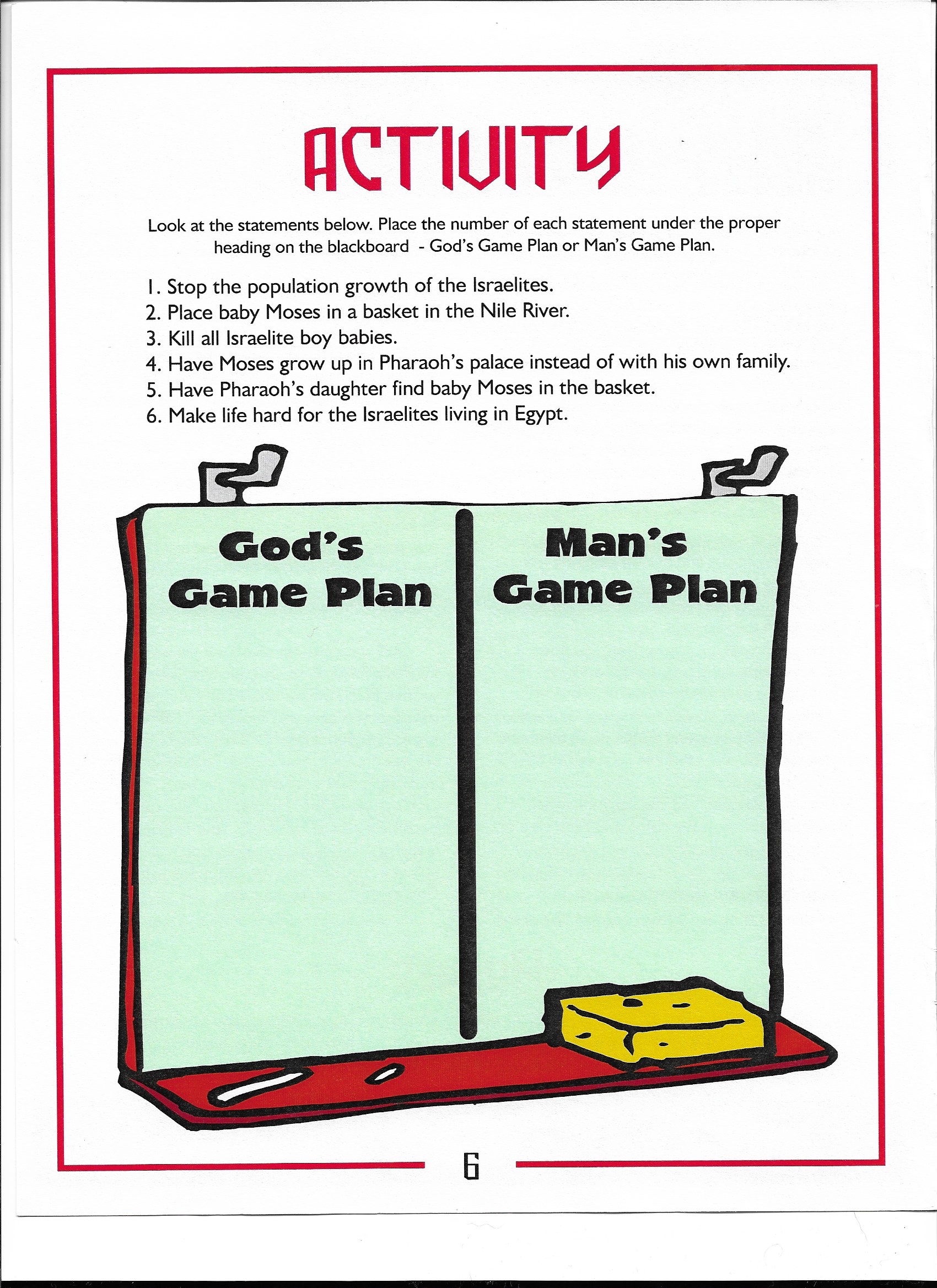
Game Plan - Demonstrate how the coach must anticipate the moves of the opposing team members and make sure every position is covered. Use lines and arrows to show this coverage. Explain that without a plan no one would know what to do and the game would be mass confusion. It may look confusing on the chalkboard, but the coach knows exactly what should happen with each play. Allow one of the students to use the chalk to draw aline from the opposing starting position to the goal line, and show how you would use your team members to block him. This is the game plan.
Pharaoh's Game Plan - Pharaoh assigned taskmasters to force the Israelites to work hard making bricks to build buildings and great cities. The taskmasters were cruel and often used whips to beat the Israelites (Exodus 1:11, 13, 14). (On your chalkboard, draw several o's to represent Pharaoh's team of taskmasters.)
God’s Game Plan - The Israelites continued to grow stronger and more in number (Exodus 1:12). (Illustrate this on the chalkboard by drawing many x’s to block Pharaoh’s o’s.)
Pharaoh’s Game Plan - Pharaoh planned to eliminate the opposition. He was afraid the Israelites would turn against him. Since there were so many Israelites, Pharaoh ordered all baby boys killed. With no boys to grow up into soldiers, he would solve his problem. (Get ready to erase x’s; stop.)
God’s Game Plan - The midwives refused to kill the baby boys. Pharaoh’s plan didn’t work.
Pharaoh’s Game Plan - Pharaoh ordered the baby boys to be thrown into the Nile River where they would be eaten by crocodiles. (Begin erasing x’s - not all because we know that there were some boys who escaped, i.e. Aaron.) Ask: How do you think God felt about Pharaoh killing all of these babies? Do you think God let Pharaoh get by with this? Can you think of anything we do today that is similar to this? (Abortion - killing babies before they are born.) Do you think that God considers it just as bad to kill a baby before it is born as it is afterwards? Do you think our nation will be punished for aborting around 50 million babies since 1973. (You will want to look up current stats.)
God’s Game Plan - God had a plan to free His people from Egyptian slavery. And he would use one of the very boys Pharaoh ordered killed to accomplish His plan. Jochebed gave birth to Moses and hid him. Then she made a waterproof basket boat to protect him. She placed the basket boat in the Nile River. Pharaoh’s own daughter rescued the baby Moses from the river. Mirian, Moses’ sister, brought their own mother to nurse and take care of the baby. (Draw a circle around one x.)
Satan’s Game Plan - Take Moses away from his family. If Moses was raised by Pharaoh’s daughter as an Egyptian, surely this would spoil God’s plan.
God’s Game Plan - Ask: Can you think of some advantages of growing up in Pharaoh’s palace? (Moses had the finest education He learned the ways of the Egyptians. He was important in Egypt.) (Draw a line from the x all the way to the end zone.) Did God turn defeat into victory? Will He do the same for us if we obey and trust Him?
God's Plan for You - Ask: Can you name some things that are part of God's plan for you? God's Word is filled with His plan for you - instructions on how you should live (Psalm 119:10-11), directions on how to enter His Kingdom (John 3:5-7). He wants you to follow His plan, obey His commands, stay away from things that will harm you. Ask: What is Satan's plan for you? (He would like to see you ruin your life with harmful things - drugs, alcohol, abortions, or killing babies before they are born, illegal acts, etc.) Following God's game plan will lead to success, a home in God's Kingdom, and a happy life. Ask: Where will Satan's game plan lead?
Teacher-Directed Activity
Give each student a "football" and have him/ her write on it at least three things that are part of God’s game plan for their life. Punch a hole in the football and thread a piece of yarn through and tie it. This can be hung on their door at home as a reminder.
REACH Activity
Back to the Bible: Directing Your Path
We can’t see the future. We don’t know, sometimes, how to avoid accidents and problems. But God does. Read Proverbs 3:5-6. Then ask your parents to share a story when God worked things out for them.
Here’s a story from one of my church friends: One snowy morning, Ryan volunteered to warm up his mother’s van for her before she left to teach at a nearby middle school. He drove the van around the block and back up into the driveway - at which point, the left front tire fell off. If his mom had been driving to school, she could have been seriously injured. What if she hadn’t let Ryan warm up her van? What if Ryan hadn’t volunteered? Praise God He directs our path!
Write about this topic and any experiences you have had in your Bible notebook.
Journal Jot: God’s Plans
We like to do what we want to do. We don’t like people telling us that we can’t. We resist being herded in a direction contrary to where we want to go.
Have you ever experienced very strongly wanting to do something? But then, something happened and you didn’t get to do what you wanted. Later on, you found out it was a very good thing!! You could seriously have been injured. Write about the experience.
If you haven’t had this kind of experience yet, ask your parents to share one of their experiences. Write about this topic in your Bible notebook.
Word Study: prothesis
The word “purpose” in your memory verse in 2 Timothy 1:9 is the Greek word: prothesis. This word is a combination of the preposition which means “before,” and a word which means “to set, place, or lay.” Literally, it means “a predetermination, purpose, intent design.” God’s purpose, or predetermined plan, was salvation for all through His Son Jesus Christ. (Source: Zodhiates’ Hebrew-Greek NAS Key Word Study Bible, 1990.)
Just Toolin’ Around: God’s Plans
There are a lot of verses and Bible stories which contrast the plans of man with the plans of God. With a concordance, find one and write it down in your Bible notebook.
Did you Know? Papyrus
The basket Moses’ mother (Jochebed) used would have been woven from papyrus or bulrushes. “Bulrushes grow from 10-15 feet tall and are as thick as three inches They grow along the banks of rivers and lakes, with their roots under the water. They were used in ancient times for paper and boats.” (Source: The Victor Journey Though the Bible, V. Gilbert Beers, 1996, p. 52.)
Stretch It Out: Weaving
Find a simple weaving pattern online. Create a small basket using cord, paper, or orchard grass. As you are weaving, think about Jochebed’s desire to weave a basket that would keep her baby Moses safe. Use your finished project as a napkin holder in the center of your dining room table.
Music Notes: O Love That Wilt Not Let Me Go
This hymn is on page 82 of the CEM Hymnal.
George Matheson was blind hymnist and pastor who wrote this hymn on the evening of his sister’s marriage. He had something that happened to him that caused him “the most severe mental suffering.” He said “The hymn was the fruit of that suffering. It was the quickest bit of work I ever did in my life. I had the impression of having it dictated to me by some inward voice rather than of working it out myself. I am quite sure that the whole work was completed in five minutes, and equally sure that it never received at my hands any retouching or correction . . .” Although George Matheson doesn’t tell the reader what the suffering was, scholar have suggested that it could have been the rejection of his college financée, just before his sister’s wedding. “When told of his impending total blindness, she is said to have informed him, ‘I do not wish to be the wife of a blind preacher.’” (Source: Amazing Grace, Kenneth Osbeck, 1990, p. 49.)
What a comforting experience - to have been gifted this hymn just when he needed it! Read through the words of this hymn and think of the feelings George Matheson must have been feeling when he wrote them. Sing the hymn. Then write down the lines which impact you the most strongly in your Bible notebook.
Questions?
Remember to write down any questions that you think of as you are reading your lesson, daily devotionals, or doing the REACH activities. Plan to ask your parents or your pastor these questions.
Song
"He's Got The Whole World In His Hands" is on page 54 of Kids Classics Collection.
Closing Prayer
Gather the kids in a huddle and lead them in prayer thanking God for His plan for Moses and Israel. Ask that God will show His plan to each student in your class, and that they would live according to His plan.
Printable Pages