YEA Lesson Library
Promises and Blessings
About This Lesson
Using Jacob’s blessing on each of his sons, this lesson teaches that our choices and actions have far-reaching consequences. Sometimes God doesn’t even have to punish us; our sins have natural consequences built in.
Scriptures
Genesis 49:1-33
Joshua 24:14-15
Matthew 25:26-29
Matthew 25:31-34
Romans 14:17-19
2 Corinthians 6:18-7:1
Ephesians 1:3-5
Ephesians 4:24-29
2 Timothy 2:21-22
Words to Know
CONCUBINE - mistress, living together outside marriage
DESCENDANTS- the children and grandchildren (and so on) of a person
PROSPER - to do very well
FERTILE - good for growing crops (land), produces many babies (animals and people)
ISOLATED - living away from other people
HOROSCOPES- predictions of the future falsely based on astrological signs
The Lesson
Andrea walked towards her group of friends huddled over a paper on the ground. "What could they be reading so intently?" she wondered. As she got closer, she could hear Britney reading out loud. Suddenly she recognized what it was: they were reading horoscopes. Andrea wanted to be with her friends, but she didn't like horoscopes. "It's more than just that they are silly," she thought to herself. "They are ungodly."
As Andrea thought about this, she turned on her heels and walked over to join the basketball game. As she sank her first lay-up, she thought about the choices Jacob's sons made and Jacob’s blessing on each of them just before he died.
In the last lesson, you learned that Jacob blessed the two sons of Joseph. Then he blessed all of his sons. It is interesting that halfway through the blessing, Jacob stopped and asked God for help. He said, "LORD, I look to you to save me" (Genesis 49:18).
Reuben was Jacob's firstborn son. He should have received the greatest blessing. But Reuben had sex with Jacob's concubine. The consequences for this sin resulted in the loss of Reuben's rights of firstborn. Reuben's descendants would not be powerful. Instead, they had a problem making right choices.
Because Simeon and Levi were so violent and had killed men when they were angry, Jacob cursed their anger. Then he said their descendants would be scattered among the other tribes of Israel.
Judah was made the leader because of the actions of Judah's three older brothers. Also, Judah's descendants were given the promise of having a ruler through the generations until Jesus Christ comes to set up His Kingdom on this earth.
Zebulun's descendants would live by the sea. Issachar’s descendants would be strong, even when forced into slavery. Dan's descendants would provide justice for their own people, but some would be disloyal to others. Gad's descendants would have conflicts with their neighbors. Asher's descendants would be farmers in the fertile lands near the Mediterranean. Naphtali's descendants would settle in an isolated hill country.
The blessing for Joseph's descendants seems to focus on Ephraim. (Remember that Ephraim was given the greater blessing, even though Manasseh was the firstborn.) Because God would be with them, Ephraim's descendants would prosper. The land and animals would be fertile. Ephraim's descendants would have lots of children and would become the most powerful of the northern tribes. Some of Benjamin's descendants would be cruel in dealing with others.
There are three things to learn about these blessings. First, the blessings are more than blessings. They are prophecies of what the descendants of each person would tend to be like. Not all of the descendants of Benjamin would be cruel, but many of them would. That’s because a child will tend to grow up behaving like the people around him, but they have a choice. You must work really hard to break away from behaviors that you have grown up with. That's why your mom tries so hard to get you to keep your room clean now. She knows that if you do it now, you'll do it as you get older too. And it's the same with God and His ways. The more we choose His ways, the more they become our normal behavior all the time. So God tells parents to teach their children about Him all the time.
The second thing to learn about the blessings is that they were the direct result of what Jacob's sons had done. If Levi and Simeon had not been violent and killed men in their anger, the blessing Jacob gave them would have been much different. Reuben also lost his blessing as firstborn because of his sins. It is the same for us today. We are given blessings based on our actions. If we follow God’s ways, good things happen to us. If we are loving, helpful, and generous, people like us and things go well. In the same way, if we don’t follow God’s ways, bad things happen to us. If we are mean, angry, and deceitful, people don't like us, don't trust us, and don't want to be around us. Things do not go well. The neat thing is - it's your choice. For example, no one can force you to be angry. You can choose to be very forgiving and loving, no matter how badly someone treats you.
The third thing is that blessings for obeying God can continue for many, many years. We today are blessed because of Jacob's obedience. Your children and grandchildren can be blessed too if you will obey God.
Here's the bottom line: As you learned in the last lesson, you are God's children. You are princes and princesses. But it's your choice. You can choose to act like your peers, doing what you feel like doing and serving yourself. If you do, you will not be princes and princesses. Or you can choose God's way and God's promises for you. If you choose God's way, He promises to bless you and be your Father. You will inherit His Kingdom. With these promises in mind, avoid everything that God hates, those things which are evil and against His ways. “ ‘I will be a Father to you, and you will be my sons and daughters,’ says the Lord Almighty. Since we have these promises, dear friends, let us purify ourselves from everything that contaminates body and spirit, perfecting holiness out of reverence for God" (2 Corinthians 6:18-7:1).
Student Prayer
Dear Heavenly Father,
Please help me to remember your promises to me when I face difficult choices. Help me always to choose you.
In Jesus' name.
Amen.
Daily Devotions
Sunday: Ephesians 1:3-5
Monday: Romans 14:17-19
Tuesday: Matthew 25:26-29
Wednesday: Ephesians 4:24-29
Thursday: Joshua 24:14-15
Friday: 2 Timothy 2:21-22
Saturday: Matthew 25:31-34
Objectives
At the end of this lesson, students will be able to:
1. Relate some of the blessings given to Jacob’s sons.
2. State that the blessings are prophecies that are being fulfilled down through the generations.
3. State the blessings were the natural consequences of the actions of Jacob's sons.
4. State that God gives the choice of following Him to each individual.
5. Describe the response we should have to God's promises.
Topics & Themes
Blessings
Choices
Consequences of Sin
God’s Kingdom
Inheritance
Integrity
Prophecy
Materials Needed
Bibles, YEA students' and teacher's books, pencils and pens, attendance and memory verse charts, stars, songbook, CD or cassette tape, music player, blackboard, chalk, Bible Pictionary or Bible Trivia, and assorted games.
Preparation
Listed below is a summary of the blessings given to each of Jacob's sons and the Scriptural references that show the fulfillment in the descendants. You may wish to familiarize yourself with these:
Reuben- descendants characterized by indecision - Judges 5:15-16.
Simeon - absorbed into Judah - Joshua 19:1, 9 - not even mentioned in the blessing Moses gave in Deuteronomy 33.
Levi - dispersed throughout Israel - Numbers 35: 2,7; Joshua 14:4; 21:41.
Judah - a lion's cub, promise of the scepter remaining in his lineage - Jesus Christ is called the Lion of the tribe of Judah (Revelation 5:5).
Dan - disloyal as described in Judges 18:27; also, Samson was a Danite - Judges 14-16.
Gad - vulnerable to attacks and raids from the Moabites- Joshua 13:24-27; 2 Kings 3:4.
Asher - fertile farmlands near the Mediterranean - Joshua 19:24-30.
Naphtali - isolated location in the hill country north of the Sea of Galilee. Joshua 19:32-38.
Joseph - fruitful is a pun on the name Ephraim, whose descendants tended to expand their territory- Joshua 17:14-18, they'd gain supremacy over the northern tribes- Joshua 16:9; Isaiah 7:1-2; Hosea 13:1; Genesis 49:22-26.
Benjamin - examples of cruelty - Judges 3:12-30, Judges 19-21.
How to Teach This Lesson
Choices- When the students come into class, invite them to play one of the games set up in various locations in the room, i.e. Bible Pictionary, Bible Trivia, Monopoly, Risk, Battleship, Crazy
Eights. Once they've played for about five minutes, ask them to stop. They will probably need to be physically moved in order not to be tempted to continue playing. Ask for volunteers to explain why they chose to play the games they did. Write their answers on the board. Then talk about choices in their lives. Many of the same reasons may apply. But are they good reasons? Do they have lasting consequences that we don’t even see or consider?
Jacob's blessings- Talk about the blessings Jacob pronounced upon his sons. Have the students tell you the names of the sons (good practice for their Ten Week Project - due next week!). Then make notes after each one about the blessing given to him.
More than blessings - Point out that the blessings were prophecies that continued to be fulfilled even "in the last days" (Genesis 49:1). (Refer to Preparation for specific instances and Scriptural references.) Talk about family characteristics and tendencies passed from generation to generation. Talk about how to break a negative pattern.
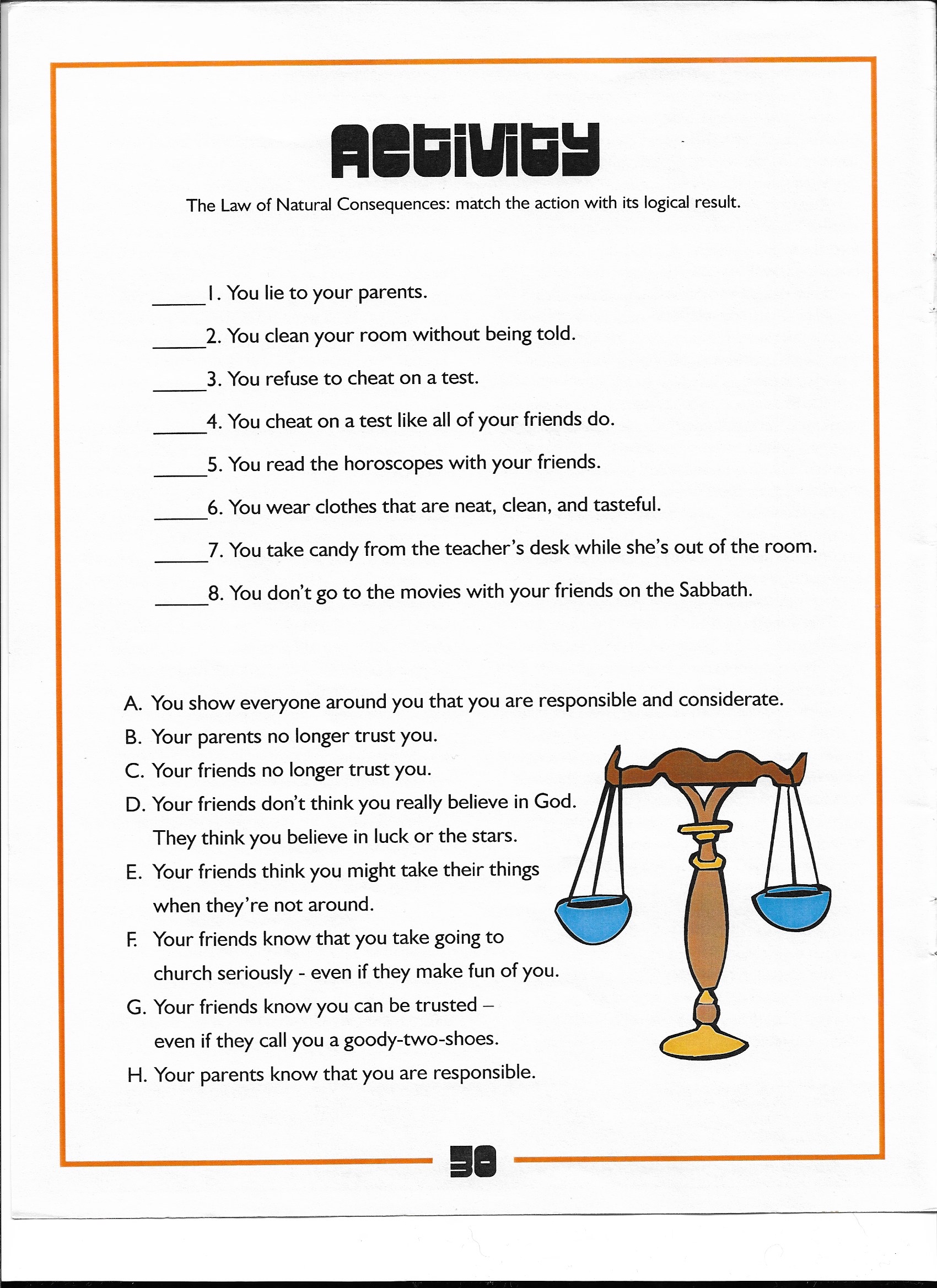
Consequences of actions - Point out that the blessings were the direct result of the actions or character of each of the sons. Draw the similarity in the Christian's walk with God. Make sure that the students know that God doesn't have to lift a finger to punish wrong-doing; in many instances, it is built in as a natural consequence to breaking His laws. But more than that, it is a reflection of who you are and where your heart is. If you are doing things that God hates, then you are not acting like a child of God. At this point, have the students recite their memory verse: 2 Corinthians 6:18-7:1: "I will be a Father to you, and you will be my sons and daughters, says the Lord Almighty. Since we have these promises, dear friends, let us purify ourselves from everything that contaminates body and spirit, perfecting holiness out of reverence for God." Then have them back up to 2 Corinthians 6:16 and read through to their memory verses (Cross
references to Leviticus 15:3 I and Deuteronomy 23:12-14).
Promises - Remind them of last week's lesson -that God is inviting them to be part of His family. They have the opportunity to become princes and princesses. If they are a child of the King, what should their actions be?
Choices - Remind them again that God is not going to force them to follow His ways. It is truly their choice. Exhort them to consider the future and what God has in store for them- not just the
present and what they feel would be good today.
Review Questions
1. What blessings were given to Jacob's sons?
2. Were the blessings just forJacob's sons? How far did they go?
3.The blessings were a direct result of what?
4. Since God has given us the promise of being His sons and daughters, what should we do?
5. Whose choice is it to follow God and His ways?
Teacher-Directed Activity
Bible Trivia or Bible Pictionary - Allow the students to return to a biblically-based game, if time allows. Note: also check the answers in the student's book. If they think the results could be different, discuss it. Consequences are not always predictable.
1B, 2H, 3G, 4C, 5D, 6A, 7E, 8F
REACH Activity
Back to the Bible: Responsible for Your Own Sins
Look up the following verses: Deuteronomy 5:9-10; Deuteronomy 24:16; Exodus 34:7; Ezekiel 18:19-20; Numbers 14:18; Exodus 20:5; Jeremiah 31:29-34; Romans 6:23; Romans 3:23. Make notes. What does each passage say about sin? Does God hold you accountable for the sins your ancestors committed?
Think about this topic. If you have questions, ask your parents or your pastor to explain how God will visit the iniquities of the fathers even to the third and fourth generation - and yet each of us is responsible for our own sins.
Journal Jot: Cultural Stereotypes
We don’t like stereotypes. We like each person to be recognized as an individual and not have assumptions made about who they are and what they like just because they live in a certain place or have a certain ancestry. It’s the idea that, if you are Irish, you have red hair, or that if you are a woman, you love to go shopping. Have you heard the stereotypical phrase, “Fighting like cats and dogs”? Do all dogs and cats fight? No, but there’s a large percentage of them who share some animosity. So, what do you think about what your lesson said - that the blessings Jacob pronounced on his sons were both a blessing and a prophecy of what their descendants would be like? Is it true for every member of that lineage? No. Is it true for a large portion of them? Yes.
Choose one of the sons of Jacob. Write down his name and the blessing/prophecy associated with him. Why would the prophecy be likely to come true? How could one of them break away from the stereotype?
Have you encountered any stereotypes? Were they directed towards you or someone else? Do you think they were true? Why or why not?
Write about all of this in your Bible notebook.
Word Study: pantokratōr
The word “Almighty” in your memory verse (2 Corinthians 6:18) is the Greek word pantokratōr, which means literally “the all-ruling, i.e. God (as absolute and universal sovereign)” (Source: Zodhiates’ Hebrew-Greek Key Word NAS Study Bible, 1990). Note: Remember to add this to the chart you started under the last lesson (Lesson 8, Just Toolin’ Around).
Think about this for a moment!! The One who says He will be a Father to you - that you will be His son or His daughter - is the God of the Universe, the absolute and universal sovereign. There is no greater being! And He has chosen you! Therefore, what is your response? 2 Corinthians 7:1 gives the answer: we should purify ourselves from everything that contaminates body and spirit, perfecting holiness out of reverence for God! But this doesn’t happen overnight or all at once. It is a process. So in your Bible notebook, write down one thing you can change to grow closer to God. Then resolve to do it!
Just Toolin’ Around: Biblical References
Using a concordance, find at least two descendants of each of the twelve sons of Jacob. Include Ephraim and Manasseh in your list. For instance, one of the chief architects of King Solomon’s temple was Hiram, whose mother was from Naphtali (1 Kings 7:14). Write down what you find in your Bible notebook.
Did you Know? Ancestors
Sometimes it’s really interesting to think of the ancestry of Biblical personages. For instance, did you know that Deborah and Barak (Judges 5:15) were descendants of Issachar. Both King Saul and the apostle Paul were from the tribe of Benjamin. Judah was the ancestor of both King David and Jesus. (Source: The Victor Journey Through the Bible, V. Gilbert Beers, 1996, p. 49.)
Stretch It Out: Family Tree
What does your family tree look like? How far back can you trace your ancestors? Do you know where your great-grandmother was born? Do you know what country your great-great grandfather lived in? This could be a huge project, if you are really interested! Start compiling information for both your mom’s side of the family and your dad’s side. Make a poster board displaying as much information as you can. Try to gather stories while you’re gathering data. Write them down. One day you may be the last person in your family to know family history.
Music Notes: Hymn of Promise
This hymn is on page 115 of the CEM Hymnal.
This hymn was written by Natalie Sleeth in 1986. “‘Hymn of Promise' . . . was written at a time when the author states that she was ‘pondering the ideas of life, death, spring and winter, . . . and the whole reawakening of the world that happens every spring.’ Inspired by a T.S. Eliot line, the germ of the hymn grew from the idea ‘in our end is our beginning,’ the phase that begins the third stanza of the hymn.” Shortly after Natalie composed the hymn, her husband was diagnosed with cancer, from which he died. He asked that her hymn be sung at his funeral. (Source: https://www.umcdiscipleship.org/resources/history-of-hymns-in-the-bulb-there-is-a-flower)
As you sing this hymn, think about the promise that we have in Jesus Christ! Read 1 Corinthians 15:16-19, 35-42. We know that, because Jesus was resurrected from the dead, we have the hope of eternal life!
Sing this hymn. Share it with your family. Think about the promise of eternal life from God.
Questions?
Write down any questions you have in your Bible notebook so that you can remember to ask your parents or your pastor.
Song
"Every Promise in the Book is Mine" is on page 15 of Kids Classics Collection.
Closing Prayer
Ask for a volunteer to lead in prayer guiding him to ask for God's help for each student in making the best choices in their everyday walk with Him.
Printable Pages