YEA Lesson Library
Letting God Make Lemonade
About This Lesson
Continuing Joseph’s story, the students learn to trust that God will work things out for the good (if not in this lifetime, in His kingdom) just as Joseph’s sufferings turned to blessings for the whole family.
Scriptures
Genesis 43 - 47:6, 27
Genesis 50:19-21
Genesis 50:20
Psalm 37:23-26
Psalm 56:3-4
Psalm 56:9-11
Romans 8:26-30
1 Thessalonians 5:23-24
2 Timothy 1:9-10
1 Peter 5:10-11
Words to Know
GOSHEN - an area in the land of Egypt
DETERMINE - decide, resolve
ACCOMPLISH - to do
The Lesson
Alexi was hurt by the lies that her best friend had told the teacher about her. Julia had told Mr. Robbins that it was Alexi who had made the mess under their desks! Julia said it was Alexi who was whispering and making noise during his lecture! But the worst was the accusation of cheating! Julia told Mr. Robbins that Alexi always tried to copy her math answers. So Mr. Robbins moved Alexi to the very front row of desks, right in front of him. She just wanted to bury her face in her arms and cry with embarrassment. She peeked quickly at Julia. Julia was sitting smugly in her desk at the back of the room. Alexi decided she would not let Julia see how much her lies had hurt. She was just going to ignore Julia as much as possible until the end of the day. Then she would go home and tell her mom what had happened.
As the day passed, Alexi began to notice things: She could see the blackboard a lot better than she could before. She wasn't distracted from the lesson by Julia's whisperings. But, best of all, she was right where Mr. Robbins could easily see her working - silently proving that Julia had been lying al along. When the bell rang at the end of the day, Alexi could hardly wait to run home. She wanted to tell her mom just how good the day had been.
Joseph must have had days when he also felt shame and embarrassment. He was separated from his family. He had been sold as a slave. He was falsely accused. He had been unfairly thrown into prison. But in each situation, God blessed Joseph.
Then Joseph's brothers came to buy grain. They told Joseph about his father and Benjamin. So Joseph told them they had to bring Benjamin the next time they wanted grain. But he kept Simeon in prison. The other brothers took the grain and traveled back home.
It wasn't long before Joseph's brothers and their families ate all the grain they bought from Joseph. They needed to go back to Egypt and buy some more. There was still famine in the land. So the brothers reminded Jacob, their father, that Joseph had demanded to see Benjamin. Jacob finally agreed to let the brothers take Benjamin with them. When Joseph saw them, he still pretended to be a stranger. He made a meal for them and sold grain to them. But when they left, he again put their money in with the grain. He also placed his silver cup in Benjamin's sack of grain. Just after the brothers had left, Joseph sent his servant after them to find who had the silver cup. All of the brothers returned to Egypt and begged for mercy from Joseph.
This time Joseph cried in front of his brothers. He told them who he was. Then he said a remarkable thing. He told them not to be upset about selling him to be a slave. He told them it was God who had sent him to Egypt - to save all of their lives. Somewhere along the line, Joseph learned that God was in control of his life - every step of the way. God had big plans for Joseph and his entire family. God was going to use the events in Joseph's life to bring good to the rest of the family - for generations to come.
Because Joseph was in charge in Egypt, he was able to know who was buying grain. He was able to be there when his brothers came for food. He was important enough that his family was given the land of Goshen to live in. They would have enough food even though there were going to be five more years of famine. Everything was working out really well for the whole family! God was in charge!
Sometimes we have really bad things happen to us in this life - separated from our families, death of someone we love, false accusations, mean actions towards us from others, illnesses,
or whatever. Sometimes we feel like burying our faces in our arms and crying from the embarrassment and pain. But that's when we need to look up and remember that God is in control. God is good - all the time. Whatever bad is in our lives, God can use it for our good. It may take years, just like it did for Joseph. It may mean lots of sorrow and tears during those years. But someday, you will see God's plan for your life. You must determine, as David did, to trust in God. “When I am afraid, I will trust in you. In God, whose word I praise, in God I trust; I will not be afraid. What can mortal man do to me?" (Psalm 56:3-4). People can do some pretty awful things to us, but God can turn evil into good. Count on it.
Student Prayer
Dear Heavenly Father,
Please teach me how to trust you all the time. I know that you love me and you have me in your hands.
In Jesus' name.
Amen.
Daily Devotions
Sunday: Genesis 50:19-21
Monday: Psalm 56:9-11
Tuesday: Psalm 37:23-26
Wednesday: Romans 8:26-30
Thursday: 2 Timothy 1:9-10
Friday: 1 Peter 5:10-11
Saturday: 1 Thessalonians 5:23-24
Objectives
By the end of this lesson, students will be able to:
1. Continue Joseph's story, through the reunion of the family and the move to Goshen.
2. Relate that situations may not always work out as they first appear.
3. State that God is in control and has our ultimate good in mind.
4. State that we must trust God, no matter what.
Topics & Themes
Benjamin
Blessings
Forgiveness
God’s Plan
Joseph
Joseph’s Brothers
Mercy
Silver Cup
Suffering
Trusting God
Materials Needed
Bibles, YEA students' and teacher's books, pencils and pens, attendance and memory verse charts, stars, songbook, CD or cassette player and music player, blackboard, chalk, lemons, knife, juicer, cups, sugar, measuring cup, spoon, ladle, premixed lemonade, poster paper, markers, crayons, rulers, Lemonade Stand sign, pitcher, ice
Preparation
Please read "How to Teach This Lesson." Before class prepare one -12 oz can of frozen yellow lemonade mixed with one - 6 oz can of frozen orange juice (with appropriate water) for a sweeter lemonade. You may also wish to make a Lemonade Stand sign to put outside the door- to greet the students as they arrive for class.
How to Teach This Lesson
Lemons- As the students come into class, hand each of them a lemon. Ask them to study it and be ready to tell something about the lemon. Write their observations down on the chalkboard. Ask: What do you know about lemons? How many of you would choose to eat a lemon over any other type of fruit? Then talk about how the word "lemon" is used in our language, i.e. if someone gives you a lemon, it probably is something that doesn't work and isn’t worth very much - like a car or lawn mower. Ask: What would you do with a car that isn't worth very much and doesn't work well?
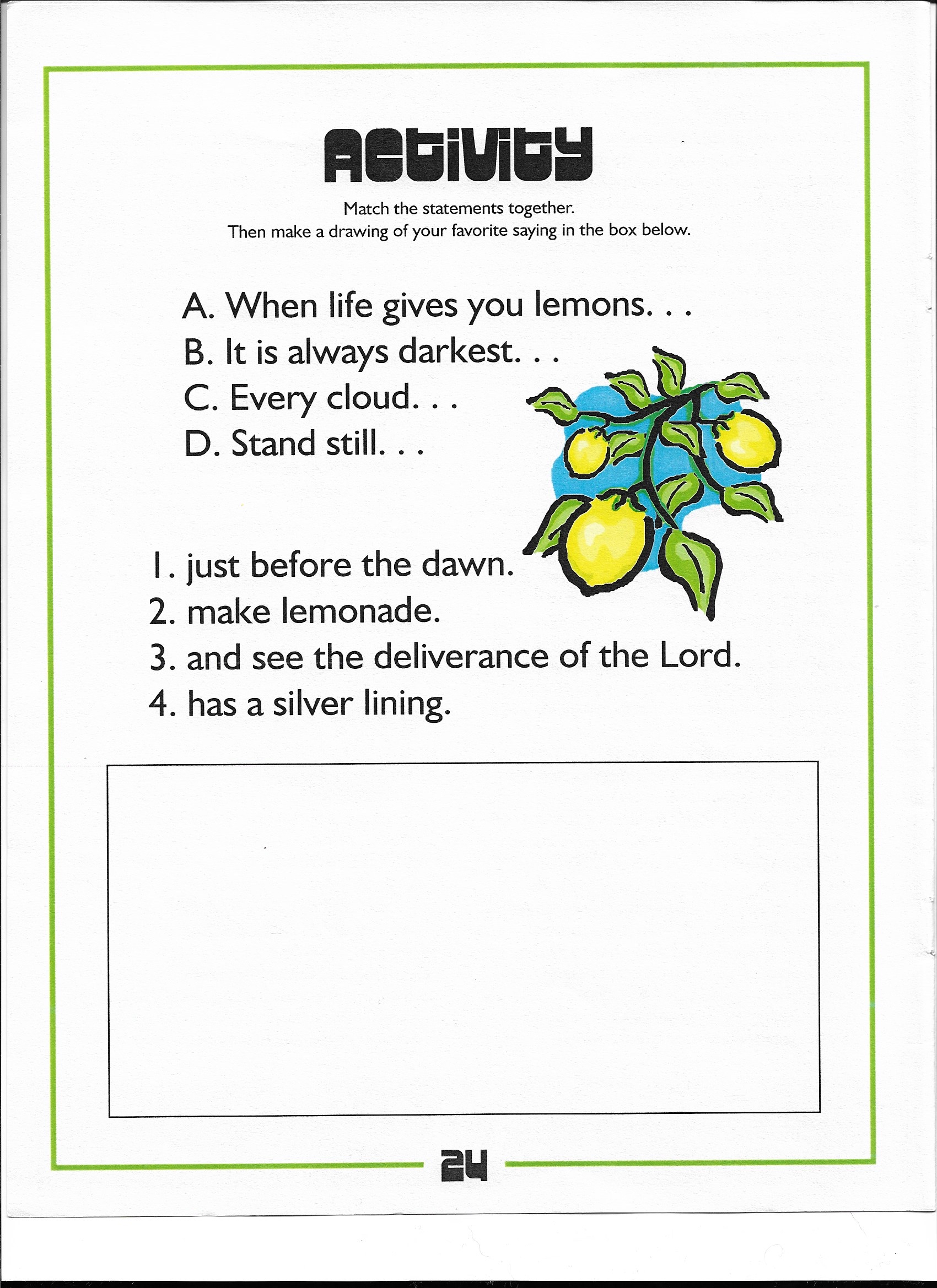
Lemonade - Write the saying,"When the world gives you lemons, make lemonade" on the board. Ask: What does that saying mean? Discuss how you can turn bad situations into good situations. If no one states that God can work out all things for our good, make sure you bring it up at this point.
Transition into Joseph - Flowing naturally into the story of Joseph, remind the students that God had continually blessed Joseph while he was in Egypt. Ask: Can you give me some examples? Then pick up the story from the brothers' second trip to Egypt to buy grain. Talk about Benjamin going along. Talk about Joseph putting the grain in their sacks, then returning their money and placing his silver cup in Benjamin's sack. Discuss how Joseph revealed himself to them.
You meant evil; God intended good- This is an amazing scripture! Have the students read Genesis 45:4-8 and Genesis 50:20. Discuss how far, as Christians, God is working for our eternity with Him. Whatever it is in our lives that He needs to lead us through- in order to get us into His Kingdom - that's what He'll do. Additionally, situations may occur because God will use us to save someone else - as He did in Joseph's life.
The Psalms - Read several verses out of the Psalms which point to God's deliverance. (Psalm 56:3-4; 55:22; 62:1-2; 78:23; 84:1 1; 91) Encourage the students to add to their Ten Week Challenge and plan to keep the list in their Bibles when they need encouragement that God is in control and He loves them.
Making lemonade - Ask: How can God change something in our lives that looks so bad into something good? We often can't see how God is going to work it out. We really don't want to suffer. But take a lesson from making lemonade. Have the students bring up their lemons. Either slice the lemons in half for them, or help them do it. Then let each student take a turn with a hand juicer (one where they supply all the friction and elbow grease). Talk about the analogies: ) slicing the lemon - you have to open it to see what you have. Step back and ask God for His involvement and guidance in the situation. 2) squeezing the juice out - this is a lot of work, especially after the first two or three! Most worthwhile things in life are a lot of work. 3) Perseverance- in order to get enough lemonade to drink you would have to squeeze a lot of lemons - and sometimes that hurts. In the same way, sometimes God has to keep squeezing you and molding you to get you to produce what He wants - and sometimes that process is painful. 4) Seeds - even after you squeeze out all the juice, there are seeds floating in the juice. Even when God keeps working with us, there are still going to be areas for improvement; don’t expect everything to be perfect right away. 5) Sugar to taste - the lemon juice is still too tart to drink comfortably. We have to add some sugar. In the same way, God's Holy Spirit in our lives makes us more loving, giving, and palatable to others.
Remember: we only receive the Holy Spirit when we acknowledge our sins and accept Jesus Christ as our Savior. (Note: You may wish to have some lemonade mixed up ahead of time to give to the students because it will take a lot of time to squeeze enough lemon juice to make enough to drink.)
Review Questions
1. What did Joseph do when his brothers came for grain the second time?
2. What did Joseph tell his brothers about how he was sold into slavery?
3. Where did Joseph want his family to live?
4. Why do situations that appear bad sometimes work out for our good?
5. If we love God and follow His ways, who is in control of our lives - always?
6. Do we always understand why we are going through something? (No.)
7. What should our response be when we face something really hard or hurtful?
Teacher-Directed Activity
Making Lemonade: see “How To Teach This Lesson.” Additional idea: If the students want to be doing something while the others are squeezing lemons, have the students come up with other sayings similar to "When the world gives you lemons, make lemonade." Then give them poster paper, markers, etc. to make up-lifting posters to hang around the church.
REACH Activity
Back to the Bible: A Way Seems Good
There’s an interesting proverb in the Bible about how we humans are not very good at predicting whether something is going to be good or bad. Proverbs 14:12 says, “There is a way that seems right to a man, but its end is the way to death.” Can you think of any examples in the Bible that illustrate this? Here are a couple: Pharaoh wanting his labor force back so he chases them into the Red Sea (Exodus 14:21-29); King Ahab stealing Naboth’s vineyard (1 Kings 21:17-19); King David having Uriah killed to cover up David’s sin with Bathsheba (2 Samuel 12:1-15). Use one of these examples, or come up with your own. Write a paragraph showing how the example you choose illustrates Proverbs 14:12. Share with your family.
Journal Jot: The End From the Beginning
We can’t see what’s going to happen in our future. We can make plans. We can work and study hard. But sometimes things happen in our lives which cause us pain. Some of them we think are really bad things. But we trust the Sovereign God, the Creator and King of the Universe. He is all-powerful. And He is all good! We must get to the place in our relationship with God that we can say, as David did, “When I am afraid, I will trust in you” (Psalm 56:3). A good place to start is by writing down the things that aren’t going well right now - the things we’re worried about. Then, write down things that have happened in the past that you were worried about that God took care of. Then write a prayer in your Bible notebook, telling God that you trust Him. Ask Him to help you with the things you are worried about. Also remember to ask Him to help you trust Him more fully and to be at peace.
Word Study: âsâh
In the memory verse for this lesson, Genesis 50:20, the Hebrew words for “to accomplish” is âsâh. It means “to work, to labor, to toil; to make, to create, to construct, to build, to accomplish.” It is used in scripture “to describe God’s creative activity.” (Source: Zodhiates’ Hebrew-Greek Key Word NAS Study Bible, 1990). So God arranged, He worked, He orchestrated the events in the lives of Joseph and his entire family to do good to them all, to save their lives from the famine. Joseph’s brothers had meant him harm. Jacob’s entire family was worried they might starve during the famine. Joseph certainly didn’t enjoy being sold as a slave, falsely accused and thrown into prison. But God “brought about” or “accomplished” His desired outcome - the saving of many lives.
I suspect in God’s kingdom we’re going to hear all kinds of stories about how God worked things out for our good when we didn’t even realize He was working behind the scenes.
Write this word and its definition in your Bible notebook.
Just Toolin’ Around: Trusting God
Using a concordance, find five scriptures which exhort the reader to trust God with all of their heart. Write these verses and scripture references in your Bible notebook. Trusting God is closely tied to believing that God is good, that He is all-powerful, and that He loves you.
Think about this topic. Do you trust God? How do you know that you trust God? How is it evident in the things that you do? Write a prayer asking God to help you learn to trust Him more deeply.
Did you Know? Goshen
“Jacob’s nationality and occupation were so loathsome in the eyes of the Egyptians, so Pharaoh gave Jacob his own area of land in which to live. This region was in the eastern section of the Nile River delta. . . It was a rich land due to the many river branches that watered the area. . . . Since it was in the northeastern corner of Egypt, it would have been one of the first sights in Egypt seen by Jacob’s caravan.” (Source: The Victor Journey Through the Bible, V. Gilbert Beers, 1996, p. 50.)
Stretch It Out: Making Lemonade
Take one of the sayings from the student activity or choose another like “When life gives you a rainy day, play in the puddles.” Make a poster. Use large, neat lettering to proclaim your hope and trust in God. Ask permission to display at church.
Music Notes: Through the Love of God, Our Savior
This hymn is on page 122 of the CEM Hymnal.
This comforting hymn was written by Mary Bowley Peters who lived in England. She married John McWilliams Peters, a rector and vicar who died when Mary was only 21. Despite her sorrow, she expressed her trust and faith in God through hymns like this one. (Source: https://austinbhebe.wordpress.com/2015/01/21/through-the-love-of-god-our-savior-all-will-be-well/)
Do you ever wonder what hymnists like Mary Peters would think about us singing their hymns so many years later? Would they be amazed that this hymn is in so many hymnals and sung around the world? Or would they simply be grateful that God had used them for His glory?
What will be your legacy? When you are long gone and books are written, what will be said about you? Did you trust God? Was your faith evident in the things you said and did? Could people point to your life and clearly see your love for God? It’s something to think about as you sing this hymn.
Questions?
Write down any questions you have in your Bible notebook so that you can remember to ask your parents or your pastor.
Song
"He's Got the Whole World in His Hands" is on page 54 of Kids Classics Collection.
Closing Prayer
Ask for a volunteer to lead in prayer asking God to help them fully trust Him.
Printable Pages