YEA Lesson Library
Who’s In Charge?
About This Lesson
This lesson continues the story of Joseph’s life: how he was second in command over Egypt and directed the distribution of grain during the famine. The students are taught that, just as Joseph honored God and was blessed, we each honor God by following His ways in all circumstances.
Scriptures
Genesis 41:39-56
Psalm 47:1-4
Isaiah 64:8
Romans 9:20-23
1 Corinthians 1:25-31
1 Corinthians 6:19-20
2 Corinthians 4:6-9
2 Corinthians 4:17
Words to Know
ABUNDANCE- plenty, lots
FAMINE - a severe shortage of food
FAVOR - when someone likes you and responds to you in a positive way
The Lesson
When Cynthia was nine years old, she was in Miss Hageman's third grade class. Cynthia liked school, and she really liked Miss Hageman. So she tried her best, wanting to please both her teacher and her parents. One day, Miss Hageman announced to the class that Cynthia had a streak of 16 days of 100 percent on her math assignment. As a reward, Cynthia would get to teach the math class the following day and grade the papers for all of her classmates. After she taught the class, she did the assignment herself. Then she checked all of the papers. That was an experience Cynthia never forgot. It was kinda fun being in charge.
Joseph had been in charge a couple of times in Egypt. First, he was in charge of Potiphar's household. Then he was in charge of the prison where he was a prisoner! Now he found himself before Pharaoh - explaining the meanings of both of Pharaoh's dreams. Then Pharaoh told Joseph, "Since God has made al this known to you, there is no one so discerning and wise as you. You shall be in charge of my palace, and all my people are to submit to your orders. Only with respect to the throne will I be greater than you. . . .I am Pharaoh, but without your word no one will lift hand or foot in all Egypt" (Genesis 41:39-40, 44).
But it didn't stop there. He put a ring on Joseph's finger to show his authority and put the royal golden chain around his neck. Then Pharaoh said: "See, I have placed you in charge of all the land of Egypt." And Joseph became famous across the land.
Pharaoh also gave Joseph a wife, Asenath.
Joseph was 30 years old when he began to serve Pharaoh. For seven years the harvests were good. Joseph collected food. In fact, he stored so much food that he quit keeping records. There was too much to count. Also during the seven years of plenty, Joseph and Asenath had two sons. He named his firstborn Manasseh, saying, "It is because God has made me forget all my trouble and all my father's household. He named his second son, Ephraim, saying, 'It is because God has made me fruitful in the land of my suffering*" (Genesis 41:50-52).
After seven years of abundance. The granaries were full to overflowing. Then the seven years of famine began. The whole area around Egypt experienced the famine. When the people started to run out of food, they went to Pharaoh. He told them, "Go to Joseph and do what he tells you.” Then Joseph opened the storehouses and sold grain to the Egyptians.
This is a remarkable story. Remember Joseph had been sold as a slave in Egypt. He had no rights! But God gave him favor in Potiphar's sight because Joseph honored God! Then, even though Joseph did the right thing, he was falsely accused and put in prison. So he was a slave with no rights and he was also a prisoner, which was doubly bad. But God again gave Joseph favor in the eyes of the warden. Why? Because God had a plan that was bigger than Joseph.
The Apostle Paul describes it this way: "Notice among yourselves, dear brothers, that few of you who follow Christ have big names or power or wealth. Instead, God has deliberately chosen to use ideas the world considers foolish and of little worth in order to shame those people considered by the world as wise and great. He has chosen a plan despised by the world, counted as nothing at all, and used it to bring down to nothing those the world considers great, so that no one anywhere can ever brag in the presence of God. For it is from God alone that you have your life through Christ Jesus. He showed us God's plan of salvation; he was the one who made us acceptable to God; he made us pure and holy and gave himself to purchase our salvation. As it says in the Scriptures; ‘If anyone is going to boast, let him boast only of what the Lord has done’ " (I Corinthians 1:26-31).
There are three things you need to remember, as Joseph did: 1) that you were born to glorify God. 2) You need to remember that who you are - your looks, personality, and achievements - should also glorify God. That means, the way you dress should always please God. Before you try to look like someone you see on television or YouTube, ask God and your mom if that’s the way you should dress. 3) You need to learn that what you become is for God's glory as well. God gives you your intelligence and He can give you the breaks as He did Joseph. He expects you to use what He gives you for His glory. Joseph never forgot these things. We've seen in this lesson that his blessings were awesome!
Always remember, "Yet, O Lord, you are our Father. We are the clay, you are the potter; we are all the work of your hand" (Isaiah 64:8. Once we know that and honor God with our lives, He makes people around us like us. He gives us the breaks in life. Then, at baptism, God gives us His Holy Spirit. Paul calls the Holy Spirit a treasure, and he - like Isaiah- calls us jars of clay. In other words, God gives us His Holy Spirit at baptism and that Spirit is powerful! It can help you through bad times like it did Joseph.
If you will learn to please God, rely on Him, and follow Him through all of the hard times that come our way in life, God will bless you as He did Joseph. Then you'll look back on your bad times and think they were worth it. We'll say as Paul did, "These troubles and sufferings of ours are, after all, quite small and won't last very long. Yet this short time of distress will result in God's richest blessing upon us forever and ever!” (2 Corinthians 4:17 TLB).
Student Prayer
Dear Heavenly Father,
When difficult things come my way, help me to remember that you are in charge of my life. Help me learn to rely on you.
In Jesus Christ's name.
Amen.
Daily Devotions
Sunday: Genesis 41:41-44
Monday: 1 Corinthians 1:25-31
Tuesday: 2 Corinthians 4:6-9
Wednesday: 1 Corinthians 6:19-20
Thursday: Isaiah 64:8
Friday: Romans 9:20-23
Saturday: Psalm 47:1-4
Objectives
At the end of this lesson, students will be able to:
1. Relate the story of how Joseph was put in charge of Egypt during the years of abundance and famine.
2. Explain that because Joseph honored God, God gave him favor and blessed him in everything that he did.
3. State that we must learn to rely on God for everything in good times and bad.
4. State that we are clay in God's hands.
5. State that we must let God mold us according to His will.
6. State that God has a plan for each of us that may be, and probably is, bigger than we can imagine.
Topics & Themes
Asenath
Authority
Blessings
Egypt
Ephraim
Famine
God’s Glory
God’s Plan
Honor God
Joseph
Manasseh
Pharaoh
Wise/Wisdom
Materials Needed
Bibles, YEA students' and teacher's books, pencils and pens, attendance and memory verse charts, stars, songbook, CD or cassette tape, music player, blackboard, chalk, newsprint (on which to shape clay or Play-Doh), one container of Play-Doh or clay for each student.
Preparation
In our society, individualism and independence are lauded as admirable attributes. We do not "pull ourselves up by our bootstraps!" We have what God wants us to have - if we live according to His ways. We are who we are because of the decisions we make from the choices God places in front of us. And sometimes, when we know we've made the wrong choice, we are amazed at how God works it out for our good!
Joseph continued to do what was right in God's sight, despite being falsely accused, being a slave, being a prisoner, being homesick, etc. Perseverance with following God’s way builds
character that God can use for His glory - but only when we realize that He's in charge. Spend some time thinking about this subject as you ask God to give you the words to effectively get it across to our kids.
How to Teach This Lesson
Play-Doh - Give each student a carton of Play-Doh or clay and ask them to construct something. Either make mental notes or take notes about what they make, how many times they smash it
and start over, and the details they add.
Share Your Notes - Ask the students to share what they made and why. Then ask them to share how many times they changed their minds. Also share your observations with them.
Shaping- Then, take some Play-Doh yourself.
1) Make a simple container. Tell the students that this is like Joseph with his family, looking after the sheep. Say - "But God wasn't finished with him yet” as you smash the clay into a lump again. 2) Make a more decorative container. Tell the students that this is like Joseph in charge of Potiphar's household affairs. He's learning and growing, giving God the honor, and God is blessing him. Then say - “But God wasn't finished with him yet" as you smash the clay into a lump again. 3) Make a more intricate container. Tell the students that this is like Joseph in charge of the prison. He's suffering, but he’s learning and growing, giving God the honor, and God is blessing him. Then say -"But God wasn’t finished with him yet." This time don't smash the container. Change its shape and add more details, handles, whatever as you talk about Pharaoh’s dreams and Joseph being put in charge of Egypt.
Suffering - Remind the students of Joseph’s many hard times- yet Joseph always followed God’s ways. God blessed him because of it. He grew in character and became a more useful "pot" for God to use.
Pots of clay -Tell the students that each of us must learn to rely on God whether life deals us a blow (and we feel smashed) or whether things go well. We must not start to feel proud of ourselves, instead of giving God the credit and glory. Have a student turn to and read 2 Corinthians 4:7-9 aloud.
Treasures in clay- Remind the students that as they grow and learn more of God and His ways (as they taste Him and see that He is good), one day they should decide to be baptized. Then they will have the treasure of the Holy Spirit in these jars of clay. And another name of the Holy Spirit is "The Comforter." The Holy Spirit helps us through those difficult times too.
Memory Verse - have each student recite the memory verse. Talk about its meaning. Remind them to add to the Ten Week Challenge.
Review Questions
1. What position did Pharaoh give to Joseph? Why?
2. Who did Pharaoh give to Joseph?
3. What did Joseph do during the years of abundance?
4. What did Joseph do during the years of famine?
5. To whom did Joseph give all the credit and honor?
6. Why do you think God allowed Joseph to go through being a slave, being falsely accused, and being thrown into prison, etc?
7. What does Isaiah call the people of God?
8. What does Paul say is the treasure in these jars of clay?
9. Who should we always rely on? Why? (Because He's in charge.)
Teacher-Directed Activity
Allow the students to reshape their clay into vessels or jars- encourage them to leave their containers in their rooms to remind themselves to be pliable in God’s hands.
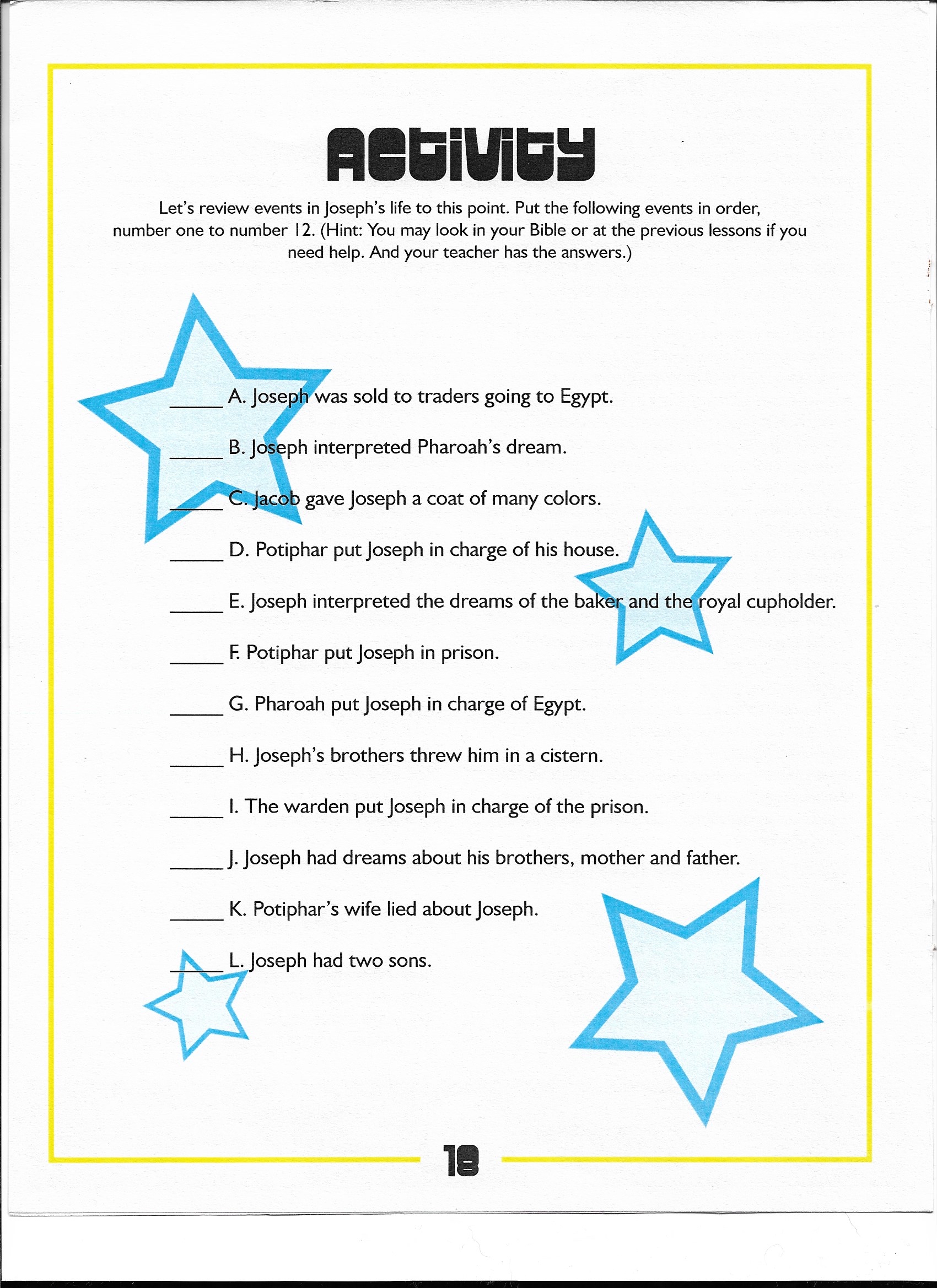
Student Activity Answers: 4A, IOB, IC, 5D, 9E, 7F, 11G, 3H, 81, 2J, 6K, 12L
REACH Activity
Back to the Bible: Boasting
The quotation in 1 Corinthians 1:31 is taken from Jeremiah 9:23-24, “Thus says the LORD, ‘Let not a wise man boast of his wisdom, and let not the mighty man boast of his might, let not a rich boast of his riches; but let him who boasts boast of this, that he understands and knows Me, that I am the LORD who exercises lovingkindness, justice, and righteousness on earth; for I delight in these things,’ declares the LORD.”
Joseph had risen to power twice - once in Potiphar’s house (Genesis 39:4-6) and again under Pharaoh (Genesis 41:41-44). But none of this was due to Joseph alone. God granted him favor. God orchestrated the events. Joseph’s job was to obey God, to do what was right in God’s sight to the best of his ability. God would take care of the rest.
So do you boast about what you have, how good your grades are, or your appearance? What are those worth compared with knowing God? Write about this in your Bible notebook.
Journal Jot: God’s Favor
Have you ever needed God’s favor - selected for an honor or job, good marks on a project, willingness of a teacher or employer to work with you when you were getting ready to go to the Feast of Tabernacles, etc? Think of a time when you prayed for God’s blessing on something and it went really, really well. Write about this in your Bible notebook. Then, even if you remembered to thank God for the outcome at the time, thank Him again now for His blessing!
Word Study: peh
Genesis 41:40 says, “You shall be over my house, and according to your command all my people shall do homage; only in the throne I will be greater than you” (NAS). The word “command” is peh in Hebrew and literally means “mouth.” In other words, whatever Joseph said, whatever came out of his mouth, was the same as a law. Except for Pharaoh, all of the people in Egypt would do exactly what Joseph said.
Joseph had to be very careful (thoughtful and precise) about what he said. Similarly, Matthew 12:36 says that we will be judged by every word we speak. We need to be very careful to speak the truth in love, guarding our tongue against every careless word.
What do you think? Writing out your thoughts before you speak them is a great idea. Write about this in your Bible notebook. Then share your thoughts with your family.
Just Toolin’ Around: Speak
Ecclesiastes 5:2 says, “ . . For God is in heaven and you are on the earth; therefore let your words be few.” What do you think that means? Using a commentary resource, read what some scholars think this means. Ask your parents what they think it means. Then write a bumper sticker which advocates for weighing your words carefully, speaking wisely, or refraining from speaking at all in certain circumstances. Sketch the bumper sticker designs in your Bible notebook. Choose the one which appeals to you the most and create it. Display it where you can see it often.
Did you Know? Symbols of Power
There were three symbols of power in the ancient Near East: the signet ring, the robe, and the gold chain. Haman was given the signet ring of King Ahasuerus (Esther 3:10) and Zerubbabel is called God’s signet ring (Haggai 2:23). The robe of the king was given to Mordecai to honor him (Esther 6:8-11) and Jonathan gave David his robe (1 Samuel 18:4) possibly to indicate that he knew David would be king instead of him. The king of Babylon offered a gold chain and the third highest position in the kingdom (Daniel 5:7, 16, 29). Pharaoh did all three for Joseph!
Stretch It Out: Storyboard
The student activity for this lesson is sequencing the events of Joseph’s life. Once you have put them in the correct order, make a story board (comic strip style) of the events. Add conversation bubbles, if you desire. Use your storyboard to retell Joseph’s life to a younger sabbath school class.
Music Notes: O God, Our Help in Ages Past
This hymn is on page 27 of the CEM Hymnal.
Isaac Watts believed that the songs sung in church were far too dull and slow. He wanted them to reflect joy and life. When he complained about the state of the music to his father, his father challenged him to do something about it. Isaac Watts then set a goal to paraphrase the psalms and include references to Jesus Christ and the Christian walk.
Write the words to this hymn in a column on the left-hand side on a page in your Bible notebook. On the right-hand side, make notes about ties you see to the verses in Psalm 90. Do you think Isaac Watts did a good job of paraphrasing this psalm?
Sing this hymn with an attitude of thankfulness at God’s help no matter what difficulties we face!
Questions?
Write down any questions you have in your Bible notebook so that you can remember to ask your parents or your pastor.
Song
"My God Is So Big" is on page 14 of Kids Classics Collection.
Closing Prayer
Lead the students in prayer asking for God's guidance in their lives always, and His mercy in teaching them to follow Him.
Printable Pages