YEA Lesson Library
Handling Christmas
About This Lesson
This lesson teaches that God doesn’t want His people to celebrate Christmas and how the student can reach people with God's love, even at Christmas time.
Scriptures
Deuteronomy 15:11
Jeremiah 10:2-5
Matthew 5:20
Matthew 25:35-46
Acts 20:35
1 Corinthians 10:19-21
James 1:22-27
Words to Know
DRUIDS - a member of a Celtic religious order of priests, soothsayers, etc.
SATURNALIA - the ancient Roman festival of Saturn, held about December 17, with general feasting and revelry in celebration of the winter solstice.
SOLSTICE - the time at which the sun reaches its farthest northern or farthest southern point.
The Lesson
We returned from the Feast of Tabernacles this year to see stores being dismantled and decorated for Christmas while shelves were being stocked with decorations and possible gift items. By Halloween, Christmas trees were decorated and lights turned on. Isn't that a little early?
Brace yourselves! The jangling Salvation Army bells will soon be ringing at the entrance of virtually every shopping mall, grocery and other stores. Church leaders will cry out to "Put Christ back in Christmas" this year. But was Christ ever really in Christmas?
Get your concordance out and look for the word "Christmas." It's simply not in your Bible. But maybe the Christmas tree is. In Jeremiah 10:3-5 we find, "For the customs of the people are worthless; they cut a tree out of the forest, and a craftsman shapes it with his chisel. They adorn it with silver and gold, they fasten it with hammer and nails so it will not totter. Like a scarecrow in a melon patch, their idols cannot speak, they must be carried because they cannot walk. Do not fear them; they can do no harm nor can they do any good" (NIV). Hmm, this really sounds like a Christmas tree, but it's in the Old Testament before Christ was ever born.
Episcopal priest Earl Count wrote a book titled 4,000 Years of Christmas: A Gift From the Ages (1997). But wasn't Jesus born more like 2000 years ago? Yep. You've got it. So what does this mean? This book shows that people were exchanging gifts, following the same customs to celebrate the ancient Roman Saturnalia as people are doing in the 21th century to celebrate Christmas. Earl Count outlines how mistletoe was adopted from Druid mystery rituals and that December 25th has more to do with Saturnalia, or worshiping the sun, than with celebrating the birth of Jesus. He relates historical connections between the exchanging of gifts on the 12 days of Christmas and customs originating in ancient, pagan Babylon 4,000 years ago.
Many ancient religions conducted festivals at that time of the year, the time of the winter solstice in the northern hemisphere, when days are the shortest, to appease the various gods to restore the sun and bring an end to winter. Nowhere in the New Testament do we see Jesus' disciples observing Christmas. As late as the third century a Catholic theologian named Origen declared that it was a sin to celebrate Christmas because of its pagan connections.
The Apostle Paul warns us to avoid having anything to do with pagan religious customs. He calls these actions to be having fellowship with demons. "What am I saying then? That an idol is anything, or what is offered to idols is anything? Rather, that the things which the Gentiles sacrifice they sacrifice to demons and not to God, and I do not want you to have fellowship with demons. You cannot drink the cup of the Lord and the cup of demons; you cannot partake of the Lord's table and the table of demons” (1 Corinthians 10:19-21).
Thousands of pagans were outwardly converting to Christianity. But they refused to give up their former religious rituals and ceremonies. They held dear the ancient Roman festival that was celebrated during late December in honor of Saturn, the god of agriculture. Dr. Count sums up this historical struggle: “To the pagans, the Saturnalia were fun. To the Christians, the Saturnalia were an abomination in homage to a disreputable god who had no existence anyway. The Christians, moreover, were dedicated to the slow, uphill task of converting these roistering pagan Romans."
So what does all of this have to do with you and the days you celebrate? First, don't allow yourself to fear and worry. Realize that for a lot of people, Christmas isn't a big deal. In fact, the world is full of people who, like yourself, don't care for the frantic pace and gift-giving of Christmas. And many Christians, who attend church on Sunday and observe Christmas each year, probably see this celebration as being greatly commercialized. In addition to those Christians, there are Jews, Muslims, and people of other religions who do not keep Christmas. So relax, you're certainly not alone.
With these things in mind, how do you handle the Christmas situation with your friends and peers? Religious tolerance is taught in schools today. So don't make a mountain out of a molehill. When your friends ask about what you're doing for Christmas, let them know that you're not interested in keeping up with all the Christmas bother any more. And Christmas is a lot of bother.
I once sold real estate for commissions only. That meant that my broker paid me nothing if I didn't sell and close on the property. Other agents in the office were frantic at Christmas trying to earn a living, going to all the parties, shopping for presents, and preparing the many special meals for house guests expected at that time of the year. December was often a high month in sales for me. My co-workers noticed that I calmly went about my work during this season. Sometimes I could even show an agent's customers’ homes and split the commission with him. Before the season was over, other agents were envious of me and remarked that they were "going to join my church so they wouldn't have to keep Christmas." So calmly go about your business, be cheerful, and see how many poor people you can help. Who knows, you may become the envy of your friends who keep Christmas.
We know that "it is more blessed to give than receive." And we should all give generously throughout the year. But count your blessings that you don't have to be in the crazy traffic and crowds that are irritable and pushy, trying to buy a gift that probably won't please the recipient, on a credit card that you'll pay for over many years. Think about it. God has solved a major problem for you. Not only does He give you the wonderful blessing of celebrating the Feast of Tabernacles for seven days, He's saved you from the enormous hassle and burden that Christmas is. Be thankful and rejoice in God's love!
Student Prayer
Gracious Father,
Thank you so much for revealing to me your holy days so that I don't have to celebrate Christmas. You've given me a greater blessing and have saved me from spending money that I don't have on gifts for people that they probably won't like. I can calmly go about my life during this season and do things that are productive.
In Jesus' name I pray.
Amen.
Daily Devotions
Sunday - Jeremiah 10:2-5
Monday - 1 Corinthians 10:19-21
Tuesday - Acts 20:35
Wednesday - Matthew 5:20
Thursday - Matthew 25:35-46
Friday - James 1:22-27
Saturday - Deuteronomy 15:11
Objectives
At the end of this lesson, students will be able to:
1. Take a proactive rather than a self-righteous approach towards Christmas.
2. Explain the origins of Christmas and why Christ has better things for them to do.
Topics & Themes
Christmas
Holidays, Christmas
Pagan Traditions
Materials Needed
Bible, YEA Students' and Teacher's books, attendance and memory verse charts, songbook, CD or cassette tape, music player, pencils, prizes, timer, newsprint pad, marker
How to Teach This Lesson
After opening the class with prayer, divide your class into groups of four and give each group three pieces of paper. Explain that they are to write "Reasons God would not have us keep Christmas" at the top of one paper. At the top of the second paper, they are to write "Good things other churches do in their community during the Christmas season." On the third piece of paper, they are to write, A" community service project for our class." Each group is to go to separate areas of the room and appoint one person to write down the things on each paper as their group brainstorms and gives their points or answers. Give them 12 minutes to complete this project. Set the timer. When the timer goes off, call the students to sit in a semicircle to discuss their answers.
Debrief - Ask: How did you feel about this project as away to focus on why a Christian shouldn’t celebrate Christmas? What did this mean to you? How was this experience like or unlike other aspects of your life? What scriptures can you come up with that reinforce your belief in why you should not observe Christmas? Have a student read Jeremiah 10:2-5.
Good things other churches do - Ask: How did you feel about listing all the good things other churches do during the Christmas season? What did you come up with? List these on the newsprint pad. This list will likely include helping out at soup kitchens on Thanksgiving or Christmas; doing food drives for the poor and needy; taking up collections for safe havens that provide shelter for battered; helping flood, tornado, or hurricane victims; helping people in the community who have had the misfortune of a house fire; helping with Special Olympics; collecting coats and toys for poor children, etc. How many of these things has our church done throughout the year? List the things the students give you on the pad. Ask: Do you think we sometimes feel superior to other churches because we don't keep Christmas? What do the two lists say about us? Ask a student to read Matthew 5:20. Ask: What does Christ look upon as righteous deeds? Ask a student to read: Matthew 25:35-46. What does this scripture say we should be doing?
Community service project - Have one person from each group read their list of community service projects they made. List these on the newsprint pad as well. Tell them you have one idea you'd like to throw into their discussion. Suggest that they get wheelbarrows to push around in neighborhoods collecting food for their local food pantry. Should they encounter someone at the door who can't or refuses to contribute, invite them to take whatever they need from your wheelbarrows. If they don't have help at a soup kitchen on Christmas day, suggest it be added as well. Now take a vote from your class to determine: 1) Which group had the best list of reasons not to celebrate Christmas, 2) which group had the best list of good things other churches do, 3) and what service project they would like to do in their community. Give a prize to the groups who won numbers one and two. Now plan the service project determining what, when and how they will go about it. Give guidance as the class needs it, but encourage them to do the planning.
Application - Ask: How much better do you think you will feel by being proactive and helping others in need during the Christmas season than condemning others for keeping it? How much better do you think Christ will feel about you for helping others than for feeling sorry for yourself because your school friends are celebrating Christmas? What actions are going to last for all eternity?
Teacher-Directed Activity
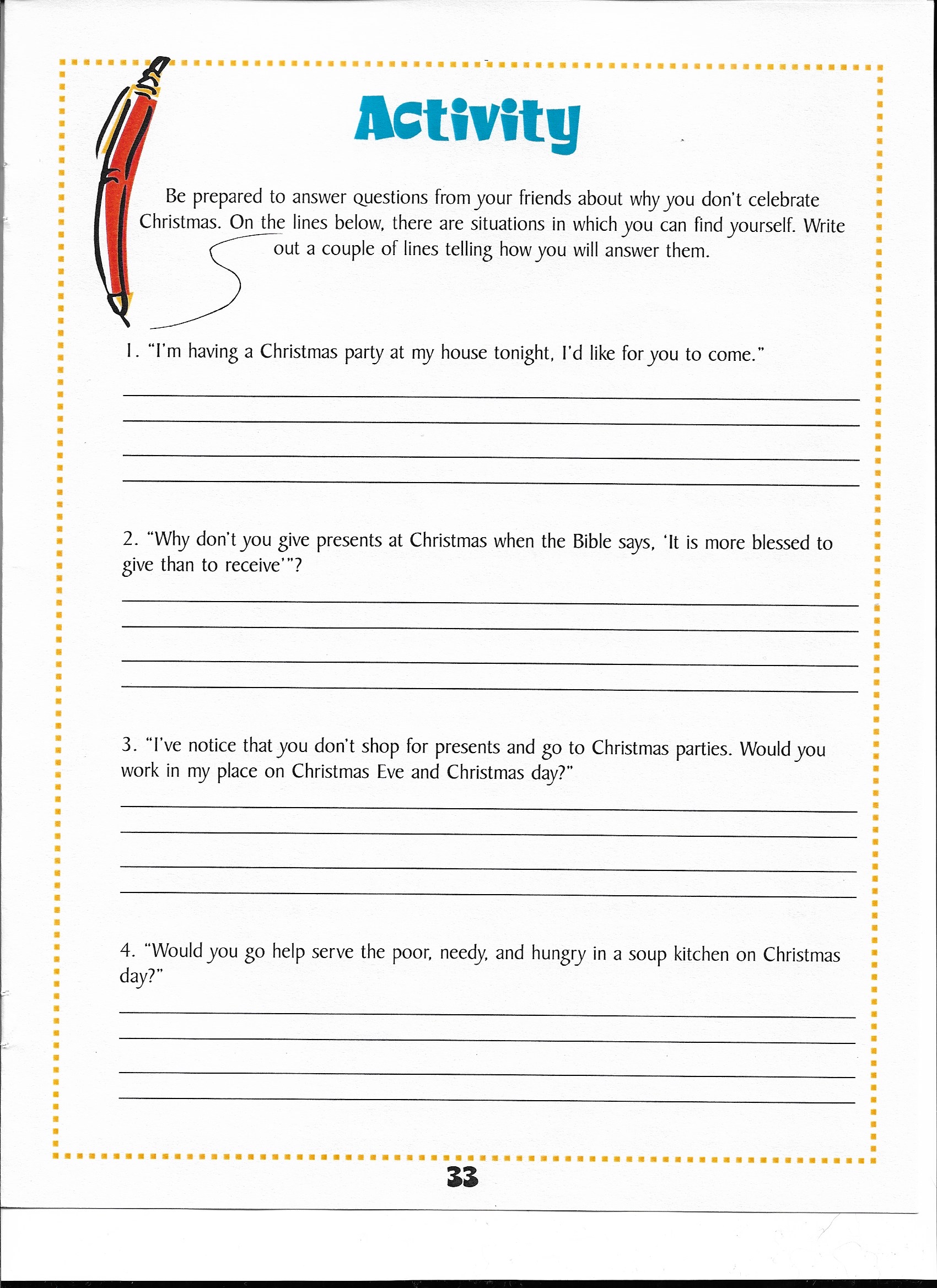
Go over the Activity in the students' book with your class. If time permits, read Background to your students.
REACH Activity
Memory Verse Spotlight: Acts 20:35
Look up the word “blessed.” Write down the Greek word and its meaning. Then find three other Scriptures where this word is used.
Write this word and its meaning in your Bible notebook. Make notes about the other locations where you find it in the Bible.
Where in the World? Christmas customs
What are the major customs associated with celebrating Christmas? What are the origins of these customs? What do any of them have to do with Jesus’ birth? Are any of them in the Bible? Write down what you discover in your Bible notebook.
They Did What Back Then? Saturnalia
Research the celebration of Saturnalia. When was it celebrated? How was it celebrated? How does it relate to Christmas? How does it relate to the birth of Jesus Christ?
Making It Mine: Give or Receive
Most people would rather receive gifts than give gifts to others. (Sometimes, however, you find someone who is extremely generous and would rather give than receive.) So what about you? Would you rather get lots of things, gifts of time or money or activities? Or would you rather give to others?
During the Christmas season, many people go deeply into debt to make sure they buy gifts for everyone. Even if you are very generous, that doesn’t seem like a wise way to live. It sounds stressful. And why are they giving? Are they made to feel guilty if they don’t give gifts to all of these people? And why are they giving anyway? If it’s Jesus’ birthday, shouldn’t He be the one getting gifts?
Here’s the other thing: Read Matthew 16:26. What are you gaining? What are you losing? Write about this topic in your Bible notebook.
Worldview Collisions: Christmas celebrations
One worldview says that Christmas is completely harmless. Since we don’t know exactly when Jesus was born, what does it matter when we celebrate it? Besides, everyone does it. And besides, there are so many wonderful family memories made from celebrating Christmas together.
One worldview says that, as long as you don’t have any mention of Jesus, it’s okay to celebrate it because it’s just a good time with family and friends.
One worldview says that, as long as you get rid of Santa Claus, Christmas is fine because you are honoring the birth of the Savior of the world. Just put Christ back in Christmas.
Another worldview says that it does matter that we don’t know when Christ was born. Furthermore, there are clues that it certainly wouldn’t have been on December 25th, the date of a pagan celebration. Also, just because people have fun doesn’t mean it is right or pleasing to God. Something that is not true is certainly not honoring to God no matter how much you want it to be. Making memories and continuing family traditions shouldn’t be connected to a pagan holiday - if you are truly seeking God.
What do you think? Which worldview makes the most sense to you? Ask your family. What do they think? Write about this topic in your Bible notebook.
Questions
As you’re working through the YEA lesson, Daily Devotionals, doing the activity, or reading the Bible, be sure to write down any questions you have. That way you’ll remember to ask someone. Also remember to share the really interesting things you’re learning with family and friends.
Song
"Love Round" is on page 15 of The Group Songbook.
Closing Prayer
Have the class form a circle and join hands. Ask for a volunteer to lead in prayer thanking God that Christmas presents them with a time to be proactive and to be doers of the word and not hearers only.
Printable Pages