YEA Lesson Library
Follow the Standard
About This Lesson
This lesson teaches that Halloween is pagan and is found in the Bible as something God wants to be celebrated.
Scriptures
Leviticus 23:34-36
Deuteronomy 12:29-32
1 Samuel 15:23
1 Kings 12:25-33
Malachi 3:6
1 Corinthians 3:11
Philippians 4:8
James 1:16-17
Words to Know
DISSEMINATION - to spread abroad as though sowing seed
The Lesson
How do you know what is the exact time? You may look at your wrist watch or you may check the clock on the wall. One may say it's three minutes past two, and the other may tell you that it is two minutes before two. So which one is right? There has to be a standard to determine if your watch is correct or the clock on the wall is right. So where do you go to see which one is right, or if they are both wrong?
"Precise Time and the Master Clock” says, "The U.S. Naval Observatory (USNO) is charged with the responsibility for precise time determination and management of time dissemination.” You will find this article interesting and may want to check it out on the web and read it.
In the same way as the U.S. Naval observatory is charged with the responsibility for precise time and has the "Master Clock," God is charged with the responsibility for setting the standard for what is precisely right and what is wrong. His standards are laid out in the Bible. As part of His standard, God has included days for us to celebrate.
As a part of God's standards, He commands a celebration of an autumn festival. We call it the Feast of Tabernacles. "On the fifteenth day of the seventh month the LORD's Feast of Tabernacles begins, and it lasts for seven days. The first day is a sacred assembly, do no regular work. For seven days present offerings made to the LORD by fire, and on the eighth day hold a sacred assembly and present an offering made to the LORD by fire. It is the closing assembly; do no regular work" (Leviticus 23:34-36, NIV).
Halloween is celebrated in America on October 31 of each year. This is about a month after the Feast of Tabernacles. The celebration includes many things such as decorations, costumes, food, trick or treating, carnivals, etc. Doing these things may seem like a lot of fun. On the surface they may seem perfectly harmless. But does celebrating this day Follow the Standard? Should you as a teenager participate in the celebration of Halloween? To answer those questions, you'll have to dig deeper than the surface.
You will recall from other YEA lessons and from reading your Bible that Jacob had 12 sons whose families grew into the 12 tribes of Israel. After a number of years, the 12 tribes of Israel split into two tribes - the Northern and the Southern Tribes. Benjamin and Judah remained with King Rehoboam. All of the other tribes followed King Jeroboam who didn't Follow the Standard. He made two golden calves as pagan gods to worship. He didn't Follow the Standard God had laid out concerning the priesthood, and he appointed priest who were not Levites. Then he changed the Feast of Tabernacles to be a month later (I Kings 12:25-33). This threw the Feast about the time Halloween is celebrated today. This isn't saying that Halloween started here. But it is saying that among other things, King Jeroboam didn't Follow the Standard for the time to celebrate God’s Feast. The Standard, God's Word, commands us to keep a Feast in the seventh month, not the eighth month.
Let's notice three things about God's command to keep the Feast of Tabernacles: I) This Feast is in the seventh month. 2) It is for seven days. 3) There is nothing said about dressing up in costumes, trick or treating, or decorating your house with witches, spiders, cats, and scary things. It's not a morbid, scary feast about death, witches, evil spirits, spiders, and demons. The Feast of Tabernacles is to be a joyful Feast. Paul told us in Philippians 4:8 "Fix your thoughts on what is true and good and right. Think about things that are pure and lovely, and dwell on the fine, good things in others" (TLB). God intends for the Feast of Tabernacles to be a lot of fun with no regrets. That is not the case with Halloween. All too often people get hurt with Halloween pranks or from sharp or harmful objects in trick or treat candy.
"The earliest Halloween celebrations were held by the Druids in honor of Samhain, Lord of the Dead, whose festival fell on November I” (Halloween Through Twenty Centuries, by Ralph Linton, pg. 4). "In many Catholic countries the belief that the dead return on this day is so strong, that food is left on the tables and people still decorate the graves of the dead (on this day)" (Dictionary of Folklore, Funk and Wagnalls, .v ,1 p. 38).
Weeks before Halloween, schools, many stores, homes, yards, and other places are decorated with weird lanterns, witch-balls, and witches cauldrons. Halloween decorations can be as important as the food for this celebration. To create a scary, spooky setting the room may be dimly lit (preferably by candle and firelight); the decorations must be bold to be effective. The colors of orange, black, and red are carried out as far as possible. Paper streamers and lanterns may be hung from the ceiling. If a person would like to have something more unusual, they might make a giant spider's web with a large spider. Large silhouettes of bats, cats, owls, and witches on broomsticks may decorate walls.
So where did Halloween come from? The testimony of history stamps Halloween as a heathen festival. It does not Follow the Standard, but it is built on a pagan foundation. 1 Corinthians 3:11 says, "For other foundation can no man lay than that is laid, which is Jesus Christ." Before Israel entered the Promised Land, God warned them against using the things to worship Him that heathen nations used in worshiping their gods. "You must not worship the LORD your God in their way, because in worshiping their gods, they do all kinds of detestable things the LORD hates. They even burn their sons and daughters in the fire as sacrifices to their gods. See that you do all I command you, do not add to it or take away from it" (Deuteronomy 12:29-32). Those who celebrate Halloween do not Follow the Standard. They are adding things to the Bible that God never said we are to do. So Follow the Standard.
Student Prayer
Righteous Father,
Thank you for giving us the Standard whereby we should live. If I will follow the Standard you've laid out, I will avoid so many bad consequences and enjoy the awesome blessings you want me to have. Thank you for showing me the evils of Halloween. I purpose to keep your Feast in the seventh month as your Standard shows.
In Jesus’ name I pray.
Amen.
Daily Devotions
Sunday - Leviticus 23:34-36
Monday - Deuteronomy 12:29-32
Tuesday - 1 Kings 12:25-33
Wednesday - 1 Corinthians 3:11
Thursday - Philippians 4:8
Friday - 1 Samuel 15:23
Saturday - James 1:16-17; Malachi 3:6
Objectives
At the end of this lesson, students will be able to:
1. State that the Bible is the standard on which we base what we do and which days we celebrate.
2. Give reasons why it is wrong to celebrate Halloween.
Topics & Themes
Blessings
Feast of Tabernacles
God’s Law
Halloween
Holidays, Halloween
Holy Days, Feast of Tabernacles
Obedience
Pagan Traditions
Materials Needed
Bible, YEA Students' and Teacher's books, attendance and memory verse charts, songbook, CD or cassette tape, music player, newsprint pad, marker, 30 items, plastic spoon, ladle, bucket
How to Teach This Lesson
After opening the class with prayer, divide the students into three teams equidistant from the bucket in the center of the room. Give each team 10 items and one set of directions (all directions are different on purpose). Tell them that when you say, “Go,” they are to read and follow the directions.
Debrief: Ask: How did you feel about the directions varying so much from one team to another? What’s the problem with having a different standard for the different teams? How was this experiment like or unlike some other aspect of your life? How is like or unlike the lesson you read for today’s class? Where do you find the standard that determines the right way to play the game? Where is our standard for telling us right from wrong? Does this standard change? Ask a student to read James 1:16-17. Ask a student to read Malachi 3:6. Where have we found these Scriptures? (Both in the Old and New Testament). What do they tell you?
The Standard - Ask: Then who or what is the Standard for right or wrong? Ask a student to read John 14:6. Have another student read John 17:17. Who can tell us what we’ve learned from this Bible study? Draw answers out of the students and write them on the newsprint pad. The answers should include: The Old and New Testament tell us that God the Father and Jesus Christ do not change and that God's Word is truth. On what kind of foundation do we base our beliefs? Ask a student to read 1 Corinthians 3:11.
Didn't Follow the Standard - Ask: What did we learn in today's lesson about a king of Israel who didn't follow the Standard? What did the Standard say about the date for keeping God's Feast? Ask a student to read 1 Kings 12:25-33. Who chose the day for this Feast? What did rebellious King Jeroboam do on this Feast?How did he not follow the standards?
Halloween - What time of the year is Halloween celebrated? What are some things that make it wrong in God's sight? List this on the pad as students give them? Let's do a contrast with the Feast of Tabernacles and Halloween. Ask every other student to tell something about Halloween observance, and every other one to give you something about the Feast of Tabernacles celebration. Write their answers on the pad as they give them. Ask: How do you see Halloween being a rebellion against God and His Standard? How does it get your mind on the wrong things? Have the students recite their memory verse at this point.
Teacher-Directed Activity
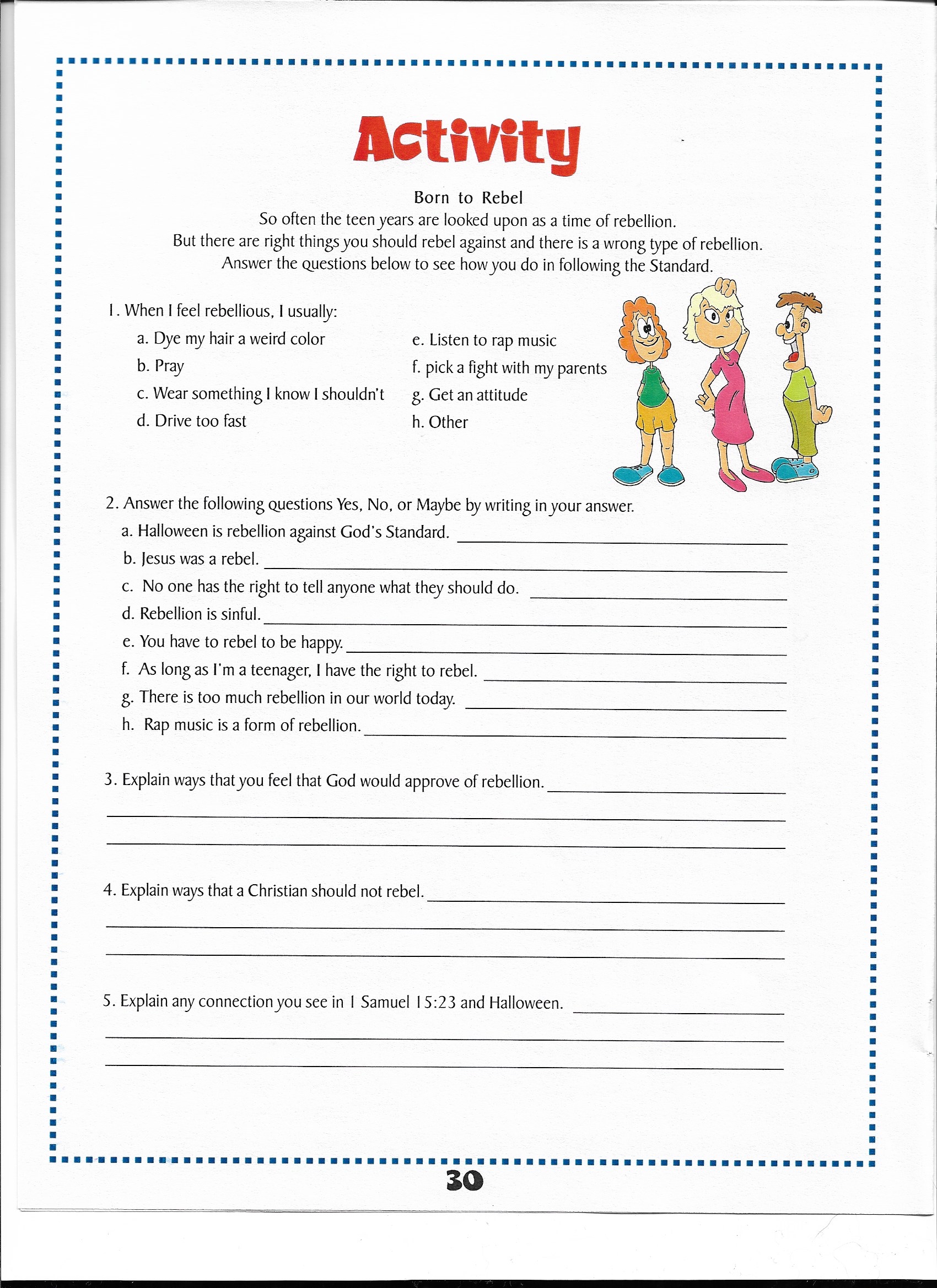
Go over the Activity in the students' book with the class. Ask: What are the consequence for rebelling against God and celebrating Halloween? What are the benefits from celebrating God’s Festivals? Ask a good reader to read Deuteronomy 28:1-13.
REACH Activity
Memory Verse Spotlight: Philippians 3:8
Look up the phrase “fix your thoughts” in five other Bible translations. Write out this verse from those translations in your Bible notebook. Be sure to include which version each one is. Then compare the words. Which translation seems the most accurate? Which one is easiest to understand? Which one do you like?
Where in the World? Halloween Origins
Do some research into the origins of Halloween. Where did it come from? What people observed it? What was the attitude towards Halloween early in the history of the U.S? Record what you learn in your Bible notebook.
They Did What Back Then? Halloween Activities
Continue your research into the activities that were part of the original celebrations of Halloween. Why did these people do these things? What kinds of activities are part of Halloween today? Why do people do these things? Record what you learn in your Bible notebook.
Making It Mine: Halloween
Satan is so good at presenting pagan things in a positive light. He makes it look fun. He tries to make people feel guilty for not letting their kids enjoy something “fun.” Then he uses the argument that it’s just harmless - what could it possibly harm to dress up like a ghost or a demon? Next, he appeals to the idea that “everyone” is doing it. So many people get involved in Halloween that it is a big money-maker for stores selling costumes and candy and decorations. Finally, Satan tries to convince people that if it doesn’t look bad, it’s not bad. That’s why some churches dress it up as trunk or treat. Obviously that doesn’t change its pagan origins.
Here’s the deal: Are you interested in pleasure for the short-term? Or are you interested in pleasing God and living forever? Do you want to totally disregard God’s commandments to avoid paganism because you want candy and costumes? Or are you going to choose God’s ways because He’s God? Don’t be deceived: outright rebellion to God’s commands will not turn out well for you.
Write about this topic in your Bible notebook. Think carefully about the choices you make. They will have long-lasting consequences.
Worldview Collisions: Harmless or Harmful
A secular worldview says that Halloween is just harmless fun. Kids get candy. People dress up in silly costumes. There should be one day a year when you get a free pass to be as wicked as you possibly can be. (I actually heard a radio announcer say that one year!!)
A Biblical worldview says that, even if we don’t understand why, God says not to observe pagan customs. We are not to dabble in them. We are not to incorporate any of the pagan customs into our lives. And if God is truly our God, then we trust Him and obey Him in all things, even if it means missing out on something that looks fun. We trust God that, in the end, it’s not fun or good or right.
What do you think? What is your worldview?
Questions
As you’re working through the YEA lesson, Daily Devotionals, doing the activity, or reading the Bible, be sure to write down any questions you have. That way you’ll remember to ask someone. Also remember to share the really interesting things you’re learning with family and friends.
Song
“Cornerstone” is on page 11 of The Group Songbook.
Closing Prayer
Have the students form a circle and join hands. Go around the circle and let everyone give at least one reason why a Christian should not celebrate Halloween. Lead in prayer thanking God for giving us His unfailing Standard to follow.
Printable Pages