YEA Lesson Library
What’s the Difference?
About This Lesson
This lesson teaches that while both Passover and Atonement picture Jesus atoning for sins, Passover is personal and the Day of Atonement is national or communal.
Scriptures
Exodus 12:3-13
Leviticus 16:20-34
Leviticus 16:34
Numbers 16:46
2 Chronicles 7:14
Psalm 103:8-12
Luke 22:20
John 3:15-17
2 Peter 3:9-10
Words to Know
ATONEMENT - covering for our sins
SCAPEGOAT - azazel; this goat carried the sins of the people into the wilderness
HOLY OF HOLIES - or Most Holy Place; where the Ark of the Covenant was kept
The Lesson
Have you ever wondered What's the Difference between Atonement and Passover? Why does God give us rituals and ceremonies for two days that seem so similar? Both days symbolize Christ removing our sin, both days are somber and serious, and both days are days that God commanded us to keep. So, What's the Difference?
Starting in Leviticus 16, God explained to Moses how Aaron, the High Priest, should make atonement for himself and his family, and for the people. God detailed instructions for the High Priest to follow exactly like he gave them. He was not to go into the Holy of Holies where the Ark of the Covenant was kept except once a year on the Day of Atonement or he would die. That was because God was there in a cloud over the Atonement cover. The following outlines instructions God gave the High Priest for the Day of Atonement:
1. Bathe yourself and put on white linen garments.
2. Enter the sanctuary with a bull as a sin offering and ram for a burnt offering.
3. From the community of Israel, take two male goats for a sin offering and a ram for a burnt offering.
4. Ofer the bull for your own sin offering making atonement for yourself and your family.
5. Take the two goats and present them before the Lord at the entrance of the Tent of Meeting. Then cast lots to determine which goat would represent the Lord in the Atonement ceremony and which one would be the scapegoat.
6. Choose by lot the goat to represent the Lord so it will be sacrificed.
7. Don't kill the scapegoat. The goat chosen by lot to be the scapegoat shall be kept alive to be sent into the desert.
8. After the bull is killed as a sacrifice for your sins and the sins of your family, you take a censor full of burning coals from the altar, two handfuls of finely ground fragrant incense behind the curtain in the Holy of Holies. This smoke will prevent you from seeing God and dying. (No physical human being can look upon God and live.)
9. Then take the bull's blood with your finger and sprinkle it on the front of the atonement cover and sprinkle it seven times before the atonement cover.
10. Slaughter the goat for the sin offering for the people and take the blood behind the curtain and do like you did with the bull's blood. This was to make atonement for the Holy of Holies because of Israel’s uncleanness, rebellion, and sins. No one can be in the Tent of Meeting from the time you go in until you come out from making atonement for yourself, your family, and the whole community of Israel.
After all of this was completed, Aaron went outside and laid both his hands on the scapegoat and confessed over it all of the wickedness, rebellion, and all of the sins of Israel. This ceremony was to symbolically put all of the sins of Israel on this goat’s head. Then this goat was sent into the desert to be released in a solitary place. This ceremony shows that our sins are removed as far as the east is from the west.
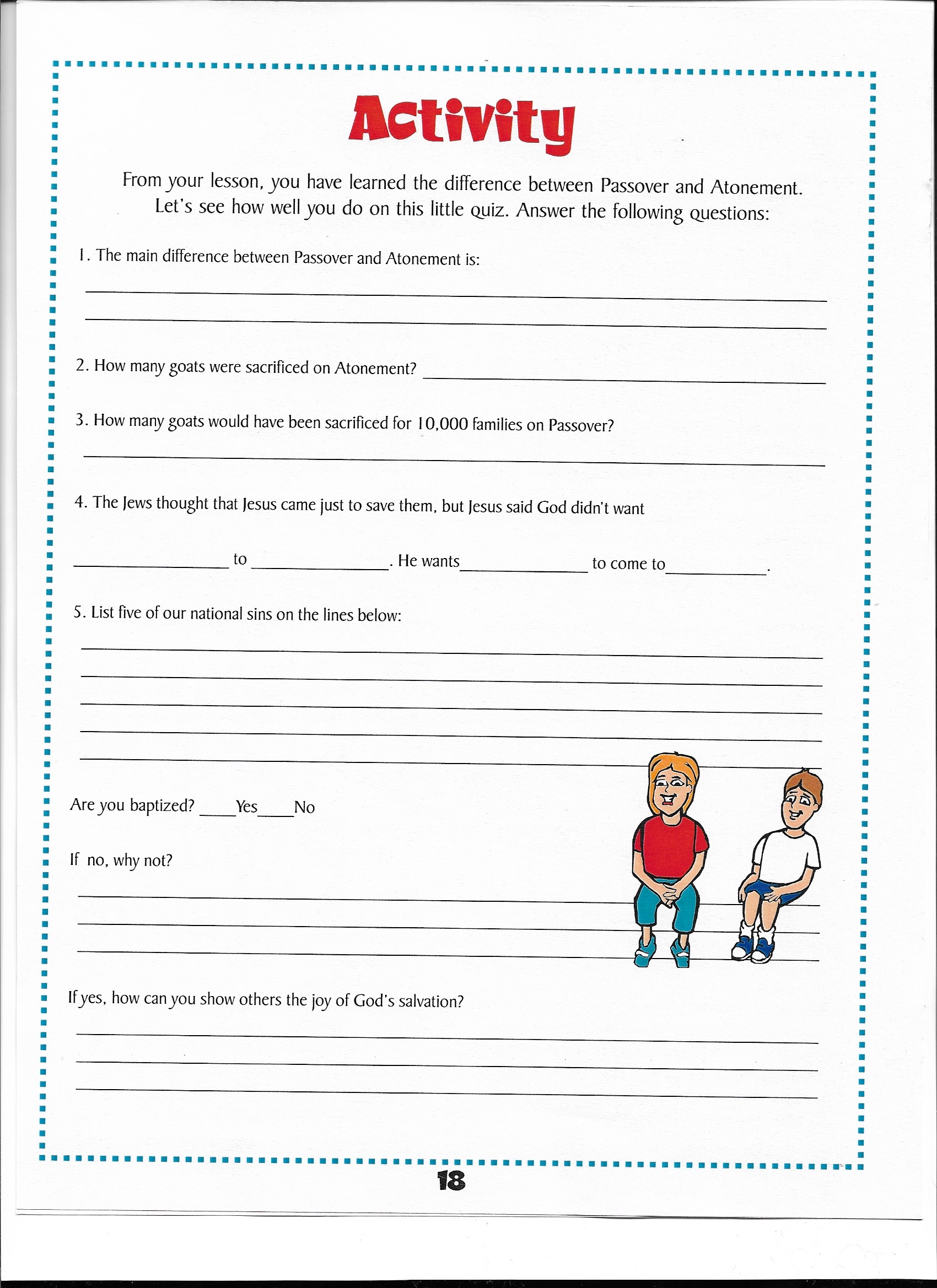
So What's the Difference between Passover and Atonement? On the original Passover night, the blood of a lamb was required for each family, meaning a lot of goats were killed. God spoke to Moses and Aaron in Exodus 12:3. "Tell the whole community of Israel that on the tenth day of this month each man is to take a lamb for his family, one for each household." In Luke 22:20 Jesus says. "This cup is the new covenant in my blood, which is poured out for you." From these verses we can see that Passover is a personal rite or ceremony.
Both days involved animal sacrifices and both point to Christ, but Atonement is national or communal forgiveness (Leviticus 16:16) while Passover shows the forgiveness of sin for the individual. This is the main difference between Atonement and Passover. At the Passover, you take the bread, you take the wine, and in doing so, you acknowledge that Christ suffered and died for you and your sins. If you were the only person alive and you committed just one sin, Christ still would have died.
Passover reminds us that Christ's sacrifice is very personal. Atonement is for our national sins which need to be forgiven. What are some of our nation’s sins? Just for starters they are greed, killing off more than 40 million babies through abortion, getting rid of God in our schools, public life, etc. If our nation came before God on the Day of Atonement asking forgiveness of our nation's sins then they could be symbolically put on the head of the goat that is sent into the desert and let go. Our nation's sins would be removed as far as the east is from the west. God would forgive us and our nation would be blessed. But there would be one requirement: We must stop doing them!
Student Prayer
Gracious Father,
You have done something amazing by sending your Son to save the world. As I keep the Day of Atonement, I humbly accept His sacrifice and acknowledge that it was not only for me that He died, but for everyone. Help our nation to recognize its sins and to repent of them.
In Jesus' holy and righteous name.
Amen.
Daily Devotions
Sunday - Leviticus 16:20-34
Monday - Exodus 12:3-13
Tuesday - Luke 22:20
Wednesday - John 3:15-17
Thursday - Psalm 103:8-12
Friday - 2 Chronicles 7:14
Saturday - Numbers 16:46
Objectives
At the end of this lesson, students will be able to:
1. Explain the main difference between Passover and Atonement.
2. List similarities between Passover and Atonement.
Topics & Themes
Atonement
Day of Atonement
Forgiveness
High Priest
Holy Days, Atonement
Holy of Holies
Jesus, Lamb of God
Passover
Sin
Materials Needed
Bible, YEA students' and teacher's books, attendance and memory verse charts, music player and CD or cassette, songbook, paper, pencils, at least one scripture about Christ's atoning sacrifice for each student
How to Teach This Lesson
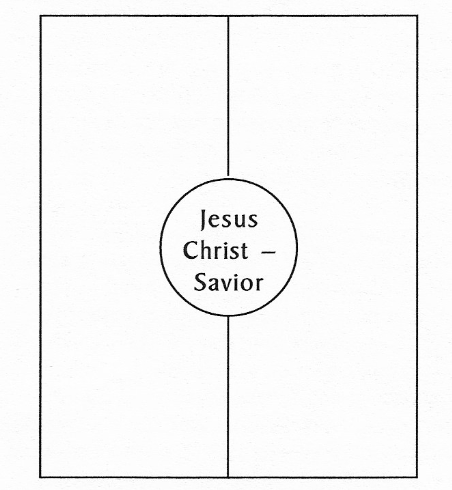
After opening the class with prayer, divide the class into groups of four. Give each group a different list (book, chapter, and verse only - have them look each verse up themselves) of four or five scriptures that mention salvation, redemption, or atonement (any dealing with Christ's sacrifice and how His death provides forgiveness of repented sins). Try to have plenty from the Old Testament, as well as the New. Give each group a piece of paper and tell the students to draw a circle in the middle. Then have them draw a line from the top of the paper to the top of the circle and from the bottom of the circle to the bottom of the paper. In the circle have them write "Jesus Christ - Savior." Instruct each group to write the scriptures which are more personal in nature on the left side of the paper and the ones more communal and general on the right. When they finish, ask each group to share the scriptures they were assigned and what side they put them on.
Debrief - Ask: How did you feel about doing this project? What are some similarities between Passover and Atonement? What are some differences? How do you think this is like or unlike things you have seen?
What can we learn? - How did you feel about God requiring the High Priest to carefully follow the instructions He laid out or he would die? What can we learn from this? How is this like or unlike other aspects of life? What does this mean to you? Why do you think God provided national or communal forgiveness through Atonement? Why should a nation or community need forgiveness, can it sin? What are some of our national sins? When sins are tolerated in a community or nation, how does it impact others? Can you think of a city in the Bible that got so evil that God had to destroy it? Can you think of a city in the Bible that repented of their sins and they didn't suffer the prophesied consequences? Say: Pharaoh had all of the boy babies put in the Nile River to die. Can you think of what the consequences were for this? (The first plague was turning the Nile into blood). What do you think will happen to our nation if we continue to kill off innocent little babies through abortion?
Application - Ask: What must a nation do to be forgiven of our sins? Ask a student to read 2 Chronicles 7:14-16. Who knows when this was said? (It was said at the dedication of the Temple by King Solomon on the first day of the Feast of Tabernacles.) What things can you do to help our nation seek repentance? Ask a student to read 1 Timothy 2:2. Ask: What is our responsibility to the leaders of our nation? Can we make a difference in whether we have a good president who will lead our nation with righteousness or end up with one who leads us into sin? What do you think a truly righteous nation would look like? What are you going to do to make our nation more pleasing in God's sight?
REACH Activity
Memory Verse Spotlight: Leviticus 16:34
Look up the word “all.” Write down the Hebrew word and its meaning. Then find three other Scriptures where this word is used. Is there any sin that would not be covered? Record what you find in your Bible notebook.
Where in the World? Atonement Rules
God was very specific in His instructions for the observance of the Day of Atonement. What did Aaron (the High Priest) have to do before he could go into the Holy of Holies? What was his clothing made from? What did the high priest have to offer for himself and his family to make atonement? What did he do with the incense? How many times did he sprinkle the blood of the bull? The goat of the sin offering that was killed was for what? (Leviticus 16:16). What was confessed on the head of the live goat of the sin offering? (Leviticus 16:21) Afterwards, what two things did the high priest have to do? (Leviticus 16:23-24)
Why do you think God was so specific about the observance of Atonement? Do you think God cares about how diligent we are to follow His law? Write an essay about this topic. Share it with your family and file it in your Bible notebook.
They Did What Back Then? Once in the Year
The high priest could enter the Holy of Holies just one day every year - on the Day of Atonement. He was the only one who was allowed to enter and when he was in there, he had specific tasks. Read Hebrews 9. As you read, take notes. Read carefully to think about the comparison that is being made about what the high priest did in the Old Testament and what Jesus, our High Priest, did for us with His death and resurrection. Write about this in your Bible notebook.
Making It Mine: Reconciled
Have you ever experienced a huge fight with a friend? Have you ever been able to forgive each other for the words that were spoken in the heat of anger? Have you ever been able to be friends again? Have you ever experienced forgiveness that completely wipes out the animosity and desire for justice? If you have, write about your experience in your Bible notebook. If you haven’t experienced this, talk with your parents. Have a discussion about how the ability to just let go of the anger and the conflict is a true gift from God. If you have never experienced this, you are not likely to completely understand how God can completely give you the ability to forgive. But can you imagine it? That’s what Jesus Christ did for us. His death completely wipes out the debt we owe to God because of our sin. Then Jesus’ resurrection to life makes it possible for us to be reconciled to God, to come boldly before the throne of grace in time of need. On this Atonement, thank God for making a way for us to not only be reconciled to Him, but also be adopted into His family. It’s absolutely incredible!
Worldview Collisions: National Sins
One Christian worldview is that we are strangers on this earth (1 Peter 2:11) and we should not get involved in the governmental affairs of our country (2 Timothy 2:4). We should keep our eyes focused on the Kingdom and serving God.
Another Christian worldview says that we are in the world, but not of the world (John 17:11, 14-15). That is, we live here, but we don’t conduct ourselves like the people who don’t know or love God. We still have to interact with people because how else would we make disciples of all nations (Matthew 28:19-20)? And as far as becoming involved with the governmental affairs, we have the examples of Daniel and Joseph who were very high up in the respective governments of Babylon and Egypt. Likewise, we are exhorted to pray for our leaders (1 Timothy 2:1-2) and the communities in which we live (Jeremiah 29:7).
What do you think? Think about the YEA lesson and its assertion that Atonement points to the forgiveness of national sins. Does that fit more with the first or the second Christian worldview? What responsibility do you have towards the country/community in which you live? Write about this topic in your Bible notebook.
Questions
As you’re working through the YEA lesson, Daily Devotionals, doing the activity, or reading the Bible, be sure to write down any questions you have. That way you’ll remember to ask someone. Also remember to share the really interesting things you’re learning with family and friends.
Song
"Create in Me aClean Heart" is on page 36 of The Group Songbook.
Closing Prayer
Have the students form a circle and join hands. Have each student give one of our national sins. Ask for a volunteer to lead in prayer asking God's guidance upon our president and our nation that it would repent of its sins and turn to Him.
Printable Pages