YEA Lesson Library
A Little Yeast
About This Lesson
This lesson teaches that during the Days of Unleavened Bread yeast represents sin. Each person should want to please God by not eating leavened products and by putting Him first always.
Scriptures
John 6:48-52
Romans 5:12
1 Corinthians 5:6-8
1 Corinthians 5:7-8
Galatians 5:9
Ephesians 5:1-21
Ephesians 6:10-18
James 1:15
Words to Know
CORRUPT - turn evil
SINCERITY - to really mean it, honesty
MALICE - mean-spirited
The Lesson
It was the middle of the Feast of Unleavened Bread and Sarah was in school. After her morning classes she plopped down beside her friends at lunch. Sarah's friend, Tasha, started talking about the birthday party she was planning that weekend. Instantly, the girls were rambling about the details.
"Oh yeah!" Said Tasha, I"almost forgot! My mom made a bunch of double peanut butter cookies for me last night. They're so good." She dug into her lunch bag and eventually pulled out a bag of scrumptious cookies. She gave each of her friends one and they each devoured their cookie, including Sarah.
As the girls finished their conversation and cookies, they began eating their lunches. Sarah's stomach dropped when she opened her lunch bag and pulled out the unleavened bread her mom had made her. "Oh no! I totally forgot about not eating leavening!”
Sarah told her mom about the cookie when she came home after school and asked her if she'd ever slipped up. Her mom answered. "It's really easy to do when you're used to eating whatever you want. That's one of the things that makes yeast such a good symbol for sin. You should ask God's forgiveness and try your best to remember not to ever do this again.”
Sin, just like tiny grains of yeast, will grow and invade other parts of your life if given the time and space to do so. The Feast of Unleavened Bread is a wonderful reminder that God wants us to remove all sin from our lives and replace that sin with righteousness. During the Feast of Unleavened Bread, leavened bread represents sin and unleavened bread represents Jesus Christ and His righteousness. Jesus said, "I am the Bread of Life."
Like yeast, sin is sometimes overlooked because it may seem small. Sin spreads and infects everything it touches, corrupting what was once good and pure.1 Thessalonians 5:22 says, "Avoid every kind of evil." Also, Ephesians 5:3 says, "But among you there must not be even a hint of sexual immorality or of any kind of impurity, or of greed, because these are improper for God's holy people." If we let sin remain in our lives it will separate us from God and draw us down the path to destruction. Think about this: Jesus still would have suffered and died for even one "little" sin of ours because that one sin would sentence us to eternal death.
In I Corinthians 5:8 it says, "Therefore let us keep the Festival, not with the old yeast, the yeast of malice and wickedness, but with bread without yeast, the bread of sincerity and truth." Malice is a state of mind that causes wicked actions. If we change our state of mind, we can change our actions." 2 Timothy 2:22 says, "Flee the evil desires of youth, and pursue righteousness, faith, love and peace, along with those who call on the Lord out of a pure heart." Fleeing is a verb, also known as an action word! We must actively choose to do right, and not wrong, putting God first in our lives.
In Matthew 16:6 Jesus told His disciples, "Be careful be on your guard against the yeast of the Pharisees and Sadducees.” The disciples, who could be a bit thickheaded at times, took Jesus literally, and had no clue what He was talking about. Jesus explained that He meant the false doctrines of the Pharisees and Sadducees. He didn't care if the Pharisees or Sadducees gave the disciples bread! He was warning them about being deceived by them. Let's face it; friends can be pretty pushy sometimes when they want you to agree with them. They may label you as a "goodie two-shoes" if you try to live a godly life. But what's more important, pleasing your friends or God? Friends come and go, but God is forever.
God knows we're only imperfect humans; after all, He's the one who created us. Still, He requires excellence from His children. He knows we will fall, but He expects us to put Him first, to seek His Kingdom above all things, and to overcome evil with good. Repeat after me: “I can do everything through Him [Jesus Christ] who strengthens me!" (Philippians 4:13). Celebrate the Feast of Unleavened Bread with the Bread of Life. Put Jesus first in your life. Keep your eyes on the prize, your focus on Christ, stay far, far away from temptations and the things that will bring you crashing to the ground.
For seven days as you eat unleavened bread, remember that it pictures putting Jesus Christ into your life. How do you do that? You do it when you talk with Him in prayer, when you study your Bible, and as you meditate on what He is saying to you through his Word.
Student Prayer
Dear God in heaven,
Please help me to put sin out of my life and follow you. Forgive me when I sin and pick me up when I fall. Teach me to follow you and live in righteousness. I know that because Jesus died for my sins, I can be forgiven and I pray all things in His name.
Amen.
Daily Devotions
Sunday - 1 Corinthians 5:6-8
Monday - Galatians 5:9
Tuesday - Ephesians 5:1-21
Wednesday- Romans 5:12
Thursday - lames 1:15
Friday - John 6:48-52
Saturday - Ephesians 6:10-18
Objectives
At the end of the lesson, the students will be able to:
1. Explain that leaven pictures sin and before the Days of Unleavened Bread begin we should have leaven out of our homes.
2. Discuss that Jesus Christ pictures the pure unleavened bread which is the Bread of Life.
Topics & Themes
Bible Study
Bread of Life
Days of Unleavened Bread
Holy Days, Unleavened Bread
Jesus, Without Sin
Leavening
Meditation
Prayer
Putting God First
Sin
Materials Needed
Bible, YEA Students' and Teacher's books, attendance and memory verse charts, music player and CD or cassette, songbook, packet of yeast (if this lesson isn't taught during the Days of Unleavened Bread), markers, colored pencils, several pieces of large white paper, scissors
How to Teach This Lesson
Open the class with prayer. Divide the class into groups of four. Give each group markers, colored pencils, and a piece of paper. Instruct each group that they will have a few minutes to create a “sin monster." Encourage them to make the monster as ugly as possible. Each person in the group draws a different part of the monster's body separately. On each part of the monster they should write a different sin. For example: a monster with a tail, four legs, and a head could have greed, lust, envy, malice, hatred and bitterness written on its parts. When each person has finished, he should cut out his part. When each group has finished doing this, have them stand up with each person holding their part of the monster in place for all to see. Then ask the students to be seated in a semicircle.
Debrief - Ask: How did you feel about making this "sin monster"? When you put your monsters together, what did it remind you of? How did each little part add up to create one big, ugly monster? How was making this sin monster like or unlike other things you can think of?
Monster compared to sin - Ask: How is sin like each part of the monster's body? What did making this "sin monster" mean to you? How is this experience like or unlike other aspects of your life? How would you compare getting rid of this "sin monster" to getting leaven out of your houses before the Days of UnleavenedBread? What about getting sin out of your life? Ask a student to read 1 Corinthians 5:6-7. How is this like the yeast I put in your hands before the class started? Ask a student to read Romans 5:12. What kind of monster characteristics did sin have in this case?
Sin is like leavening - Ask: How did one man's sin, in the verse that was just read, affect others? Where do you think sin actually starts? Ask a student to read James 1:15? So what is the result of sin? What happens if you put no restraints or boundaries on sin? Ask a student to read Ecclesiastes 7:17. What are some sins that are easy for us to commit that will soon grow into a "monster sin”? How do you see breaking the Sabbath growing into something larger? How do you see telling a lie growing into something larger? How do you see eating leavened bread during the Days of Unleavened Bread growing into something large?
Application - Ask a student to read John 6:48- 52. What do you think this scripture shows us about eating unleavened bread for seven days instead of leavened bread? How do you replace sin in your life? What is unleavened bread a symbol of? What things can we do to put more of Christ into our lives? Ask for a volunteer to read Ephesians 6:10-18. How is this like or unlike the "sin monster" you made at the beginning of this class? (Each individual part protects parts of the body but altogether the armor protects and strengthens the whole person.) During the Days of Unleavened Bread, will you put on the Armor of Christ? Will you keep it on all year long? What will you do each day to shine your armor?
Teacher-Directed Activity
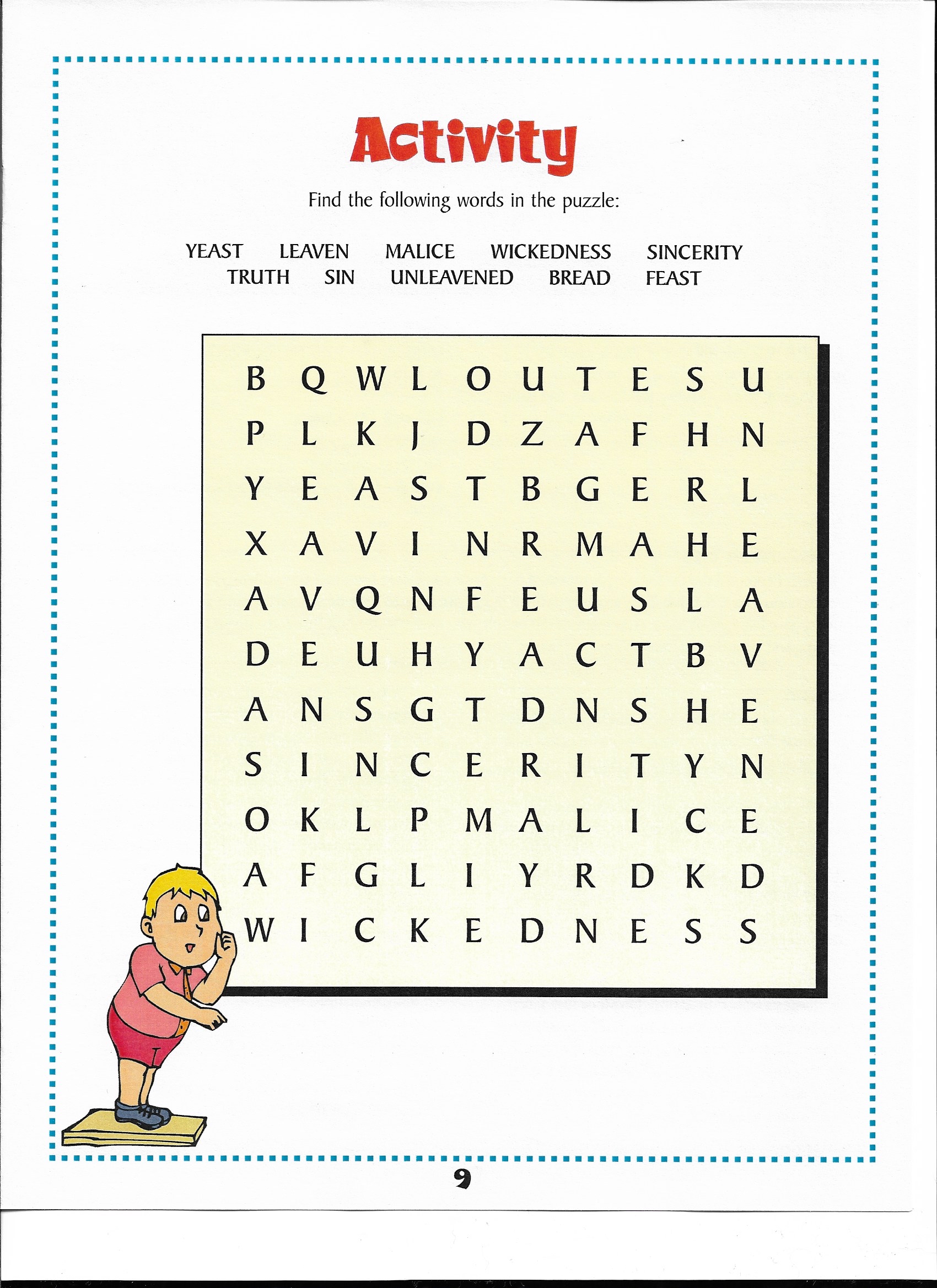
Go over the activity in class and give answers to their word search.
REACH Activity
Memory Verse Spotlight: 1 Corinthians 5:7
Look up the word “yeast.” Write down the Greek word and its meaning. Then find three other Scriptures where this word is used.
Do some research. Where did the yeast come from in the Old and New Testament times? Where does yeast come from today? What leavens our bread today? Is baking soda and baking powder the same thing as yeast? Why do we throw out leavened bread products with baking soda and baking powder? Read 1 Thessalonians 5:22. How does this verse relate to this topic?
Where in the World? Pharisees and Sadducees
There were three groups of Jews in the leadership positions during Jesus’ day: the Pharisees, the Sadducees, and the Herodians. Do some research. What were their teachings which were so flawed? What was it Jesus objected to?
The scary thing for all of these religious leaders (and subsequent religious leaders down to today) is that they have been entrusted to help people learn more about God, develop a closer relationship with God, and to serve God as He desires. Therefore, James 3:1 should serve as a warning for anyone who takes a leadership role with God’s people, professing to teach about God. Write about what you find in your Bible notebook.
They Did What Back Then? Unleavened Bread
People in Jesus’ day ate unleavened bread and leavened bread (what we would call sour dough) all the time. Unleavened bread was not unusual. Find several instances in the Old Testament that specifically say that they ate unleavened bread. Is there any indication in those passages that it was connected to the Holy Days? Try to find at least one that isn’t connected to the Days of Unleavened Bread.
Making It Mine: Oops
Have you ever eaten anything leavened during the Days of Unleavened Bread? It’s so easy to slip up! Leavening is in so many of our food items. And we’re so used to eating those things without even thinking about it. But that’s the point, isn’t it! Sin can creep in when we’re not paying attention; that’s what’s behind Jesus’ warning about the leavening of the Pharisees and Sadducees. So think about how leavening is used as an object lesson for us. As easy as it is to eat leavening, it’s that easy to do something that is contrary to God’s law - not because God’s law is so difficult to follow. It’s just that we are so busy going about our lives that we neglect to pay close attention. Think about this. Pray about this. Ask God for eyes to see the sin - and to avoid it even after the Days of Unleavened Bread are over.
Worldview Collisions: Physical vs. Spiritual
There are opposing “Christian” views about obedience to God. Your job is to diligently research them and compare them to what God has revealed in the Bible.
Some people say that the physical observance of the law is Old Testament; the spiritual observance of the law is New Testament. This group of people say that you don’t have to worry about keeping the dietary laws; it’s what goes into your thoughts that makes you unclean, not the food. You don’t have to worry about observing the Days of Unleavened Bread; you just have to be extra careful to avoid sin for seven days. You don’t need to be careful not to work on the Sabbath; God knows you have to provide for your family and as long as you rest, it’s ok. And so on.
Some people say that, while it’s good to try to do what God says, He knows we cannot fulfill the law perfectly. That’s why Jesus Christ came to this earth. Jesus kept the law perfectly for us. So, if we slip up, we just tell Him we won’t do it again. But it’s not important to go overboard with keeping the law; that’s Jewish legalism.
Another group of people says that you are not going to keep God’s law perfectly as long as you are in this physical body, but you should strive to diligently obey God out of love and reverence for Him. The physical observance of His laws helps us understand the spiritual application, so both are important. You should not kill your neighbor; you shouldn’t even hate your neighbor.
Write about these opposing “Christian” worldviews. Which do you think is most accurate? Why?
Questions
As you’re working through the YEA lesson, Daily Devotionals, doing the activity, or reading the Bible, be sure to write down any questions you have. That way you’ll remember to ask someone. Also remember to share the really interesting things you’re learning with family and friends.
Song
"One Bread, One Body" is on page 48 of The Group Songbook.
Closing Prayer
Ask the students to form a circle and hold hands. Starting with yourself, go around the room and give one sin and one thing you can do to overcome it. Ask for a volunteer to lead the class in prayer asking God to be with each student, guiding them and helping them to seek God in all they do.
Printable Pages