YEA Lesson Library
Why is Halloween Bad?
About This Lesson
This lesson teaches the origins of Halloween and the reasons why Christians do not participate in any part of it.
Scriptures
Exodus 22:18
Deuteronomy 18:9-14
2 Chronicles 33:6
I Corinthians 10:20-21
2 Corinthians 6:14-17
Ephesians 5:11
Philippians 4:8
I Thes. 5:22
2 Timothy 1:7-10
James 4:7-8
I Peter 5:8
Words to Know
CELTS - one of an ancient people of western and central Europe, including the Britons, Gauls, Scots, Irish
DRUIDS - priests to the Celtic people
DIVINATION - seeking to know the past, present or future by astrology, horoscopes, channeling, tarot, etc.
OCCULT - secret knowledge and practices or pertaining to, dealing with supernatural influences
WITCHCRAFT - practice of the occult
SEANCE - a meeting of persons to try to hear messages from the dead. Usually conducted by a medium.
The Lesson
On Halloween, Katie attended a party where the Ouija board was brought out. It seemed harmless, so she played with her friends. But this seemingly innocent “game” created an unquenchable thirst within Katie to gain more supernatural power. She tried such things as voodoo, magic, witchcraft, and astrology, not understanding where it might lead. In the end demonic spirits controlled Katie, leaving her without control over her own life.
Seemingly innocent things such as Halloween can appear to be a lot of fun. After all, everyone keeps Halloween and dresses up to get candy. Just because “everyone does it,” does that mean these things are not dangerous? Where did such things as Halloween come from?
The modern celebration of Halloween originated from the ancient fire festival, “Samhain” (pronounced “sow-in,” sow rhyming with cow). Samhain was a joyful celebration of the final harvest, first observed hundreds of years before Christ by the ancient Celts. It was celebrated on November 1. Samhain symbolized the death of the old year and the beginning of a new one. The eve of Samhain, October 31, was the most feared time of the year. The Celts believed that at this time the division between the physical earth and the supernatural world became very thin. At this time ghosts and spirits of the dead were free to wander as they pleased.
The Celtic priests who carried out the celebration rituals were called Druids. Most rituals performed by Druids involved the offering of sacrifices to placate the various gods. Samhain was to frighten away evil spirits to ensure that the sun would return after winter. During Samhain all fires were extinguished except bonfires built by Druids. Householders paid a fee for embers from the “holy” fire to relight the home fire. The embers were carried back to the homes in carved out turnips and beets. During this festival, people engaged in witchcraft such as fortune telling, divinations, casting spells, general mischief, and destruction. The focus of Samhain was fear, death, horror, and evil.
The ancient origins of some current Halloween customs are:
Bonfires - built by Druids on Samhain to rejuvenate the sun and banish evil spirits. The fires represented the sun and were used for the burning of animal, crop, and occasional human sacrifices. (“Bon Fire” literally means a fire in which bones were burned.)
Trick or treat - during Samhain, Druids believed the dead played tricks on mankind and caused panic and destruction. To appease the spirits of the dead the country people would leave delicious treats of food and fruit to satisfy the wandering spirits so they would not cause them or their households any harm.
Jack-o’-lantern - from the carved out turnips and beets used to carry embers from the bonfire back to their homes to relight the family hearth.
Costumes/masks - the Celts disguised them- selves in hideous costumes and masks made from animal skins and heads. They blackened their faces with soot hoping to blend in with demonic ghosts and spirits so they would not be noticed and possessed.
Bobbing for apples - a marriage or fortune divination. The first person to bite an apple without using their hands would be the first to marry or would have good luck in the coming year.
Why do we now call the feast of Samhain, Halloween? In the seventh century Pope Boniface IV established All Saints’ Day to recognize all of the saints who did not have their own day. It was originally celebrated on May 13, but was moved by Pope Gregory to November I in the eighth century. Many believe this was done to appease both the pagans and the Christians by putting a “Christian” label on the pagan rituals. Halloween was originally called All Hallows’ Eve. This means the evening or night before All Saints’ Day, “Hallow” is an old English word for “saint.” This was eventually shortened to Halloween.
Halloween observance in the United States was outlawed until 1845. The Irish, who immigrated into this country in the early 1840’s, brought many of their holidays and customs with them. Some changes were made to traditions such as carving pumpkins (which were plentiful here) instead of turnips. According to the Dauphin County Library System, the first official citywide observation of Halloween occurred in 1921 in Anoka, Minnesota. New York City followed in 1923 and Los Angeles in 1925.
Halloween has quickly grown into a major holiday. In America major stores start putting Halloween candy and costumes on the shelves as school supplies come off the shelves. Currently Halloween is second only to Christmas in total retail sales.
Katie found out the hard way what can happen when you play around with the spirit world. What guidelines does God give us about the parts that make up a celebration focused on death, evil, witchcraft, and fear? What are you going to do about it?
Student Prayer
Father in Heaven,
We come to you in the name of your Son, Jesus Christ, to thank you for the opportunity to learn more about you and your desires for us. Help us to focus on your ways every day and guide us in all our thoughts, and what we do and say. Help us to use your Word as our guide in making decisions on how we live each day so we may live to honor you.
In Jesus' name.
Amen.
Daily Devotions
Sunday - 2 Corinthians 6:14-17
Monday - Ephesians 5:1I
Tuesday - I Corinthians 10:21-21
Wednesday - Exodus 22:18
Thursday - 2 Chronicles 33:6
Friday - 2 Timothy 1:7-10
Saturday - James 4:7-8
Objectives
At the end of this lesson, students will be able to:
1. Recite the history of the Halloween holiday.
2. List the origin of the following Halloween traditions: jack o’lantern, bobbing for apples, masks/costumes, trick or treat, bonfires.
3. Discuss ‘real life’ situations and solutions about the observance of Halloween based on Scripture.
Topics & Themes
Death
Evil
Fear
Halloween
Harvest
Holidays, Halloween
Pagan Traditions
Materials Needed
Bible, YEA Students’ and Teacher’s books, attendance and memory verse charts, songbook, markers, poster board, scissors, tape, etc.
How to Teach This Lesson
Prior to class make copies of each of the following situations, one per team. Open the class with prayer and divide the group into 4 teams. Assign each team a situation. Have each team discuss the “real-life” situation and determine how it should be handled. Allow 5-15 (depending on your time constraints) to find a solution and to plan a presentation. Have markers, poster board, scissors, etc., so teams can make visual aids to assist in their presentations. The focus of each solution should be obedience to God and how to stand firm when answering their peers. Let teams decide how to present their solutions to the other teams. The teams should be prepared to answer audience questions.
Situation # I - You and two other friends are spending the weekend with your best friend while your parents are out of town. On Friday night after dinner your best friend tells the three of you that he just bought a new advanced computer game that is similar to Dungeons and Dragons. His parents don’t know he has the game because he knows they won’t approve. His plan for the weekend is for the four of you to assume the roles assigned by the game and play for the entire weekend. Your other two friends are okay with it. They have heard that these games can be really neat. You do not feel comfortable doing this. What do you do?
Situation #2 - You are secretary of your school’s Spanish Club. This year the club has decided to sell Halloween candy to support all fall activities. There is a real push to sell as much as possible because the club wants to go to the annual conference in San Antonio, Texas. You support the club and really want to go. What should you do?
Situation #3 - You are a freshman member of the high school band. You enjoy band and want to be as helpful as possible. This year, to help raise money for new music stands and uniforms, the band will have several fund-raising projects. The first is to sell pumpkins during October and November. The pumpkins are being donated by a student’s father. They must be picked, hauled into town, and sold at the produce stand near the school. Help is needed picking, decorating the stand, and selling the produce. The produce stand is open every day after school, and on weekends. Your best friend is a little shy and wants you to work with her to decorate the stand for Halloween and Thanksgiving and wants you to share a Saturday morning sales shift with her. Should you help? What type of help could you provide? What do you tell your best friend?
Situation #4 - You have just moved to a new area with your family. You are new at school and really want to make a good impression and fit in. The girl who lives next door to you is in your class and is very nice. She is popular and has helped you meet new friends at school. You have been invited to a Saturday night sleepover with several other popular girls at school. That night she has rented two movies, Children of the Corn and Scary Movie. Before the movies, she tells all of you she thinks she has a gift for reading tarot cards. She is learning from her older sister and wants to practice on all of you. What should you do?
Have each team give their presentation with their solution. Then answer questions from the audience.
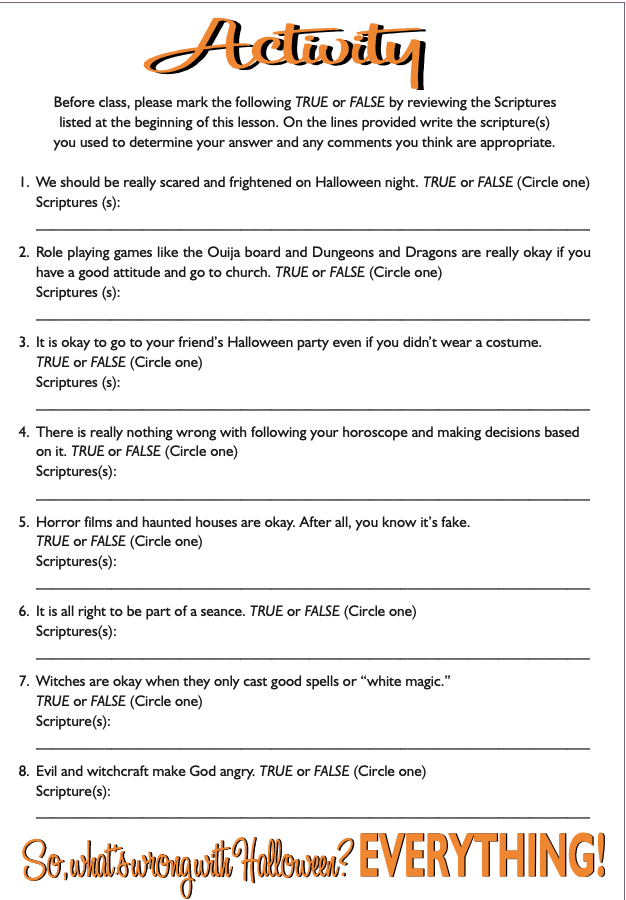
Now review the eight questions and the scriptural references at the beginning of the students’ lesson. Have class members read the questions and give their answers and scriptural reasons. Remind the class of the story about Katie. Ask one of the students to read Ephesians 6:12-13 aloud. Ask: What do you have to do to be protected from Satan and his demons?
REACH Activity
Memory Verse Spotlight
Look up the word “enemy” from 1 Peter 5:8. What word is used in other translations? Write down the Greek word and its meaning. Then find three other Scriptures where this word is used. Share your findings with your family.
Where in the World?
Where did the Celtic peoples live? Where did these people come from? Can you find any evidence to support the idea they were descendants of the lost ten tribes of Israel? Add a copy of a map of where they lived to your Bible notebook.
They Did What Back Then?
People’s fascination with the spirit world is not a recent occurrence. In fact, the Bible includes a very curious event involving Samuel, Saul, and the witch of Endor (1 Samuel 28). Deuteronomy 26:14 and Leviticus 19:31 indicates that the event in 1 Samuel 28, while not lawful in Israel, was not a one-time event. God is very clear about those who practice magic arts and dabble in the spirit world (Revelation 22:15). After reading these scriptures, write a response in your Bible notebook.
Making It Mine
Don’t you find it interesting that Satan imitates Godly themes to pervert them and draw God’s people away from following God’s ways!?! Paul tells the Romans (13:14) to put on the Lord Jesus Christ. He tells the Ephesians (6:10-17) to put on the full armor of God. In the Old Testament, the Levitical priests had special garments they wore when serving in the Temple and especially the Holy of Holies (Exodus 28). But nowhere does God say it is okay to dress up as a ghost or goblin or skeleton or something else that is dead. Some people think Halloween is okay if you dress up as something silly - like a banana or salt/pepper shaker. But the problem is the origins of Halloween. Is it really possible to take something pagan, clean it up, and call it Christian? What did God think about the Israelites doing that in Exodus 32? Just because they called it a festival to God didn’t make the worship of the golden calf any less repulsive to God.
What do you think? Is it okay to keep Halloween? Why or why not? Write your thoughts in your Bible notebook.Then share your thoughts with your family.
Worldview Collisions
A secular worldview says If it feels good, do it. There are a lot of things that may feel good at the time but will cause lots of heartache and pain later on!! Can you think of a few? Write them down.
A Biblical worldview says that God knows what is best because He’s the Creator. The Creator of the world knows what is best for His creation. But it doesn’t just stop there. God is good and God is love. He wants the very best for His creation. So He gave us the owner’s manual to know how to make the creation work in the very best way. It’s called the Bible, with all of God’s laws, commandments, and decrees. His ways will ensure that you know what will make you feel good, not just for this life, but for eternity.
Think about this topic and how it relates to participating in pagan customs like Halloween. Write about it in your Bible notebook.
Questions
As you’re working through the YEA lesson, Daily Devotionals, doing the activity, or reading the Bible, be sure to write down any questions you have. That way you’ll remember to ask someone. Also remember to share the really interesting things you’re learning with family and friends.
Song
“Bubblin’ ” is on page 21 of The Group Songbook.
Closing Prayer
Have the students form a circle and join hands. Ask for a volunteer to lead in prayer thanking God for being the one True God, their Protector, and for helping us to understand the dangers of such things as Halloween.
Printable Pages