YEA Lesson Library
What About Easter?
About This Lesson
This lesson teaches that Easter is a pagan holiday and should not be celebrated.
Scriptures
Exodus 20:2-3
Exodus 32:1-35
Deuteronomy 4:2
Deuteronomy 12:2-3
Deuteronomy 12:29-32
Deuteronomy 12:32
Revelation 22:18
Words to Know
IDOLATRY - worshiping a god other than the true God
GENTILES - peoples of all other nations except Israel
HEATHEN - irreligious; pagans
OBELISK - a tapering four-sided stone used in the worship of false gods
SUPPLICATION - earnest request made in prayer
The Lesson
You probably have spring break just in time for one of the greatest religious celebrations – Easter and Good Friday. Your friends may spend a lot of time shopping for a really neat dress to wear to church on Easter Sunday morning. They may get up early and go to a park or special place for a religious service as the sun comes up. Your friends probably have the best of intentions. This may be a very deep religious experience for them. And they probably believe this is what God would have them do. But what does it say in the Bible about celebrating Easter?
As Israel came out of a pagan nation and headed for the Promised Land, God continued to teach them how to obey and worship Him. He was very specific about days and customs whereby they could worship Him. Idolatry was a very serious sin that He warned His people not to practice. “I am Jehovah your God who liberated you from slavery in Egypt. You may worship no other god other than me” (Exodus 20:2, 3 TLB).
“Then, as God finished speaking with Moses on Mount Sinai, he gave him the two tablets of stone on which the Ten Commandments were written with the finger of God.
“When Moses didn’t come back down the mountain right away, the people went to Aaron. ‘Look’, they said, ‘make us a god to lead us, for this fellow Moses who brought us here from Egypt has disappeared; something must have happened to him’” (Exodus 32:1 TLB).
Aaron participated in this evil idolatry. He asked for their golden earrings, melted them down, and formed them into the shape of a calf for the people to worship. When Moses returned and saw what the Israelites were doing, he was appalled at this evil act. He asked Aaron to explain. Aaron blamed the wicked bunch of Israelites and said they wanted him to make them a god to lead them since Moses hadn’t come back. The penalty for their idolatry was extremely severe. God told them to get their swords and go from one end of the camp to the other and kill even their own brothers, friends, and neighbors. About three thousand men died that day (Exodus 32).
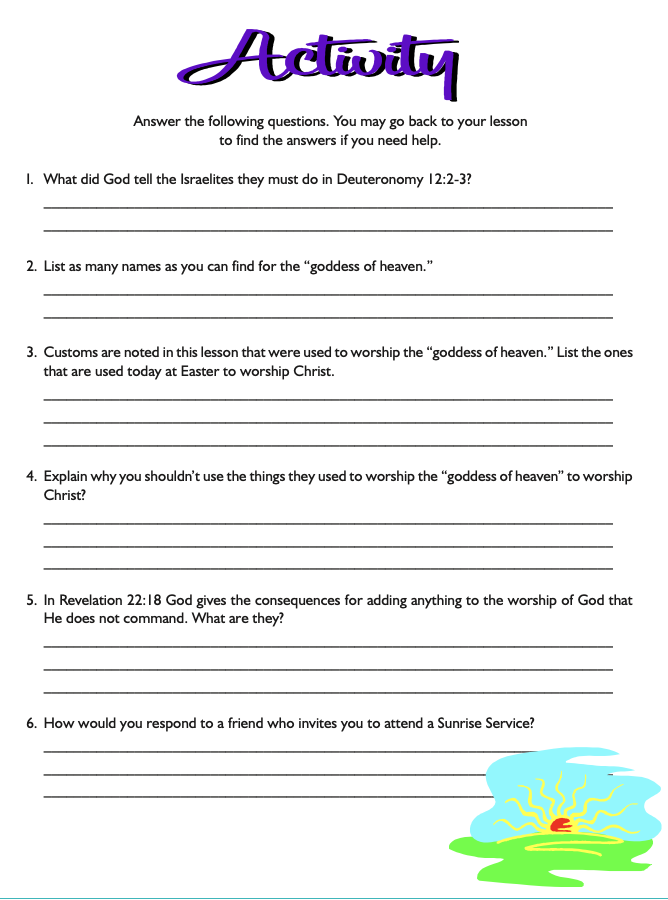
Down through history, Israelites and Gentiles alike have worshiped other gods. This was very displeasing to God. “You must destroy all the heathen altars wherever you find them – high in the mountains, up in the hills, or under the trees. Break the altars, smash the obelisks, burn the shameful images, cut down the metal idols, and leave nothing even to remind you of them!” (Deuteronomy 12:2-3 TLB).
In the Book of Judges, Israel goes through five different patterns – sin, slavery, supplication, salvation, and silence. “They forsook the LORD, the God of their fathers, who had brought them out of Egypt. They followed and worshiped various gods of the peoples around them. They provoked the LORD to anger because they forsook him and served Baal and the Ashtoreths.
What were the Ashtoreths? Astarte was one of them. “She was goddess of the evening star and renowned for her beauty. She was a goddess of fertility, love and war, often linked with Baal” (The Expositor’s Bible Commentary, page 395). Astarte is another name for Easter.
In the spring of the year, about the time of the Passover, a feast was celebrated to this goddess. It was a joyous day of celebrations and games. Before the sun came up on Sunday morning, the people would meet outside and face the rising sun to praise Easter, their goddess. The celebration included finding colored eggs which were hidden in the grass, around trees, and in other hiding places. The children especially enjoyed the game. This happened many years before Jesus was ever born. Then rabbits were added to this celebration. (You can find even more information about this in the Encyclopaedia Britannica, Macropaedia Knowledge in Depth, volume 7, p. 475.)
God tells us to celebrate the Passover and the Days of Unleavened Bread. We don’t please Him if we add to or take away from what He has said, “Don’t add to what I’m commanding you. Don’t subtract from it either. Instead, obey the commands of the LORD your God that I’m giving you” (Deuteronomy 4:2 NlrV Kid’s Devotional Bible). God is very serious about this. “I am warning everyone who hears the words of the prophecy of this book. If you add anything to them, God will add to you the plagues told about in this book. If you take any words away from this book of prophecy, God will take away from you your share in the tree of life. He will also take away your place in the Holy City. This book tells about these things” (Revelation 22:18).
God is so pure, so good, so righteous. We must not confuse Him with other gods or goddesses. Every good and perfect gift comes from Him including our salvation. We’ve seen some of the horrible consequences for worshiping a false god such as Easter. Keeping God’s Holy Days brings blessings.
Student Prayer
Dear One True God and Father,
Thank you for giving me days to celebrate that show your plan for mankind. Help me never to be tempted to leave you for a false god. We can make a god out of anything – money, fame, popularity, sports, beauty, etc. But you are my God and I put my trust in you. Many of my friends celebrate Easter. Help me to be a light to them and not condemn them.
In Jesus’ name I pray.
Amen.
Daily Devotions
Sunday - Deuteronomy 12:2-3
Monday - Deuteronomy 12:29-32
Tuesday - Exodus 32:1-5
Wednesday - Exodus 32:6-10
Thursday - Deuteronomy 4:2
Friday - Revelation 22:18
Saturday - Exodus 32:11-16
Objectives
At the end of this lesson, students will be able to:
1. Explain that there is no place in the Bible where God commands us to celebrate Easter.
2. Discuss that God forbids us from using ways the heathens worship their gods to worship Him.
3. Explain that Easter is a goddess that has been worshiped for thousands of years by similar names depending on the nation and language.
Topics & Themes
Consequences of Sin
Easter
Golden Calf
Holidays, Easter
Jesus, Resurrection of
Pagan Traditions
Ten Commandments
No Other Gods (Idolatry)
Trusting God
Materials Needed
Bible, Students’ and Teacher’s books, attendance and memory verse charts, songbook, concordances, paper, pencils, timer, award, newsprint pad
How to Teach This Lesson
Before class, arrange the seats in a semicircle. Open the class with prayer. Hand out a concordance to every student along with a pencil and piece of paper. Tell the class that the church has taught that we should not celebrate Easter. Let’s hold court today and put Easter on trial to see if the church is correct. The evidence will be presented and the class will be the jury and decide after the evidence is presented. Explain that you will give them five minutes to find as many places in the Bible as they can find where God commands us to keep any or all of the Holy Days. They are to jot down the Bible references on their piece of paper. They can even use their YEA books to find evidence. Tell them the one who has the most correct Scriptures will get a an award. Start the timer.
When the timer rings, go around the room and let each student tell how many Scriptures they found where God commands us to keep any or all of the Holy Days. List these on the newsprint pad. During the next portion, you can verify these Scriptures to ensure they are correct.
Now tell the students that you will give them three minutes to find evidence that God wants us to keep Easter. They are to find as many places in the Bible as they can find where God gave a command to celebrate Easter, or where the New Testament Church kept Easter. Tell them that the person who can find where God commanded Easter to be celebrated will be awarded $20. Tell them they can use their Bibles, concordances, and YEA books. Start the timer. Expect them to find the one place in Acts 12:4 in the King James Version where Easter is mentioned. This is a mistranslation and should be Passover. The New Adventure NIV Study Bible says, “After arresting him, he put him in prison, handing him over to be guarded by four squads of four soldiers each. Herod intended to bring him out for public trial after the Passover.”
While students are trying to find biblical evidence that we should celebrate Easter, verify Scriptures on the newsprint pad for accuracy. When the timer rings, ask for biblical evidence that God commands us to keep Easter. After they give results you may have to give an explanation of Acts 12:4. Write on another sheet of newsprint “no evidence.” Ask: According to biblical evidence, which days should we celebrate: Easter or the Holy Days in the Bible? Then say, “case dismissed” and give the award to the person with the most Scriptures for celebrating the Holy Days.
Summarize the information under Background and put it in terms Intermediates will understand. Then ask: Why does God not want us to celebrate Easter? Can we please God by having an Easter egg hunt, going to a sunrise service, or eating hot cross buns if we do these things to His honor? Ask one of the students to read Deuteronomy 12:29-32 aloud.
We know that we should not keep Easter, but should we condemn our friends and relative who do? No. Then what should we do? Be a light to them and be prepared to answer their questions if they ask.
REACH Activity
Memory Verse Spotlight
Look up the word “add” from Deuteronomy 12:32 in a Bible lexicon or dictionary. Write down the Hebrew word and its meaning. It’s pretty straight-forward, isn’t it! Then find three other Scriptures where this word is used. What does this tell you about how God feels about adding things to the worship of Him that He has not commanded?
Where in the World?
Where in the world did somebody get the idea that rabbits and chocolate eggs and Easter bonnets belong in the worship of the One True God? If you do the research, you can trace the origins back to worship of pagan gods and goddesses. Rabbits are very fertile - they have lots of baby rabbits. One mother rabbit can have up to twelve babies at a time and they can have three or four litters in one year! That’s a lot of rabbits. In pagan cultures, rabbits were seen as a symbol of life because they have so many kittens!
Easter is a combination of celebrating a pagan goddess who is supposedly the goddess of fertility (or life), the rabbits as a symbol of fertility, the egg as another symbol of fertility and the resurrection of Jesus Christ (coming back to life). Perhaps somebody thought it wouldn’t matter what people were celebrating as long as they were all celebrating on the same day. But it does matter! God says not to add to His commandments or take away from them. And the pagan customs of worship are abhorrent to Him. Easter is not Christian. Do the research for yourself. Then write down what you find in your Bible notebook so you’ll be prepared to give an answer to anyone who asks you why you don’t celebrate Easter.
They Did What Back Then?
In our human wisdom, we tend to think that the pagan customs aren’t that bad. They even might be kinda fun. But God predicted the historical cycle of Israel which occurred time and time again. The command is found in Deuteronomy 7:1-6; Deuteronomy 11:16-17; Deuteronomy 12:2-4 - and throughout the Bible. When God’s people incorporated pagan worship into their worship of God, eventually they turned away from God’s commandments. Things would start to go very badly for them. They experienced the curses that naturally come from not following God’s laws. When things got bad, they called out to God to save them. They would repent and begin purifying the land from its idolatry and perversion. God would rescue them and things would start to go well again. Then they’d begin to incorporate pagan customs into their lives and it would all start again. Count how many judges are recorded in the book of Judges alone which were part of this cycle.
Think about this pattern of waffling on keeping God’s commandments and the resulting pain it causes. Draw a diagram which depicts the vicious cycle of sin, slavery, supplication, salvation, and silence. Put it in your Bible notebook.
Making It Mine
How do you answer your friends when they ask you why you don’t celebrate Easter? 1 Peter 3:15 exhorts us to be ready to give an answer to anyone who asks us. So write out your answers to the following questions in your Bible notebook. Discuss your answers with your parents and/or your Sabbath school teacher.
1. Why don’t you celebrate the resurrection of Jesus Christ on Easter?
2. When do you think Jesus was resurrected?
3. As long as I’m not worshipping a pagan goddess, why does it matter if I celebrate Easter?
4. What harm is there in participating in an Easter egg hunt?
5. Don’t you want kids to have fun?
Worldview Collisions
The celebration of pagan holidays is a variation of the secular worldview which says that each person gets to decide for themselves what is right and what is wrong. A Biblical worldview says that God has the right to decide how He wants to be worshipped. He is very clear about not taking pagan customs and attaching His name to them. It all comes down to whether you think you are smarter than God and whether you can pick and choose which of God’s commandments to keep. If you believe these things, then you do not believe God is sovereign. In essence, you believe that you are God. This is not a Biblical worldview. The scary thing is that many people believe that they are christians, but they do not have a true Biblical worldview which says that God is God.
What do you think? Your words and your actions will follow your thoughts and beliefs. That’s a good way to check what your worldview really is.
Questions
As you’re working through the YEA lesson, Daily Devotionals, doing the activity, or reading the Bible, be sure to write down any questions you have. That way you’ll remember to ask someone. Also remember to share the really interesting things you’re learning with family and friends.
Song
“Glory and Praise to Our God” is on page 8 of The Group Songbook.
Closing Prayer
Have students form a circle and hold hands. Ask for a volunteer to lead in prayer thanking God for giving them Holy Days in the Bible to celebrate which teach about the true God and His plan. Ask God to help them to love those who keep Easter and never condemn them.
Printable Pages