YEA Lesson Library
Feast of Tabernacles
About This Lesson
This lesson teaches that the spiritual food we gain at the Feast of Tabernacles is of much greater value than the physical fun stuff.
Scriptures
Leviticus 23:39-43
Deuteronomy 16:13-15
Psalm 119:127-130
Proverbs 3:15-17
Proverbs 19:8-10
Matthew I3:45-46
Matthew 13:44-46
Philippians 2:5-7
Words to Know
CUBIC ZIRCONIUM - an inexpensive stone commonly used to resemble a diamond
GLITTER - makes a brilliant show by reflecting light
The Lesson
One spring night, a thief broke into a jewelry store. It was an unusual break-in. The burglar stole no jewelry. What he did was switch the prices on every piece of jewelry that he could find. Some of the bracelets, rings, necklaces, and watches were the real thing. They were made of 14 or 18 carat gold and studded with diamonds, rubies, emeralds, pearls and other precious stones. Other pieces were simply costume jewelry. They were beautiful, but only gold plated, with cubic zirconium and other imitation stones.
The management didn’t realize what had been done at first. Customers were leaving their store with imitation jewelry for which they paid a big price. Yet others purchased expensive jewelry for mere pennies on the dollar.
Our world kind of looks like that jewelry store. It looks like someone came and switched the prices.
Sometimes we overlook real value for junk. The Feast of Tabernacles helps us understand the difference between something really valuable and junk. Like the imitation jewelry, there are a lot of attractive things in this world that glitter. But they are not lasting like a diamond or a real pearl.
Jesus said we should listen to this story. “The Kingdom of Heaven is like a pearl merchant on the lookout for choice pearls. He discovered a real bargain – a pearl of great value – and sold everything he owned to purchase it!”(Matthew 13:44 NIV).
Have you ever gone to the Feast just for the fun of it? Were you there simply to see your friends and enjoy the activities? Did you skip youth classes? Did you write notes during the sermon while thinking about things entirely different from what the minister was saying? Then what you got out of the Feast was very similar to imitation jewelry with artificial diamonds in it. Oh, it was attractive. But it was worth- less – mere junk that won’t last!
Five days after Israel fasted and kept their first Day of Atonement, God said they were to celebrate yet another Holy Day. It was to be the Festival of Shelters. “On the first day there will be a sacred assembly of all the people, don’t do any hard work that day. . . Remember that the first and last days of the festival are days of solemn rest. On the first day, take boughs of fruit trees laden with fruit, and palm fronds, and the boughs of leafy trees – such as willows that grow by the brooks – and (build shelters with them), rejoicing before the Lord your God for seven days. This seven day annual feast is a law from generation to generation. During those seven days, all of you who are native Israelites are to live in these shelters. The purpose of this is to remind the people of Israel, generation after generation, that I rescued you from Egypt, and caused you to live in shelters. I am Jehovah your God” (Leviticus 23:34, 39b-43 TLB).
Did you notice why they were to live in shelters and who was to live in them? Israelites were to live in them and it was to remind them that God rescued them from Egypt. Do you remember our lesson about the Feast of Trumpets that talked about Jesus Christ returning to this earth to rescue us?
God commands us to rejoice at the Feast of Tabernacles. YEA goes to a lot of trouble and expense to provide ways for you to rejoice at the CEM Feast site. We provide fun YEA classes and lots of exciting activities for our youth. God wants you to develop friendships and create lasting relationships. But if you only come to the Feast for physical activities and fun, you’re like the people who walked out of the jewelry store with fake jewelry thinking they had the real thing. Laser tag, skating and beach parties, a teen dance, and family picnics are wonderful things you should enjoy. But they are only temporary – they are the “glitter.”
Jesus Christ came to this earth as a temporary flesh and blood baby. The Feast of Tabernacles has Jewish history, but Jesus Christ is also pictured in it. He gave up being a permanent Spiritual being to come to this earth as temporary flesh and blood. He lived a temporary life like you and me so He could die for our sins. He now sits at the right hand of the Father and has inherited everything! He will soon return to this earth and set up His Kingdom that we can share with Him if we are ready.
What you learn about God and Jesus Christ and how they can help you every day of your life can be compared to 18 carat gold. Things you learn in the sermons and your YEA classes are the real gems – they give you wisdom that has eternal value. “For such wisdom is far more valuable than precious jewels. Nothing else compares with it. Wisdom gives: A long, good life, riches, honor, pleasure, peace” (Proverbs 3:15-17 TLB). Enjoy the Feast of Tabernacles, but don’t be fooled by temporary glitter. Look for the 18 carat gold that will last an eternity!
Student Prayer
Great and Wonderful God,
Thank you for the Feast of Tabernacles that teaches us that the temporary glitter of this world is not where it is at. Learning your way of life gives wisdom. That is more precious than silver, gold or any precious stone. Your Kingdom will be permanent and its worth is invaluable! Help me to give up the junk for the pearl of great price.
In Jesus’ name I pray.
Amen.
Daily Devotions
Sunday - Leviticus 23:39-43
Monday - Matthew 13:44-46
Tuesday - Proverbs 3:15-17
Wednesday - Proverbs 19:8-10
Thursday - Deuteronomy 16:13-15
Friday - Psalm 119:127-130
Saturday - Philippians 2:5-7
Objectives
At the end of this lesson, students will be able to:
1. Make the association between the values of fake and real jewelry and physical and spiritual values.
2. Explain that we should rejoice at the Feast, but physical activities are temporary. The spiritual things we learn and do have eternal value.
3. Discuss that the Feast of Tabernacles has Jewish history, but Jesus Christ and His Kingdom are pictured in the Feast.
4. Give an offering on the Holy Day.
Topics & Themes
Booth
Feast of Tabernacles
God’s Kingdom
Holy Day, Feast of Tabernacles
Jesus, Birth of
Putting God First
Seeking God
Worship God
Materials Needed
Bible, YEA Students’ and Teacher’s books, attendance and memory verse charts, songbook, paper, pencils, prizes, timer, newsprint pad
How to Teach This Lesson
After opening the class with prayer, hand each student a piece of paper and pencil. Explain that you’re starting the class with a contest. The person with the most realistic things on their list will be the winner and will get a prize. First, allow two minutes for every student to make a list of all the physical things they do at the Feast of Tabernacles. Set the timer and say, “You may begin.” When the timer goes off, everyone is to stop. Have each student tell how many things are on their list and then read it. As their lists are read, write each thing on a newsprint pad. Ask if anyone has other things that are not on the winner’s list. Add those things to the newsprint pad. Award the prize.
Now hand out another sheet of paper to each student. Explain that this time they are to list the things they do at the Feast that have spiritual and lasting value. Again, allow two minutes to make the lists. Start the timer and say “go.” Do the same things you did after the first contest.Then, give them one more piece of paper and ask them to look at their two lists and make a third list. This time they are to write down the things that have both physical and spiritual value. Give them two minutes, start the clock and say “go.” Repeat the previous steps. Give the third award and debrief by asking these questions:
How would you compare the value of costume jewelry to the same article in solid gold? Ask one of the students to read Matthew 13:44 aloud.
Which items on the first list would you say are equivalent to costume jewelry? What makes them like costume jewelry?
If someone was giving you a gift and you had the option of getting a gold plated watch or a watch made of 18 carat gold, which would you take? Why?
Why is solid gold more valuable than something gold plated? Gold plated jewelry will soon lose its finish and won’t last nearly as long as a solid gold piece.
What things do we do at the Feast that you would consider to be solid gold? Why?
What lesson do we learn at the Feast that is similar to the characteristics costume jewelry has? We live in temporary houses to remind us that our bodies and this world are only temporary. Things in this world may have a lot of glitter, but they don’t have eternal value. Ask one of the students to read Proverbs 3:15-17 aloud. Ask: Why should you want wisdom? It gives a long, good life, riches, honor, pleasure, peace.
What have you learned in your lesson about the Feast of Tabernacles being Jewish or Christ centered? The Feast has Jewish history, but Christ and His Kingdom are pictured in this Feast. He came in the flesh as a temporary human being to give His life that we might share His Kingdom with Him.
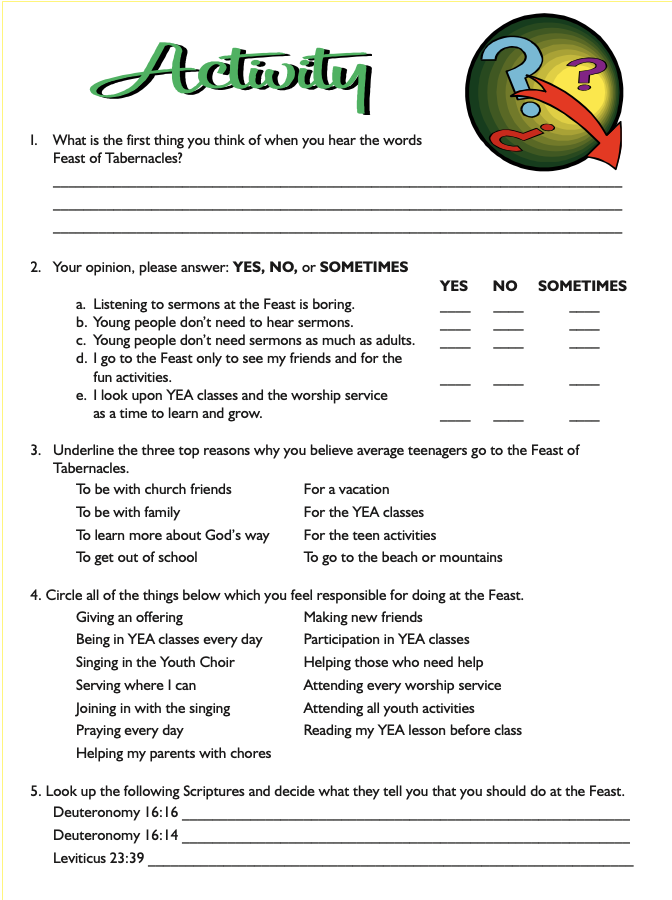
Now go over the activity in the Students’ book.
REACH Activity
Memory Verse Spotlight
Look up the phrase “of great value” in Matthew 13:46. Write down the Greek words and their meaning. Then find three other Scriptures where this word is used.
To Jesus, what was of such great value that He gave everything He had to purchase it? To you, what is of such great value that you would give everything you have to purchase it? Write about these things in your Bible notebook.
Where in the World?
Leviticus 23:42-43 contains the commandment for God’s people to live in temporary dwellings (tabernacles, tents, booths, or sukkah) during the Feast of Tabernacles. It also gives the reason why: because God made the Israelites live in temporary dwellings for 40 years when He brought them out of Egypt. The Apostle Paul uses this to describe our human life. That is, physical human beings are temporary. (2 Corinthians 5) If we want to live eternally we must have a relationship with Jesus Christ. This is a good thing to be reminded of every year as we celebrate the Feast of Tabernacles.
Research what the sukkah or temporary dwellings may have looked like, what trees were used, and other requirements about them. If possible, construct a tabernacle in your backyard. Take a picture of it every day for seven days. What happens to the leaves as the week progresses? Write an essay about what you have learned and keep it in your Bible notebook.
They Did What Back Then?
Israel harvests grain in the spring (Days of Unleavened Bread and Pentecost). Do you know what is harvested in the fall? Two major crops in Israel are grapes and olives. Research the history of these two crops in Israel. Share what you find with your family. You may choose to make a poster, a video presentation, or travel brochure.
Making It Mine
What is your number one reason for celebrating the Feast of Tabernacles? Spend some time thinking about your answer and write it down in your Bible notebook. Then - and only after you have answered that question - consider this: Our number one reason for celebrating the Feast of Tabernacles should be because God tells us to. His Holy Days are a perpetual ordinance. So we go in obedience to honor our King. We rejoice because of what He has done and what He will do in our lives.
If your answer is something like “spending time with my friends,” “having fun at the church events,” or “having a fun family vacation,” you may enjoy the Feast, but you will not have the best feast ever. If you put God first, all of the rest of it is just a bonus. Seriously pray about your attitude and your reasons for keeping God’s Holy Days - especially about this holy day which points to eternal life in God’s kingdom.
Worldview Collisions
Secular worldviews promote each individual. Each person becomes the god of his universe and believes that everything revolves around him. When that happens, the individual thinks that his feelings and desires are more important than anyone else’s feelings and desires. He doesn’t care if he damages someone’s property or hurts someone else as long as he gets what he wants. Obviously, there are degrees of intensity from someone who is slightly self-centered to the drama queen to the dictator/egomaniac. A Biblical worldview says that God is first. He is God alone and He will share His glory with no one else! Since God is Sovereign, He has the right and responsibility to set the standards. He is the One who endows each person with inalienable rights: life, liberty, and the pursuit of happiness. When each person recognizes God’s sovereignty and submits to God’s commandments, life works much more smoothly!
Choose one current event. Analyze what is happening and from which worldview the people are conducting themselves. Are they acting in their own best interest? Or are they submitting to the sovereignty of God? Write about it in your Bible notebook. Then write a paragraph about what our world will be like when Jesus comes back to set up His kingdom and His sovereignty is recognized by all.
Questions
As you’re working through the YEA lesson, Daily Devotionals, doing the activity, or reading the Bible, be sure to write down any questions you have. That way you’ll remember to ask someone. Also remember to share the really interesting things you’re learning with family and friends.
Song
“More Precious Than Silver” is on page 25 of The Group Songbook.
Closing Prayer
Have the students form a circle and join hands. Ask for a volunteer to lead in prayer thanking God for the wonderful blessing of the Feast of Tabernacles and ask for wisdom to recognize the difference between things with eternal and temporary value and to choose eternal values.
Printable Pages